Dual Employment in India: What Section 30 Actually Says About a Second Job in 2026
In short
Section 60 of the Factories Act was repealed. Its replacement bars a second job in a factory only within twelve hours, and the penalty falls on the employer.
A packaging unit outside Pune finds out that one of its machine operators is also on the rolls of a unit two kilometres away. The HR manager does what every article on the subject tells him to do. He writes a show cause notice, and he cites section 60 of the Factories Act, 1948, which prohibits double employment.
There are two problems with that notice. The first is that section 60 was repealed on 21 November 2025 along with the rest of the Factories Act. The second is that the section which replaced it does not say what section 60 said, and on the facts he has, it may not have been broken at all.
And there is a third thing, which is the one that should worry him. If it wasbroken, the offence is not the operator's. It is his factory's, and it now starts at two lakh rupees.
What section 30 actually says
The Occupational Safety, Health and Working Conditions Code, 2020 carries the double employment rule at section 30. It is one sentence, and it is worth reading beside the sentence it replaced, because almost nothing written about moonlighting in India tracks the difference.
Factories Act, 1948, s.60(repealed). Restriction on double employment. "No adult worker shall be required or allowed to work in any factory on any day on which he has already been working in any other factory, save in such circumstances as may be prescribed."
OSH Code, 2020, s.30.Restriction on double employment in factory and mine. "No worker shall be required or allowed to work in a mine or factory if he has already been working in any other such similar establishment within the preceding twelve hours, save in such circumstances as may be prescribed by appropriate Government."
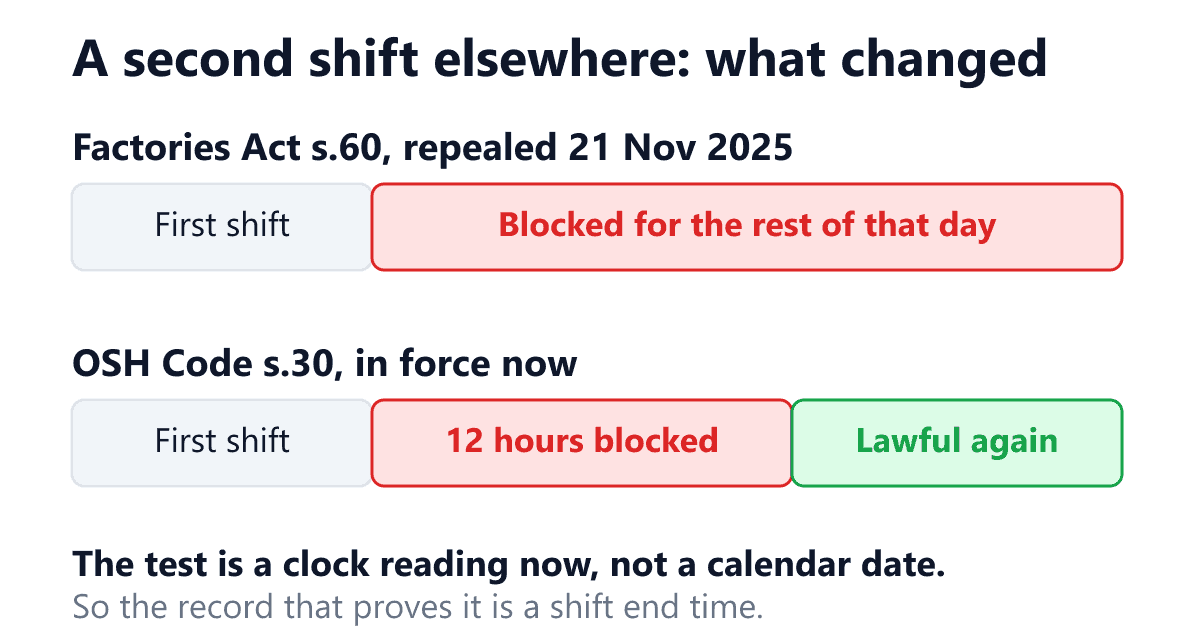
Section 60 tested a calendar date. Any hour of the same day, in any other factory, and the bar applied. Section 30 tests a clock. It applies only where the earlier work fell inside the twelve hours immediately preceding, and once that window has passed, the second engagement is outside the section entirely.
That is a real loosening, and it was a deliberate one. A worker who finishes a shift at 6am and starts another at 8pm the same evening was caught by section 60 and is not caught by section 30. The same worker starting at 4pm still is.
The word that decides who is in trouble
Both versions of the rule are written the same way, and the construction is the whole story: required or allowed to work. Neither section says a worker shall not work two jobs. Both say an establishment shall not have him.
Read section 30 against that grammar and the person exposed is the second employer, because the second employer is the one doing the allowing. The worker is the subject of the sentence but not the target of the duty, and there is no penalty in the Code addressed to him.
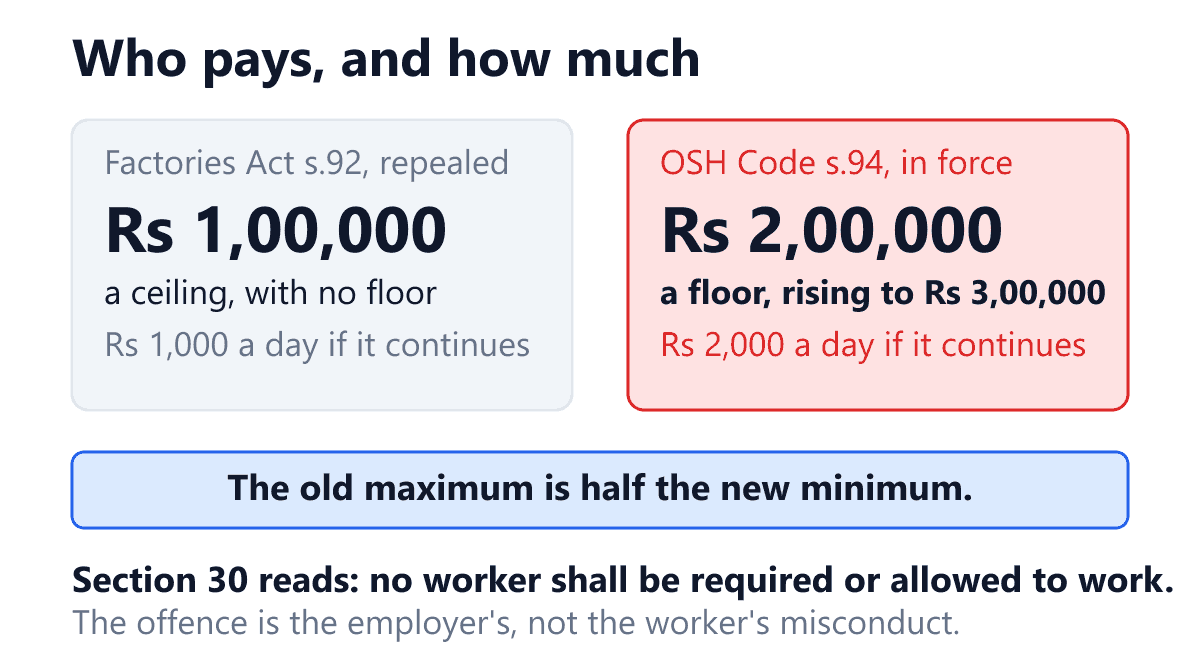
What the duty costs moved a long way when the Codes came in. The Factories Act ran its general penalty through section 92: imprisonment up to two years, or a fine up to one lakh rupees, or both, with a thousand rupees a day if the contravention continued after conviction. It was a ceiling with nothing underneath it, so a first breach could be disposed of for very little. Section 94 of the OSH Code is drafted the other way round.
OSH Code, s.94.Where there is any contravention of the Code or the rules made under it, the employer or principal employer "shall be liable to penalty which shall not be less than two lakhs rupees but which may extend up to three lakh rupees", and if the contravention continues after conviction, a further penalty extending to two thousand rupees for each day it continues.
One lakh was the old maximum. Two lakh is the new minimum. There is no longer a small end of this offence.
Section 30 does not reach most employers
Everything above is about factories and mines, and the section says exactly that. It does not say establishment, which is the word the Code uses everywhere else and defines at section 2(v) to cover any place of industry, trade, business, manufacturing or occupation with ten or more workers. Section 30 was written narrowly and reads narrowly.
Then the definition of factory at section 2(w) narrows it again. A factory is premises where twenty or more workers work with the aid of power, or forty or more without it, and a manufacturing process is carried on. And the definition carries an express carve out: it "does not include a mobile unit belonging to the armed forces of the Union, railways running shed or a hotel, restaurant or eating place".
| Your workplace | Is OSH Code s.30 engaged? |
|---|---|
| Mine, or port and dock work | Yes, and with no worker threshold. |
| Manufacturing with 20+ workers using power | Yes. |
| Manufacturing with 40+ workers, no power | Yes. |
| Manufacturing under those counts | No. Not a factory within s.2(w). |
| Hotel, restaurant or eating place | No. Expressly excluded from the definition, at any size. |
| Shop, office, clinic, IT services, warehouse, agency | No. Not a factory or a mine. |
For the large majority of Indian employers, then, section 30 is not the answer to anything. What fills the gap is the State Shops and Commercial Establishments Act, and that varies, and it is drifting in the same direction. The Bombay Shops and Establishments Act, 1948 carried a restriction on working elsewhere on a day of holiday or leave. Maharashtra replaced that Act with the Maharashtra Shops and Establishments (Regulation of Employment and Conditions of Service) Act, 2017, and the 2017 Act contains no double employment provision at all. Its sections 12 and 14 cap daily hours and spread over inside your establishment and say nothing about what a worker does outside it.
Read your own state's Act before you write anything into a notice. This is one of the provisions states have been dropping rather than carrying forward, and a clause that existed in a 1948 statute may not exist in the Act that replaced it.
What binds when no statute does
Absent section 30, the restriction on a second job in India is contractual, not statutory. There is no central law making moonlighting per se unlawful for an employee outside a factory or a mine, and any blanket prohibition has to survive Article 19(1)(g) of the Constitution, which protects the right to practise any profession or carry on any occupation subject to reasonable restrictions. A clause banning all outside work of any kind at any hour is the least defensible version you can write. A clause requiring disclosure and prior approval, refused only where there is a real conflict, is the most.
Three instruments do the work:
- The appointment letter or employment contract. Since 21 November 2025 a written appointment letter is not optional for establishments of ten or more workers, which means every one of those employers now has a document in which to put this clause and no excuse for not having one. Our guide to the appointment letter the labour codes made mandatory covers the sixteen items the format requires; the exclusivity or disclosure clause sits alongside them.
- Standing orders, at 300 or more workers. Paragraph 22 of the Model Standing Orders, 2020 provides that a worker shall not at any time work against the interest of the establishment and shall not take any employment in addition to his job in the establishment which may adversely affect the interest of his employer, with an exception where the employer has given prior permission. Note the qualifier. Even the model form does not ban a second job outright, it bans one that harms you, and it contemplates that you will sometimes say yes. See what the model standing orders do at 300 workers for when these are deemed to apply to you.
- Confidentiality and conflict of interest terms. In practice these carry more weight than the exclusivity clause, because they are about a specific harm you can point at rather than about the mere fact of other work.
What your PF filing shows, whether you look or not
The reason dual employment surfaces at all is usually not an investigator. It is the Universal Account Number.
Paragraph 26A of the Employees' Provident Funds Scheme, 1952 provides that a member continues to be a member until he withdraws the amount standing to his credit or is covered by an exemption. Membership does not lapse when someone changes jobs and it does not lapse when wages rise past the fifteen thousand rupee threshold that decides who is an excluded employee at the point of first joining. The UAN follows the person, and every employer's monthly electronic challan cum return attaches a member id to that same UAN.
So where two employers are both contributing in the same wage month, both contributions land against one UAN and the overlapping period is a fact in the EPFO record rather than an allegation. That is what makes this different from most conduct questions. It is not something you have to prove. It is something already written down, in a filing you make yourself, every month.
Two practical consequences. First, the fifteen thousand rupee wage ceiling does not rescue a second employer who assumed a well paid new joiner was an excluded employee: if the person is already a member, paragraph 26A keeps them one. Second, an overlap in the record is not by itself proof of misconduct. Notice periods, garden leave and a delayed exit filing by a previous employer all produce overlapping months in entirely ordinary circumstances, and EPFO's own handling of overlap for transfer purposes has been relaxed rather than tightened. Establish which it is before anyone writes a letter.
The record that answers a twelve hour question
If you are a factory or a mine, section 30 has quietly handed you an evidence problem that section 60 never posed.
A calendar day test could be answered from a monthly attendance sheet. A twelve hour test cannot. To show that you did not allow a worker to work inside the preceding twelve hours, you need the time the previous engagement ended and the time yours began, and both of those are clock readings on particular dates. A muster roll that records P for present answers nothing. Neither does a WhatsApp message saying someone reached the site.
Three things have to be in the record on the day, because none of them can be reconstructed at the end of the month:
- The time each shift ended, not just that it happened. This is the reading section 30 turns on, and it is the one most attendance systems throw away because payroll only wanted the total.
- The gap between one shift and the next for the same person, computed across the midnight boundary rather than inside a single date, so a shift ending at 6am and one starting at 4pm the same day reads as ten hours and not as two entries on one row.
- Who entered the row and when. A time that a manager typed in after the fact and a time the worker's own check out produced are different kinds of evidence, and the difference should be visible on the record rather than inferred from it.
Shiftelio records check in and check out as times against a rostered shift rather than as a presence flag, so the end of a shift survives into the attendance record and into payroll instead of being collapsed into a day count, and a manual correction is stored as a manual correction with the manager's name on it. The rest gap between consecutive shifts for one person is then arithmetic on data you already hold. If you are drafting the clause rather than checking the roster, the labour law guide covers the appointment letter particulars the Codes now require, and the free attendance register is the format an Inspector cum Facilitator expects those times to be presented in.
What to do this month
- Find out whether section 30 applies to you at all. Count workers, and check whether a manufacturing process runs with power. Below twenty with power or forty without, and in every hotel, restaurant and eating place, this section is not your problem and citing it in a notice will cost you the notice.
- If it does apply, stop describing it as the worker's misconduct. The duty is yours. Fix the roster and the joining checks first, and treat the disciplinary question as a separate one that stands or falls on your standing orders.
- Read the exclusivity clause you are actually using. If it is a blanket ban on all outside activity, rewrite it as disclosure with prior approval. The narrower clause is the more enforceable one, and it also gets you the disclosure that the blanket ban guarantees you never receive.
- At 300 or more workers, check whether you have certified standing orders. If you do not, the model form applies to you as it stands, qualifier and all, and paragraph 22 is not the blanket ban most HR policies quote it as.
- Keep shift end times. Whatever you conclude about the law, the record that answers a twelve hour question is not the record that answered a calendar day question, and it has to be collected before you need it.
Frequently asked questions
Is moonlighting illegal in India in 2026?
Not as a general proposition. There is no central statute making a second job unlawful for an employee outside a mine or a factory. Section 30 of the OSH Code restricts work in a mine or factory within twelve hours of work in another such establishment, and that is the whole of the statutory bar. Everything else is a matter of your contract and, at 300 or more workers, your standing orders.
What happened to section 60 of the Factories Act?
It was repealed. The OSH Code amalgamated thirteen central enactments including the Factories Act, 1948 and came into force on 21 November 2025. Section 30 of the Code is its successor, and it replaced section 60's same day prohibition with a twelve hour window.
Can I terminate an employee for a second job?
That is a different question from whether a statute was broken, and it is answered by your contract and your standing orders rather than by the OSH Code. Where the model standing orders apply, paragraph 22 reaches additional employment which may adversely affect the interest of the employer, and permits it where prior permission was given. A termination resting on the bare fact of other work, with no conflict shown and no clause requiring disclosure, is the weak version of this case.
Does the twelve hour rule apply to an office or a shop?
No. Section 30 names a mine or a factory, and section 2(w) defines factory by a manufacturing process and a worker count, expressly excluding a hotel, restaurant or eating place. An office, shop, clinic or IT firm falls outside it. Your State Shops and Commercial Establishments Act governs instead, and not every state Act carries a double employment provision. Maharashtra's 2017 Act does not.
How does an employer find out about dual employment?
Usually through the provident fund record. A UAN stays with the person under paragraph 26A of the EPF Scheme, 1952, so contributions filed by two employers for the same wage month attach to the same account and the overlap is visible. Overlapping months are not proof of misconduct on their own: notice periods and a previous employer's late exit filing produce the same pattern.
Who is penalised if section 30 is broken?
The employer. Section 30 says no worker shall be required or allowedto work, which makes the contravention the establishment's, and section 94 sets the penalty at not less than two lakh rupees and up to three lakh rupees, with up to two thousand rupees for each day it continues after conviction. The Code contains no penalty addressed to the worker for this.
Is there any exception to the twelve hour restriction?
Section 30 ends with the words "save in such circumstances as may be prescribed by appropriate Government", and the Code's rule making provisions reserve the power to prescribe circumstances for exemption from the restriction. Whether your appropriate government has exercised it, and on what conditions, is a question for the rules notified in your sphere rather than for the Code.
The short version
- Section 60 of the Factories Act, 1948, the provision every moonlighting explainer still cites, was repealed on 21 November 2025.
- Its successor is section 30 of the OSH Code, 2020, and it is narrower: work in a mine or factory is barred only where the worker has already worked in another such establishment within the preceding twelve hours.
- The test moved from a calendar date to a clock reading, which loosens the rule on the worker and changes what an employer has to be able to show.
- Section 30 binds mines and factories only. A factory needs 20 workers with power or 40 without, and hotels, restaurants and eating places are excluded from the definition outright.
- Both the old and the new section are written at the employer: required or allowed to work. The second employer carries the exposure.
- Section 94 sets the penalty at a floor of two lakh rupees, rising to three lakh. Section 92 of the repealed Act had a ceiling of one lakh and no floor.
- Outside a mine or factory there is no central statutory bar. Maharashtra's 2017 Shops Act dropped the provision its 1948 predecessor carried, and other states differ.
- Paragraph 22 of the Model Standing Orders, 2020 reaches additional employment which may adversely affect the employer's interest, with prior permission as an exception. It is not a blanket ban, and it applies at 300 or more workers where your own orders are not certified.
- Overlapping contributions on one UAN are what makes dual employment visible, and notice periods produce the same pattern innocently.
Position as at 8 September 2026. Sections 2(v), 2(w), 30 and 94 are quoted from the Occupational Safety, Health and Working Conditions Code, 2020 as published by the Directorate General of Mines Safety under the Ministry of Labour and Employment. Sections 60 and 92 of the Factories Act, 1948 are cited as the repealed provisions section 30 and section 94 replace. No rule number is given for any prescribed exception under section 30: the Code reserves the power and the article does not rest on any particular rule having been made. State Shops and Commercial Establishments Acts continue to apply outside the OSH Code's factory and mine categories and differ from each other on this point. This is general information about central legislation and not advice on any particular establishment or any particular employee.
Sources
- The Occupational Safety, Health and Working Conditions Code, 2020, as published by the Directorate General of Mines Safety, Ministry of Labour and Employment - sections 2(v), 2(w), 29, 30 and 94, and the list of thirteen enactments the Code amalgamates, from which every quoted passage in this article is taken.
- Occupational Safety, Health and Working Conditions Code, 2020, Ministry of Labour and Employment- the Ministry's own page for the Code and the rules made under it.
- The Factories Act, 1948, Ministry of Labour and Employment - sections 60 and 92, the repealed same day prohibition and the penalty that carried it.
- The Maharashtra Shops and Establishments (Regulation of Employment and Conditions of Service) Act, 2017 - sections 1(3), 12 and 14, and the absence of any double employment provision in the Act that replaced the Bombay Shops and Establishments Act, 1948.
- Employees' Provident Fund Organisation- the Employees' Provident Funds Scheme, 1952, paragraph 26A on retention of membership, and the Universal Account Number.
Keep reading
See how Shiftelio does this in practice with shift end times, which is what a twelve hour gap is measured from.
Work your own numbers with the free attendance register template. No signup, no email.