Employee Calling In Sick? How to Handle the Call and Record the Day Off Yourself
In short
When an employee calls in sick, thank them, ask only what you need to plan, cover the shift, and record the day off yourself the same morning.
- On the call, ask three things only: are you off today, how long do you expect to be off, and is there anything urgent to hand over.
- Record the day yourself the same morning, as approved sick leave, so pay and the leave balance are right without anybody remembering it later.
- Find cover from who is free, not who answers first, and tell the team who is covering.
When an employee calls in sick, thank them for telling you, ask only what you need to plan the day, find cover for the shift, and record the day off yourself before you do anything else. The call is not the problem. The problem is the sick day that never gets written down, because that is the one that turns into a wrong paycheck, a wrong leave balance and an argument a month later.
This guide is for owners and managers of hourly teams in restaurants, retail, cleaning, care and field service, where most sick days arrive as a phone call or a text at the start of a shift, not as a request in an app. It covers what to say on the call, how to cover the shift, how to handle somebody who calls in sick every Monday, and how Shiftelio lets you record the day off for them in under a minute.
Why sick calls go wrong in a shift team
In an office, a sick day is an empty desk. On a shift floor it is an empty till, a kitchen one cook short, or a client's home with nobody at the door. So the call comes early, it comes by phone or text, and the manager's first thought is cover, not paperwork. That order is right. The trouble is that the paperwork then never happens.
Four habits cause most of the damage:
- The sick day lives only in a text. The manager reads it, finds cover, and moves on. Nothing on the timesheet says why the person was not there.
- The person is asked to "put it in the app later". They are ill. They forget, or they do it three days later with the wrong dates.
- Absences are recorded differently by each manager. One marks it sick leave, one marks it unpaid, one marks nothing at all, and payroll gets three answers for the same kind of day.
- Patterns are judged from memory. "She is always off on Mondays" is a feeling until somebody counts. Sometimes the count proves it, and often it does not.
And you want the call. Public health advice to workers is plain: the CDC's workplace flu poster says tell your supervisor and stay home from work when you may have flu. A sick cook who comes in to avoid an awkward phone call can take half the kitchen down with them. So the goal is not fewer sick calls. It is sick calls that come early, are handled kindly and are written down every time.
What to say when an employee calls in sick
Keep the call short and kind. The person is unwell, and a call that feels like a cross-examination teaches staff to text at the last minute instead of calling early.
"Thanks for letting me know before the shift" is the most useful sentence you can say. It rewards the behavior you want: early notice, not a no-show.
Are you off today only, or longer? Is there anything urgent: a key you hold, a delivery you were meant to sign for, a client expecting you at nine? You do not need a diagnosis, and most small businesses should not ask for one. Rules on what an employer may ask and when a doctor's note can be required differ between countries, states and provinces, so check the rules where you operate before you write them into a policy.
"I'll put today down as sick leave, you'll see it on your phone. Text me tonight if tomorrow is likely too." The person now knows the day is recorded and when you expect to hear from them again.
Before you start ringing round for cover, record the day off. It takes a minute, and it is the step that gets forgotten once the morning gets busy. If you are a manager and not the owner, record it in the same place the owner would look.
Look at who is not already working that day and who is not already off, and ask them in turn. Do not simply give the shift to whoever answers first every time: the same two reliable people end up covering everything, and they are the next ones to burn out. Researchers at Harvard's Shift Project found that for hourly service workers with the least stable schedules, schedule instability is "a strong, robust predictor of turnover", and a shift dropped on somebody at short notice every week is exactly that.
One line in the team chat or the noticeboard: "Sam is off sick today, Priya is covering the evening shift." It stops the "where is Sam?" messages and makes sure the person covering knows they are expected.
When an employee calls in sick every Monday
Autocomplete tells you how common this worry is: "employee calls in sick every Monday", "too much", "once a week". Before you act on it, count.
- Look at the person's sick days for the last six to twelve months, not the last three weeks.
- Compare with the rest of the team. If everybody's sick days cluster on Mondays, it may be your Monday schedule, not one person.
- Check what else falls on those days: a split shift, a long commute, a childcare gap, a task nobody likes.
- Talk to the person privately, with the dates in front of you, and ask an open question: "I've noticed most of your sick days are Mondays. Is something making Mondays hard?"
- Agree on one thing that changes, and look at the record again in two or three months.
- If you need to take it further, follow your written absence policy and the employment rules where you operate.
This only works if every sick day was recorded when it happened. A pattern you reconstruct from old texts is not a record, and the person will rightly dispute it.
A sick call policy you can copy
- Call or text your manager as early as you can, and at least before your shift starts.
- Say whether you expect to be off one day or longer. You do not need to say what is wrong.
- Your manager records the day as sick leave the same day, and you will see it on your phone.
- If you are off for more than one day, update your manager each evening unless you have agreed otherwise.
- When your sick leave runs out, further days are recorded as unpaid leave.
- Any extra rules, such as a doctor's note after a number of days, follow the law where you work.
Change the details to fit your business. What matters is that everybody knows the rule before they are ill, and that the manager, not the sick person, does the recording.
How Shiftelio records a sick day for an employee
Shiftelio has a button for exactly this moment. On the owner's Leaves screen, Add leave lets you, or a manager you have allowed to approve leave, put a day off on somebody's record yourself, without waiting for them to request it.
Open Leaves and tap Add leave. Choose One person, Several people (three cooks with the same stomach bug) or Everyone at a site (a planned shutdown week at one location). Search the name and tick it.
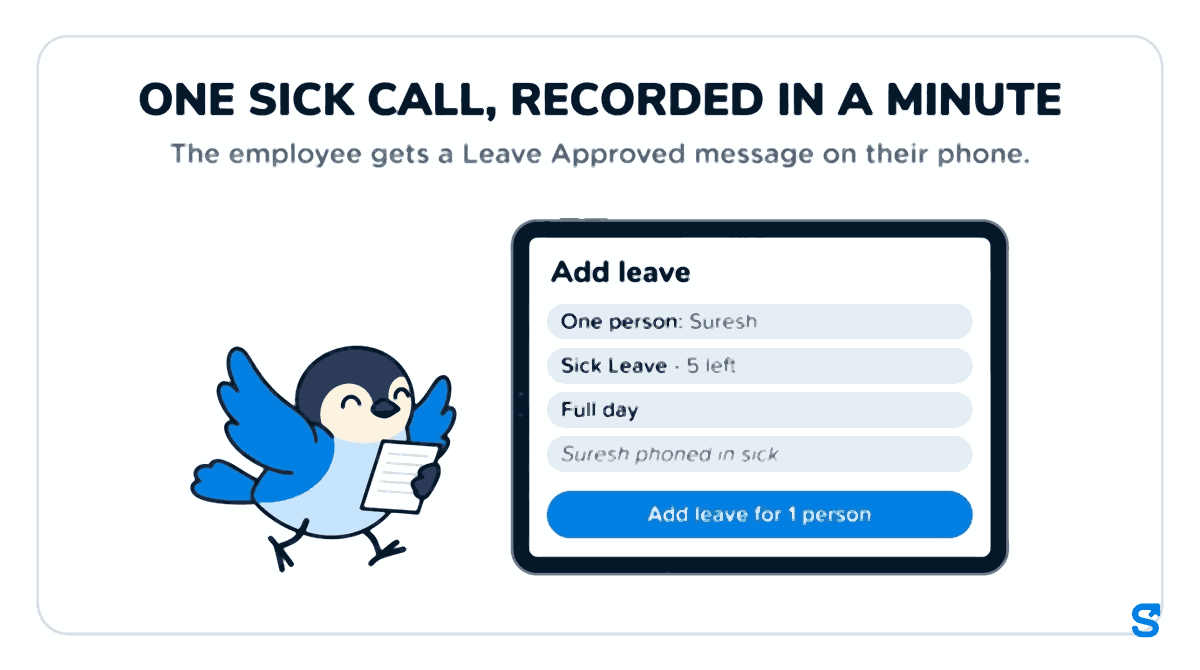
Pick the dates. For a single day you can choose Full day or Half day, first half or second half, for somebody who went home at lunch. Then pick the Leave type. For one person the list shows the days left beside each type, for example Sick Leave - 5 left, so you know before you tap whether this day will be paid. Add a note if you like: "Suresh phoned in sick".
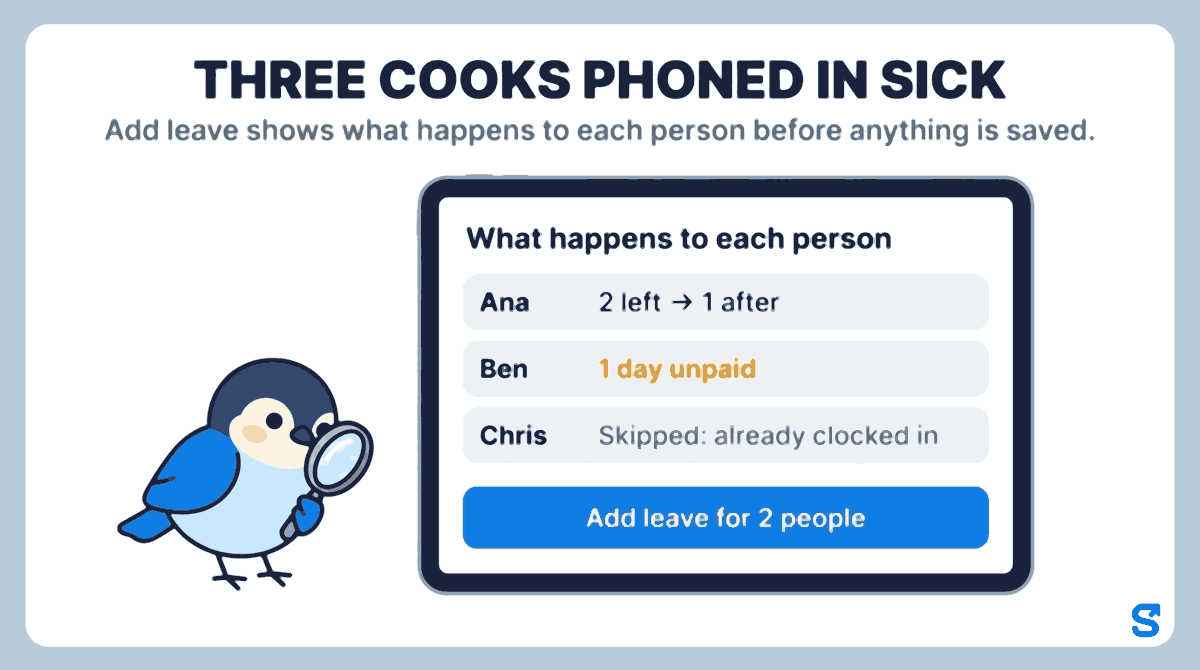
Nothing is saved until you add the leave. Preview shows What happens to each person: "Sick Leave: 5 left → 4 after" for somebody with days left, the split into paid and unpaid days for somebody who is running out, and "Weekly off or holiday - not counted" for a date they were not due to work anyway. Anybody who should not get this leave is shown as skipped, with the reason: already on leave that day, or already clocked in that day.
Say three cooks phoned in sick. Ana has 2 sick days left, so hers goes from 2 left to 1 after. Ben has no sick leave left, so his day is shown as 1 day unpaid. Chris is skipped because he already clocked in that morning. You add leave for 2 people, not 3, and nobody's pay is a surprise.
Tap Add leave for 1 person (or for however many). The day is Saved as approved, added by you. The employee gets a Leave Approved message on their phone, so they know the call was heard and the day is recorded. The day counts against their sick leave, comes off pay only if it is unpaid, and shows as leave on the shift schedule, so nobody builds a shift around a person who is in bed.
Felt better and came in after all? Open the day on the Requests tab and tap Cancel leave. The paid days go back to the person's balance. When staff do send requests themselves, the same tab now lets you tick several and Approve many at once.
What it does not do: Shiftelio does not find cover for you or message the team about the gap; you still choose who covers the shift. It does not ask for or store a doctor's note as part of adding leave. And it does not work out how many sick days anybody is entitled to by law: you set the days per year for each leave type yourself, and you check the rules where you operate.
Which app lets a manager record a sick day for an employee?
Questions owners ask
How do I handle an employee calling in sick?
Thank them, ask whether they expect to be off one day or longer, record the day off yourself, then find cover. Keep the call short and do not ask for a diagnosis.
Should the employee or the manager record a sick day?
The manager should. The person is ill and will forget or get the dates wrong. Recording it the same morning keeps pay and the leave balance right.
Can I ask an employee why they are sick?
You can ask how long they expect to be off, but most small businesses should not ask for a diagnosis. What you may ask, and when you may ask for a note, depends on the law where you operate.
What should I do if an employee calls in sick every Monday?
Count before you act. Look at six to twelve months of recorded sick days, compare with the team, then talk to the person privately with the dates in front of you.
How do I track employee absences?
Record every absence in one place, on the day, with the type of leave. A written record over months is what lets you spot a real pattern and answer pay questions.
What happens when an employee has no sick days left?
The extra days are usually recorded as unpaid leave. In Shiftelio the preview shows the paid and unpaid split for each person before you save.
Can I record sick leave for several employees at once?
Yes. In Shiftelio, Add leave lets you pick several people, or everyone at one site, for the same dates, and shows what happens to each person before you save.