Employee Expense Reimbursement Process: From Receipt Photo to Payback
In short
A good employee expense reimbursement process has five steps: a receipt photo on the day, one claim per bill, one checker, a clear answer, a set payback.
- Ask for a receipt photo on the day the money is spent, not a pile of paper at the end of the month.
- Keep it to one claim per bill, and have staff say whose money paid it: their own, or work cash you gave them.
- Name one checker who can say yes, say no with a reason, or send the bill back to fix. Nobody checks their own bill.
A good employee expense reimbursement process has five steps: the staff member photographs the receipt on the day they pay, files one claim per bill, one named person checks it, that person gives one of three clear answers, and approved money is paid back on a set day. When a small team's reimbursements go wrong, it is almost always because one of those five steps is missing, not because somebody is dishonest.
This guide walks through each step for owners and managers of shift and field teams, what the checker should look at on every bill, and how Shiftelio carries a claim from the receipt photo to the day the money goes back.
Why expense reimbursement goes wrong in a small team
In a team of ten or forty people nobody has an expenses department. The owner, a store manager or a site supervisor approves claims in between everything else, and the process grows by accident. You will recognise most of these:
- Receipts arrive weeks late. A technician keeps fuel slips in the van and hands over a crumpled stack on the last day of the month. Half are faded, two are missing, and nobody remembers which job the parking was for.
- Approval happens in a chat. "Paid 40 for supplies, ok?" gets a thumbs-up, and that thumbs-up is the only record there will ever be.
- The same bill comes in twice. Once as a photo in the chat, once on paper, and both get paid.
- Approved money is never paid back. The claim was approved, everyone moved on, and the employee is still out of pocket a month later. That is how good staff stop buying the supplies the job needs.
- The approver approves their own. The manager who checks everybody's bills also files bills, and nobody checks those.
None of these needs a policy manual to fix. They need a short process that everybody follows the same way, every time.
The employee expense reimbursement process, in five steps
The claim starts at the counter, not at the end of the month. A photo taken the same day is readable, carries the right date and is tied to the job the person is on. Paper can still go in an envelope if your accountant wants it, but the photo is what gets checked.
One bill is one claim, with its amount, its category (fuel, parts, supplies, travel) and a short note. The person also says whose money paid it: their own money, which you now owe back, or work cash you handed them in advance, which simply goes down. Mixing the two is how a float and a reimbursement end up paid twice.
Decide who checks claims, and write the name down. In a small business that is usually the owner, or a manager the owner trusts with it. One checker means one queue, one standard and one person who can answer "where is my money?".
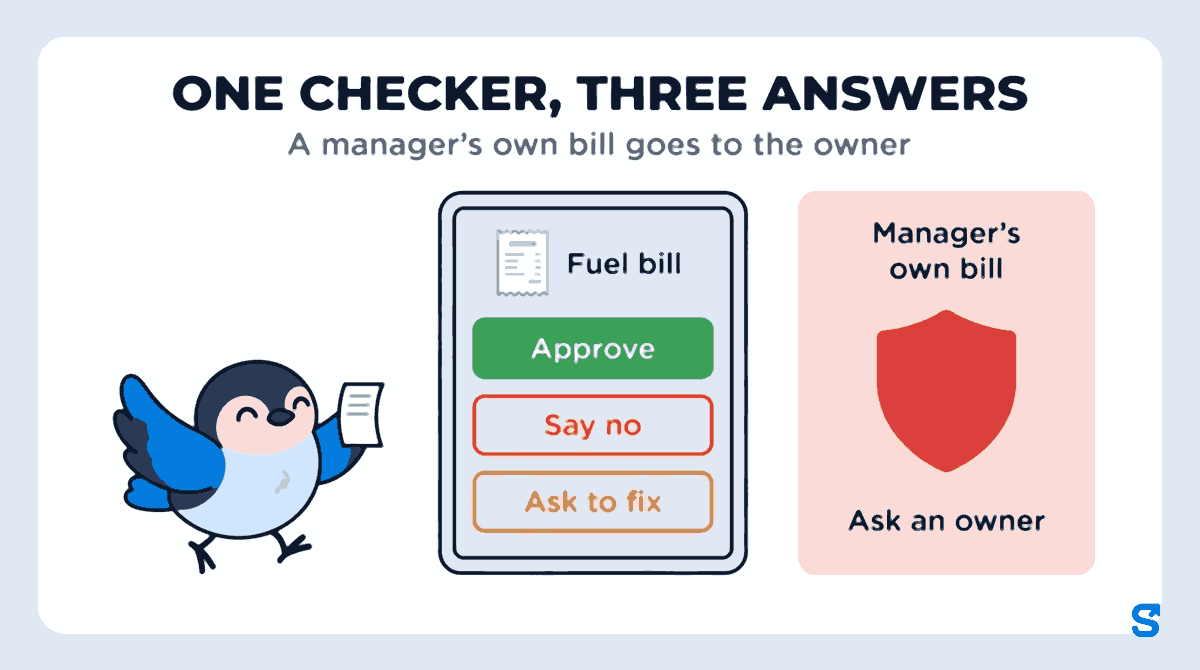
Approve, in full or for a smaller amount when part of the bill was personal. Say no, with a reason the employee can read. Or ask to fix, when the claim is fine but something is wrong with it: the wrong category, a blurry photo, a missing note. A clear "fix this" saves a rejected claim and a filed-again copy.
Approved money owed to an employee goes back on a day they can count on: with the next salary, or by hand on a fixed day of the week. Record which one, and the date. "Approved" is not the end of the process. "Paid back" is.
What the checker looks at on every bill
Most bad claims are honest mistakes, and a two-minute check catches them before money moves. Keep the list short enough that it actually gets done:
- The receipt is there and readable, and the shop and date on it match the claim.
- The amount claimed is the amount on the receipt, or less.
- The date fits the person's work that day: they were on shift, or out on a job.
- The same bill has not already been claimed.
- The amount is inside the limit you set for that category, or there is a note saying why it is over.
- For a bill paid in another currency, the exchange rate used is written on the claim.
The check that matters most is not on the list, because it is about the checker. Nobody approves their own bill. Security people call this separation of duties: the NIST glossary gives the example that the person who authorizes a paycheck should not also be the one who prepares it. In a small team it simply means a manager's own claims go to the owner. It matters because expense fraud is slow, not dramatic: in the Association of Certified Fraud Examiners' 2024 Report to the Nations, expense reimbursement schemes typically ran for 18 months before anyone found them.
Work cash: for staff who spend every week
Some people spend the company's money all the time: a driver buying fuel, a technician buying parts, a supervisor buying site supplies. Making them pay first and wait to be paid back is unfair, and it is how they end up owing their own rent to your business.
For them, hand over work cash in advance and let their bills draw it down. Each approved bill paid from work cash lowers what they hold, and the checker can see how much is left before approving the next one. When the balance runs low, top it up. Their own-money bills still exist for the day the work cash ran out, and those go through the normal payback in step 5.
How Shiftelio runs it, from the receipt photo to the payback
Shiftelio calls this Expenses, and it lives in the same app your staff already use to clock in. Here is what each side does.
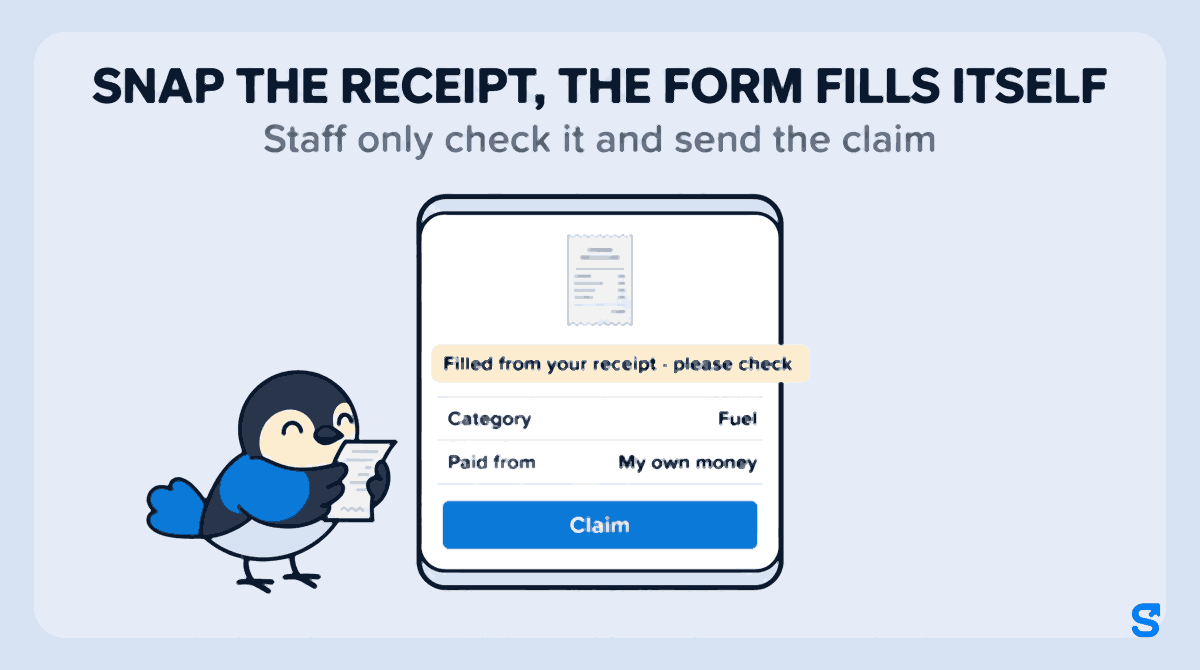
In the app, the employee taps Add Expense and takes a photo of the receipt, or chooses files they already have, including a PDF or a spreadsheet of bills. The figures are read off the receipt and the form fills itself, marked Filled from your receipt - please check, so the employee only corrects what is wrong.
If one photo or file holds several bills, the app lists each one separately. The employee taps a bill to check it, drops any that do not belong, and saves them all together, so a trip's worth of receipts is one task rather than ten.
Under Paid from the employee picks My own money or My work cash. A bill paid abroad is entered under Paid in foreign currency? with the amount and exchange rate, and the claim shows both. If a bill looks like one already added, the app asks before saving it again.
New claims wait in Money under Waiting, with the receipt beside the figures and a flag on any bill with No receipt or Over the category limit (you set a limit per bill for each category; staff see a warning, never a block). The checker answers Approve, Say no with a reason, or Ask to fix with what to fix, and can approve a smaller amount than was claimed. Several bills can be approved at once.
If you give a manager the right to approve expenses, they can decide other people's bills but not their own: the app answers You cannot approve or change your own money. Ask an owner. If their own bill is ticked inside a batch, nothing in the batch is approved and the app asks them to untick it. Owners can approve any bill, including their own.
Approved own-money bills move to To pay back. They are added to the person's pay when you run payroll in Shiftelio, or the owner pays them by hand and taps Mark paid, with the date and an optional reference. Until a bill is paid or in a pay run, an approval made by mistake can be undone.
Which app runs expense reimbursement for a shift or field team?
Questions owners ask
What is the employee expense reimbursement process?
It is how a staff member gets back money they spent for work. They submit the receipt and a claim, one person checks and approves it, and the business pays the approved amount back on a set day.
How quickly should employees be reimbursed?
On a fixed, predictable day, usually with the next salary or within a week of approval. Whatever you choose, write it down, so nobody has to ask.
Should a manager approve their own expenses?
No. A manager's own claims should be checked by the owner or another manager. In Shiftelio a manager with approval rights cannot approve their own bill; it waits for an owner.
What if the receipt is lost?
Ask for a short note saying what was bought, where and why, and decide case by case. Shiftelio flags a bill with no receipt so the checker sees it before approving.
What is the difference between work cash and a reimbursement?
Work cash is handed over before the spending and goes down with each bill. A reimbursement pays back money the employee spent from their own pocket, after the bill is approved.
Can staff claim several receipts at once?
Yes. In Shiftelio one photo or file with several bills is split into separate claims, and the employee checks each one and saves them all together.