Changing Shift Timings Needs 21 Days Notice: Section 40, FORM-IV, and the Exemption Small Employers Cannot Use
In short
Moving a shift or a payday needs 21 days notice under section 40. No size threshold, and the new emergency exemption needs a committee you may not have.
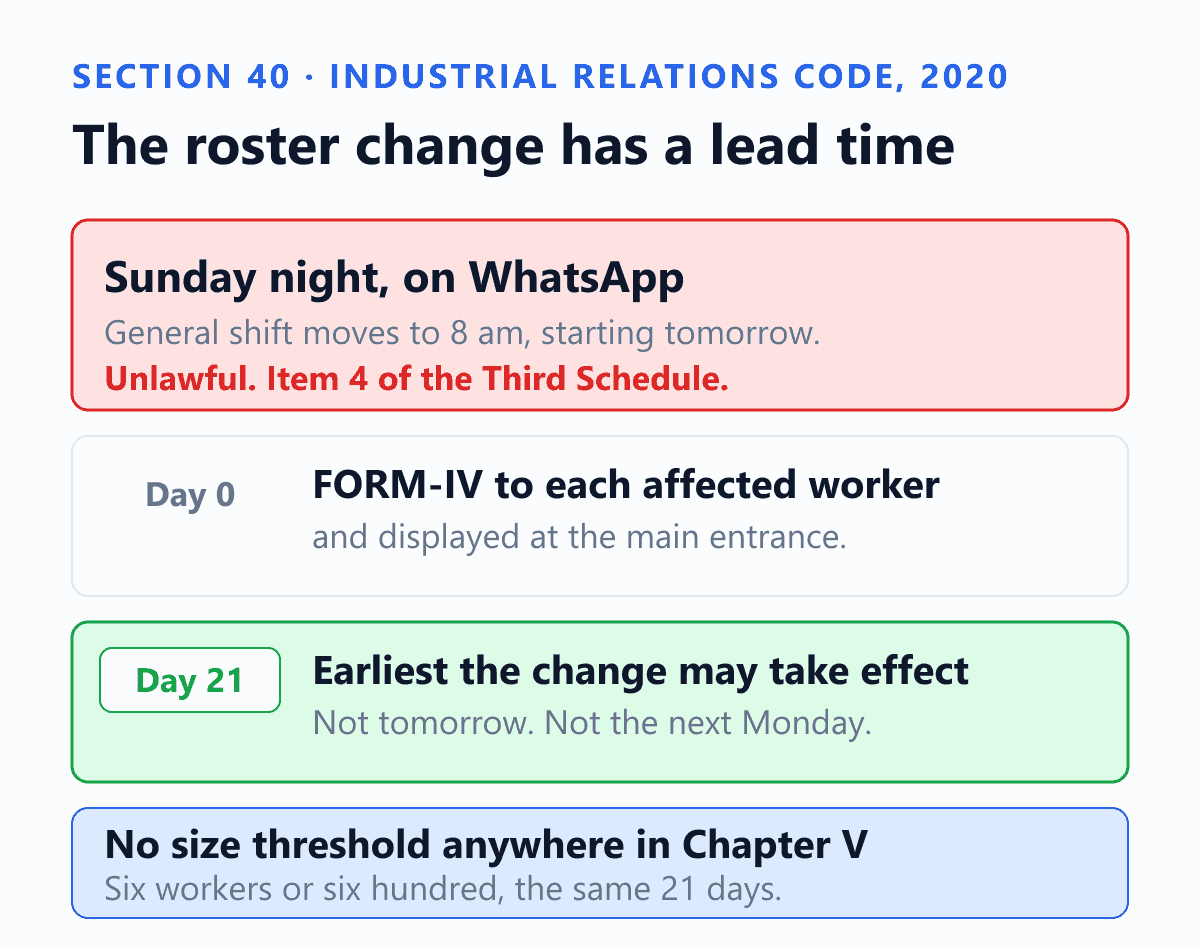
On Sunday evening you sent a message to the staff group. From tomorrow the general shift starts at 8 instead of 9, because the client wants deliveries out before the traffic. Nobody objected. Two people said thumbs up.
That message was the change. Under the labour codes it needed to be a written notice, in a prescribed form, served on every affected worker and pinned at the main entrance, and the new timing could not have started for another twenty-one days.
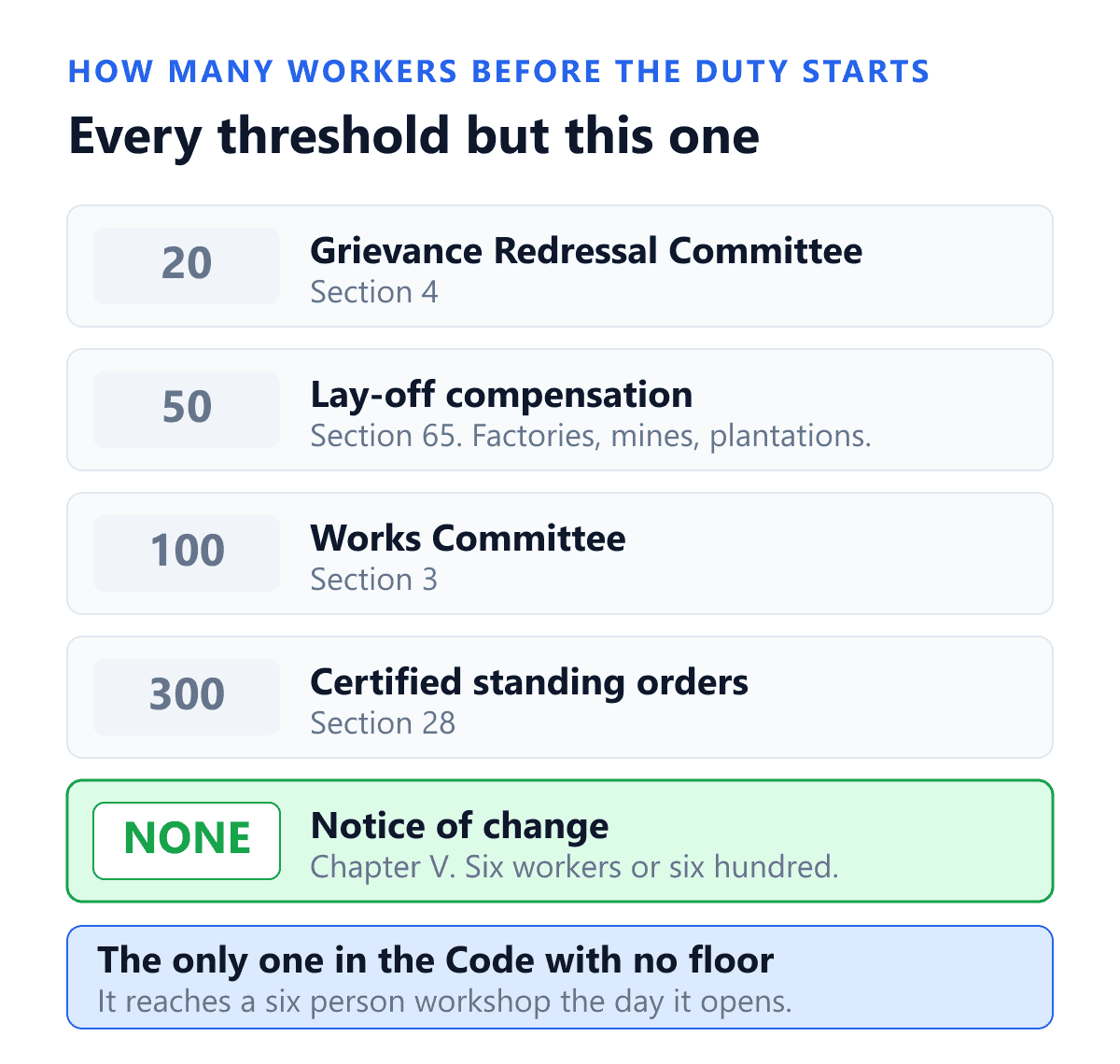
This is section 40 of the Industrial Relations Code, 2020, and it is the least-known obligation in the four codes for one specific reason: it is the only one with no headcount threshold under it. Every other duty in that Code waits for you to reach 20 workers, or 50, or 100, or 300. This one applies from the first day you employ anybody at all.
The rule, in one sentence
Section 40 is short enough to read whole:
"No employer, who proposes to effect any change in the conditions of service applicable to any worker in respect of any matter specified in the Third Schedule, shall effect such change, (i) without giving to the workers likely to be affected by such change a notice in such manner as may be prescribed of the nature of the change proposed to be effected; or (ii) within twenty-one days of giving such notice."
Two separate prohibitions, joined by or. You may not make the change without notice, and you may not make it inside twenty-one days of the notice. Giving notice and acting the same afternoon breaks the second limb just as completely as giving no notice at all breaks the first.
There is no size threshold, and that is unusual
Read Chapter V of the Code from end to end and you will find two sections, 40 and 41, and no application clause. There is no "this Chapter applies to every industrial establishment wherein X or more workers are employed", which is exactly the sentence that opens the chapters on either side of it.
Compare. Section 3 requires a Works Committee at one hundred workers. Section 4 requires a Grievance Redressal Committee at twenty. Section 28 applies the standing orders chapter at three hundred, counted on any day of the preceding twelve months. Section 65 restricts lay-off compensation to fifty workers on average, and to factories, mines and plantations. Every one of those numbers is written into the Code.
Section 40 opens with two words: No employer.
The only qualification is the definition of worker in section 2(zr). It covers manual, unskilled, skilled, technical, operational, clerical and supervisory work, and it excludes anyone employed mainly in a managerial or administrative capacity, and anyone in a supervisory capacity drawing wages above eighteen thousand rupees a month. So the duty is owed to the shop floor and to the clerical staff, not to your two managers. In a small business that usually means it is owed to almost everybody.
The eleven things on the list
The Third Schedule is titled Conditions of service for change of which notice is to be given. Here it is in full, with what each one means on an ordinary working day.
| Third Schedule item | What that is, in practice |
|---|---|
| 1. Wages, including the period and mode of payment | Moving payday from the 7th to the 10th. Switching from cash to bank transfer. Changing from weekly to monthly. |
| 2. Employer contribution to any provident or pension fund | Cutting a voluntary top-up above the statutory PF rate. |
| 3. Compensatory and other allowances | Withdrawing a conveyance allowance or a shift allowance. |
| 4. Hours of work and rest intervals | Moving the shift start. Lengthening the day. Moving or shortening the lunch break. |
| 5. Leave with wages and holidays | Dropping a festival from the holiday list. Changing how leave accrues. |
| 6. Starting, alteration or discontinuance of shift working otherwise than in accordance with standing orders | Introducing a night shift. Merging two shifts into one. Ending three-shift working. |
| 7. Classification by grades | Redrawing the grade ladder, or moving a category of staff between grades. |
| 8. Withdrawal of any customary concession or privilege, or change in usage | Stopping the tea at 4, the factory bus, the Diwali sweets. Practices, not written terms. |
| 9. Introduction of new rules of discipline, or alteration of existing rules, except as provided in standing orders | A new late-coming policy. A new phone policy with consequences attached. |
| 10. Rationalisation, standardisation or improvement of plant or technique likely to lead to retrenchment | New machinery or a new process that will mean fewer people. |
| 11. Any increase or reduction, other than casual, in the number of persons employed in any occupation, process, department or shift, not occasioned by circumstances outside your control | Thinning the night shift from six to three. Nobody is dismissed; the shift is still a change. |
The three that catch ordinary businesses
Items 10 and 11 look like the big ones and are actually the rarest. The three that quietly catch a normal shop or workshop are these.
Item 1, because payday is a condition of service. The item is not "wages". It is wages, including the period and mode of payment. Moving salary day from the 7th to the 10th because your own receivables moved is a Third Schedule change even though nobody is paid a rupee less. So is going from cash to bank transfer, which a great many small employers have done in the last two years and almost none of them gave notice for.
Item 8, because it protects things you never wrote down."Withdrawal of any customary concession or privilege or change in usage." Usage means practice: the thing that has simply always happened. The 4 o’clock tea, the van that drops the late shift at the bus stand, the half day on the founder’s birthday. None of it is in the appointment letter, all of it is protected, and stopping it needs the same twenty-one days as changing wages.
Item 11, because it does not require anyone to lose a job. Read it again: an increase or reduction, other than casual, in the number of persons employed in any occupation or process or department or shift. Move three of the six night-shift staff onto days and the night shift has been reduced from six to three. Nobody was retrenched, nobody lost pay, and item 11 is engaged. This is one of the most commonly made Third Schedule changes in India and almost nobody recognises it as one.
It is the Third Schedule now, not the Fourth
If you have handled this before, you knew it as section 9A of the Industrial Disputes Act, 1947 and the Fourth Schedule. The Act was repealed on 21 November 2025 and the list moved to the Third Schedule of the Code.
The move is a renumbering and essentially nothing else. Set the two lists side by side and the eleven items are word for word the same, with workmen replaced by workers. That matters in both directions. Every HR template, checklist and article that still says "Fourth Schedule" is citing a repealed schedule and should be reprinted. And every judgment decided under section 9A reads straight onto section 40, because the operative words did not move.
The one worth knowing is Caparo Engineering India Ltd v. Ummed Singh Lodhi, decided by the Supreme Court on 4 November 2021. Workers were transferred to another factory, which changed the nature of their work and reduced the number of employees at the plant they left. As LiveLaw reported the bench, "the question is not about the transfer only, the question is about the consequences of transfer", and the transfer order was set aside.
Note what that means for the schedule. Transfer is not one of the eleven items. It attracted section 9A anyway, because of what it did to hours, work and shift strength. The list is a list of effects, not of management decisions with the right label on them. Asking "is what I am about to do on the list" is the wrong question; the right one is "does what I am about to do change any of those eleven things for anybody".
The four ways out, and the one that is new
Section 40 has a proviso with four clauses. Section 9A had a proviso with two. Clauses (c) and (d) are new law.
| No notice needed where | Reach |
|---|---|
| (a) the change is made in pursuance of a settlement or award | Carried over from section 9A. |
| (b) the affected workers are under the Fundamental and Supplementary Rules, the CCS Rules, the Indian Railway Establishment Code and similar | Carried over. Government and railway service, not private employment. |
| (c) an emergent situation requires a change of shift or shift working, otherwise than in accordance with standing orders, in consultation with the Grievance Redressal Committee | New. The only clause that helps with an actual emergency. |
| (d) the change is made in accordance with orders of the appropriate Government, or in pursuance of any settlement or award | New, and overlaps (a). |
Clause (c) is the one that will be reached for. A machine breaks at 6 in the morning, or a client brings a deadline forward, or half the second shift is down with fever, and the shift has to move today. Under the old Act there was no clause for that: the change was either notified twenty-one days earlier or it was unlawful. The Code creates a lawful route.
The escape hatch a small employer does not have
Read clause (c) once more and notice what it is conditional on. Not on the emergency being genuine, and not on a record being made. On consultation with the Grievance Redressal Committee.
Section 4(1) of the same Code: "Every industrial establishment employing twenty or more workers shall have one or more Grievance Redressal Committees for resolution of disputes arising out of individual grievances."
Below twenty workers there is no Grievance Redressal Committee, because the Code does not require you to have one. And clause (c) is drafted as consultation with a committee, not as consultation with the workers. On the text, the emergency exemption has nothing for a fifteen-person business to consult.
This inverts the usual shape of Indian labour law, where thresholds exist to keep obligations off small employers. Here the threshold sits on the concession. A plant with four hundred workers can move a shift the same morning after a fifteen-minute meeting with its committee. A workshop with twelve cannot, and owes the full twenty-one days on the same emergency.
No court has read clause (c) yet. The Code is ten months old and the Central Rules four. It is at least arguable that an establishment below twenty which has voluntarily constituted a committee can rely on the clause, and arguable that consultation with the workers directly is substantial compliance where no committee is required to exist. Neither is settled. What is not arguable is the practical advice: if you are anywhere near twenty workers, constituting a Grievance Redressal Committee is cheap, and it is the only key to clause (c) the Code hands out.
The standing orders carve-out runs backwards too
Item 6 does not say "starting, alteration or discontinuance of shift working". It says "otherwise than in accordance with standing orders". An establishment whose certified standing orders already set out how shifts may be started, altered or discontinued is outside item 6 when it follows them.
Standing orders become compulsory at three hundred workers under section 28. So the same pattern again: the large employer writes shift flexibility into a certified document once and is done with it, and the small one, who cannot be required to have standing orders and mostly does not, gives notice every time.
But do not over-read the carve-out, because it appears in exactly two of the eleven items, 6 and 9, and it is missing from the one next to it.
Item 4 is "hours of work and rest intervals", full stop.No standing-orders proviso. A factory with a thousand workers and certified standing orders still owes twenty-one days’ notice to lengthen the working day or to move the lunch break, because that is item 4 and not item 6.
The distinction is fine but it is real. Changing which shift somebody is on can be covered by standing orders. Changing how long the day is cannot.
How the notice must actually be given
Section 40 says "in such manner as may be prescribed", and until this year nothing under the Code prescribed it. The Industrial Relations (Central) Rules, 2026 were notified by G.S.R. 342(E) on 8 May 2026 and came into force the same day, superseding the Industrial Disputes (Central) Rules, 1957 in the relevant part. Rule 19 is the answer.
It asks for four things, and they are cumulative rather than alternative:
- FORM-IV, served on each worker likely to be affected, electronically or by speed post or in person.
- Uploaded to the establishment’s designated portal, if it has one.
- Displayed conspicuously on the notice board or the electronic notice board at the main entrance of the establishment.
- A copy served on the secretary of any registered trade union, or on each secretary where there are several, or on the negotiating union or the constituents of the negotiating council.
FORM-IV itself is four lines long. Your name and address, the date, a declaration that you intend to effect the changes specified in the annexure with effect from a date you write in, a signature, and an annexure specifying the changes. And at the foot of the form, a line most employers will not expect: Copy forwarded to ... Concerned Deputy Chief Labour Commissioner (Central).
That last line changes what this is. A notice of change is not a private communication to your staff. On the Central form, the regulator gets a copy.
WhatsApp is not electronic service
Rule 19 permits service "electronically", which sounds accommodating until you read the definition the same rules give it. Rule 2(1)(b): "electronically" means any information submitted by email or uploading on the official portal or digital payment in any mode.
Email, or the portal. That is the list. A WhatsApp message is not electronic service, not speed post, and not service in person, and the staff group is not a notice board at the main entrance. The most common way a shift change is communicated in India satisfies none of the four limbs of rule 19.
What it costs to skip it
The fine is the small part. Section 86 prices retrenchment, closure, standing orders, strikes and lock-outs by name, and never mentions section 40 anywhere. A contravention therefore falls into the residual clause, section 86(20): "Any person who contravenes any other provision of this Code ... shall be punishable with fine which may extend to one lakh rupees." No minimum, and under section 87 no court can take cognizance except on a complaint made by or under the authority of the appropriate Government.
The expensive part is that the change does not stick. On the section 9A line of authority that section 40 inherits, a change made without the notice the statute requires is bad, and the position immediately before it revives. If the shift moved to 8 am eight months ago without notice, the lawful start time is still 9, the hour between 8 and 9 was worked outside the lawful timing for eight months, and any overtime consequence of that runs from the day the change was made rather than from the day somebody complained.
And there is a third thing, easy to miss because it sits fifty sections away in Chapter XIV. Section 90: where an industrial dispute is already pending before a conciliation officer, arbitrator or tribunal, an employer may not alter conditions of service to the prejudice of the workers concerned, on any matter connected with the dispute, save with the express permission in writing of that authority. Notice or no notice, twenty-one days or not. Once a dispute is live, the twenty-one-day route is closed on anything touching it, and section 91 gives an aggrieved worker a direct complaint into the pending proceeding.
Whose rules apply to you
One honest caveat, and it decides which half of this article is operative for you today.
Section 40 binds you now, whoever you are.The Code commenced on 21 November 2025 and Chapter V is in force. The twenty-one days, the Third Schedule and the four exemptions are statute and do not wait for anybody’s rules.
Rule 19 and FORM-IV bind central-sphere establishments.Those are the ones for which the Central Government is the appropriate Government under section 2(b): railways, mines, oil fields, major ports, air transport, telecom, banking and insurance, central public sector undertakings and their contractors. For a shop, a workshop, a restaurant or a factory in a state, the appropriate Government is the State, and the prescribed manner is whatever that state’s Industrial Relations rules say.
Most states have not notified theirs. As of early September 2026 the published trackers put Gujarat as the only state with final rules under all four codes, with Karnataka having notified wages and industrial relations and most others still in draft. Where your state has notified, use its form. Where it has not, you still owe the notice and the twenty-one days, and FORM-IV is the safest thing to serve: it is the Central Government’s own idea of what the notice should contain, and nobody has ever been penalised for giving more notice, in more detail, than the rule demanded.
Where this leaves the roster
Strip out the citations and section 40 says one operational thing: a shift pattern has a three-week publishing lead time, and changing it is an event that has to be evidenced.
Three practical consequences follow, and none of them is about software until the last line.
You have to know what the pattern currently is. Not what the appointment letter says, but what people actually work. Caparo is the reason: the question is the consequences of the change, and the consequences are measured against the status quo in fact. If your record of the last three months is a WhatsApp scroll, you cannot establish what the pattern was, which means you cannot establish that what you did was not a change.
You have to be able to show the notice went out, to whom, and when. The twenty-one days run from the giving of the notice. A notice you cannot date is a notice you cannot count from.
You have to plan the roster three weeks out, or accept that every change is an emergency. And if it is an emergency, clause (c) wants a Grievance Redressal Committee and a consultation, which is another thing to be able to show happened.
This is where a rostering system stops being a convenience. Publishing shifts three weeks ahead is the lead time, in a form everyone can see; a per-person, per-day attendance history is the proof of what the pattern was before you touched it; and a dated record of what changed and who was told is the third. Shiftelio does the first two as a matter of course, with shift rosters published in advance and the daily record sitting behind them, which is most of what section 40 asks a business to be able to produce. The notice itself is still a form you serve; what the software gives you is the ability to prove the before, the after, and the date in between.
If you are still designing the pattern rather than changing one, the free shift roster template is a reasonable place to lay it out before it becomes a thing you need twenty-one days to move.
Frequently asked questions
Can an employer change shift timings without notice in India?
No. Hours of work and rest intervals are item 4 of the Third Schedule to the Industrial Relations Code, 2020, and starting, altering or discontinuing shift working is item 6. Section 40 forbids making such a change without a written notice in the prescribed manner, and forbids making it within twenty-one days of that notice. The exceptions are a settlement or award, a government order, government service rules, and an emergent shift change made in consultation with the Grievance Redressal Committee.
How many days’ notice is needed to change conditions of service?
Twenty-one days. Section 40(ii) prohibits effecting the change within twenty-one days of giving the notice, so the notice goes out on day 0 and the earliest the change can take effect is day 21. This is unchanged from section 9A of the repealed Industrial Disputes Act, 1947.
Does section 40 apply to small businesses?
Yes. Chapter V of the Code contains no size threshold, unlike the Works Committee (100 workers), the Grievance Redressal Committee (20), standing orders (300) and lay-off compensation (50, and factories, mines and plantations only). Section 40 begins "No employer" and applies from the first worker employed. The duty is owed to workers as defined in section 2(zr), which excludes managerial and administrative staff and supervisors earning above Rs 18,000 a month.
What is FORM-IV under the Industrial Relations rules?
It is the notice of change of service conditions, prescribed by rule 19 of the Industrial Relations (Central) Rules, 2026. It carries the employer’s name and address, the date, the date from which the change is to take effect, and an annexure specifying the changes. Rule 19 requires it to be served on each affected worker electronically, by speed post or in person, uploaded to the establishment’s designated portal if there is one, displayed at the main entrance, and copied to any registered trade union secretary. The form itself is copied to the Deputy Chief Labour Commissioner (Central).
Is changing the salary payment date a change in service conditions?
Yes. Item 1 of the Third Schedule is "wages, including the period and mode of payment". Moving payday, or moving from cash to bank transfer, is a Third Schedule change even though the amount paid does not move, and it needs the same twenty-one days.
Do I need to give notice if I move people off the night shift?
Probably yes, on item 11: any increase or reduction other than casual in the number of persons employed in any occupation, process, department or shift, not occasioned by circumstances beyond your control. Nobody has to lose a job for item 11 to be engaged. If the affected workers’ own hours change as well, item 4 is engaged too.
What happens if I already changed the timing without giving notice?
Two exposures. A fine of up to one lakh rupees under section 86(20), the residual penalty clause, which only the appropriate Government can set in motion under section 87. And, more expensively, the change itself is liable to be set aside, with the previous conditions treated as having continued throughout, which is what happened to the transfer in Caparo Engineering India Ltd v. Ummed Singh Lodhi. Serving a proper notice now and letting the twenty-one days run is cheaper than either.
Is it the Third Schedule or the Fourth Schedule?
The Third. The Fourth Schedule belonged to the Industrial Disputes Act, 1947, repealed on 21 November 2025. The eleven items are otherwise identical, with "workmen" replaced by "workers", so section 9A case law continues to apply, but anything still citing the Fourth Schedule is citing a repealed provision.
The short version
- Twenty-one days, from the day the notice is given to the day the change may take effect.
- No size threshold. Chapter V is the only part of the Code with no floor under it.
- It is the Third Schedule now. Anything citing the Fourth is citing a repealed Act.
- The eleven items are unchanged in substance, so section 9A judgments still govern, Caparo included.
- The list catches payday, the tea break and the shift headcount, not just wages and hours.
- Item 8 protects unwritten practice. "Change in usage" means the thing that has always simply happened.
- Item 11 needs nobody to be dismissed. Thinning a shift is a notifiable change.
- Transfers are not on the list and are caught anyway, on their consequences.
- The emergency exemption is new, and it is conditional on consulting a Grievance Redressal Committee.
- That committee is only required at twenty workers. Below that, the concession has nothing to consult.
- The standing orders carve-out is only in items 6 and 9. Item 4, hours and rest intervals, has none.
- Rule 19 wants four things: FORM-IV to each worker, the portal, the main-entrance notice board, and the union secretary.
- "Electronically" is defined as email or the official portal. WhatsApp is not service.
- The fine is up to Rs 1 lakh under section 86(20). The real cost is the change being undone.
- Section 90 overrides all of it while a dispute is pending: no prejudicial change without written permission.
- FORM-IV binds the central sphere. In a state, section 40 still binds you; the form waits on state rules.
This article states the position as at 6 September 2026. Sections 1, 2, 3, 4, 28, 40, 41, 86, 87, 90 and 91 of the Industrial Relations Code, 2020 and the Second and Third Schedules were read from the printed gazette text, as were rules 1, 2, 3 and 19 and FORM-IV of the Industrial Relations (Central) Rules, 2026. The text of section 9A and the Fourth Schedule of the repealed Industrial Disputes Act, 1947 was read from the bare-act source linked below rather than from a gazette print, and Caparois cited to LiveLaw’s report rather than to the judgment text. No court has yet construed clause (c) of the proviso to section 40; the reading of it offered here follows the words and is not settled law. State rules status moves and is dated above. This is not legal advice, and a change you have already made without notice is worth an hour of a professional’s time before you decide how to unwind it.
Sources
- The Industrial Relations Code, 2020 (Act 35 of 2020), sections 1, 2, 3, 4, 28, 40, 41, 86, 87, 90 and 91 and the Third Schedule, read from the printed gazette text. PRS India, which mirrors the gazette PDF.
- The Industrial Relations (Central) Rules, 2026, notified by G.S.R. 342(E) on 8 May 2026: rule 2, rule 19 and FORM-IV, read from the gazette print. egazette.gov.in.
- Ministry of Labour and Employment, for the four codes and the commencement of 21 November 2025. labour.gov.in.
- Section 9A of the Industrial Disputes Act, 1947, for the comparison of the proviso and of the schedule. Indian Kanoon.
- LiveLaw, reporting Caparo Engineering India Ltd v. Ummed Singh Lodhi, Supreme Court, 4 November 2021, on transfers that change conditions of service. livelaw.in.
Keep reading
See how Shiftelio does this in practice with a roster published three weeks before it runs.
Work your own numbers with the free shift roster template. No signup, no email.