Shift Swaps: How to Approve One Without Paying for an Extra Day by Mistake
In short
A shift swap moves a working day, it does not add one. Decide swap or extra day before you publish the schedule, so a traded day is never paid as a bonus.
- A shift swap moves a working day to a different day. The person works the same number of days that week, so the swapped day is paid as a normal day.
- An extra day is a day added on top of the usual week. It is paid on top, and missing it is not an absence.
- The two look identical on a schedule: somebody is working on a day they usually have off. Decide which one it is before you publish the week, not when you run pay.
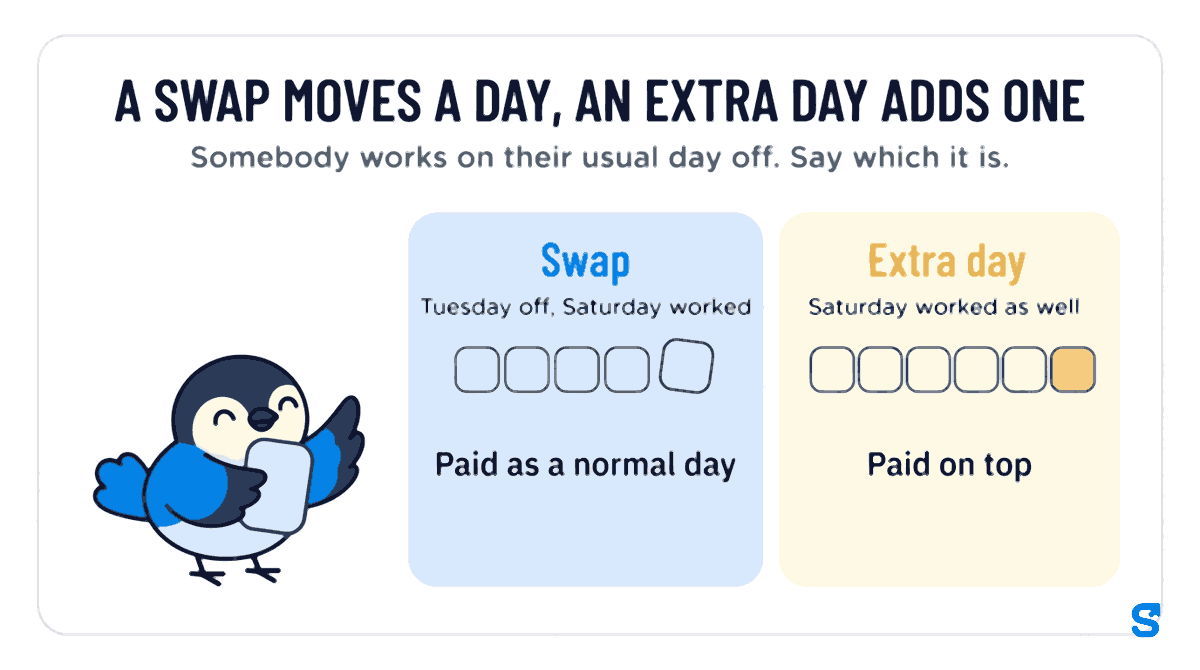
A shift swap moves a working day, it does not add one: if Maria takes Tuesday off and works Saturday instead, she still works her usual five days and Saturday is paid as a normal day. The mistake that costs money is treating every day worked outside someone's usual week as an extra day, so decide "swap or extra" for each one before you publish the schedule.
That sounds obvious until you look at the schedule a manager actually publishes. Maria working a Saturday looks exactly the same whether she traded it for Tuesday or is coming in on top of her week. The schedule does not say which, and three weeks later, when pay is being checked, nobody remembers. This guide is for owners and managers of restaurants, cafes, retail stores and salons who let their staff trade days and want the pay to come out right without thinking about it every week.
What a shift swap actually means
People search "swap shift meaning" because the phrase is used for two different things.
A swap between two days. One person moves one of their working days. Maria usually works Monday to Friday. She asks for Tuesday off for a family event and offers to work Saturday instead. Same person, same number of days, different days.
A swap between two people. Maria and Jordan trade a shift. Jordan takes Maria's Tuesday, Maria takes Jordan's Saturday. Look at each of them on their own and it is the first kind twice: each one moved a day.
Either way, the question for pay is the same, and it is asked per person: did this person work more days this week than they usually do, or the same days moved around?
| Swap | Extra day | |
|---|---|---|
| What happened | A usual working day moved to another day | A day added on top of the usual week |
| Days worked that week | The usual number | More than usual |
| How it is paid | As a normal day, nothing extra | On top of the usual pay |
| If they do not come in | It counts as an absence | Nothing is taken off |
| Typical request | "Can I have Tuesday off and do Saturday?" | "Can you come in on your day off?" |
Why the schedule alone gets it wrong
On a weekly schedule, a swap and an extra day are both "somebody working on a day that is normally their day off". If your pay is worked out from the schedule, one of two things happens:
- Every unusual day is treated as an extra. Maria's traded Saturday is paid on top of her five days, so a favour she asked for becomes a pay rise. Across a team that trades a few days a month, that adds up quietly, and the person who notices is usually the colleague who did not get it.
- Every unusual day is treated as a swap. The cook who came in on his day off to cover a sick colleague is paid nothing extra. He notices the first time, and the next time you ask for cover, he is busy.
Both are fixed the same way: say which it is when the day goes on the schedule, while the person who agreed it still remembers.
Swaps are worth getting right because schedules in shift work change a lot. The Shift Project at Harvard, which surveys hourly service-sector workers in the US, reports on its secure scheduling page that 57% deal with last-minute changes to the timing of their shift. Its study of hourly retail and food service workers, Uncertain Time, found that unstable schedules predict people leaving their jobs. Letting staff trade days keeps the schedule livable for them; labeling each trade correctly keeps it fair for everybody else.
The counting rule that settles most swaps for you
You do not have to label every unusual day by hand. For each person, count the days in the week:
Maria's usual week is Monday to Friday: five days.
If she is on Monday, Wednesday, Thursday, Friday and Saturday, that is still five days.
Same number: the Saturday is a swap. More than usual (six days because she kept Tuesday as well): the Saturday is an extra day.
If she works Saturday and Sunday but drops only Tuesday, one of the two weekend days is a swap and the other is an extra, and nothing in the schedule says which. That is the one case a manager has to decide.
This is the rule a fair manager applies in their head anyway. Writing it down is what makes it the same every week, whoever builds the schedule.
A shift swap policy you can copy
"Shift swap policy example" is one of the most common things managers search. The policy does not need to be long. It needs to answer four questions before anyone asks them:
- Who can ask: any team member, for any shift on the published schedule.
- How to ask: in writing (a message is fine), naming the day they want off and the day or the person covering it.
- Who approves: the manager who builds the schedule. A swap is not agreed until it is on the schedule.
- By when: at least 48 hours before the earlier of the two shifts, except for emergencies.
- Same skills: a cover has to be able to do the job (a trained barista for a barista shift, a key-holder for an opening).
- Swap or extra is decided at approval: the manager says which it is when the change goes on the schedule, and the person is told.
- Missed swapped shift: if someone does not turn up for a day they swapped in, it counts as a missed working day, the same as any other.
That last line matters more than it looks. A swapped day replaced a normal working day, so not coming in is an absence. An extra day was never part of the usual week, so missing it costs nothing. Saying so up front removes the most common argument.
The 48-hour notice and the same-skills rule are practice, not rules from anywhere: pick the numbers that fit your business and write them down.
Handling a shift swap request without the back-and-forth
Most swap requests arrive as a text at the worst moment. A simple routine keeps them from turning into a thread:
- The request arrives: "Can I swap Tuesday for Saturday?" Before saying yes, check Saturday still has the right people on it.
- Approve it on the schedule, not in the chat: a yes in a message thread is not a schedule. Move the day on the schedule itself.
- Say what it is: swap or extra. If you are not sure, ask the person: "Is this instead of Tuesday, or as well as?"
- Publish the week: the person sees the change on their phone, and so does everybody else on those shifts.
- Pay follows the schedule: because the day was labeled when it was approved, there is nothing to reconstruct at the end of the month.
How Shiftelio's roster decides swap or extra for you
In Shiftelio, the Shift Schedules feature includes a weekly roster: plan who works when, and at what rate. When you put somebody on a day outside their usual working days, the roster asks one question, "What is this day?", with three answers:
- Work it out for me (the default). Shiftelio counts the days as above and shows you its answer in plain words: "Right now this counts as a swap, the same number of days as usual, just different ones."
- Instead of a normal day. Paid as a normal day, nothing extra. If they do not come in, it counts as an absence.
- On top of the usual days. Paid as an extra day on top of the usual pay. If they do not come in, nothing is taken off.
"Work it out for me" stays live while you edit. Give Maria Tuesday off after you have already added her Saturday, and the Saturday turns from an extra into a swap by itself, without another click.
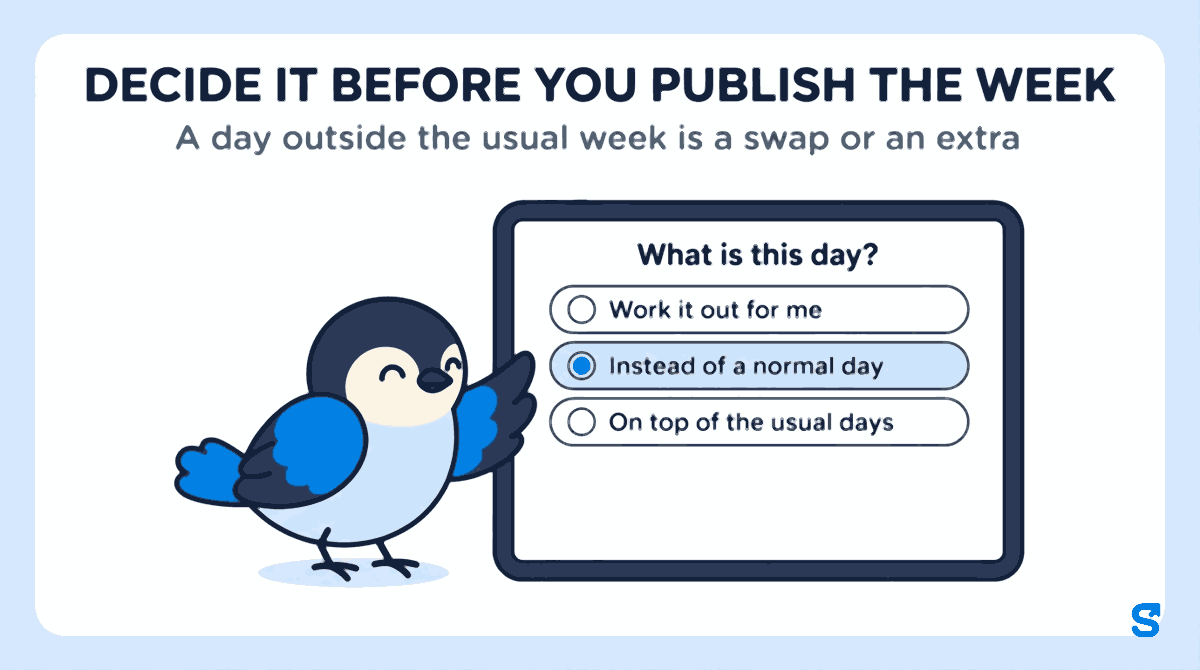
When a week has a day the count cannot settle, such as two weekend days and only one weekday dropped, that day shows Choose on the roster, and the week cannot be published until you do, because the answer changes what people are paid. Changes stay a draft that only managers can see until you press Publish, so staff never see a half-finished week.
On the staff side, each person's week in the app marks the day as Swapped day or Extra day, so Maria can see that her Saturday replaced Tuesday before payday, not after.
One honest limit: the count looks at one roster week at a time. If someone takes a day off this week and makes it up next week, the made-up day reads as an extra, and you mark it Instead of a normal day yourself.
Which scheduling app tells a swap from an extra day
Questions managers ask about shift swaps
What does swap shift mean?
A shift swap means a working day is moved, not added: one person works a different day instead of a usual one, or two people trade shifts. Each person still works their usual number of days.
Is a swapped shift paid extra?
No, a true swap is paid as a normal day, because the person works their usual number of days that week. Only a day added on top of the usual week is paid as an extra.
What if someone does not turn up for a shift they swapped into?
Treat it as a missed working day, the same as missing any normal shift. The swapped day replaced a usual day, so it is part of their week.
Should employees be allowed to swap shifts without asking?
Most small businesses let staff arrange a swap between themselves but require the manager to approve it on the schedule. That way the right skills are on every shift and pay follows what was approved.
How do I write a shift swap policy?
Answer four questions in a few lines: who can ask, how they ask, who approves and by when. Add how a missed swapped shift is treated, and say that swap or extra is decided when the swap is approved.
Can staff swap shifts with each other in Shiftelio?
No, there is no staff-to-staff swap request in Shiftelio. Staff ask their manager, and the manager moves the day on the roster, where it is marked as a swap or an extra before the week is published.