Time Theft at Work: Five Examples Small Teams See, and How to Stop Each One
In short
Time theft is being paid for time not worked. The five common kinds, from buddy punching to long breaks, and the one check that stops each of them.
- Time theft is getting paid for time you did not work: a friend clocks you in, you clock in before you arrive, a break runs long, or a timesheet is changed after the fact.
- It is almost always small and almost never one person. Twenty minutes a day is 80 hours a year, two full work weeks, for one employee.
- Each kind has its own fix. A shared time clock cannot tell who is standing at it, so tie the clock-in to the worker's own phone, a selfie and the workplace location.
Time theft is when an employee is paid for time they did not work: a coworker clocks them in, they clock in before they arrive, a break runs long, or the hours are changed after the fact. You prevent it by making each of those visible on the record, so honest time is easy to prove and padded time stands out by itself.
That is the whole idea. This guide walks through the five kinds of time theft that small teams in restaurants, stores, cleaning crews and field services actually see, what each one costs, and the one check that stops each, without buying a fingerprint clock and without treating your honest staff like suspects.
What counts as time theft, and what does not
Time theft, also called stealing time at work or time card fraud, is any gap between the hours on the timesheet and the hours actually worked, in the employee's favor. It covers clocking in and out, breaks, and edits.
It does not cover everything that annoys a manager. Somebody who is slow at a task, or who checks their phone for two minutes between customers, is a performance conversation. Time theft is about the record of hours: was the person at work, working, for the time they are paid for?
Keeping that line clear matters. If every small thing gets called theft, staff stop trusting the record, and the record is the thing you need them to trust.
Why small minutes matter
Almost nobody steals a whole shift. What happens is ten minutes here and fifteen there, and because it is small, it repeats.
- 20 minutes: a late start, an early finish or a long break, on one day
- 5 days a week: a normal full-time schedule
- 48 weeks: a working year, after time off
- 80 hours a year: two full 40-hour work weeks, for one employee
That figure is 20 minutes a day, five days a week, for 48 weeks. It is an example, not a survey. The point is the shape: you would never knowingly pay one person for two weeks they did not work, but small minutes do it quietly, and on a team of ten they rarely stay with one person.
The five kinds of time theft, and the check for each
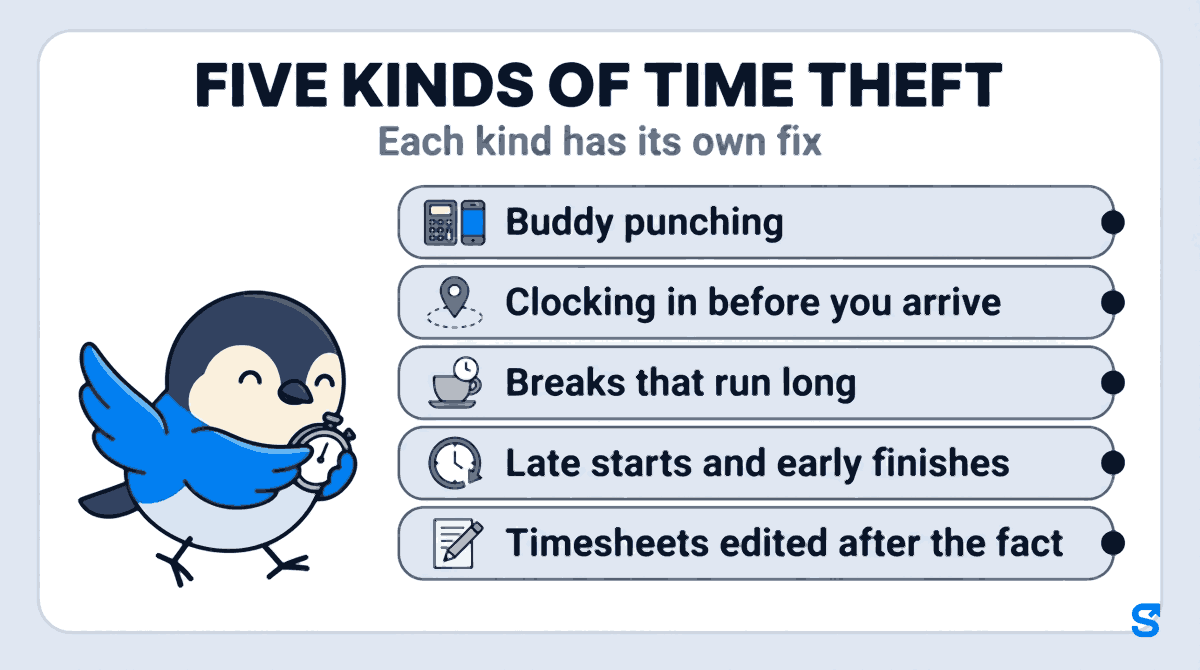
What it looks like: a friend taps your PIN on the tablet by the door while you are still on the bus, or clocks you out at closing after you have gone home. It survives on any shared clock, because a PIN pad, a swipe card or a kiosk only knows a code was entered, not who entered it.
The check: each person clocks in on their own registered work phone, with a selfie taken at that moment. A coworker cannot easily lend you their phone and your face at the same time.
What it looks like: with a phone time clock and no location check, a worker can clock in from the parking lot, the coffee shop down the street, or the bus. The timesheet says they started; the store says they had not.
The check: draw a geofence, a circle around each workplace, and choose what happens when somebody clocks in outside it: allow it and tell you, or block it. For crews that move between sites, give each site its own geofence.
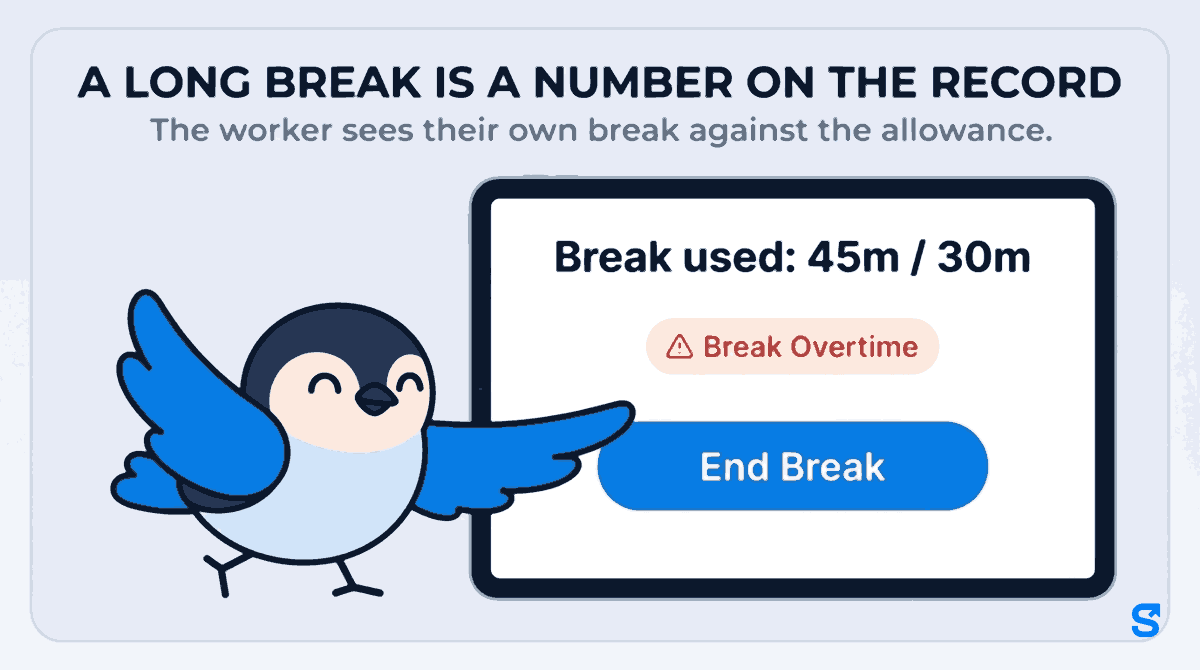
What it looks like: a 30-minute break becomes 45, every day. Nobody is timing it, and when the manager finally says something it becomes one person's word against another's.
The check: staff tap Break and End Break in the app, and each shift carries the break allowance you set. The worker sees "Break used" against their allowance while the break is running (for the long break above, 45m / 30m), and the app shows Break Overtime when it goes past it. The break time stays on that day's record, so the conversation starts from a number both of you can see.
What it looks like: a shift says 9 to 5, the clock-in says 9:20, and nobody notices because the timesheet only shows total hours. Or somebody leaves at 4:30 and asks a coworker to clock them out (which is buddy punching again).
The check: plan the shift in the roster, so every clock-in is compared with the shift it belongs to. A late clock-in is recorded as late, and the worker is told so on their phone before they confirm it. Late becomes a fact on the record, not an accusation.
What it looks like: a missed clock-out is "fixed" with a generous time, a whole day is added that never happened, or a record that showed a problem quietly disappears. This is the hardest kind to see, because the final timesheet looks clean, and it is not always the worker who makes the edit.
The check: keep a log of every change to attendance. Each edit shows what changed, who made it and when, and a deleted day stays visible in the log instead of vanishing. A clean timesheet with a busy edit history is the thing to look at.
Put it in place without treating staff like suspects
Most of your staff are not stealing time, and the way you introduce these checks decides whether they feel trusted or watched. A short sequence works for most small teams:
- Write the rule on one page first. You clock yourself in and out, on your own phone, at work, and never for anybody else. Breaks are the length on your shift. Changes to your hours go through the manager and are logged.
- Say how it is checked. Your registered phone, a selfie and the workplace location at clock-in and clock-out, and your break time against your allowance. A rule people can see is a deterrent before it is a control.
- Say what to do when life happens. Running late? Message the manager. A late arrival recorded honestly is a scheduling conversation, not a disciplinary one. New phone? The manager approves it the same day.
- Start gentle for a month. Set the geofence and the phone rule to tell you rather than block anyone, so nobody is stuck at the door on day one, and learn where the real patterns are.
- Look at the patterns, not single events. One late clock-in is traffic. The same person late every Monday, or the same two people always clocking in a minute apart, is worth a quiet conversation.
- Apply the same rule to everybody, including the manager who edits timesheets. The edit log is there to protect honest managers too.
Have each person read and acknowledge the page. Staff who were never stealing time notice almost nothing: clocking in happens on their own phone, and they can see their own break and their own hours.
What software will not fix
Be honest with yourself about the limits. A time clock can prove someone was at work and on the clock. It cannot prove they were working hard. Long phone calls on the shop floor, a slow job padded to fill the shift, or a manager who signs off whatever is in front of them are management problems, and the fix is clear expectations, a schedule that matches the real workload, and a manager who looks at the record.
If some of your staff carry no smartphone at all, the phone checks do not apply to them. A supervisor can clock them in from one device, and that punch is recorded as the supervisor's, not as proof the worker was there.
And this guide does not cover law. Whether time theft is a disciplinary matter, a firing offense or something more serious depends on your country, your state or province, and your own written policy. For your case, ask a local employment lawyer.
Which app shows each kind of time theft on the record
Here is what the same day looks like for one worker once the checks are on: a clock-in on their own phone, inside the store's geofence, a break that ran past the allowance, and the record that shows it.
See how employee tracking works for the clock-in checks, and shift scheduling for planning the shifts each clock-in is compared with. Everything else Shiftelio does is on the features page, or start from the Shiftelio home page.
For more on why keeping an honest record of hours matters beyond any one country, the International Labour Organization's overview of working time is a good starting point, and the U.S. Small Business Administration's guide to managing employees covers setting written policies for a small team.
Questions owners ask
What is time theft?
Time theft is being paid for time you did not work. It includes a coworker clocking you in, clocking in before you arrive, long breaks, and timesheets changed after the fact.
What are examples of time theft at work?
The common examples are buddy punching, clocking in from outside the workplace, breaks that run past the allowance, late starts and early finishes, and padded edits to a timesheet.
How do you prevent time theft without a fingerprint clock?
Have each worker clock in on their own registered phone, with a selfie and a geofence around the workplace. Then track breaks against an allowance and keep a log of every timesheet edit.
Is time theft illegal?
That depends on where you are and on the case, and this guide does not cover law. Most employers handle it under their own written policy; for anything more, ask a local employment lawyer.
Will tracking time make honest staff feel watched?
Not if you explain it first and apply it to everyone. The checks run at clock-in, clock-out and breaks, staff can see their own record, and an honest day looks the same as before.