Advance on Wages: How a UK Small Business Lends to Staff and Gets It Back
In short
Yes, a UK employer can lend staff money or advance wages. Agree the repayment in writing, then take it back in set amounts from each pay run.
- An advance on wages is pay handed over early; a staff loan is money lent on top of pay and paid back over several months.
- gov.uk says an employer is not allowed to make deductions from pay unless, among other reasons, the worker agrees in writing or the contract says they can.
- Write down four things before paying out: the amount, the monthly deduction, the first pay run it comes off, and what happens if the person leaves.
Yes, a UK employer can lend money to a member of staff or pay part of their wages early. The part that goes wrong is getting it back: agree the amount and the repayment in writing before the money leaves, then take the same fixed sum from each pay run until the balance reaches zero.
Most small owners do not get this wrong on purpose. A kitchen porter asks for a sub before payday, you hand over £300 from the till or by bank transfer, and you mean to take it back over the next few months. Then payday comes, somebody else is running the wages, and the £100 never comes off. Or it comes off twice. This guide walks through doing it properly, and then shows how the Loans & Advances screen in Shiftelio keeps the count for you.
Advance or loan: what is the difference?
The two words get used for the same thing, and it helps to keep them apart, because they are repaid differently.
| Advance on wages | Staff loan | |
|---|---|---|
| What it is | Wages already being earned, paid early | Extra money lent on top of pay |
| Typical size | Part of one month's pay | Larger than one month's pay |
| Paid back | Usually from the next pay run, in one go | In equal amounts over several pay runs |
| Where it shows | One deduction on the next payslip | A deduction on every payslip until cleared |
In a café, a shop or a cleaning firm the usual request is the first one: "can I have £200 of this month's money now, the car failed its MOT". The second comes up less often, for a deposit on a flat or a family emergency, and runs over three to twelve months.
What gov.uk says about taking it back from pay
Law is not the main job of this article, and we are not lawyers. These are the lines from the official pages that matter here.
The gov.uk page on deductions from your pay (checked on 6 October 2026) says an employer "is not allowed to make deductions unless" one of a list of reasons applies, and that list includes "you agree in writing" and "your contract says they can". The rule behind it sits in section 13 of the Employment Rights Act 1996 on legislation.gov.uk.
The same gov.uk page says a deduction "cannot normally reduce your pay below the National Minimum Wage even if you agree to it", and lists "repayment of a loan or advance of wages" among the exceptions to that rule.
This is general information, not legal advice: check with the agency or an employment lawyer for your case.
The four things to write down before you hand over the money
Whatever you use to keep track, settle these four with the person and put them in a short note you both sign. A text message thread is not the same as a signed note.
Write the amount in pounds and which of the two it is. "£300 advance on October wages" leaves nobody guessing later.
A fixed sum, not "whatever we can manage". £100 a month for three months is a plan. Choose an amount the person can live without on payday.
Name the month. If the advance is paid on 10 October and wages are paid monthly, the first deduction is usually the November pay run.
Agree it now, while everybody is on good terms. Leaving it to the last week of somebody's notice is where most of the arguments start.
Doing it in Shiftelio: Loans & Advances
Shiftelio's own description of this feature is short: give staff an advance on their pay and track what comes back. In the owner's app it lives under Loans & Advances. You tap New Loan and fill in one form:
- Employee, and Type: Salary Advance or Loan.
- Amount, in pounds for a UK business.
- The monthly deduction. The form calls this field EMI Amount; it is the fixed sum that comes off each pay run.
- Interest Rate (%) and Tenure (months), if you want them. Most small employers leave interest at 0.
- Disbursed Date and Start Deduction: the day you paid it out and the pay run the first deduction comes from.
- How was it paid out?: Cash, Bank Transfer, Cheque or Other, and a short Description such as "MOT repair, agreed 10 Oct".
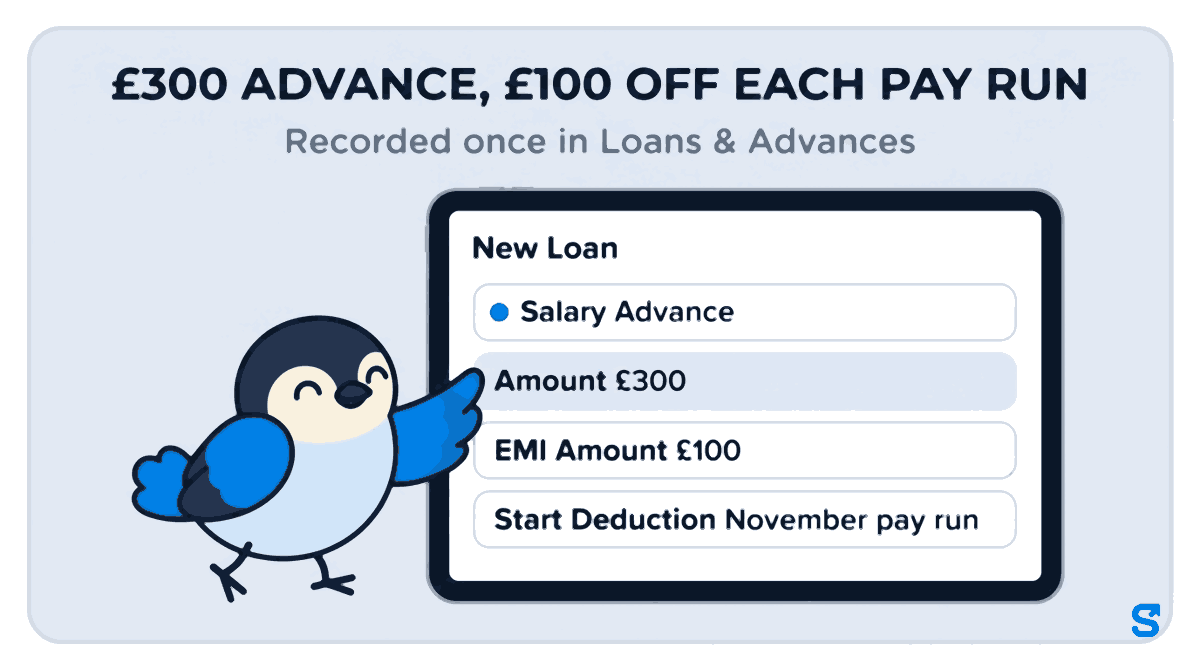
The new entry waits under Pending Approval until someone who can approve it does. That split is useful in a business with a manager: you can let a supervisor record an advance a member of staff asked for while keeping the approval yourself, through the roles screen.
Once it is approved, the deduction is taken from the next pay run automatically, and again every month after, until the outstanding balance reaches zero. Nobody has to remember it on payday.
What the member of staff sees on their payslip
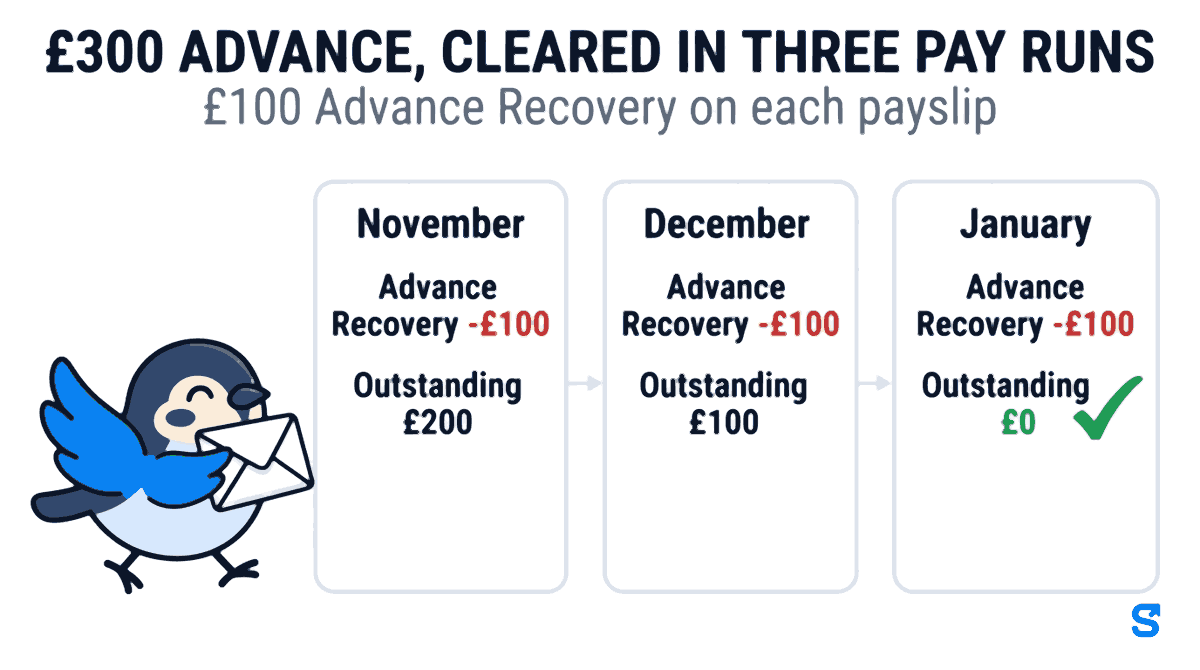
When the pay run is done, the payslip in the staff member's own app shows the deduction as its own line, Advance Recovery, beside any other deductions. So the person who borrowed £300 can see £100 come off in November, again in December, and the last £100 in January, without asking you where their money went.
On your side, the Loans & Advances screen keeps the running totals at the top: Total Disbursed, Active Loans, Pending Approval, Total Outstanding and This Month EMI, the total coming off this month across everybody. Open any loan and History shows its Repayment Ledger, every deduction with its date and pay period.
If somebody pays part back in cash, tap Repay/Settle and record the payment with a note such as "paid £50 in cash". The balance drops by that amount and the payroll deductions carry on from the new figure.
A worked example from a café
A café with nine staff pays everyone monthly on the last Friday. On 10 October its kitchen porter asks for £300 towards a car repair.
- 10 Oct: the owner and the porter sign a two-line note: £300 advance, £100 a month from the November pay run, any balance left comes off the final pay if he leaves. The owner pays it by bank transfer and records it under Loans & Advances as a Salary Advance.
- November pay run: £100 Advance Recovery on the payslip. Outstanding: £200.
- December pay run: £100 again. Outstanding: £100.
- January pay run: the last £100. Outstanding: £0. The £300 advance is cleared in three pay runs and shows as Completed.
Nobody had to keep a list on the back of the rota, and the porter could check the balance on his own phone.
Which app keeps track of staff advances?
You can see the rest of what the owner's app covers on the features page, or start from Shiftelio for UK businesses.
Questions owners ask
Can an employer loan money to an employee in the UK?
Yes. Nothing stops an employer lending to staff. What matters is agreeing in writing how it is paid back, because gov.uk lists a written agreement or a contract term among the reasons a deduction from pay is allowed.
Can my employer deduct a loan from my wages?
Only on the terms gov.uk sets out, such as a written agreement or a term in the contract. Agreeing the deduction before the money is paid out avoids most disputes.
How much should come off each pay run?
A fixed sum the person can manage, agreed in advance. £50 to £100 a month is common for a small advance; a larger loan is spread over more months.
Does Shiftelio deduct the advance automatically?
Yes. Once an advance or loan is approved in Loans & Advances, the agreed amount comes off each pay run from the start month until the balance is zero.
Can a manager give out advances without me?
A manager with permission to create loans can record one, but it stays under Pending Approval until someone allowed to approve it does. You decide who has which permission.