Canteen Rules at 100 Workers: What Section 24 of the OSH Code Actually Counts
In short
The canteen threshold counts workers plus contract labourers, not your payroll. What section 24 owes every employee with no threshold at all, and what waits on your state rules.
A knitwear unit outside Tiruppur has 62 people on its payroll. Fifty-two of them are on the floor; the other ten are the owner, two in accounts, a purchase manager, and a handful of supervisors on salaries north of Rs 30,000. Housekeeping, security and loading are done by two contractors who between them keep 55 people on the premises every working day.
Ask the office how many people work there and the answer is 62. Ask the Code, and the answer that matters for the canteen is 107.
Section 24 of the Occupational Safety, Health and Working Conditions Code, 2020 is the welfare section. It is quoted constantly and read almost never, because every published summary of it collapses into a table of thresholds, and section 24 is not a table of thresholds. It is one sentence that binds you today, and two sub-sections that bind you only once somebody makes a rule. Getting those two halves the wrong way round is how a business ends up planning a canteen it may not owe this year while going without the first-aid box it has owed every employee from the day the Code applied to it.
The sentence everyone reads half of
Sub-section (1) is the operative duty. It is worth having in front of you in full, because the list inside it is longer than the summaries admit:
"The employer shall be responsible to provide and maintain in his establishment such welfare facilities for the employees as may be prescribed by the Central Government, including, adequate and suitable facilities for washing to male and female employees separately; bathing places and locker rooms for male, female and transgender employees separately; place of keeping clothing not worn during working hours and for the drying of wet clothing; sitting arrangements for all employees obliged to work in a standing position; facilities of canteen in an establishment for employees thereof, wherein one hundred or more workers including contract labourers are ordinarily employed; in case of mines, medical examination of the employees employed or to be employed in the mines, before their employment and at specific intervals; adequate first-aid boxes or cupboards with contents readily accessible during all working hours; and any other welfare measures which the Central Government considers, under the set of circumstances, as required for decent standard of life of the employees."
Eight items. Exactly one of them carries a number. The others carry no threshold at all, which means they are owed in a small office and in a two-thousand-person plant on identical terms. That is the first thing the tables lose.
More than one population, inside one sentence
Read the nouns rather than the facilities and the sentence stops being a list and starts being an argument.
The washing facilities, the bathing places and locker rooms, the clothing storage, the sitting arrangements and the first-aid boxes are all owed to employees. Under section 2 of the OSH Code an employee is any person employed on wages to do skilled, semi-skilled, unskilled, manual, operational, supervisory, managerial, administrative, technical or clerical work. Your accounts staff are employees. Your purchase manager is an employee. There is no seat in the building outside that word.
The canteen is different, twice over. It is triggered by a count of workers, and "worker" in the same section 2 is a narrower word: it excludes persons employed in a managerial or administrative capacity, and persons employed in a supervisory capacity who draw wages of eighteen thousand rupees a month or more. Then the clause immediately widens again with four words most readers skim: including contract labourers.
So the number that decides whether you owe a canteen is not your payroll count, and it is not your worker count either. It is your worker count plus the contract labour ordinarily employed on the premises.
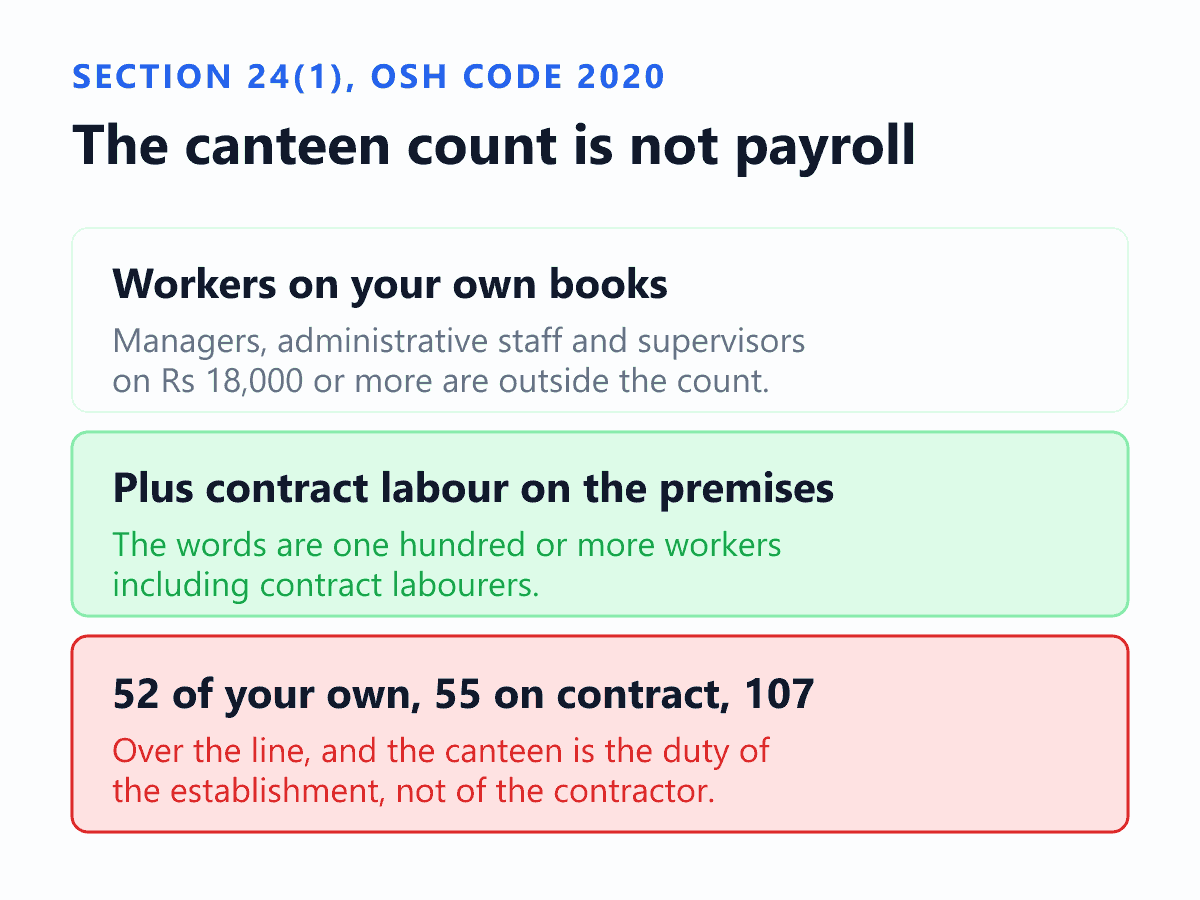
Run the Tiruppur arithmetic. Sixty-two on the payroll, less the owner, the two in accounts, the purchase manager and the supervisors above Rs 18,000, leaves 52 workers. Add the 55 contract staff and the count is 107. The canteen question arose the day the second contractor's team walked in, and nothing in the office ever recorded that day as significant.
This is not an exotic edge case. It is the ordinary shape of a mid-size Indian manufacturing, warehousing, hospitality or facilities business, where the payroll headcount and the site headcount have not been the same number for years.
"Ordinarily employed" is a habit, not a headcount on a Tuesday
The clause says ordinarily employed, not "employed". That wording does two things, and they cut in opposite directions.
It protects you from a spike. A unit that normally runs 80 and takes 40 extra hands for three weeks of festival demand has not become a hundred-worker establishment because of those three weeks. The word "ordinarily" is what lets you say so.
It also removes the defence you were probably going to reach for. A unit that runs 107 for eleven months and 84 in the monsoon does not get to be an 84-worker establishment. Ordinarily employed describes the normal state of the place, and the normal state of the place is a matter of record over a period, not an assertion about the day the Inspector-cum-Facilitator happened to visit.
Which is the practical problem in one line: "ordinarily" is decided on evidence, and the evidence is your attendance record. An employer with a clean daily record of everyone on site, contractor staff included, can point at a year and say what the normal count was. An employer without one is arguing from memory against a number somebody else wrote down.
The other half of section 24, and why it has a different clock
Sub-sections (2) and (3) read nothing like sub-section (1), and the difference is the single most useful thing in this article.
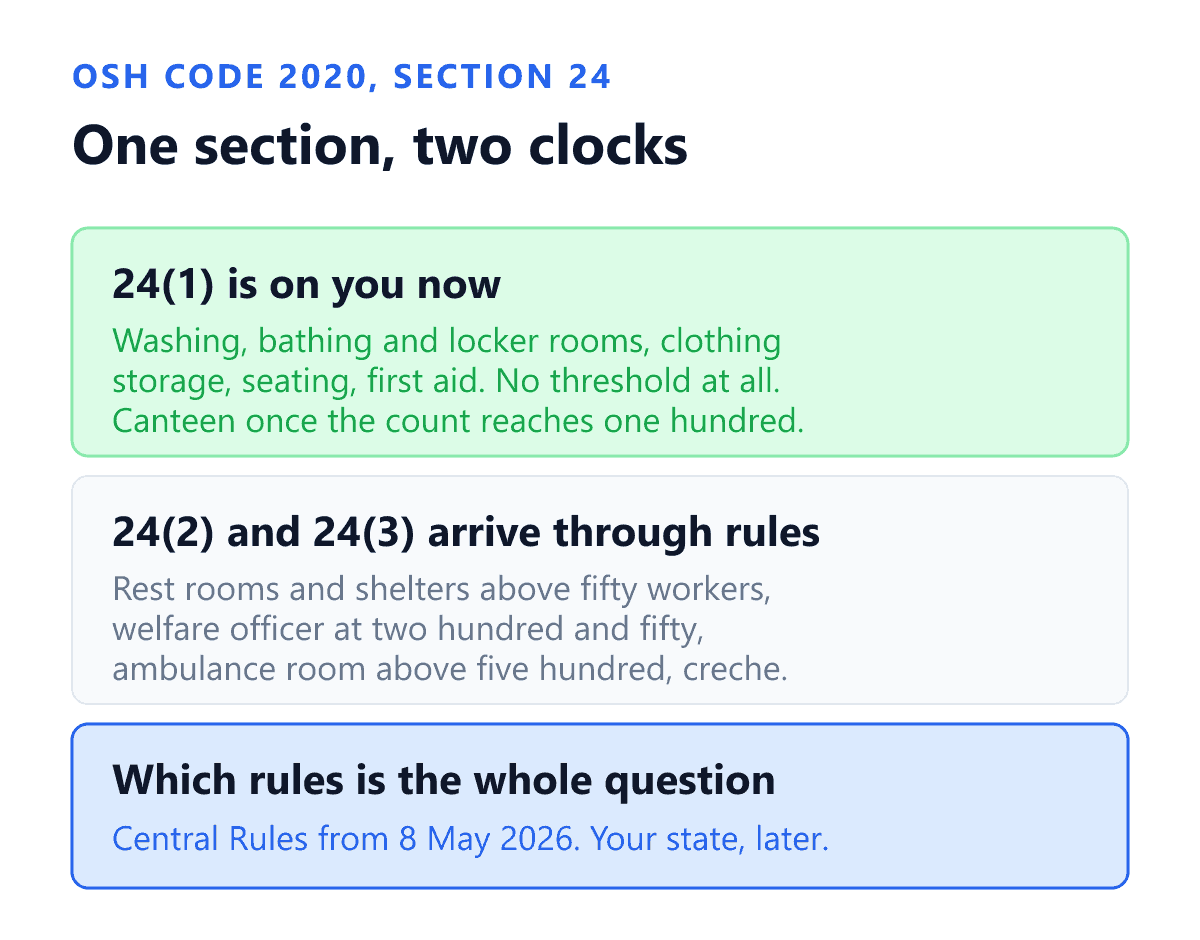
Sub-section (1) says the employer shall be responsible. Sub-sections (2) and (3) are cast as powers of the Central Government: 24(3) opens "The Central Government may make rules to provide for the facility of creche", and 24(2) is the sub-section under which the ambulance room, the shelters and rest rooms and the welfare officer are prescribed. They authorise rules; they do not by themselves impose duties. Everything in them reaches an employer through a notified rule or not at all.
| Facility | Where it sits | Count in the Code | How it reaches you |
|---|---|---|---|
| Washing, bathing, lockers, clothing storage, seating, first aid | 24(1) | No threshold | Directly, as a duty on the employer |
| Canteen | 24(1) | 100 or more workers, contract labour included | Directly, with the count written into the section |
| Shelters and rest rooms | 24(2) | More than 50 workers | Through rules |
| Welfare officer | 24(2) | 250 or more workers | Through rules |
| Ambulance room | 24(2) | More than 500 workers | Through rules |
| Creche | 24(3) | 50 workers | Through rules |
The creche is the clearest illustration of why the distinction matters, and it is why it has an article of its own on this site: the creche duty most Indian employers actually owe does not come from section 24(3) at all. It comes from section 67 of the Code on Social Security, which uses a different word for the people being counted and therefore produces a different count in the same building.
Which rules, though
The Ministry of Labour and Employment notified the Central Rules under all four labour codes on 8 May 2026, and the OSH (Central) Rules, 2026 gather the welfare obligations into a single chapter with a common set of standards, in place of the scattered sector-by-sector provisions of the Factories Act, the Mines Act, the Contract Labour Act and the rest. Reported summaries put washing facilities, bathing places and locker rooms, canteen, sitting arrangement, first aid, ambulance room, shelters and rest rooms, creches, welfare officers and mock drills in that one chapter.
Then comes the scoping question that decides whether any of that is yours. The Central Rules apply where the Central Government is the appropriate government: mines, major ports, railways, banking, insurance, telecom, central public sector undertakings, and establishments operating across more than one state under central control. A standalone unit in Tiruppur, a restaurant group in Bengaluru, a warehouse in Bhiwandi, is governed by the state rules made under the same Code.
Do not read the central table as your table. Most states have modelled their OSH rules closely on the central drafting, but the numbers inside 24(2) and 24(3) reach you only as your state notified them, and several states had not notified at the date of writing. The 24(1) duties, canteen included, do not depend on that: the count is in the section itself.
Your contractor's people count, and the facility is still yours
The sting in section 24 is that both halves of the contract labour question go against the principal employer.
First, the count. The canteen clause says "including contract labourers" in terms. There is no reading of it in which the contractor's 55 people sit outside the number.
Second, the duty. Where contract labour works on the principal employer's premises, the basic amenities on those premises are the principal employer's responsibility, not the contractor's: toilets and washrooms, drinking water, washing and changing facilities, the first-aid box, the canteen, the creche. What stays with the contractor is the employment relationship, the wages and the statutory dues that follow from it, which is the subject of a separate and equally uncomfortable article.
The practical consequence for a facilities-heavy business is worth stating flatly. Outsourcing housekeeping and security reduces your payroll, your PF filing and your administrative load. It does not reduce your headcount for section 24, and it does not move a single welfare facility off your premises. If the contract was signed on the assumption that it did, the contract was signed on a misreading.
What it costs, and why the cheapest item is the most dangerous
Section 94 of the Code is the general penalty, the one that applies where the Code does not name a specific consequence. It reads as a floor of two lakh rupees, extending to three lakh, and, where the contravention continues after conviction, a further penalty of up to two thousand rupees for every day it continues.
Note the direction of that number. Two lakh is not the maximum. It is the minimum.
Now put that against the eight items in sub-section (1). A canteen is a real project: space, a licence, staff, a budget line, months of planning. A first-aid box with the prescribed contents, readily accessible during all working hours, costs under a thousand rupees and takes an afternoon. Both sit in the same penalty band, and only one of them is routinely missing.
The same is true of the sitting arrangement for employees obliged to work in a standing position, which is the least-known line in the whole section. Every retail counter, every security desk, every reception, every packing bench in the country is inside that clause, and almost none of them have thought about it as a statutory duty with a two lakh rupee floor attached.
An employee who contravenes the Code faces a fine of up to ten thousand rupees. The asymmetry is deliberate and it is the shape of the whole Code: these are employer duties, and the employer is where the penalty sits.
The count is a record problem before it is a compliance problem
Everything above reduces to one question no lawyer can answer for you: how many people are ordinarily on your premises, and can you prove it for a period rather than assert it for a day?
For most businesses in the 60 to 300 range the honest answer is no. The payroll system knows the payroll. The contractor knows the contractor's people, approximately, and bills monthly in round numbers. Nobody holds one register covering everyone who walked in, so nobody can say what "ordinarily employed" came to last year without reconstructing it from invoices.
That reconstruction is exactly the thing you do not want to be doing in front of an Inspector-cum-Facilitator, and it is exactly the thing the labour codes now expect you to have already. The register set under the Central Rules is built around one daily record of who was present, and every threshold in the Codes is a query against it.
Shiftelio keeps that record as a by-product of running the day rather than as an archive somebody has to maintain. Contractor staff go on the same roster as your own, tagged as contract, checking in through the same phone-based GPS and selfie punch as everyone else. Three things follow that bear directly on section 24:
- One number for the site, not two for the office. The daily count is your workers and the contractor's people together, which is the number section 24(1) actually asks for, rather than the payroll number that answers a different question.
- "Ordinarily" becomes a chart instead of an argument. A twelve-month view of daily site headcount is what the word means, and it is the difference between saying the unit normally runs 84 and showing it.
- The day you crossed is a date, not a discovery. A threshold you can see approaching is a decision with a lead time. A threshold you find out about during an inspection is a penalty with a two lakh rupee floor.
For the two documents that come up first in any welfare inspection, the free statutory attendance register gives the format the Codes expect, and the labour law overview maps the rest of the thresholds onto the same record.
What to do this month
None of this needs a consultant, and most of it fits in one afternoon plus one purchase order.
- Take the site count, not the payroll count. Your workers, excluding managers, administrative staff and supervisors on Rs 18,000 or more, plus every contract labourer ordinarily on the premises. Write the number and the date down. It is the evidence that the duty applied or did not.
- Walk the eight items in 24(1). Separate washing for men and women. Separate bathing places and locker rooms for men, women and transgender employees. Somewhere to keep and dry clothing. Seating for anyone who works standing. First-aid boxes, stocked, reachable in every shift including the night shift. These have no threshold and most of them are cheap.
- Check the first-aid box is accessible "during all working hours". A box locked in an office that closes at six fails the clause in a unit that runs to ten, and this is the single most common way the duty is breached by a business that believes it has complied.
- Read your state's OSH rules for 24(2) and 24(3), not the central ones, unless you are genuinely in the central sphere. Rest rooms, welfare officer, ambulance room and creche all arrive that way.
- If the site count is inside about fifteen of a hundred, start planning the canteen now. Space and a licence are not a same-week purchase, and the count does not wait for you to be ready.
- Re-read the contractor agreement. A clause saying the contractor provides amenities for its own staff does not bind the Inspector-cum-Facilitator. Price the facilities into the contract instead, and know that the duty stays yours.
- Start counting contractor staff on the same daily register as your own, today rather than in the month you need the history.
Frequently asked questions
Is a canteen mandatory for 100 employees in India?
Not for 100 employees. For 100 workers, which is a different and narrower word, and then only after adding contract labourers back in. Section 24(1) of the OSH Code, 2020 requires a canteen in an establishment wherein one hundred or more workers including contract labourers are ordinarily employed. Managers, administrative staff and supervisors on Rs 18,000 a month or more are not workers and do not count toward the hundred.
Do contract workers count toward the canteen threshold?
Yes, expressly. The clause says "one hundred or more workers including contract labourers". This is the most commonly missed part of the section, because the contractor's staff usually sit outside every headcount the business keeps for itself.
Who has to provide the canteen, us or the contractor?
The employer of the establishment. Where contract labour works on the principal employer's premises, the amenities on those premises are the principal employer's responsibility. The contractor's people raise your count, and the facility is still yours to provide and maintain.
What welfare facilities have no threshold at all?
Separate washing facilities for men and women; separate bathing places and locker rooms for men, women and transgender employees; a place to keep clothing not worn during working hours and to dry wet clothing; sitting arrangements for anyone obliged to work in a standing position; and adequate first-aid boxes with contents readily accessible during all working hours. All of these are owed in an establishment of any size.
When must a welfare officer be appointed?
Section 24(2) contemplates a welfare officer where 250 or more workers are ordinarily employed. It is an enabling provision, so the obligation reaches a particular establishment through the rules notified by its appropriate government, and the operative figure is the one in those rules.
What is the threshold for an ambulance room?
More than 500 workers, again under section 24(2) and again through rules rather than directly from the section. Where a rule has been notified it usually comes with a staffing requirement attached rather than being a room on its own.
Does "ordinarily employed" mean on a particular day?
No. It describes the normal state of the establishment over a period. A short seasonal spike does not by itself put you over a threshold, and equally a short seasonal dip does not take you under one. Because it is a question about a period, it is answered by a record rather than by a headcount taken on the day of an inspection.
What is the penalty for not providing welfare facilities?
The general penalty in section 94 applies where the Code prescribes no specific consequence: not less than two lakh rupees, extending to three lakh rupees, and where the contravention continues after conviction, a further penalty of up to two thousand rupees for each day it continues. Two lakh is the floor, not the ceiling.
Do these rules apply to an office or only to a factory?
Section 24 speaks of establishments, not factories. Whether the OSH Code applies to your establishment at all depends on its coverage thresholds and on your state's notification, but where it applies, an office is inside section 24 in the same way a plant is. The canteen clause is the one part more likely to bind a factory, warehouse or site in practice, simply because that is where a hundred workers plus contract labour is a normal count.
The short version
- Section 24(1) is a duty on you. Section 24(2) and 24(3) are powers to make rules, and they reach you only through the rules your own appropriate government notified.
- Seven of the eight items in 24(1) carry no threshold at all. They are owed in a two-person office.
- The canteen threshold is 100 or more workers including contract labourers, ordinarily employed. Managers, administrative staff and supervisors on Rs 18,000 or more are outside the count; the contractor's people are inside it.
- The welfare facilities for contract labour on your premises are yours, not the contractor's.
- "Ordinarily employed" is a question about a period, so it is decided by your attendance record and not by the day an inspector visits.
- Rest rooms above 50, welfare officer at 250, ambulance room above 500, creche at 50 - all through rules, and the Central Rules of 8 May 2026 are not your rules unless the Central Government is your appropriate government.
- Section 94 starts at two lakh rupees. The missing first-aid box and the missing canteen are in the same band.
Position as at 7 September 2026. Section 24(1), the section 2 definitions of "employee" and "worker", and section 94 are quoted or described from the text of the Occupational Safety, Health and Working Conditions Code, 2020 as in force. The thresholds inside sub-sections (2) and (3) are the Code's own numbers; what binds a particular establishment is its appropriate government's notified rules. The consolidation of welfare obligations into one chapter of the OSH (Central) Rules, 2026 notified on 8 May 2026 is described as reported by legal summaries, not quoted, and no rule number is cited here because the gazette text was not read directly for this article. Several States had not notified their own rules under the Code at the date of writing. This is general information and not legal advice for a particular establishment.
Sources
- The Occupational Safety, Health and Working Conditions Code, 2020, India Code (Government of India)- section 2 for the definitions of "employee" and "worker", section 24 for the welfare facilities, and section 94 for the general penalty.
- Ministry of Labour and Employment, Labour Codes - the four codes in force from 21 November 2025 and the Central Rules notified on 8 May 2026.
- PRS Legislative Research, The Occupational Safety, Health and Working Conditions Code, 2020 - the bill text, the consolidation of thirteen central labour laws, and the passage history.
- Press Information Bureau, Government of India - the official summary of the OSH Code and the uniform welfare thresholds it introduces across sectors.
Keep reading
See how Shiftelio does this in practice with one daily site count that includes contractor staff.
Work your own numbers with the free statutory attendance register. No signup, no email.