Statutory Registers and Wage Slips Under the Labour Codes: Every Form an Indian SME Must Now Keep
In short
The Labour Code Central Rules of 8 May 2026 name the registers by form number. Form I, Form IV, Form IX, the Form V wage slip, electronic maintenance and five-year retention, explained.
If you run a small business in India and you have been treating the Labour Codes as something that happens to large companies, the last window to keep thinking that closed on 8 May 2026.
That is the day the Ministry of Labour & Employment notified the Central Rules under all four Labour Codes in the Gazette of India. The Codes themselves came into force on 21 November 2025, but a code without rules is a statement of intent: it tells you what the law wants and not what you have to file, on which form, by when, or for how long you have to keep it. The Central Rules supply exactly that missing half. They are the reason the reform stopped being a headline and became a filing cabinet.
This guide is the practical version for an owner of a 10 to 200 person business: which registers you must now maintain, which forms they have to be in, what a wage slip has to say, how long you have to keep everything, and what an inspector will actually ask for. It assumes you have read nothing else. For historical context on how the framework looked before the Rules landed, when the Codes were in force but the procedural detail was still in draft, see our labour law guide for Indian employers, which tracks the reform from the 2025 commencement onwards.
What Actually Changed on 8 May 2026
Three things, in ascending order of how much they will cost you if you ignore them.
- The registers are now named and numbered.Before, “maintain proper records” was an obligation with no shape. Now the Code on Wages (Central) Rules, 2026 specify a particular form for each register, and an inspector asking for “Form IX” is asking for a document with a defined set of columns.
- Electronic is expressly allowed: and effectively expected. The Rules permit registers, wage slips, notices and returns to be maintained and issued electronically. This is written as a relaxation. In practice it sets the standard against which your shoebox of paper will be judged.
- Retention is five years from the last entry.Not five years from the financial year. Not five years from the employee’s exit. Five years from the date of the last entry in that register, which for a live register means the clock never starts.
One important scoping note before you read further, because it is the single most common misreading of this reform. The Central Rules apply where the Central Government is the “appropriate government”: mines, major ports, railways, banking, insurance, telecom, central PSUs, and establishments operating in more than one state under central control. For a standalone restaurant in Pune, a retail chain in Bengaluru, or a 40-person factory in Ludhiana, the state rules under the same Codes govern. Most states have modelled their rules closely on the central ones, but the form numbers, the return dates and the thresholds can differ. Treat the Central Rules as the reference implementation and check your state notification for the local variation. The complete text of the central notifications is on the Ministry’s portal at labour.gov.in, and the Codes themselves are on the Government of India’s official statute repository at indiacode.nic.in.
The Four Registers Every Establishment Must Now Maintain
Under the Code on Wages (Central) Rules, 2026, an employer must maintain the following, electronically or physically, and keep them current rather than reconstructed at year end.
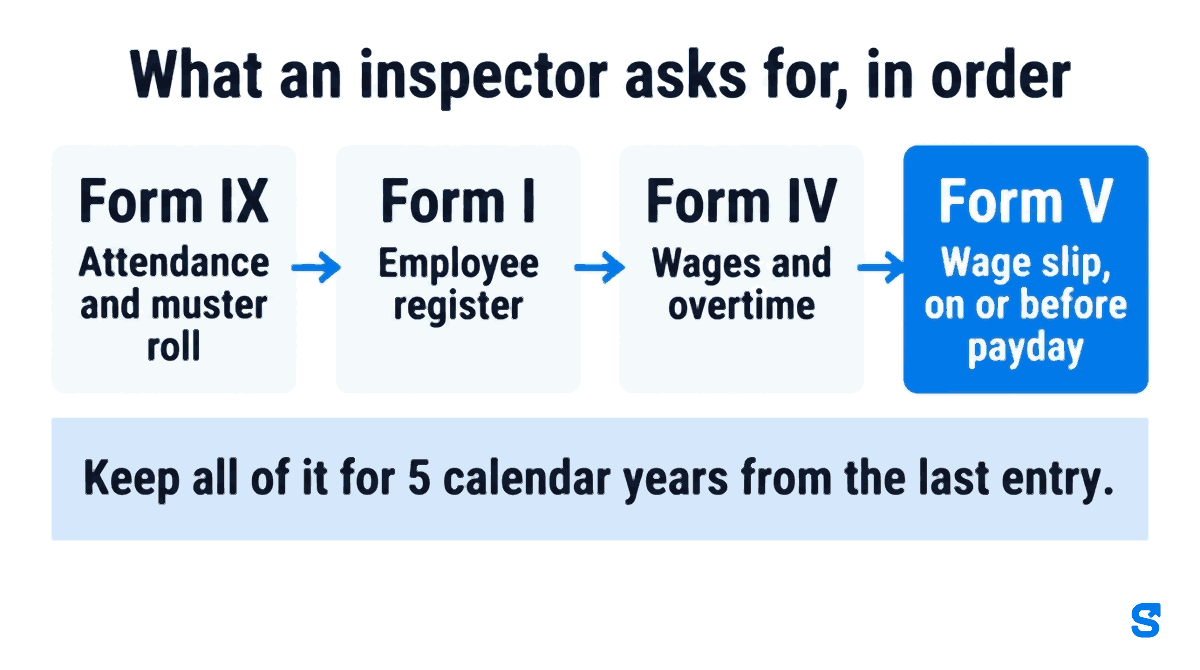
Form I: the Employee Register
The master list. Name, father’s or spouse’s name, date of birth, date of joining, designation, category of employment, wage rate, bank account and UAN, Aadhaar-linked identifiers, and date of exit where applicable. This is the register that proves who worked for you and on what terms, and it is the first thing an inspector reconciles every other document against.
The commonest SME failure here is not absence but drift: the register was built once at incorporation and never updated when a worker was promoted, given a raise, or left. A Form I that shows a wage rate the payslips contradict is worse than no Form I, because it converts a paperwork gap into a documented discrepancy.
Form IV: the Register of Wages, Overtime, Advances, Fines and Deductions
The money register, and the one that gets read most closely. For each wage period it must show the ordinary wages payable, the number of overtime hours and the overtime wages at twice the ordinary rate, every advance paid, every fine imposed, and every deduction made, ending at the net amount paid.
Two details matter more than they look. First, fines and deductions are itemised, not netted: you cannot show a lower gross and call the difference an adjustment. Second, the overtime column has to reconcile against the attendance record. If Form IV shows twelve hours of overtime and Form IX shows a worker who left at closing time every day, one of the two is wrong and the burden of explaining which sits with you.
Form IX: the Attendance Register-cum-Muster Roll
The single most important record in the set, and the one Indian SMEs are weakest on. It records, per worker per day, whether they were present, the hours worked, the overtime hours, and the weekly off taken. Everything downstream, wages, overtime, leave balances, PF and ESI wages, the annual return, is computed from it.
A muster roll is only worth what its verification is worth. A register signed at the end of the month from memory, a WhatsApp group where the site supervisor posts a headcount, or a paper sheet initialled by whoever arrives first are all technically “a record” and none of them survive a challenge, because none of them can show when and where the entry was made. This is precisely where the electronic-maintenance permission in the Rules cuts both ways: once a contemporaneous, timestamped record is easy to keep, an unverified one becomes harder to defend.
Registers under the OSH Rules
The Occupational Safety, Health and Working Conditions (Central) Rules, 2026 add two more that most SME owners have never heard of: a Register of Accidents and Dangerous Occurrences, and a Register of Leave with Wages. The second one catches almost everybody, because leave in a small Indian business is usually tracked in the owner’s head or in a WhatsApp reply. It is now a register with a prescribed shape and a five-year life.
How One Punch Becomes Four Statutory Records
The most useful way to understand the Rules is not as five separate obligations but as a single chain, each link derived from the one above it:
Every record below the first is derived from the one above it. Break the top link and nothing underneath it is defensible.
This is also the diagnostic. If you cannot draw an unbroken line from a specific day’s attendance entry to a specific line on a specific wage slip, you do not have a compliance problem in one register: you have a break in the chain, and every record below the break inherits it.
Wage Slips in Form V, Issued On or Before Payment
Every employer must issue a wage slip in Form V to every employee, electronically or physically, on or before the payment of wages. Not afterwards, not on request, not annually.
The timing word is doing real work. A payslip generated three weeks later, when the accountant gets to it, does not comply even if its contents are perfect, because the statutory purpose of the slip is to let the worker check the amount before or asthey receive it. If your current practice is to transfer salaries on the 5th and email payslips whenever the month’s books close, that is the change to make first: it is the cheapest fix on this entire list and the most visible one.
A note to save you a confusing afternoon: this Form V is the wage slip under the Code on Wages Rules. It is not the same document as the Form V filed under the EPF Scheme notified in June 2026. Two different statutes, two different Form Vs, both live. Label your templates.
The Five-Year Retention Rule, and Why It Is the Clause That Catches SMEs
Registers under the Wage Rules must be preserved for five years from the date of the last entry. Under the Social Security (Central) Rules, 2026, the equivalent obligation runs for five calendar years from the last entry.
Read that carefully, because it is not the rule most owners assume. “Five years from the last entry” on a register you are still writing into means the retention period restarts every time you use it. A live attendance register is never five years old. In practice the obligation is: keep everything, indefinitely, for as long as the register is in use, plus five years after you close it.
This is where paper quietly loses. Five years of daily muster rolls for 40 workers is a physical archive somebody has to store, protect from damp and rodents, and produce on demand. Five years of the same data in a database is a line in a backup policy. The Rules do not tell you to digitise. The retention arithmetic does.
Appointment Letters Are Now Mandatory for Every Worker
The OSH Rules prescribe a format for the appointment letter and require one to be issued to every worker. There is no carve-out for daily wagers, for probationers, for “he is my cousin’s son”, or for the two helpers who have been there since before you registered the business.
For a lot of Indian SMEs this is the largest single piece of one-time work in the whole reform, because the honest starting position is that most of the workforce has never had anything in writing. The letter has to name the designation, category of employment, wage rate and components, hours, place of work, and the statutory benefits the worker is entitled to. Budget a week, do it once, and file a signed copy against each Form I row.
Working Hours, Weekly Rest and the Overtime Cap
The Code on Wages (Central) Rules, 2026 restate the operating limits in a form you can put on a roster:
- Normal working hours are eight in a day, with a weekly ceiling of 48 hours for anyone not on a daily wage period.
- Weekly rest is at least one day per week, ordinarily Sunday for a six-day week and Saturday and Sunday for a five-day week, and no worker may go more than ten consecutive days without a rest day. The employer may fix a different rest day, but must notify it in advance.
- Overtime is payable at not less than twice the normal rate of wages. The 1.5x multiplier that circulates in Indian HR WhatsApp groups is borrowed from the United States and has never been the Indian rule.
- Work on a rest day attracts overtime for that day and a substitute rest day on normal pay. It is not an either/or.
- Spread-overunder the OSH framework may not exceed twelve hours in a day: the total elapsed time from clock-in to clock-out, including breaks, not just hours worked.
- The overtime ceiling under the OSH (Central) Rules, 2026 is 144 hours in any quarter. This is higher than the 50-hour quarterly cap most SMEs learned under the Factories Act, and higher than the 125 hours proposed in the December 2025 draft rules. Check your state notification before relying on the central figure.
None of these are new ideas. What is new is that the attendance register you must now keep makes each of them checkable from a single document. A ten-day-consecutive-work breach used to be invisible without reconstructing a month by hand. In Form IX it is a row.
If you want the formulas rather than the limits, our companion guide on how to calculate overtime pay in India works through both the monthly and daily-wage cases with numbers.
The 50% Wage Rule and What It Does to Your Payroll
The reform’s biggest cash impact is not a register. It is the definition of “wages”.
Under the Code on Wages, wages are Basic plus Dearness Allowance plus Retaining Allowance, and the components the Code excludes, HRA, conveyance, bonus, overtime, commission and the rest, may not exceed one half of total remuneration. Anything past that half is added back and treated as wages.
The popular shorthand, “basic must be 50% of CTC”, is not quite what the law says, and the difference matters. The Code does not order you to set basic at half of CTC. It says that if your excluded allowances run past half of total pay, the excess is added back whether or not you restructure. Restructuring is how you choose the number. It is not how you avoid it.
The consequences flow straight through to cost, because PF (12% + 12%), gratuity (15 days’ wages per completed year, divided by 26) and statutory bonus are all computed on the wage component:
- EPF contributions rise for anyone below the wage ceiling whose basic was previously suppressed.
- Gratuity liability rises for every employee, retrospectively in effect, since it is computed on last-drawn wages.
- ESI coverage can change at the margin, because the Rs 21,000 threshold is now tested against a wider wage figure. Employees who were outside ESIC may now fall inside it.
- Overtime gets more expensive, because the ordinary rate it is doubled from is computed on the wider base.
Model this before your next appraisal cycle, not after. A restructure applied at increment time costs a conversation; the same restructure applied mid-year, with arrears, costs the conversation plus the arrears. Our free PF and ESI calculator will do the per-employee arithmetic without a signup.
Your Month-One Compliance Checklist
In the order that gets you the most defensibility for the least work:
- Start a contemporaneous attendance record today. Not backfilled, not reconstructed. Whatever you use, the entry must be made on the day, with the time. Everything else on this list is derived from this one.
- Build Form I from your current payroll. One row per person, including everyone informal. Reconcile the wage rate against what you actually pay.
- Issue appointment letters to every worker in the prescribed format, and file the signed copy against the Form I row.
- Move wage slips to on-or-before payment. If you pay on the 5th, the slip goes out on the 5th at the latest. Electronic delivery is fine and is the easier way to prove the date.
- Split fines, advances and deductions out of your payroll sheet so Form IV can be produced without manual reconstruction each month.
- Open a Register of Leave with Wages. Whatever leave policy you run, it now needs a register that says what was taken and what remains.
- Model the 50% wage rule across your salary bands and price the PF and gratuity delta before the next appraisal cycle.
- Check your state’s rules against the central ones for form numbers, return dates and the overtime ceiling. Where your state has not notified, the central rules apply as the fallback.
- Write down your retention policy.Five years from the last entry, which on a live register means “keep it”. Decide where, and who is responsible.
- Diarise the annual returns: the unified annual return in Form XXIII under the Social Security Rules is due by the end of February, and Form XVII under the OSH Rules is the corresponding annual filing.
If You Still Run Attendance on Paper or WhatsApp
Here is the uncomfortable arithmetic. The Rules ask for a daily, per-worker, contemporaneous attendance record; a wage register that reconciles to it; a wage slip issued on or before payday; and five years of retention on all of it. A paper muster roll can technically satisfy every one of those. It just cannot satisfy them cheaply, and it cannot satisfy the reconciliation requirement at all without somebody re-keying the month into a spreadsheet, which is where the discrepancies come from in the first place.
This is the specific gap Shiftelio was built for, so treat the following as an interested party describing its own product, but the mechanics are worth understanding regardless of what you eventually buy:
- The punch is verified where it happens. Each in and out is a live selfie with GPS geo-fencing, so the muster-roll entry carries a time, a place and an identity rather than an initial. No biometric machine at the gate, which matters when your workers are on three sites.
- The attendance record is the payroll input.Hours, overtime and weekly offs flow into the wage calculation directly, so Form IV cannot disagree with Form IX: there is only one set of numbers.
- Overtime is computed at 2x on the correct base, per shift, with the divisor configurable for your state’s rules, and appears as its own payslip line showing hours and rate.
- Payslips go out on payday, to the worker’s phone, with a delivery timestamp, which is the practical way to evidence “on or before payment”.
- Retention is a backup policy, not a storeroom. Five years of muster rolls for 40 workers is roughly 50,000 rows. That is nothing to a database and a genuine problem for a filing cabinet.
- Leave, advances and deductions live in the same place as attendance and wages, which is what makes the Register of Leave with Wages and the fines-and-deductions columns of Form IV producible rather than reconstructable.
All of it sits in the flat annual price with no per-employee fee, and GPS is not a paid add-on. If you would rather start with paper done properly, our free attendance register generator produces a printable month in the format an inspector expects, with the weekly off marked and the monthly totals counted. No signup.
Frequently Asked Questions
Do the Central Rules apply to my shop or restaurant?
Usually not directly. The Central Rules bind establishments where the Central Government is the appropriate government. A single-state shop, restaurant or factory is governed by that state’s rules under the same four Codes. Most states have tracked the central drafting closely, so the obligations described here are a reliable guide, but confirm your form numbers and return dates against your state notification.
Can I keep the registers only in a spreadsheet?
Electronic maintenance is expressly permitted, and a spreadsheet is electronic. The practical risk is not the format but the evidence: a spreadsheet has no reliable record of when a row was written, so a challenged entry is hard to defend. A system with an audit trail is not legally required, but it is the difference between producing a record and proving one.
What happens if an inspector finds the registers missing?
The Codes moved to an inspector-cum-facilitator model, so a first finding is more likely to produce a compliance direction than an immediate prosecution. That is not a reason to relax: the direction comes with a deadline, and non-maintenance of records shifts the burden of proof onto the employer in any subsequent wage claim. When the register is missing, the worker’s account of hours worked is the only account on the table.
Do I need to keep records for employees who have already left?
Yes. The retention period runs from the last entry in the register, not from the employee’s exit date, and a leaver’s rows sit inside registers that are still live.
Is the overtime cap 50, 125 or 144 hours per quarter?
Under the OSH (Central) Rules, 2026 as notified, it is 144 hours in any quarter. The 50-hour figure comes from the Factories Act framework these rules replace, and 125 was the number in the December 2025 draft that did not survive into the final notification. Where your state has notified its own OSH rules, that figure governs.
Does the 50% wage rule mean I have to give everyone a raise?
No. It changes how the same total remuneration is divided, and therefore what PF, gratuity and bonus are computed on. Take-home can fall slightly while employer cost rises, which is an outcome worth explaining to staff before they see it on a payslip rather than after.
Which Product Produces These Registers, and What It Costs
The Bottom Line
The Labour Codes made the law. The Central Rules of 8 May 2026 made the paperwork, and the paperwork is what an inspector reads. For a small Indian business the whole reform reduces to one operational question: can you produce, for any given worker on any given day in the last five years, a record of when they worked, what they were paid for it, and the slip that told them so?
If the answer is yes, nothing else on this page is urgent. If the answer is “probably, give me a week and the old registers”, that week is the compliance gap, and it is cheaper to close it now than during an inspection.
Keep reading
See how Shiftelio does this in practice with attendance and payroll that produce the registers as a by-product.
Still deciding what to buy? Compare nine attendance apps ranked by real annual cost at 25 employees.
Work your own numbers with the free attendance register generator. No signup, no email.