Overtime Calculation in India: Formula, Worked Examples, and What SMEs Get Wrong
In short
Overtime calculation in India: (Basic + DA) ÷ (26 × 8) × 2 × OT hours. Worked examples for monthly and daily wages, the caps, and eight common mistakes.
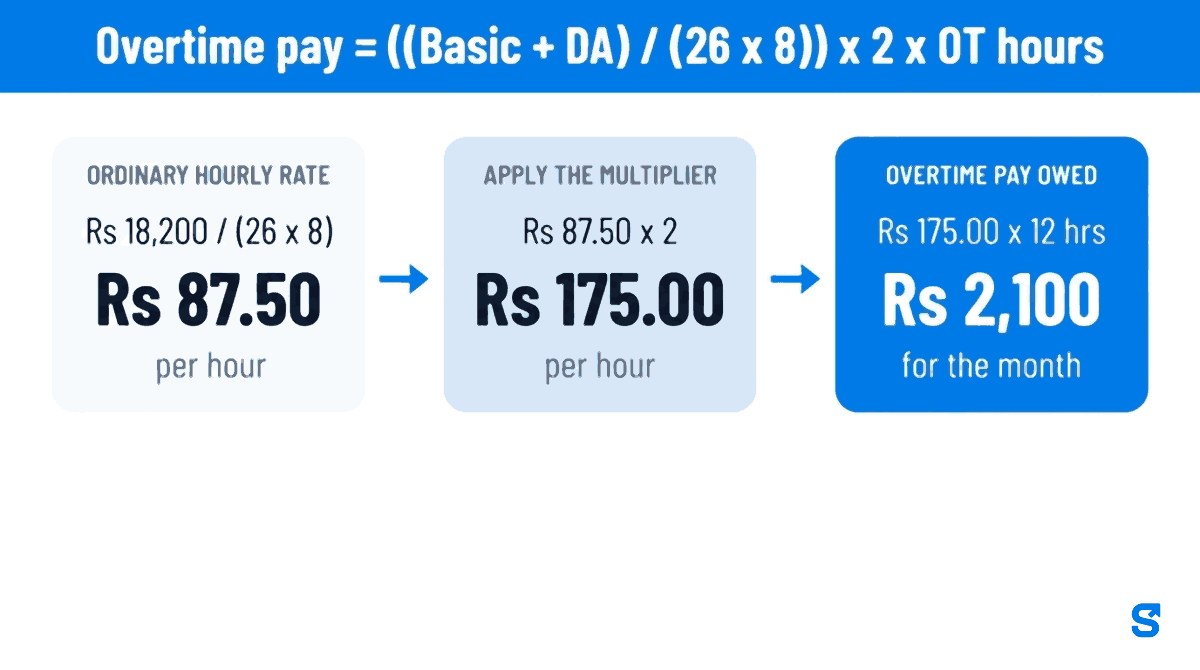
Overtime calculation in India, in one line: divide the monthly ordinary wage (Basic + DA) by the working days and the daily hours to get the hourly rate, multiply it by 2, then multiply by the overtime hours. For Rs 18,200 a month, 26 working days of 8 hours and 12 hours of overtime, that is Rs 87.50 an hour, Rs 175 for each overtime hour, and Rs 2,100 for the month.
Ask any Indian labour commissioner what the single most common wage complaint is and you will hear the same answer: unpaid or wrongly-paid overtime. It shows up in factories, retail chains, restaurants, hospitals, warehouses, and back-office BPOs. The rules are not new, they are not complicated, and the formulas are printed inside statutes that have been in force for decades. Yet most Indian small and medium businesses either underpay overtime, pay it in cash off the books, or pay a flat "extra" that has no legal basis at all.
This guide walks through what overtime actually is under Indian law in 2026, the two formulas that cover 90% of situations, the eight mistakes SME owners repeat every payroll cycle, and how to build a workflow that pays the right amount every time without a spreadsheet argument at the end of the month.
Note (August 2026): India's four Labour Codes came into force on 21 November 2025 and the final Central Rules were notified on 8 May 2026. The 2x rate and the formulas below are unchanged, but the daily overtime trigger moves from 9 hours to 8 under the OSH Code, and the quarterly cap now depends on whether your establishment sits in the central or the state sphere. Our Labour Code compliance checklist for 2026 covers the current position in full; this guide remains the reference for the underlying statutes and calculations.
What Counts as Overtime Under Indian Law?
Overtime is any work performed by an eligible employee beyond the statutory daily or weekly hours prescribed by the law that governs their workplace. For most Indian SMEs, that law is one of two:
- The Factories Act, 1948: applies to any establishment where 10 or more workers use power, or 20 or more work without power. Section 51 caps the working week at 48 hours; Section 54 caps the working day at 9 hours; Section 59 requires payment at twice the ordinary rate of wages for any hour beyond either cap. See the full statute on the Government of India's official code repository at indiacode.nic.in.
- The state Shops and Commercial Establishments Act: applies to shops, offices, restaurants, hotels, cinemas, and most non-factory workplaces. Each state has its own version (Maharashtra Shops Act, Karnataka Shops Act, Delhi Shops Act, etc.), but almost all cap daily hours at 9 and weekly hours at 48, and require overtime at twice the ordinary wage.
A third statute, the Minimum Wages Act, 1948, applies to workers in scheduled employments. Under Rule 25 of the Central Rules, overtime is again payable at twice the ordinary rate, and at 1.5 times only for agricultural workers.
In plain English: for the overwhelming majority of Indian SMEs, the overtime rate is 2x the ordinary wage. Not 1.5x. Not "an extra Rs 100". Twice.
Who Is Actually Entitled to Overtime in India?
This is the single most misunderstood question in Indian payroll. The answer is not "everyone earning below a threshold". It depends on the law and the role:
- Workers under the Factories Act: every worker other than a person employed in a managerial or confidential capacity. A shift supervisor on the shop floor is usually a worker. A production manager sitting in an office is usually not.
- Employees under state Shops Acts: almost all employees except those in a "position of management". Karnataka, Maharashtra, and Delhi carve out managers and confidential-post holders; the rest are covered.
- Gig and platform workers: currently outside overtime coverage, though the Code on Social Security, 2020 introduces a separate welfare framework once fully notified.
A common SME mistake is assuming that salaried employees are exempt because they are on a monthly salary. That is not what the law says. If a salaried employee falls within the definition of "worker" or "employee" under the applicable act and is not a genuine manager, overtime is owed.
The Two Overtime Formulas Every SME Needs
Only two formulas cover the vast majority of Indian payroll. Learn them once and stop re-inventing them each month.
Formula 1: Factories Act & State Shops Acts (2x ordinary rate)
For a monthly-paid worker whose ordinary wage is the Basic plus Dearness Allowance (DA):
Overtime pay = ((Basic + DA) ÷ (26 × 8)) × 2 × OT hours
The divisor 26 × 8 gives the hourly ordinary rate assuming a 26-day working month of 8 hours per day. Some states use 30 days as the divisor; check your state Shops Rules. The 2 is the statutory multiplier.
Worked example: a shop assistant in Pune earning Basic + DA of Rs 18,200 per month works 12 hours of overtime in a month.
- Ordinary hourly rate = 18,200 ÷ (26 × 8) = Rs 87.50
- Overtime rate = 87.50 × 2 = Rs 175 per hour
- Overtime pay owed = 175 × 12 = Rs 2,100
Overtime calculation for monthly salary employees
The only judgement call in Formula 1 is the divisor, and it is where most spreadsheets quietly differ from each other. Three versions are in use:
- 26 × 8. A fixed 26-day month. Simple, and the one most payroll staff learned.
- The month's real working days × the shift length. A month with 27 scheduled working days gives a slightly lower hourly rate than one with 25. This follows the roster rather than a convention.
- 30 × 8. Used where a state's Shops Rules or an appointment letter spreads the salary over every calendar day. It gives the lowest hourly rate of the three, so check that your rules actually allow it before you use it.
Whichever you choose, write it down and use the same one every month. A divisor that changes with whoever runs payroll is how two workers with the same salary end up with different overtime rates.
Formula 2: Minimum Wages Act (2x ordinary rate; 1.5x for agriculture)
For a daily-wage worker in a scheduled employment (construction, security, loading, sanitation, etc.):
Overtime pay = (Daily notified minimum wage ÷ 8) × 2 × OT hours
Worked example: a construction helper in Bengaluru whose notified minimum daily wage is Rs 592 works 3 hours of overtime on a shift.
- Ordinary hourly rate = 592 ÷ 8 = Rs 74
- Overtime rate = 74 × 2 = Rs 148 per hour
- Overtime pay owed for that shift = 148 × 3 = Rs 444
The Weekly and Quarterly Caps You Cannot Ignore
Paying the right rate is only half the compliance picture. Indian statutes also cap how much overtime you can require:
- Factories Act, Section 65(3)(iv): a worker cannot be required to work more than 60 hours in any week, and total overtime in any quarter cannot exceed 50 hours (raised to 75 hours during peak periods only by state notification).
- State Shops Acts: most states cap total overtime at 50 hours in a quarter and prohibit work beyond a total spread-over of 10 to 12 hours in a day.
- Rest interval: the Factories Act requires at least a 30-minute break after 5 hours of continuous work. State Shops Acts have similar rules.
An SME that pays the right hourly rate but routinely works staff for 70-hour weeks is still in breach and still exposed to labour-department penalties, worker complaints, and inspector visits.
Eight Overtime Mistakes Indian SMEs Repeat Every Month
- Paying 1.5x instead of 2x. The 1.5x multiplier is borrowed from US Fair Labor Standards Act (FLSA) rules and has no place in Indian law outside a narrow agricultural carve-out. In every other case the statutory rate is 2x.
- Using CTC instead of Basic + DA as the ordinary rate. HRA, conveyance, and other allowances are not part of the "ordinary rate of wages" for overtime calculation. Using CTC inflates the OT bill for the employer and is legally incorrect either way.
- Rounding down the hourly rate to Rs 50 or Rs 75. The rate must be calculated to the paisa from the actual wage. Rounding down under-pays and creates recoverable liability.
- Treating early clock-in as free work. If a worker is required to be on premises at 8:45 AM for a 9 AM shift, those 15 minutes count as working time under Section 2(k) of the Factories Act ("work" includes the time when a worker is at the disposal of the employer).
- Paying overtime in cash off the register. A common workaround. It fails PF, ESI, and Income Tax audit trails; leaves no proof for the worker; and is exactly the pattern labour inspectors look for.
- Comp-off in lieu of overtime pay. Compensatory off is only permitted under specific state Shops Rules and only when notified in writing to the labour officer. In factories it is not a valid substitute for cash overtime.
- Not paying overtime on weekly-off working. Work on a scheduled weekly holiday is overtime from minute one; the substitute rest day must be granted within three days on either side.
- Excluding "salaried" or "confirmed" staff. Salaried status has no bearing on entitlement. Only a genuine managerial or confidential role removes the entitlement, and that determination is a substantive test, not a job-title test.
What the Code on Wages, 2019 Changes (When It Is Fully Notified)
India's four Labour Codes (the Code on Wages, 2019; the Industrial Relations Code, 2020; the Occupational Safety, Health and Working Conditions Code, 2020; and the Code on Social Security, 2020) consolidate 29 central labour laws. They came into force on 21 November 2025, and the final Central Rules under all four were notified on 8 May 2026. State rules are still arriving through 2026, which is why the pre-Code state caps described above continue to bind most state-sphere establishments in the meantime. For the current operating checklist, see our Labour Code compliance checklist for 2026, and for background on the pre-Code framework, our labour law guide for Indian employers.
Once the Codes commence in full, three things change for overtime:
- A single definition of "wages" replaces the current variation across statutes. Basic + DA + Retaining Allowance forms the wage; if allowances exceed 50% of total remuneration, the excess is added back into wages for calculation. This makes the OT base wider than most SMEs currently use.
- The 2x rate is retained in Section 14 of the Code on Wages. Employers hoping the Codes would soften the multiplier will be disappointed.
- Overtime hours cap moves under the OSH Code. The OSH (Central) Rules, 2026 set the cap at 144 hours per quarter, subject to worker consent and daily-hours limits, but that figure binds central-sphere establishments. A state-sphere shop or factory stays on its existing state cap until that state notifies its own OSH rules. Track the notification status on the Ministry's official portal.
Bottom line: none of the changes let you pay less. They widen the wage base and standardise the framework. An SME that already pays 2x on Basic + DA and stays inside quarterly caps will move to the Codes without any downward revision to worker pay.
Building an Overtime Workflow That Survives an Audit
Overtime disputes are rarely about whether extra hours were worked. They are almost always about the absence of a verifiable record. A workflow that survives a labour inspector visit or a wages authority claim has five elements:
- An objective in-time and out-time record for every worker, on every shift, with the location and identity verified at the moment of the punch. Paper registers and WhatsApp messages are not enough: an inspector can and does reject them as unverified.
- A shift schedule that names the ordinary daily hours per role, so overtime is calculable as the delta between scheduled and worked hours.
- A payroll engine that reads the verified attendance record, applies the correct formula per employment law, and produces a payslip line-item for overtime with the rate and hours shown.
- Signed acknowledgement from the worker on the payslip that both the ordinary and overtime components have been received.
- Statutory Form filings: Form 10 under the Factories Rules (overtime register), the Muster Roll under state Shops Rules, and the wage register. These forms exist so the labour department can audit; keeping them up to date is not optional.
If any one of those five links breaks, the OT number on the payslip becomes disputable, and in a labour-court dispute the burden of proof lies on the employer, not the worker. The Supreme Court reaffirmed this position in Ram Lal Bhaskar v. State of Bihar and it has held ever since.
How Shiftelio Handles Overtime for Indian SMEs
A payroll spreadsheet cannot verify who was actually present or where. That is the core reason SME overtime numbers drift into either underpayment (worker complaints) or overpayment (padded punches nobody catches).
Updated September 2026. An earlier version of this section said Shiftelio fixed the overtime multiplier at 2x, let you choose a 26 × 8 or 30 × 8 divisor, and warned you as a worker neared the quarterly cap. None of that is how the product works today, so here is what it actually does.
- Verified in and out, per shift. Each check-in is a live selfie inside the workplace geofence, so the hours going into the overtime calculation are hours worked at the workplace, not hours claimed on WhatsApp.
- Overtime starts where the shift ends. Every shift pattern has a length. Hours worked past it that day are overtime. So set the shift length to the ordinary daily hours your law and your appointment letter promise.
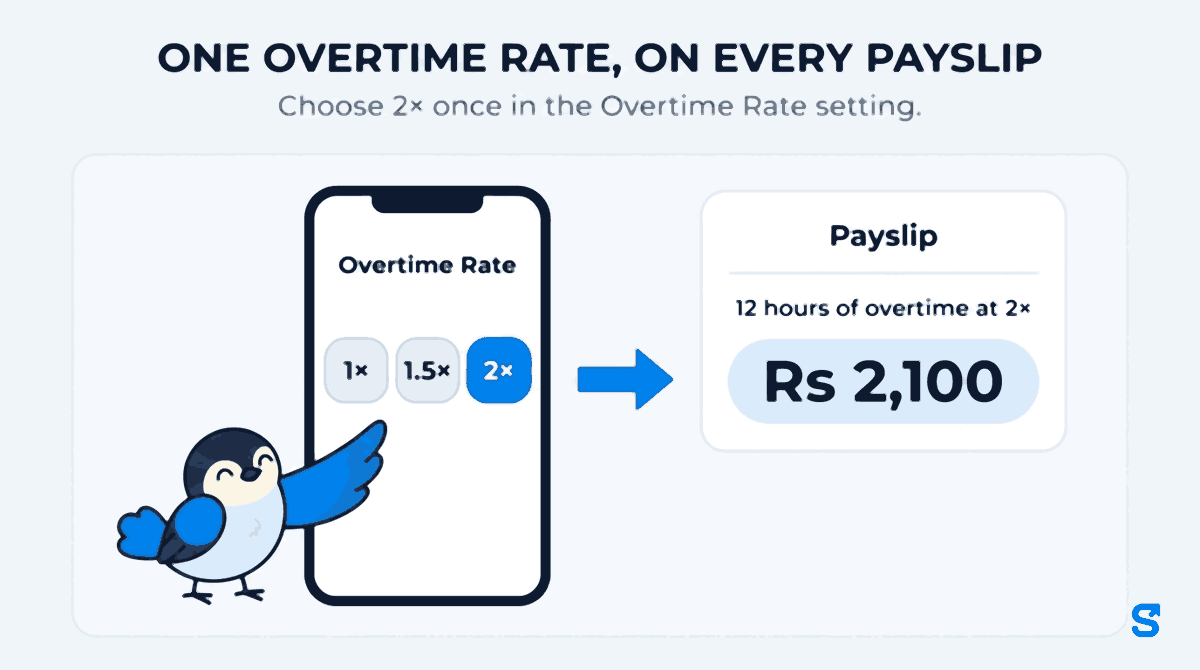
- You choose the Overtime Rate, once. In Settings, the Overtime Rate takes any multiple from 1× to 3×, with one-tap choices of 1×, 1.5× and 2×, and a date it applies from. If you never set it, extra hours are paid at the normal hourly rate with no premium, and the setting tells you in plain words that Factories Act and OSH Code establishments must pay 2×. Shiftelio does not choose the rate for you.
- One person can have their own rate. "Overtime rate for this person" on the employee's page is for somebody who was promised something different. Everybody else follows the company rate, including any later change to it.
- The divisor is the real month. For a monthly-paid employee the hourly rate is the monthly pay on their shift pattern, divided by the working days scheduled in that month and by the shift length. That is the second divisor above: in a month with 26 working days on an 8-hour shift it is exactly the 26 × 8 of Formula 1.
- Extra hours can be switched off, per shift pattern. "Don’t pay overtime" still records the hours past the shift and shows the owner how many went unpaid. Use it only for staff the law does not entitle to overtime, such as a genuine manager. For a covered worker, unpaid extra hours are exactly the complaint this article opened with.
- Overtime Rounding is optional and off by default. Switched on, it pays overtime in whole blocks of 15, 20, 30 or 60 minutes. With 30-minute blocks on an 8-hour shift, 8 hours 36 minutes pays 30 minutes of overtime and 8 hours 9 minutes pays none. Read mistake 4 above before you switch it on: dropped minutes are still working time.
- The payslip shows the working. Overtime is its own line with the hours and the rate they were multiplied by, the payroll export records the multiplier used for each overtime hour, and the employee can see the rate their own overtime was paid at.
Run the Pune example through it. The shop assistant is on an 8-hour shift, Monday to Saturday, at Rs 18,200 a month, in a month with 26 working days. The Overtime Rate is set to 2×. She works 12 hours past the end of her shifts across the month. One overtime rate, on every payslip: hers shows 12 hours of overtime at 2×, Rs 2,100, the same number Formula 1 gave by hand.
To check a single case before you trust any system, our free overtime calculator runs the same arithmetic in the browser.
Which App Works Out Overtime From Verified Attendance?
Frequently Asked Overtime Questions from Indian SME Owners
Do I have to pay overtime to a probationer?
Yes. Probationary status has no effect on statutory entitlement. The only question is whether the person is a "worker" or "employee" under the applicable act.
Can I ask staff to work extra hours during festival season?
Yes, within the daily 9-hour cap and the weekly 60-hour cap under the Factories Act, and with the worker's consent under state Shops Rules. Additional overtime above 50 hours in a quarter usually needs a state notification.
Is overtime pay taxable?
Yes. Overtime is treated as salary income under Section 17 of the Income Tax Act, 1961 and is subject to TDS in the same manner as ordinary salary.
Does PF and ESI apply on overtime wages?
PF: no. Section 6 of the EPF Act specifically excludes overtime allowance from "basic wages" for PF calculation. ESI: yes. The ESI Act treats overtime as wages under Section 2(22) and contributions are due on it.
What if the employee refuses to work overtime?
Overtime is not automatic. Under state Shops Rules and the Codes, worker consent is generally required and refusal cannot be grounds for disciplinary action, subject to any specific contractual provision that itself complies with the underlying statute.
The Bottom Line for Indian SME Owners
Overtime in India is 2x the ordinary rate on Basic + DA, capped at 50 hours per quarter for most workplaces, and enforceable through a wage register and an inspector visit. Nothing in that sentence is new: the Factories Act has said the same thing since 1948. What has changed in 2026 is the ease with which the underlying attendance data can be captured, verified, and turned into a payroll line-item that survives an audit. A phone-based GPS attendance app plus a payroll engine that applies the right formula is now cheaper than the cost of one wrongly-calculated OT dispute in a labour court.
Pay the right rate, track the hours honestly, and file the forms. The rules are on your side when you do.
Keep reading
See how Shiftelio does this in practice with automated payroll with per-shift overtime at the correct 2x rate.
Work your own numbers with the free overtime calculator. No signup, no email.