PF and ESI Compliance Checklist for Small Business Owners in India (FY 2025-26)
In short
A plain-language checklist covering PF thresholds, ESI rates, monthly due dates, and penalties for late payment. Written for business owners, not accountants.
This guide describes FY 2025-26, before the Labour Codes
The four Labour Codes came into force on 21 November 2025 and the EPF Scheme, 2026 replaced the 1952 scheme on 29 June 2026. The contribution rates below are unchanged, but the definition of the wages they apply to is not. For the current position, read the new salary structure and the 50% wage rule. Keep this page for reconciling filings from the period it covers.
A small business owner crossed 20 employees in March and did not realise that PF registration became mandatory the moment that happened. By the time the EPFO notice arrived in June, three months of contributions had accumulated without payment. The result: 12% annual interest under Section 7Q, plus damages under Section 14B starting at 5% and rising to 25% depending on how long the delay continues.
This is not a rare situation. EPFO added over 20 lakh net new members in May 2025 alone, which means tens of thousands of businesses crossed the 20-employee threshold that month. Most did not have a compliance calendar ready.
This checklist covers what you need to know as a business owner, without the accountant's jargon.
Does This Apply to Your Business?
Two thresholds determine whether you must register:
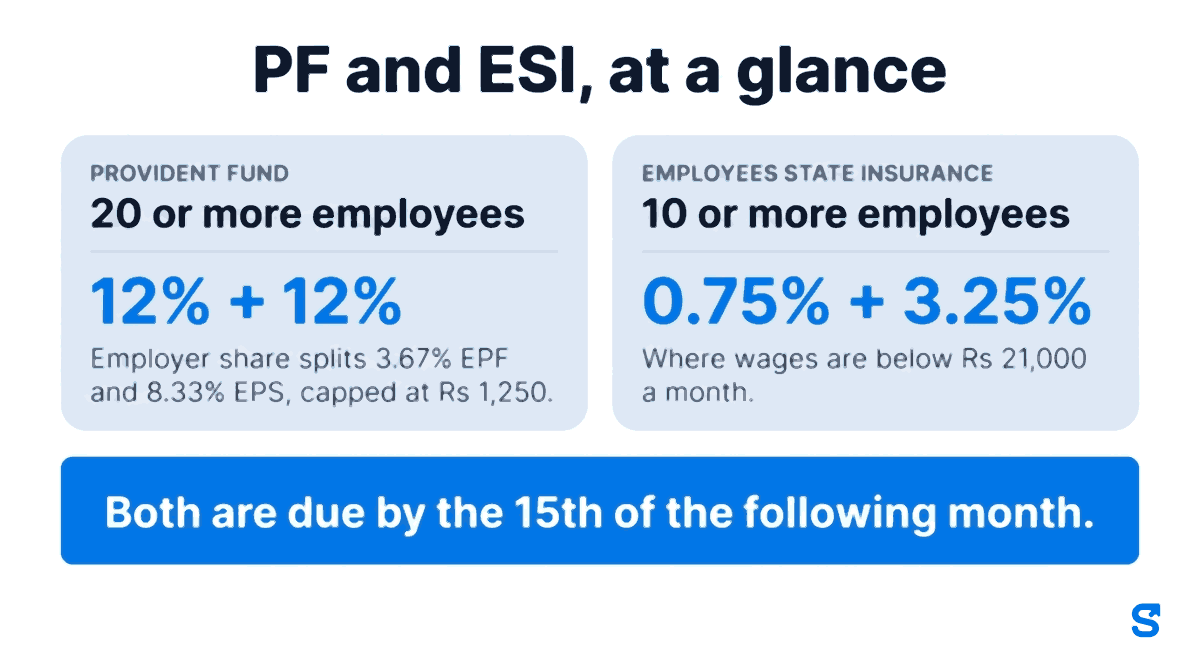
- Provident Fund (PF/EPF): Mandatory if you have 20 or more employees on any day. Registration must happen within one month of crossing the threshold.
- Employees State Insurance (ESI/ESIC): Mandatory if you have 10 or more employees and at least some earn below Rs 21,000 per month (Rs 25,000 for employees with disabilities).
One rule applies to both: once you are registered, the obligation does not go away if your headcount later drops below the threshold. This is called the "once covered, always covered" principle. You cannot de-register simply because a few employees left and you are back below 20 (for PF) or 10 (for ESI).
The definition of "employees" for headcount purposes is broad and can include contractual staff in many situations. If you use a labour contractor, consult a professional before assuming those workers do not count.
The Numbers You Need to Know
Provident Fund
| Item | Rate | Paid by |
|---|---|---|
| Employee contribution | 12% of basic wages | Deducted from employee salary |
| Employer contribution | 12% of basic wages | Employer bears this cost |
| Wage cap (mandatory) | Rs 15,000/month basic | Above this, contribution continues if employee is already a member |
Of the employer's 12%, a split applies: 3.67% goes to the employee's EPF account, and 8.33% goes to the Employees Pension Scheme (EPS). The EPS portion is capped at a maximum of Rs 1,250 per month (because the EPS wage ceiling is Rs 15,000 x 8.33% = Rs 1,249.50).
Employees State Insurance
| Item | Rate |
|---|---|
| Employee contribution | 0.75% of gross wages |
| Employer contribution | 3.25% of gross wages |
| Total contribution | 4% of gross wages |
| Wage ceiling for eligibility | Rs 21,000/month gross (Rs 25,000 for disabled employees) |
Employees earning above Rs 21,000 per month are not covered by ESI and do not have ESI deducted. You only contribute for employees within the wage ceiling.
The Two Dates That Matter Every Month
Both PF and ESI payments are due by the 15th of the following month. If wages for June are paid on 30 June, the PF and ESI contributions for June must reach EPFO and ESIC respectively by 15 July.
Note: Many older articles still cite the 21st as the ESI due date. This was changed to the 15th in June 2017. The current correct deadline for both is the 15th. There is no grace period. A payment that arrives on the 16th triggers interest from the 16th.
Annual return under EPFO is due by 25 April for the preceding year.
What Happens When You Miss a Deadline
Two separate financial consequences apply for late PF payment, and they run simultaneously:
Interest under Section 7Q: 12% per annum simple interest on the unpaid amount, calculated from the due date until you make the payment. This applies from day one of the delay.
Damages under Section 14B: A separate penalty that escalates the longer you wait.
- Delay up to 2 months: 5% per annum on arrears
- Delay 2 to 4 months: 10% per annum
- Delay 4 to 6 months: 15% per annum
- Delay beyond 6 months: 25% per annum
A concrete example: if you owe Rs 1 lakh in PF contributions and pay 3 months late, you owe Rs 1 lakh plus 12% interest plus 10% Section 14B damages, all running simultaneously. The total additional cost for a 3-month delay on Rs 1 lakh is approximately Rs 5,500 to Rs 6,000. On larger payrolls, these numbers scale significantly.
For ESI, the penalty structure is similar: 12% per annum interest under Section 85B, and damages of up to 25% of arrears.
Deliberate default can also attract criminal prosecution under Section 14 of the EPF Act, with imprisonment of up to 3 years.
The 5 Mistakes That Trigger Most EPFO and ESIC Notices
- Wrong PF base calculation. Many businesses calculate PF on only the basic salary component listed on the payslip, but the EPFO definition of "basic wages" may include allowances that were separately structured to reduce the PF base. This is the single most litigated area in PF compliance and the most common reason for retrospective EPFO demands.
- Missing the threshold moment. The obligation starts from the day you cross 20 employees (for PF) or 10 (for ESI), not from the next financial year or the next audit. Businesses that cross the threshold mid-year but register only at year-end face a retrospective liability from the crossing date.
- Late UAN generation for new employees. New employees must have a Universal Account Number (UAN) generated within 30 days of joining. Delays create compliance gaps that show up during EPFO audits.
- Assuming headcount drops eliminate the obligation. Once covered, always covered. A business that crossed 20 employees and later dropped to 15 is still obligated to contribute for the remaining employees under PF.
- Not self-disclosing errors promptly. A 2-month-old error that you voluntarily disclose costs 5% damages. The same error found 6 months later in a Section 7A EPFO inquiry costs 25% damages plus accumulated 12% interest. Early disclosure is almost always the cheaper path.
Quick Compliance Checklist
- Register for PF within 1 month of reaching 20 employees, ESI within 15 days of reaching 10
- Generate UAN for every new employee within 30 days of joining
- Calculate PF on the correct "basic wages" base (consult a professional if in doubt)
- Pay both PF and ESI by the 15th of the following month, every month
- File the monthly Electronic Challan cum Return (ECR) through the EPFO unified portal
- File the annual PF return by 25 April
- Maintain a wages register and attendance register as required under the EPF and MP Act
- If you miss a payment, disclose and pay as soon as possible, because the Section 14B damages escalate fast
How Payroll Software Reduces Compliance Risk
The single biggest source of compliance errors is manual calculation. Payroll software that is configured for Indian statutory rules auto-calculates PF on the correct base, flags the ESI wage ceiling, generates the ECR file in the format EPFO requires, and sends you a reminder before the 15th of every month.
It does not replace your CA for complex scenarios, but it eliminates the most common causes of notices: wrong rates, missed deadlines, and arithmetic errors in large payrolls.
Keep reading
See how Shiftelio does this in practice with the full EPFO compliance guide for Indian employers.
Work your own numbers with the free PF and ESI calculator. No signup, no email.