How to Stop Buddy Punching in Your Business Without Buying Any Hardware
In short
Buddy punching costs Indian SMEs thousands every year. Learn how GPS selfie verification catches proxy attendance on any smartphone, no biometric machine needed.
Indian business owners call it "proxy attendance." The rest of the world calls it buddy punching. Both names describe the same thing: one employee marking attendance on behalf of a colleague who has not actually arrived yet. It is one of the most common forms of payroll fraud in India, and most business owners only discover it months or years after it starts.
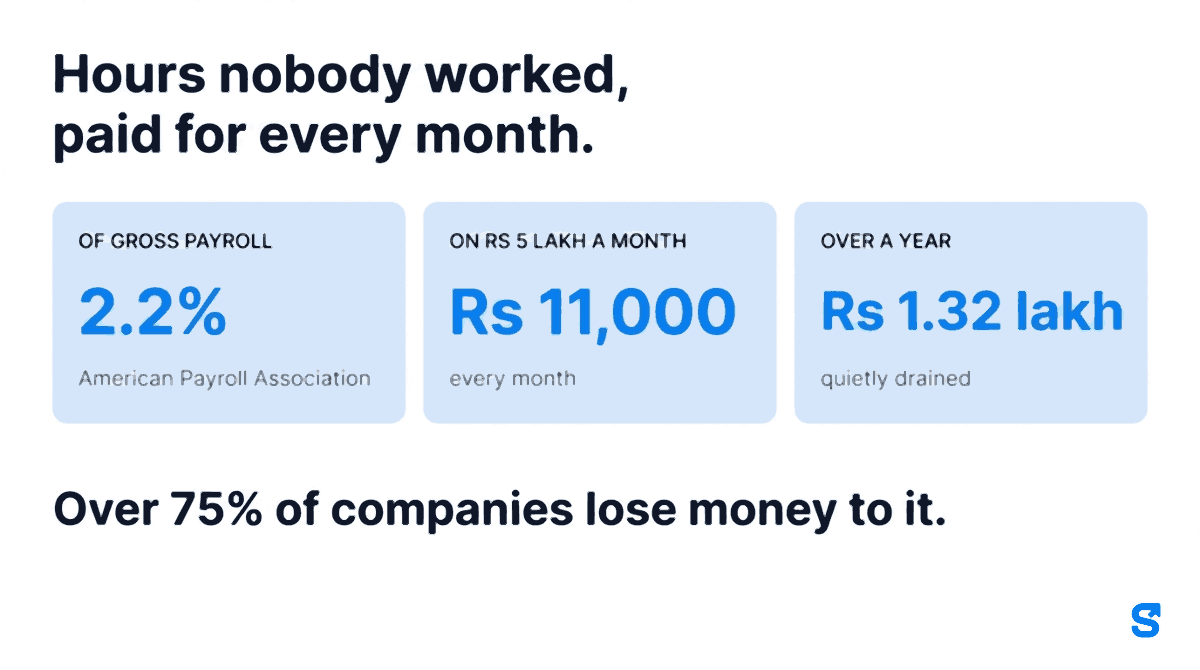
According to the American Payroll Association, over 75% of companies lose money to buddy punching, which accounts for approximately 2.2% of gross payroll. For an Indian SME paying Rs 5 lakh a month in salaries, that is Rs 11,000 every month going to hours that were never worked. Across a year, that is Rs 1.32 lakh quietly drained from your payroll.
A 2024 report by Petpooja estimated that payroll fraud in Indian SMEs, including proxy attendance, drains 3 to 8% of monthly payroll, and the average detection time under manual systems is 24 to 36 months. By the time most business owners notice, the cumulative loss runs into lakhs.
What Is Buddy Punching? (And Why Indians Call It "Proxy")
Proxy attendance and buddy punching are the same act. An employee who is late, absent, or leaving early asks a colleague to mark them as present. The colleague obliges, the register shows full attendance, and the absent employee receives a full day's pay.
In a 40-person logistics firm in Pune, it might look like this: a delivery rider calls his colleague at 9:02 AM and says "bhai, sign kar de mujhe", meaning just mark me in, I'll be there by 10. The colleague signs the register. The supervisor is busy with dispatch. Nobody notices. It happens again the next week, and the week after.
According to HR professionals cited by Zee Business, statistics indicate that three out of four employees do not always report accurate attendance. The problem is not one bad actor. It is a systematic failure of the verification method.
How Much Money Are Indian SMEs Losing Right Now?
Globally, companies lose an estimated equivalent of Rs 28 lakh crore annually to attendance fraud and related productivity losses, according to Zee Business citing industry data. India's share of that figure is substantial given the size of its informal and semi-formal workforce.
At the SME level, the ACFE 2024 Report to the Nations found that payroll fraud is 1.5 times more likely in businesses with fewer than 100 employees than in larger companies. Small businesses are more vulnerable because they have fewer controls, less separation of duties, and supervisors who often double as friends with the staff they manage.
For a concrete India-specific figure: a business with 100 employees and Rs 5 crore in annual payroll can typically recover Rs 10 to Rs 20 lakh per year by eliminating proxy attendance and buddy punching through GPS-verified attendance, according to analysis by MemoFaceAI's India SME buyer's guide. The recovery comes not just from catching fraud but from removing the ambiguity that makes the informal "just mark me present" culture possible in the first place.
Which Industries in India Are Hit the Hardest?
Proxy attendance is more common wherever attendance verification is weakest and employee headcount is high enough that no single manager can watch everyone personally.
- Retail shops and supermarket chains: Multiple branches, part-time staff who know each other across shifts, and managers who rotate between locations create ideal conditions for proxy attendance to go undetected.
- Restaurants and QSR chains: High staff turnover, split shifts, and the casual culture of F&B kitchens make proxy punching extremely common. India's restaurant sector employs 8.5 million people with monthly attrition rates near 19%, and staff frequently cover for each other as a matter of solidarity.
- Construction sites: Daily wage workers supervised by a contractor who has their own incentives to manipulate headcount. The ACFE found construction has the highest payroll fraud rate at 23% of all fraud cases globally.
- Logistics and delivery: Riders and drivers who are never at the office can ask a colleague at the depot to sign them in before they have started their route. There is no one watching the register.
How Proxy Attendance Actually Happens: Real Scenarios
Understanding the mechanics helps in choosing the right fix. Proxy attendance happens through four main routes:
- Paper register sign-in: A colleague signs someone else's name. Takes five seconds and leaves no trace. The most common method across all industries.
- Shared biometric PIN or ID card: In access-control systems where employees punch a number or tap a card, the card or PIN can be handed to a colleague. No face verification means the system cannot distinguish between the cardholders.
- Manager favouritism: A supervisor manually corrects the register at the end of the day as a personal favour. This happens more often than business owners realise.
- WhatsApp attendance groups: An employee sends "reached" from home, from a tea shop, or from the previous site. There is no GPS check, no photo, no way to verify the claim.
Why Old Systems Cannot Catch It
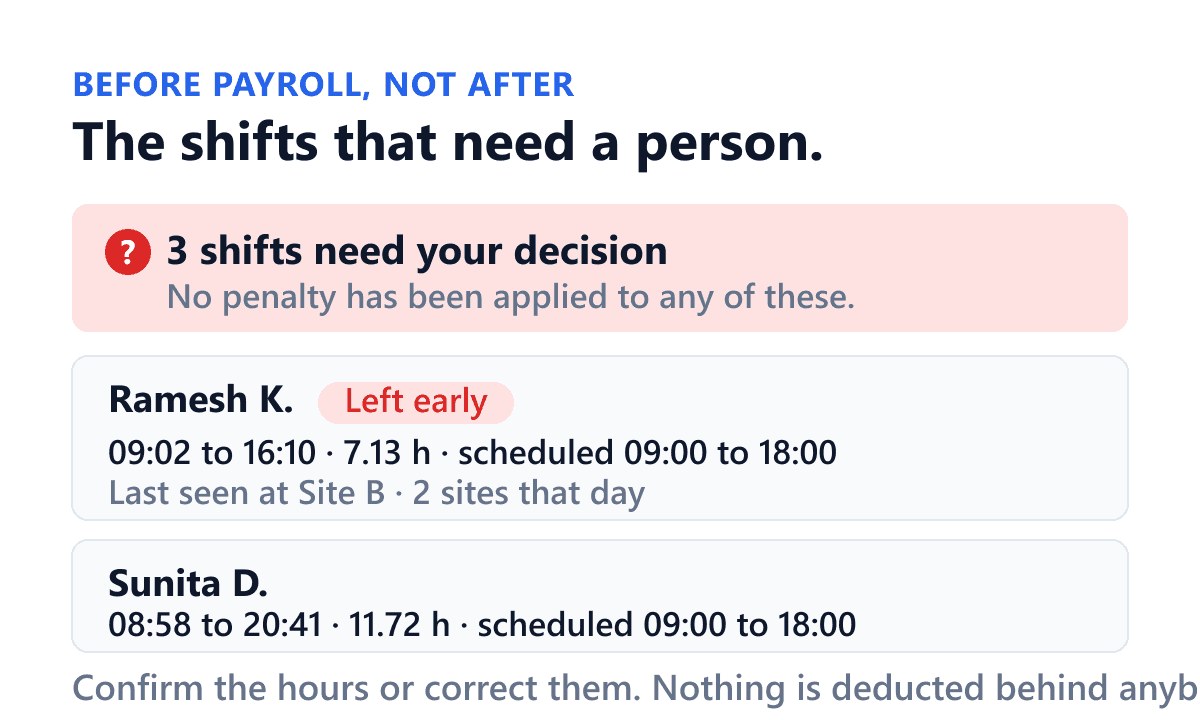
The fundamental problem with every traditional method is that it verifies identity without verifying presence. A fingerprint machine knows whose finger is on the scanner, but it does not know if the scanner is being used on the right site, or whether the system is being operated at all when the site manager is not watching.
RFID cards are shareable. Fingerprint machines can be fooled with a silicone imprint in older models, and can be pressed by a colleague's actual finger in any model. Manual registers are fillable by anyone with a pen. WhatsApp messages are sendable from anywhere.
And critically: the average time to detect payroll fraud in an Indian SME under manual systems is 24 to 36 months. That is two to three years of losses before the pattern becomes visible.
What Actually Stops Buddy Punching in 2026
The only verification method that addresses all four fraud routes simultaneously is GPS selfie attendance. Here is how each check-in works:
- The employee opens the app at the start of their shift.
- The app captures a live selfie using the front camera. The photo is taken inside the app at that moment and cannot be picked from the gallery, so a saved picture of a colleague cannot be submitted in their place.
- Simultaneously, the phone's GPS confirms the employee is within the geo-fenced boundary of the workplace. If they are outside it, the check-in is blocked.
- The punch records which phone made it, and the location trail through the shift records which phone walked it. A shift opened on one phone and walked on another is flagged for the owner to look at.
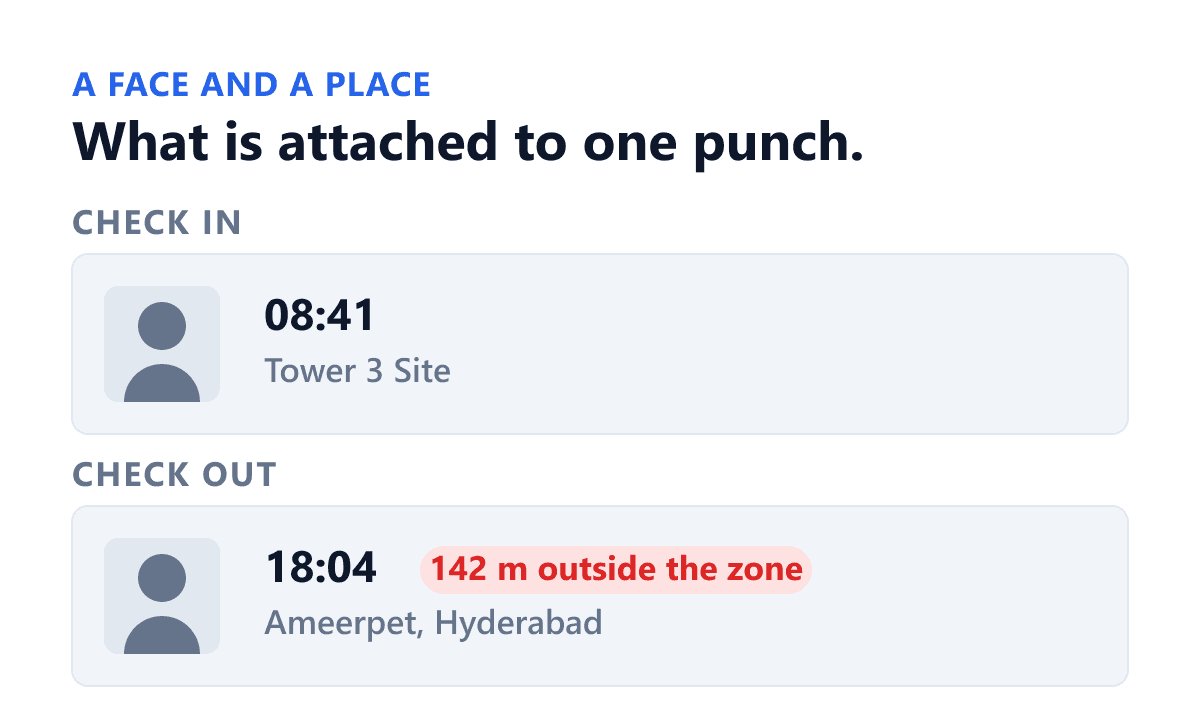
A colleague cannot hand someone else their phone to check in, because the selfie will not match. They cannot fake the location, because the geo-fence catches spoofing. They cannot ask the supervisor to mark them manually, because the supervisor's own dashboard shows the gap immediately.
The entire check-in takes about ten seconds. There is no queue at the gate, no card to forget at home, no fingerprint enrollment session.
What to Look for in an Attendance App for Your Business
Not all GPS attendance apps are equal. Before choosing one, verify these specific features:
- Live selfie capture inside the app, not a photo uploaded from the gallery
- GPS geo-fencing with a configurable radius for each site
- Fake GPS detection that blocks mock location apps on Android
- Works on any Android or iOS device your staff already owns
- Real-time dashboard showing who is present and who is absent right now
- Direct payroll integration so attendance records feed into salary calculation automatically
- Offline mode for sites with poor connectivity
Analysis from MemoFaceAI's buyer's guide found that a 100-employee Indian business can recover Rs 10 to Rs 20 lakh annually just by eliminating proxy attendance through GPS selfie verification. For a 25-person business, the recovery is proportionally smaller but still likely exceeds the annual software cost in the first month.
The Product That Runs These Three Checks
The Bottom Line for Indian SME Owners
Three out of four employees do not always report accurate attendance. That is not an indictment of your staff. It is a description of what happens when the verification method makes inaccuracy easy and invisible. Paper registers, shared cards, and WhatsApp groups all make proxy attendance easy.
GPS selfie attendance makes it structurally impossible. The employee has to be physically present at the right location, with their own face in front of their own camera, at the right time. There is no workaround that a colleague can provide.
For most Indian SMEs, eliminating proxy attendance recovers more money in the first month than the annual cost of the software. The payroll leak has probably been running longer than you think.
Keep reading
See how Shiftelio does this in practice with the geofence, the selfie and the mock-location check, on one page.
Still deciding what to buy? Compare what nine attendance apps cost for 25 employees with GPS switched on.
Free to use, no signup: Attendance register generator.