Why Your WhatsApp Attendance Group Is Hurting Your Business (And What to Use Instead)
In short
A WhatsApp group cannot verify location, cannot connect to payroll, and creates zero audit trail. Here is why Indian SMEs are moving to dedicated attendance apps.
It is 9:15 AM. You have 23 messages in the attendance group. Four people have not replied. Two sent "reached" but you are not sure if they mean the office or the site. One sent a voice note you have not listened to yet. And you still do not know who is actually at work.
Every Indian business owner who has run a WhatsApp attendance group knows this scene. India has over 500 million WhatsApp users, and 80 percent of small businesses use it for some form of internal communication. Starting an attendance group costs nothing and takes two minutes. That is why it became the default for small teams.
But using WhatsApp as an attendance system has specific, fixable problems, and they get more expensive as your team grows past 10 people.
Problem 1: No Location Verification
An employee can type "reached" from bed, from a tea stall across the road, or from another city entirely. WhatsApp has no geo-fencing or GPS verification built into its messaging function. A message is just text. There is no way to confirm the sender was physically at the workplace when they sent it.
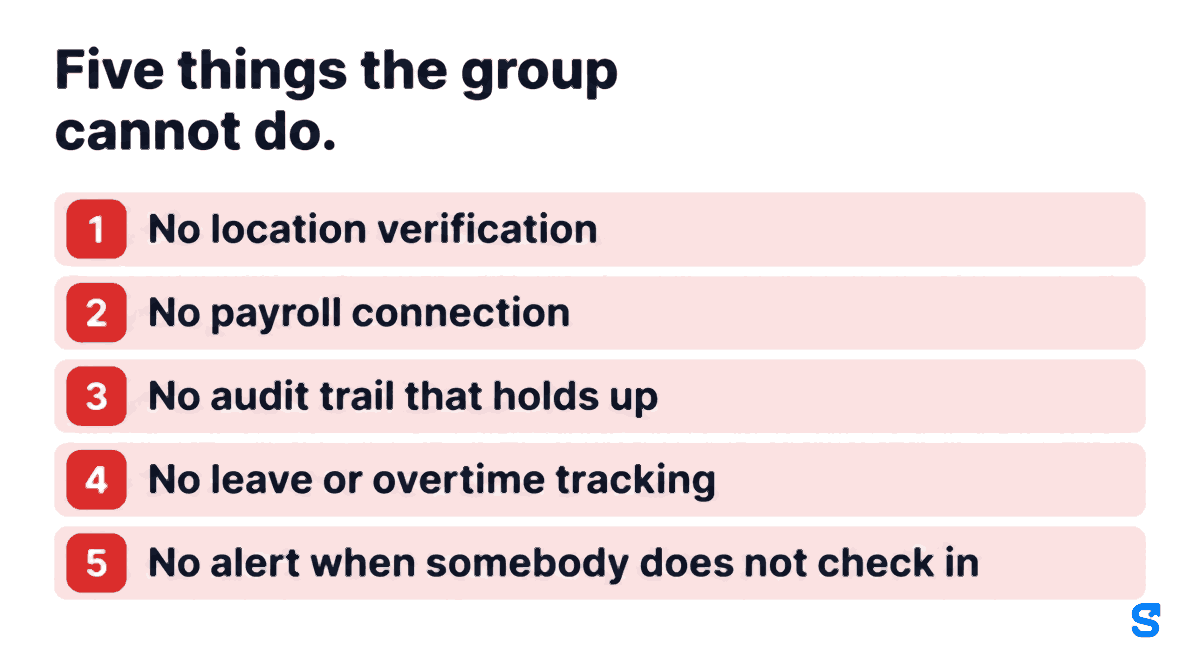
This is the core structural problem with WhatsApp attendance: it relies entirely on trust and honesty. For a 5-person team where the owner is present at all times, that might be fine. For a 20-person team across two locations, it creates a gap that employees learn to exploit quickly.
Problem 2: No Payroll Connection
At the end of every month, someone in your business has to count the messages in the group, match them to each employee, cross-check against leave records, and manually enter the days into a spreadsheet or accounting software before payroll can be processed.
HR platforms tracking Indian SME workflows estimate that this reconciliation process takes 15 to 20 hours per month for a team of 20 employees. That is two and a half working days of somebody's time, every single month, doing a task that a dedicated attendance app does automatically.
Errors in this manual process mean employees get paid for days they were absent, or get deducted for days they were present. Both create problems: one costs you money, the other creates a dispute.
Problem 3: No Audit Trail That Holds Up
WhatsApp messages can be deleted by either party. Group admins can remove messages. Employees can claim they sent an attendance message that you deleted. You can claim an employee never sent one.
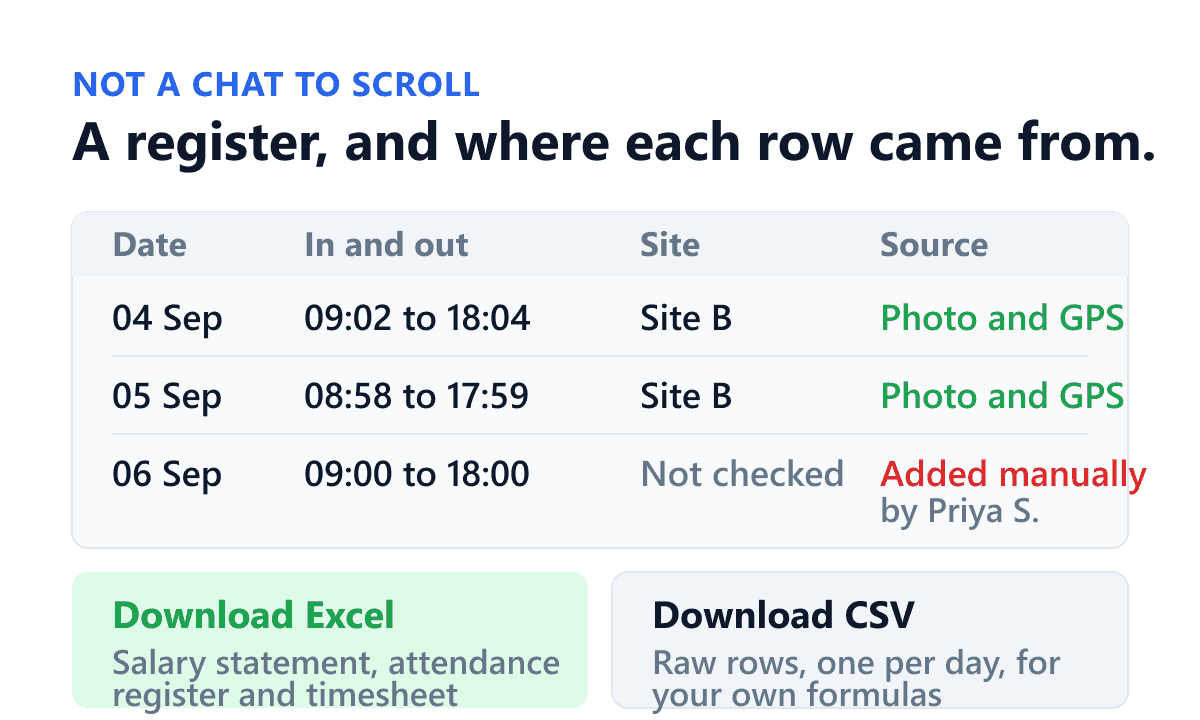
More importantly, under Indian labour law, a WhatsApp message screenshot is not a reliable attendance record. If an employee files a complaint about a salary deduction with the Labour Commissioner, a printed WhatsApp conversation may not be sufficient documentation. The Factories Act and Shops and Establishments Acts across Indian states require employers to maintain a proper attendance register, a format that a WhatsApp chat does not naturally produce.
A dedicated attendance app generates a timestamped, uneditable record for every check-in and check-out, with GPS coordinates and a photo. That is a defensible audit trail.
Problem 4: No Leave or Overtime Tracking
In a WhatsApp group, a late arrival looks identical to an on-time one. "Reached" at 9:05 AM and "Reached" at 10:45 AM appear as the same message. Half-days, early departures, and overtime worked past closing time are all invisible unless someone is watching the timestamps and recording them separately.
Leave requests in a WhatsApp group mix with attendance messages, making it difficult to maintain a clear record of approved leave versus unauthorised absence. Over time, employees learn that the informal system works in their favour when things are vague.
Problem 5: No Alerts When Someone Does Not Check In
If an employee does not send a message, the group owner has to notice it manually, by scrolling through 20 other messages and remembering who has not appeared yet. There is no automatic alert, no escalation, and no way to see at a glance who is absent versus who has not checked in yet.
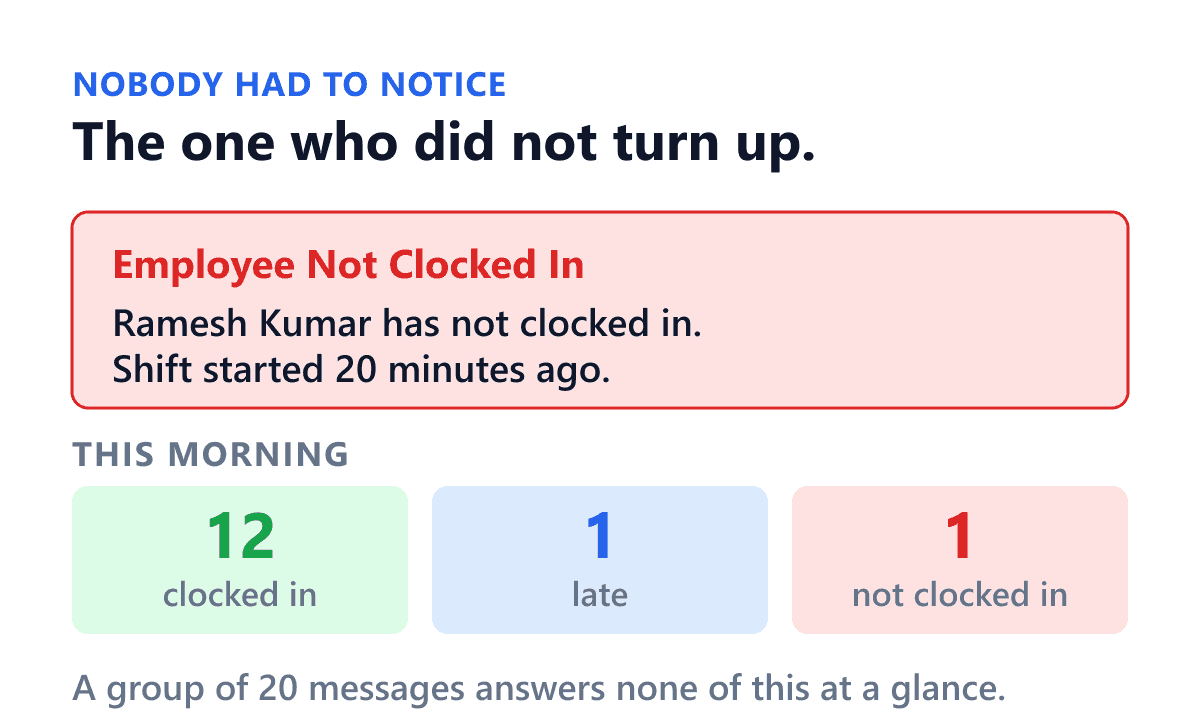
A dedicated attendance app sends you a notification by 10 AM listing everyone who has not yet checked in. You see it on your phone, you call the relevant person, and you know the status of your team without opening a chat group and counting names.
What a Dedicated Attendance App Does Differently
The replacement for a WhatsApp attendance group is not complicated. A dedicated app does the same thing, in that the employee opens it and marks themselves present, but adds the verification and automation that WhatsApp cannot provide:
- Geo-fenced check-in: the employee can only mark present from within a set radius of the workplace.
- Selfie verification: confirms the right person is checking in, not a colleague doing it on their behalf.
- Automatic payroll sync: present days flow directly into salary calculation, no manual counting required.
- Leave management: leave requests, approvals, and deductions are tracked in the same place as attendance.
- Real-time dashboard: you see who is present and who is absent at any moment, across all your locations.
- Tamper-proof records: every check-in is timestamped and cannot be edited after the fact.
When Is the Right Time to Switch?
If your team is above 10 employees and you have any of the following, the WhatsApp group has already become a problem that costs more than it saves:
- You have had at least one salary dispute linked to attendance in the past year.
- You or a manager spends more than two hours a month reconciling attendance for payroll.
- You have field staff or employees at more than one location.
- You run shifts and need to track late arrivals and overtime accurately.
Attendance apps for Indian SMEs typically cost Rs 30 to Rs 200 per employee per month. For a team of 20, that is Rs 600 to Rs 4,000 a month, less than one hour of managerial time spent on manual reconciliation. Some, like Shiftelio, offer a flat annual price that works out to under Rs 500 a month for 25 employees.
What Replacing the Group Actually Costs
The Transition Is Simpler Than You Think
The most common reason business owners stick with the WhatsApp group is inertia. Everyone is already on WhatsApp, changing habits is uncomfortable, and the group works well enough on most days.
In practice, migrating takes less than two hours. You add employee numbers to the new app, they receive an invite and download it, and the group can stay active for general communication, just not for attendance. The first month of accurate, automatic attendance data usually removes any doubt about whether the switch was worth it.
Your WhatsApp group served a purpose when the team was small. Now the team has grown past what a chat group can reliably manage. The next step is straightforward: replace the group message with a ten-second app check-in and let the software handle everything after that.
Keep reading
See how Shiftelio does this in practice with attendance that records itself, without a WhatsApp group.
Still deciding what to buy? Compare what to use instead of the group, with prices.
Free to use, no signup: Attendance register generator.