GPS Attendance Without a Biometric Machine: A Complete Guide for Indian SMEs
In short
Biometric machines cost Rs 5,000-30,000, break down, and fail in Indian heat. Here is how to get accurate attendance using just the phones your staff already carry.
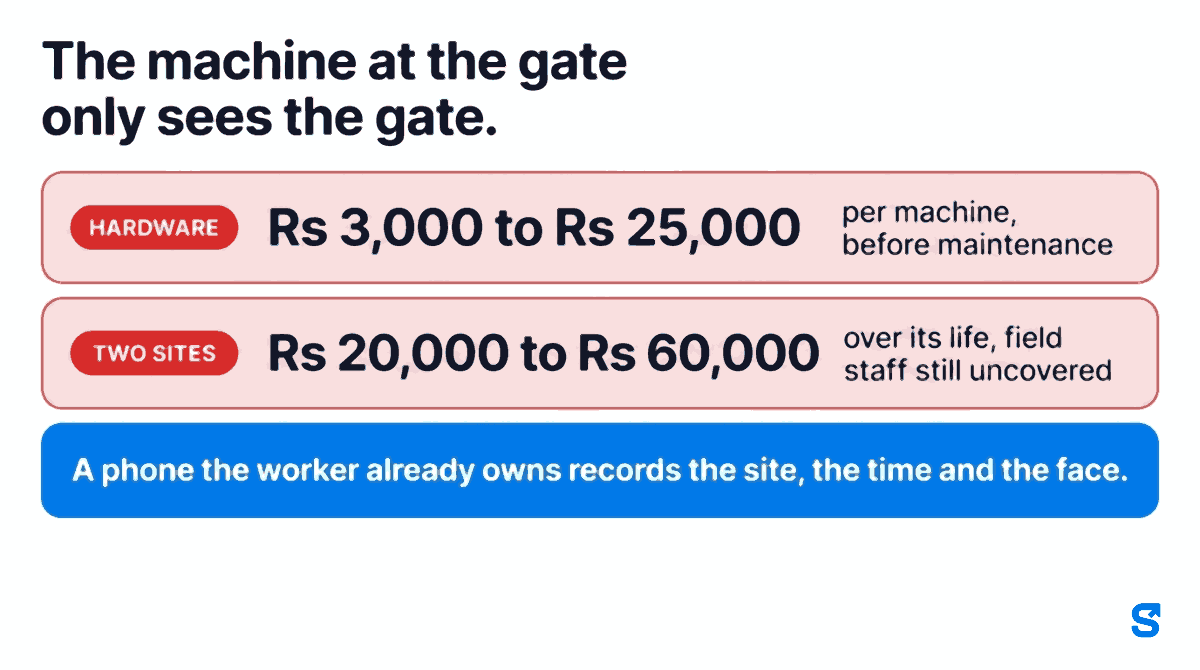
The average biometric attendance machine in India costs Rs 3,000 to Rs 25,000 upfront. Add annual maintenance, a technician visit when the sensor fouls up, and a replacement every three to five years, and a two-location business is spending Rs 20,000 to Rs 60,000 on hardware that still does not cover its field staff.
Meanwhile, 57 million MSMEs in India are employing 241 million workers, and the vast majority have not automated even basic attendance. They are using paper registers, WhatsApp groups, or biometric machines that fail in the Indian summer. There is a simpler option: use the phones your staff already carry.
Why Biometric Machines Struggle in Indian Conditions
Biometric fingerprint scanners have specific, documented failure modes that show up disproportionately in Indian workplaces:
- Dry or calloused fingers: Construction workers, cooks, cleaners, and anyone working with chemicals has skin that does not read cleanly on an optical scanner. The machine rejects the scan, the employee tries three times, a queue builds at the gate.
- Power cuts: A machine with no UPS stops working the moment the power goes. In Tier 2 and Tier 3 cities, and on construction sites where power comes from a generator, this is a daily problem.
- Sensor degradation: The scanner glass scratches and accumulates grease over time. After 18 to 24 months of heavy use, the accuracy drops and the technician needs to be called.
- No coverage for field staff: A machine at the office entrance cannot track a delivery driver, a sales representative, or a worker on a second site. The machine only knows about the people who walk past it.
- Buddy punching still works: A colleague can press someone else's finger on the sensor, or in older machines, use an imprint. Hardware alone does not fully stop proxy attendance.
What "Attendance Without a Machine" Means in Practice
Mobile-based GPS attendance replaces the hardware entirely. Here is how a check-in works from the employee's side:
- The employee opens the attendance app on their phone at the start of their shift.
- The app asks for a live selfie using the front camera. The photo is taken inside the app at that moment and cannot be picked from the gallery.
- Simultaneously, the phone's GPS confirms the employee's location against the geo-fence you have set for that site.
- If both the face and the location check out, the check-in is recorded with a timestamp and map pin.
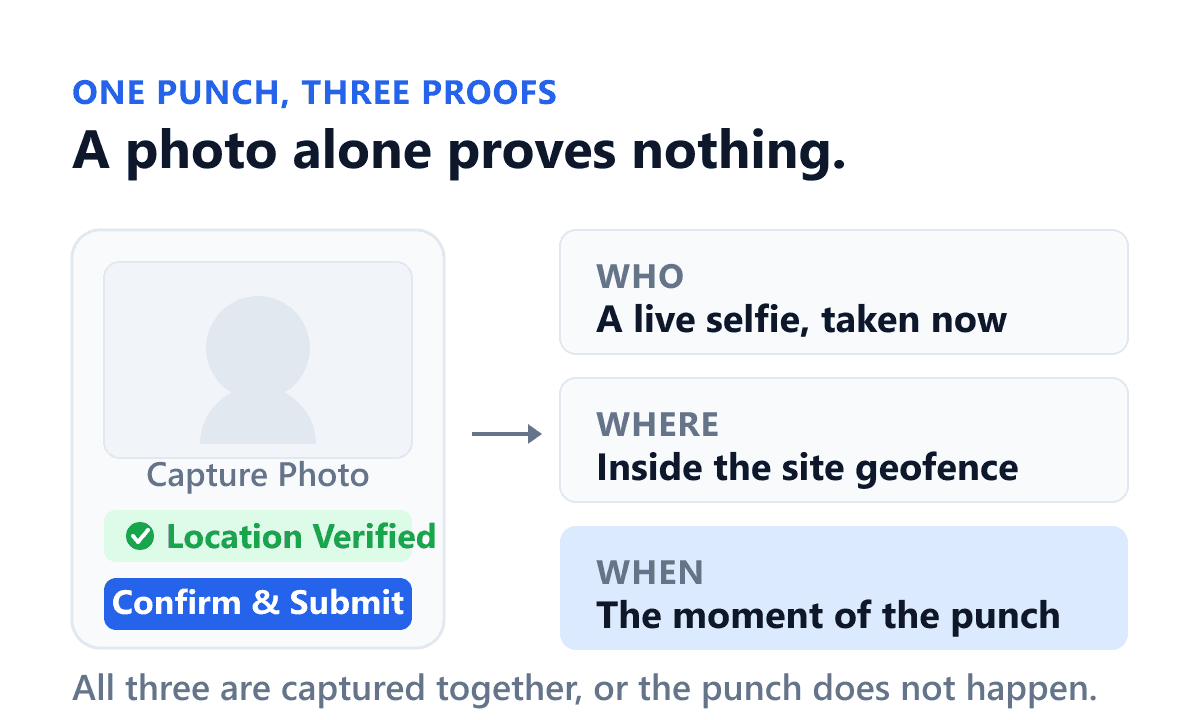
The whole process takes about ten seconds. There is no queue at the gate, no failed scan, no technician callout. The data goes straight into the attendance record and, at month end, into the payroll calculation.
The Real Cost Comparison
For a business with 20 employees across two locations:
| Cost Item | Biometric Machine | Mobile App |
|---|---|---|
| Hardware (2 locations) | Rs 6,000 to Rs 50,000 | Rs 0 |
| Annual maintenance | Rs 3,000 to Rs 10,000 | Rs 0 |
| Installation and cabling | Rs 1,000 to Rs 5,000 | Rs 0 |
| Software (20 employees/year) | Separate subscription | Rs 5,999 (flat) |
| Field staff coverage | No | Yes |
| Works during power cut | No (without UPS) | Yes (phone battery) |
Research from HR platforms tracking Indian SME payroll has found that manual or inaccurate attendance leads to 2 to 5 percent payroll leakage per month. For a business paying Rs 3 lakh in monthly salaries, recovering even 2 percent covers the annual software cost in the first month.
Which Indian Businesses Benefit Most
Restaurants and Cafes
There is no space at the counter for a biometric machine, and even if there were, kitchen staff with wet or oily hands would fail the scan constantly. A phone-based check-in from the back kitchen takes ten seconds and requires no hardware installation.
Construction Sites
Workers move between floors and between sites. A machine at the gate does not know if someone walked off to a different site at noon. GPS geo-fencing pins each check-in to a specific location and time. Daily wage payroll feeds directly from the attendance data.
Logistics and Delivery
Delivery drivers are never at the office. GPS check-in from the depot or the first drop point is the only practical attendance method for field-based staff.
Retail Chains with Multiple Outlets
A business owner with three outlets does not want to buy three biometric machines, manage three AMC contracts, and log into three separate systems to see who is present where. A mobile app shows all locations on one dashboard.
What to Look for in a Mobile Attendance App for Indian SMEs
Not all attendance apps are equal. Before choosing one, check for these specific features:
- Live selfie taken inside the app: A photo uploaded from the gallery should not be accepted. The camera must open at the moment of the punch.
- GPS geo-fencing: You set the allowed radius. Employees outside that radius cannot mark attendance.
- Fake GPS detection: Many Android phones allow a "mock location" app that spoofs GPS coordinates. A good attendance app detects and blocks this.
- Offline mode: For sites with patchy connectivity, the punch should save locally and sync when the phone reconnects.
- Direct payroll export: Attendance records should flow automatically into salary calculation without a manual export step.
- Data stored in India: For businesses subject to Indian data regulations, confirm that employee biometric data and location data is stored on Indian servers.
How Long Does Setup Take?
A typical setup for a 20-person business takes less than two hours:
- Add your business name, location address, and geo-fence radius (takes about 10 minutes).
- Add employee names and phone numbers, or import a list from Excel (takes about 20 minutes for 20 employees).
- Employees receive an SMS or WhatsApp invite, download the app, and are ready to check in (takes about 30 minutes for the team).
Compare this with a biometric machine installation: the technician visit, the cabling, the enrollment session where every employee has to register their finger, and the software configuration. That process often takes a full working day and requires someone to be on-site throughout.
The Product That Replaces the Machine
The Bottom Line
A biometric machine made sense when smartphones were not ubiquitous. In 2026, with 78 percent of Indian MSMEs still relying on manual attendance tracking despite nearly universal smartphone ownership among employees, the simpler path is to use the hardware that is already in everyone's pocket.
GPS selfie attendance costs less, covers field staff, works during power cuts, eliminates buddy punching, and connects directly to payroll. The biometric machine does not do any of those last three things reliably.
Keep reading
See how Shiftelio does this in practice with GPS attendance with a selfie, and what happens when somebody fakes the location.
Still deciding what to buy? Compare the attendance apps Indian small businesses actually use, ranked by real annual cost.
Free to use, no signup: Attendance register generator.