Best Way to Track Attendance for Construction Workers at Your Site in India
In short
Construction sites have no internet, multiple locations, and daily wage workers. Here is how GPS-based mobile attendance solves all three problems without a machine at the gate.
India's construction sector employs over 70 million workers and is on track to reach 100 million by 2030. Yet most sites still track attendance with a paper muster roll that a supervisor fills in manually, often at the end of the day from memory. The result is wage disputes, labour inspector visits, and a payroll process that takes longer than it should every single month.
There is a specific reason why the usual attendance apps do not work on construction sites, and a specific reason why paper registers create more problems than they solve. This article covers both, and what actually works instead.
Why Paper Muster Rolls Are Costing You Money Every Month
A paper muster roll filled in by a site supervisor has two structural weaknesses. First, it relies entirely on the supervisor's honesty. Research from the Global Fund to End Modern Slavery found that India's construction labour chain can have nine or more intermediary layers between the principal employer and the worker, with each layer having an incentive to under-report or over-report headcount depending on how payments flow. A paper register at the site gate does not help the contractor at the top of that chain verify what is actually happening.
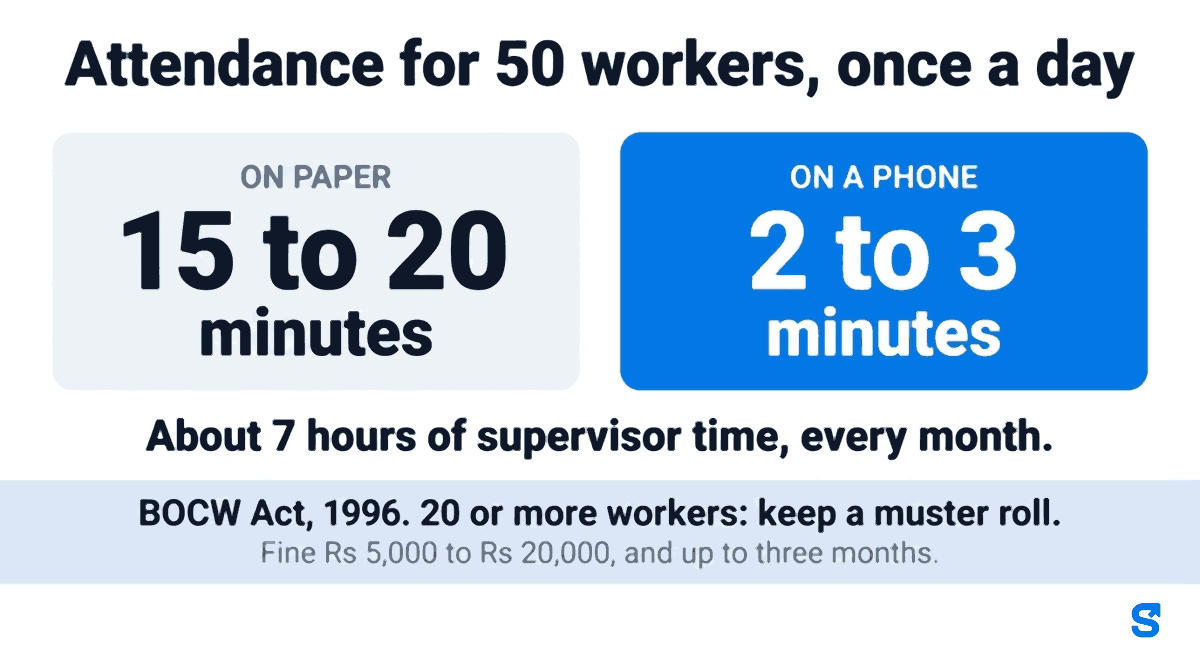
Second, paper registers are difficult to consolidate across multiple sites. A contractor running three sites in different parts of the city cannot see the combined headcount in real time. At month end, someone physically collects the registers from each site, re-enters the data into a spreadsheet, and then calculates daily wages. Yojo's field data from Indian construction sites shows that manually recording attendance for 50 workers on paper takes 15 to 20 minutes per day. Digital attendance reduces this to 2 to 3 minutes. Over 26 working days, that is roughly 7 hours of supervisor time saved every month on a single site.
What the Law Actually Says About Construction Attendance Records
The Building and Other Construction Workers (Regulation of Employment and Conditions of Service) Act, 1996 (BOCW Act) requires every establishment employing 20 or more construction workers to maintain a muster roll showing attendance, wages paid, and overtime. These records must be retained for a minimum of three years. Non-compliance carries fines of Rs 5,000 to Rs 20,000 and up to three months imprisonment.
The Contract Labour (Regulation and Abolition) Act, 1970 places a similar obligation on any contractor employing 20 or more workers: a muster roll is mandatory, and it is the first document a labour inspector or court will ask for in a wage dispute.
The practical implication: if an inspector visits your site and you cannot produce a proper muster roll, you are immediately liable. If a worker disputes their wage payment before a labour court, a paper register that the supervisor may have filled in retrospectively is a weak defence. A GPS-verified digital record with timestamps, on the other hand, is accepted as valid evidence under the Information Technology Act, 2000. Digital attendance records increasingly hold up better in court and during inspections than handwritten registers.
The Biggest Problem on Every Construction Site: No Internet
Most standard HR and attendance apps assume a stable internet connection. On a construction site, that assumption fails constantly. Basements, upper floors of under-construction buildings, remote project sites, and sites in Tier 3 cities often have patchy or no connectivity throughout the working day.
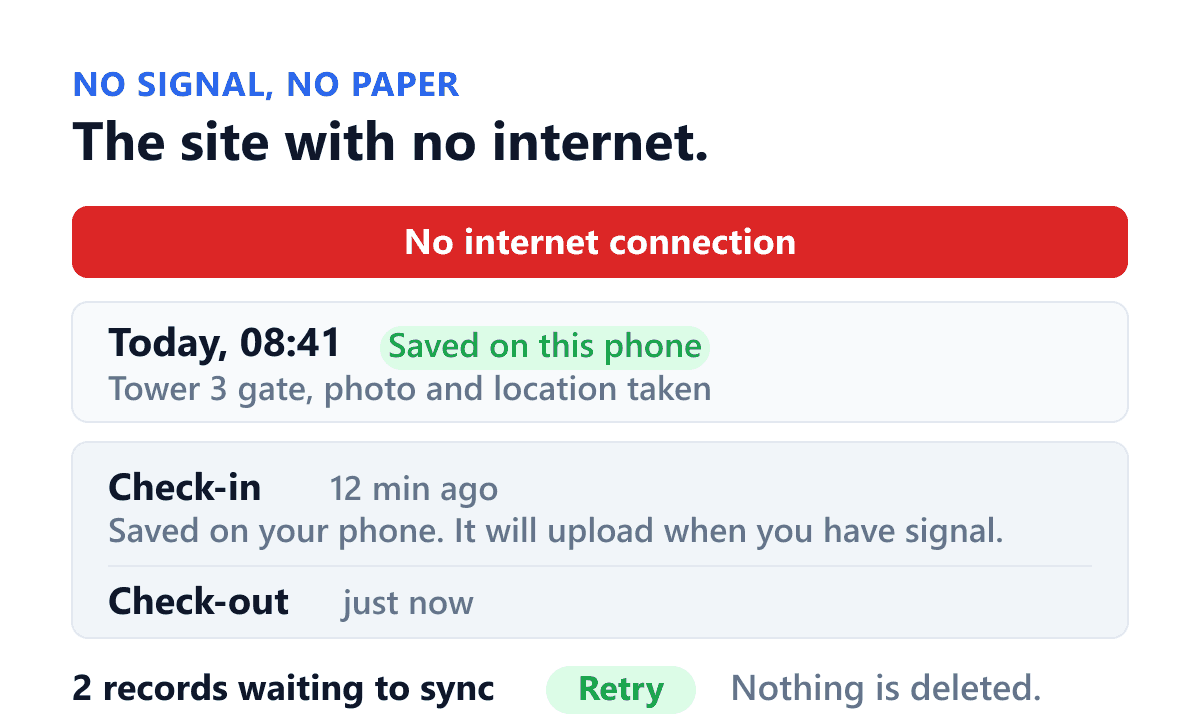
An attendance app that requires live internet to record a punch fails the moment connectivity drops. Workers queue at the gate trying to check in, the supervisor gives up and reverts to paper, and you are back where you started.
The correct solution for construction is an offline-first attendance app. The employee or supervisor marks attendance locally on the phone. The record is saved to the device with the timestamp locked at the moment of punch. When internet connectivity returns, the app syncs automatically to the cloud. The timestamp cannot be altered retroactively because it was recorded at the device level when the punch happened.
GPS Geo-Fencing: How to Know Workers Are Actually On Site
A geo-fence is a virtual boundary you draw around a site address. When an employee marks attendance, the phone's GPS confirms they are physically inside that boundary. If they are outside it, the check-in is blocked.
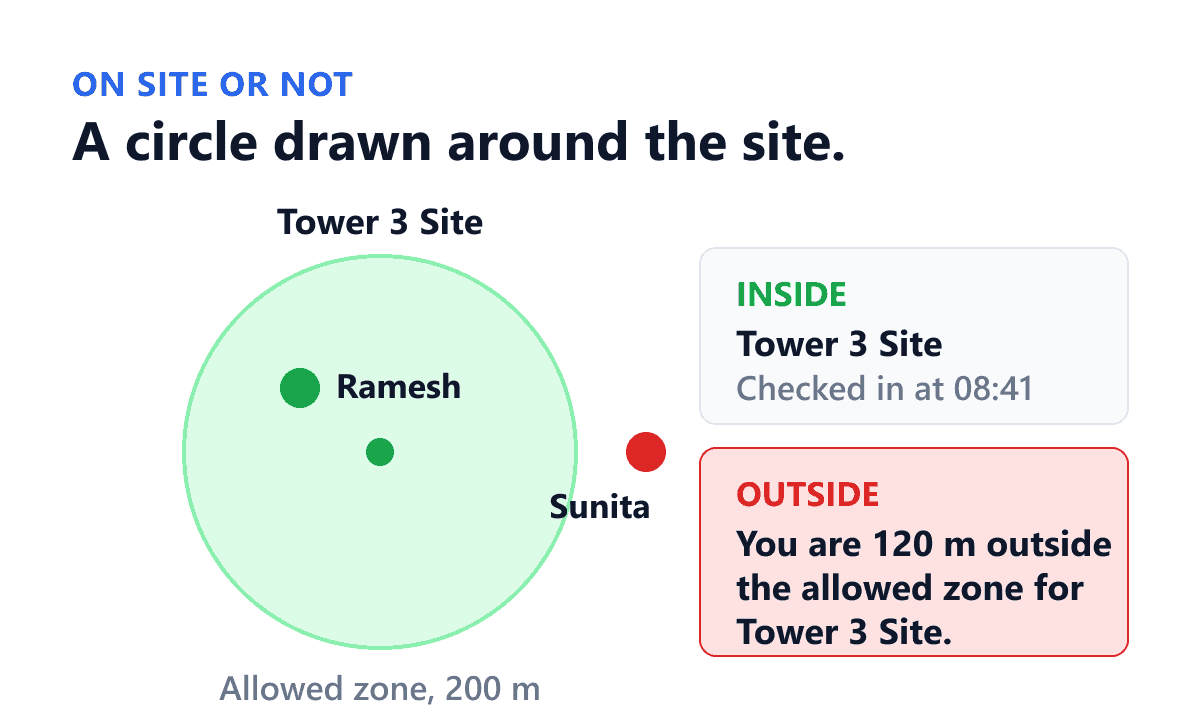
For a construction site, you set the geo-fence radius to cover the actual site area, typically 100 to 300 metres depending on the project size. A worker who marks attendance from outside the boundary, or whose phone shows a fake GPS location, is automatically rejected.
For a contractor managing multiple sites, you create a separate geo-fence for each location. Each site has its own attendance log. At month end, you have a clean record of which worker was at which site on which day, without anyone manually consolidating paper registers.
Multiple geo-fences are managed from a single dashboard. You can see the live headcount at each site from your phone or laptop, without calling the site supervisor.
Tracking Daily Wage Workers and Migrant Labour
Construction in India's major cities draws heavily on migrant workers. Maharashtra has approximately 20 million migrant workers, Delhi 15 million, and Tamil Nadu 10 million, with the majority coming from UP, Bihar, Jharkhand, Odisha, and Chhattisgarh. These workers often move between sites, work for multiple contractors, and may not have consistent documentation.
For daily wage payroll, the attendance record is the payroll input. A worker who was present for 22 days at Rs 700 per day is owed Rs 15,400. Getting this calculation wrong, in either direction, creates disputes. GPS-verified attendance gives you a clean daily record that both the contractor and the worker can refer to, reducing the most common source of wage disputes: disagreement over how many days someone actually worked.
An attendance app that supports gang-marking is particularly useful on large sites: the site supervisor can mark attendance for a group of workers simultaneously, with GPS confirming the supervisor's own location on site. This is practical for sites where workers do not all have smartphones.
How Digital Attendance Protects You in a Labour Dispute
Wage disputes on construction sites often come down to one question: was the worker present on the disputed days? With a paper register, both sides can claim the record was inaccurate. With GPS-timestamped digital records, the punch data speaks for itself: here is the GPS coordinate, here is the timestamp, here is the site boundary that was active that day.
BOCW-compliant digital muster rolls can be exported in the format required for inspector visits. Instead of presenting a worn paper register, you print or share a clean, dated report. This takes seconds from a dashboard rather than minutes of searching through physical files.
Digital records also make it harder for intermediary contractors to manipulate headcount. If the principal employer has independent GPS-verified records, a sub-contractor cannot inflate or deflate the attendance figures for their own benefit.
What to Look for in an Attendance App Built for Construction
Most HR apps are designed for office environments. A construction-specific attendance app needs a different feature set:
- Offline mode: Attendance must record locally without internet and sync when connectivity returns. This is non-negotiable for most construction sites.
- GPS geo-fencing with multiple site support: Each site should have its own boundary. The contractor should be able to manage all sites from one dashboard.
- Fake GPS detection: Android phones allow mock location apps that spoof coordinates. A reliable attendance app detects and blocks these.
- Works on basic Android phones: Not all construction workers or supervisors carry high-end devices. The app should work on any Android running version 8 or above.
- Supervisor gang-marking: For sites where workers do not have their own phones, a supervisor should be able to mark attendance for a group from their own device, with the site GPS as the verification.
- Daily wage payroll export: The attendance data should feed directly into a daily wage calculation, not require a separate manual export step.
- BOCW-format muster roll export: The monthly report should be downloadable in a format that satisfies the attendance register requirement under the BOCW Act.
The Hazri Register in Excel Versus an App on the Phone
Most contractors who have moved off pure paper have moved to Excel, not to software, and that is a reasonable place to be. A spreadsheet costs nothing, the site clerk already knows how to use it, it opens on a laptop with no signal at all, and for one site with a stable gang of eight men who turn up at the same gate every morning it is a perfectly sensible answer. If that describes your operation, the rest of this section may not apply to you yet.
It stops being sensible for specific reasons, and they are worth naming precisely rather than hand-waving about digital transformation:
- The cell is typed by somebody, not observed. The supervisor fills the sheet in the evening, or the worker reports his own days. What lands in the file is what was reported, not what happened. Nothing in the file distinguishes the two.
- There is no evidence behind any cell. When a worker says he was present 24 days and your sheet says 22, the sheet is one claim against another. There is no coordinate, no timestamp and no photograph attached to the number, so it settles nothing in front of a labour officer.
- A formula error is silent. A dragged range that stops one row short, or a day rate pasted into the wrong column, produces a wrong wage that looks exactly like a right one. Nothing turns red. You find it when somebody complains, or you never find it.
- The file lives on one laptop. It goes wherever that machine goes, including into a repair shop or out of the company with the person who leaves. The BOCW retention obligation runs three years; a hard disk does not undertake to.
- Two sites means two files. Three sites means three, and somebody merges them by hand at month end, which is a fourth file with its own copy-paste errors and no way of knowing which version is current.
- The transcription is a whole day that only exists because the record and the pay run are separate. Register at the gate, then sheet on the laptop, then wage calculation, then payslip. Each hop is re-keying. An app removes the hops, not the arithmetic.
Here is the arithmetic without the sales pitch. Put a modest value on the time of whoever does that month-end work, say Rs 500 an hour, whether that is a clerk you pay or your own Sunday evening. Collecting registers, re-keying a 50-worker month and reconciling it against wages is comfortably a full day, so roughly 8 hours a month, or about 96 hours a year. The Growth plan is Rs 5,999 a year, which at that same Rs 500 an hour is about 12 hours of the work it removes. The comparison is not free versus paid; it is 96 hours versus roughly 12, plus the fact that at the end of it you have evidence you did not have before.
What Excel is not is illegal. A spreadsheet muster roll that is genuinely maintained daily satisfies the BOCW record-keeping obligation, and anyone who tells you otherwise is selling something. The argument against it is effort and evidence, not legality.
Which Product Does This on a Site, and What It Costs
Getting Started: How a Site Manager Can Set Up Digital Attendance in One Day
Unlike a biometric machine installation, which requires a technician visit and a full-day enrollment session, a GPS attendance app for a construction site can be operational in a few hours:
- Add the site address and draw the geo-fence on a map. This takes about 10 minutes per site.
- Add worker names and phone numbers, or create supervisor accounts for gang-marking, which is about 30 minutes for a 50-person site.
- Workers or supervisors download the app and are ready to punch in from the next shift.
- For workers without smartphones, set up supervisor-mode marking, where the site supervisor marks the gang present from their own geo-verified location.
The first month of clean, consolidated attendance data across all your sites will show you exactly how much time and wage money the paper register was costing.
Keep reading
See how Shiftelio does this in practice with site attendance that replaces the hazri register and feeds the wage run.
Still deciding what to buy? Compare the full ranked comparison, with the annual cost of each at 25 staff.
Free to use, no signup: HR letter formats.