New Salary Structure in India Under the Labour Codes: How to Restructure CTC for the 50% Wage Rule
In short
The Labour Codes cap excluded allowances at half of total pay and add back the excess. Two worked restructures, what it does to PF, gratuity, ESI and overtime, and the three routes open to an SME.
For twenty years, Indian salary structures were designed backwards. You picked a CTC, set Basic at whatever kept the provident fund bill low, 30%, sometimes 25%, and swept the rest into HRA, conveyance and a special allowance that existed for no reason other than to be the balancing figure. It was legal, it was universal, and every payroll consultant in the country recommended it.
That design no longer works. The four Labour Codes came into force on 21 November 2025, the Central Rules under all four were notified on 8 May 2026, and the EPF Scheme, 2026 replaced the 1952 scheme on 29 June 2026. Together they install a single statutory definition of “wages” that caps excluded allowances at half of total pay and adds back anything beyond it. Your payslip can still say Basic is 30%. The law will read it as 50%, and will charge you provident fund, gratuity and overtime on that figure.
This guide covers the new salary structure in India end-to-end: what the definition actually says, how to run the 50% test on a real employee, two fully worked before-and-after restructures, exactly which liabilities rise and by how much, the three restructuring routes and which of them are lawful, and a checklist for getting it done.
What Changed, and When
Four dates matter, and confusing them is the single most common reason an SME thinks it has more time than it does:
| Date | What happened | Why it matters to payroll |
|---|---|---|
| 21 Nov 2025 | All four Labour Codes brought into force, repealing 29 central labour laws | The new definition of wages is live law, not a draft |
| 8 May 2026 | Central Rules notified under all four Codes | Registers, wage slips and return formats are now prescribed |
| 29 Jun 2026 | EPF Scheme, 2026 supersedes the EPF Scheme, 1952 | PF now sits on the Code definition of wages, filed electronically |
| Rolling | State rules notified state by state | Registers and inspection procedure vary; the wage definition does not |
The last row is where owners go wrong. State rules are still landing, and it is tempting to read that as “the codes have not started for me yet”. They have. The definition of wages sits in the parent Act, Section 2(y) of the Code on Wages, 2019, mirrored word for word by Section 2(88) of the Code on Social Security, 2020, and a parent Act does not wait for a state rule. What the state rules govern is the paperwork around it. The Ministry of Labour and Employment publishes the codes, the notified rules and its own FAQs at labour.gov.in.
The New Definition of Wages, in Plain English
Section 2(y) has three parts, and you need all three to compute anything.
Part 1: What always counts as wages
Only three components are wages by their nature: basic pay, dearness allowance, and retaining allowance where one is paid. Nothing else on a typical Indian payslip qualifies automatically.
Part 2: What is excluded
The Code then lists exclusions, lettered (a) to (i) in the operative proviso. In the order an SME payslip actually uses them:
- House rent allowance
- Conveyance allowance and travelling concession
- Special allowance, and any sum paid to defray special expenses of the job
- The value of house accommodation, light, water, medical attendance and other amenities
- The employer's contribution to provident fund or pension, and interest on it
- Overtime allowance
- Commission payable to the employee
- Any bonus not forming part of the terms of employment
- Gratuity, retrenchment compensation and other exit payments
Part 3: The proviso that changes everything
Then comes the sentence that rewrote Indian payroll. If the total of the excluded components exceeds one-half of all remuneration, or such other percentage as the Central Government notifies, the amount in excess of that half is added back and treated as wages.
Read that carefully, because the common misreading is expensive. The law does not order you to set Basic at 50%. It does not fine you for setting Basic at 30%. It simply stops caring what you called the components, computes the excess, and adds it to the wage base you owe statutory money on. You can comply by restructuring, or you can comply by paying on a number your payslip never mentions. Those are the only two options, and only one of them is predictable.
One more sub-rule catches employers who pay partly in kind: remuneration in kind counts, but only up to 15% of total wages. Free meals, accommodation or fuel above that ceiling do not shrink the cash wage bill.
How to Run the 50% Test on One Employee
Four steps, and they must be done per employee, per month, not once for the company. An employee whose special allowance is topped up mid-year can cross the line while a colleague on the same grade does not.
The wage add-back, step by step
- Total all remuneration for the monthEvery cash component on the payslip, before deductions.
- Add up the excluded componentsHRA + conveyance + special allowance + commission + overtime + amenities.
- Compare that total against one-half of step 1At or below half: wages are simply Basic + DA + retaining allowance. Stop here.
- Above half: add the excess to wagesDeemed wages = Basic + DA + (excluded total − half of total remuneration).
The resulting figure, deemed wages, is the base for provident fund, gratuity, overtime, bonus, leave encashment, notice pay and retrenchment compensation.
Worked Example 1: Rs 24,000 a Month, Below the PF Ceiling
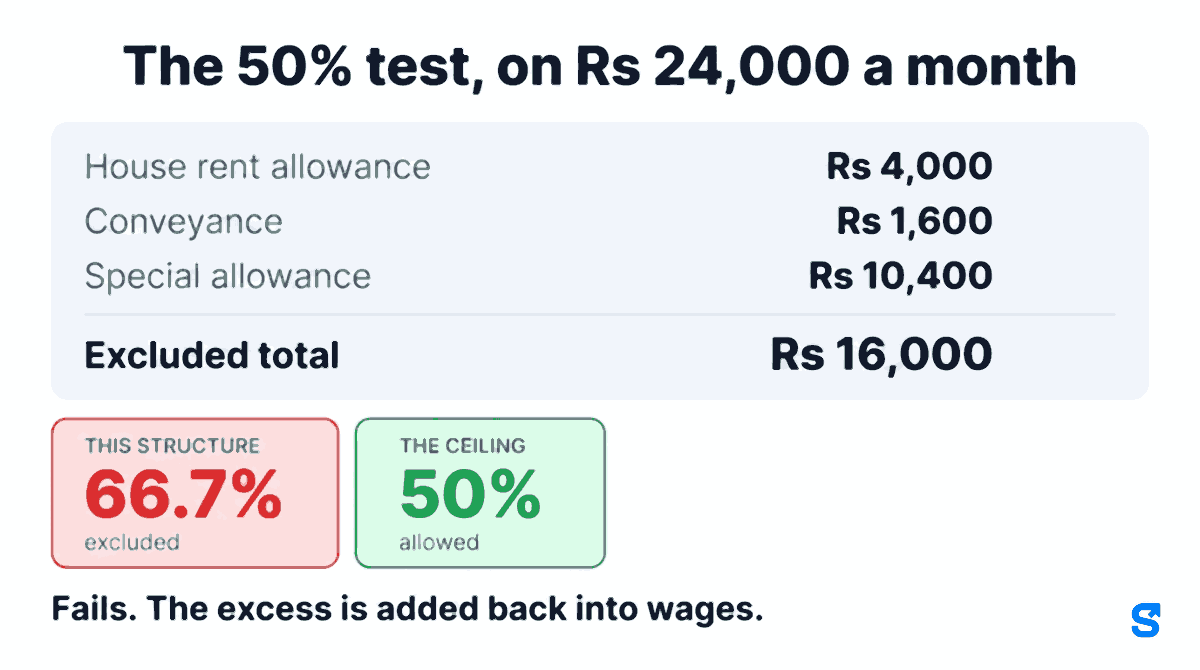
This is where the rule bites hardest, and it is the pay band most Indian SMEs employ in. A shop supervisor in Nagpur on Rs 24,000 gross, structured the conventional way:
| Component | Old structure | Counts as wages? |
|---|---|---|
| Basic | Rs 8,000 | Yes |
| HRA | Rs 4,000 | Excluded |
| Conveyance | Rs 1,600 | Excluded |
| Special allowance | Rs 10,400 | Excluded |
| Total remuneration | Rs 24,000 | — |
Running the test:
- Excluded total = 4,000 + 1,600 + 10,400 = Rs 16,000, which is 66.7% of pay
- One-half of total remuneration = Rs 12,000
- Excess = 16,000 − 12,000 = Rs 4,000
- Deemed wages = 8,000 + 4,000 = Rs 12,000, against a stated Basic of Rs 8,000
What that does to the bill, per employee:
| Liability | On old Basic (8,000) | On deemed wages (12,000) |
|---|---|---|
| Employer PF at 12% | Rs 960/month | Rs 1,440/month |
| Employee PF at 12% (reduces take-home) | Rs 960/month | Rs 1,440/month |
| Gratuity after 5 years (15/26 formula) | Rs 23,077 | Rs 34,615 |
| Overtime rate (2x, 26 × 8 divisor) | Rs 76.92/hour | Rs 115.38/hour |
Rs 480 a month of extra employer PF is Rs 5,760 a year per employee. Across twenty staff on similar structures, that is a six-figure annual cost appearing in a business that changed nothing about what it pays anyone. The same Rs 480 comes out of the employee's take-home as their own contribution, which is why staff notice this change before the finance team explains it.
Worked Example 2: Rs 40,000 a Month, Above the PF Ceiling
Higher salaries behave differently, and the difference is worth knowing before you restructure everybody in a panic. A branch manager on Rs 40,000 gross:
- Basic 16,000, HRA 8,000, conveyance 2,400, special allowance 13,600
- Excluded total = Rs 24,000 (60%); half of pay = Rs 20,000; excess = Rs 4,000
- Deemed wages = 16,000 + 4,000 = Rs 20,000
Provident fund: no change. The mandatory PF ceiling is Rs 15,000 of wages a month. Both the old Basic and the new deemed wage sit above it, so an employer who contributes on the ceiling pays Rs 1,800 either way. Contributing on the full wage remains voluntary and unmatched.
Gratuity: up 25%.Gratuity has no ceiling on the wage base, only on the payout. Ten years' service moves from Rs 92,308 to Rs 115,385, and that liability accrues on the balance sheet from today, not on the day the person resigns.
Overtime, notice pay, leave encashment: up 25%, because each is computed on wages.
So the rule of thumb is: below the PF ceiling, the cash cost hits immediately and monthly. Above it, the cost is mostly deferred into gratuity and exit payments: quieter, larger, and easier to under-provision for.
The One Consequence Most SMEs Have Not Modelled: ESI
Employees' State Insurance applies to employees whose wages do not exceed Rs 21,000 a month. The ceiling has not moved. What moved is the meaning of “wages” used to test it.
Under the old ESI reading, the test ran close to gross pay, so the Rs 24,000 supervisor in Example 1 sat outside ESI. Under the Code definition, that employee's wages are Rs 12,000: comfortably inside the ceiling. Employees your payroll has never treated as ESI-covered may now be covered, which means contributions, an insurance number, and exposure if you miss them.
This is the point on which practitioner opinion is least settled and on which the Ministry's own FAQs have been revised more than once. Do not resolve it from a blog post, this one included: check your specific structures against the current Ministry of Labour FAQs on the Labour Codes and, where a borderline employee is involved, with your regional ESIC office in writing. A written reply is worth more than a consultant's confidence.
The Three Ways to Restructure, and What Each Costs
Route 1: Raise Basic to 50%, hold CTC flat
The tidiest option. Rewrite the Rs 24,000 structure as Basic 12,000, HRA 4,800, conveyance 1,600, special allowance 5,600. Excluded components now total Rs 12,000, exactly half, so nothing is added back and the payslip finally means what it says.
The catch is take-home. Employee PF rises from Rs 960 to Rs 1,440, so net pay drops about Rs 480: roughly 2% to 5% for most SME pay bands. The money is not lost; it goes into the employee's own retirement account. But if nobody explains that in advance, you will spend a fortnight answering the same question. Send a one-page note with the revised structure showing the old net, the new net, and the increase in their PF balance.
Route 2: Raise Basic and gross up, so take-home is unchanged
Increase total remuneration enough to absorb the higher employee contribution. Staff see no reduction; you carry both the extra employer PF and the top-up. It is the most expensive route and the most popular one in businesses with tight labour markets, where a visible pay cut costs more in attrition than the increase costs in cash.
Route 3: Change nothing and pay on the deemed wage
Perfectly lawful. The add-back is automatic, so an employer who computes PF, gratuity and overtime on the deemed figure while leaving the payslip alone is compliant. The risk is not legal, it is operational: the wage base then exists only inside whoever runs your payroll spreadsheet, it is invisible to the employee, and it is exactly the number that gets forgotten when that person leaves or when a new hire is set up. Arrears found in an inspection carry interest and damages.
Route 4 does not exist
You cannot cut an employee's existing wages to bring the ratio into line, and you cannot relabel a special allowance as a “reimbursement” where no expense is actually incurred and vouched. Both are read as evasion, and the second one fails the moment an inspector asks for the bills. Renaming a component has never been a defence under Indian wage law.
Everything That Moves With the Wage Base
Owners model the PF impact and stop. These all sit on the same definition:
- Provident fund and pension: 12% each side, on wages, capped at Rs 15,000 for mandatory purposes.
- Gratuity: last drawn wages × 15 ÷ 26 × years of service. Under the Code on Social Security, fixed-term employees earn it pro rata without the five-year qualifying period, which is a genuine new liability for anyone hiring on contract.
- Overtime: twice the ordinary rate of wages. A higher base raises every overtime hour you have already scheduled.
- Statutory bonus: eligibility and calculation both run off wages.
- Leave encashment: paid on wages, so the carry-forward liability on your books rises with no policy change.
- Notice pay and retrenchment compensation: 15 days' wages per completed year, on the higher base. The Industrial Relations Rules also require an employer who retrenches a worker to transfer 15 days' last drawn wages to a designated account with the Labour Commissioner within 10 days.
- ESI: both the coverage test and the contribution, as above.
Where the Numbers Come From: Attendance
Here is the part that gets skipped. Every figure above is a rate. What you actually pay is a rate multiplied by time: days present, days of loss of pay, hours of overtime, leave taken, leave carried forward. Restructuring fixes the rate. It does nothing for the multiplier, and under the new wage base an error in the multiplier costs more than it used to, because every hour is now worth more.
An overtime hour in Example 1 went from Rs 76.92 to Rs 115.38. If your overtime hours come from a supervisor's notebook or a WhatsApp message, the same sloppiness that used to cost Rs 77 an hour now costs Rs 115: in both directions, because padded punches are as expensive as unpaid ones are risky. The Central Rules also prescribe the wage register and wage slip you have to produce on inspection, and a register can only be as accurate as the attendance behind it.
How Shiftelio Handles the New Wage Definition
Shiftelio was built for exactly this shape of problem: Indian statutory payroll sitting directly on verified attendance rather than on a spreadsheet somebody retypes:
- Wages computed per employee, per month. The payroll engine totals the excluded components, runs the 50% test, and applies the add-back where it triggers, so the statutory base is derived rather than remembered. An employee whose special allowance changes mid-year is recomputed automatically.
- PF, ESI and PT on the derived base. Contributions follow the deemed wage, the Rs 15,000 PF ceiling is applied where it bites, and the ESI ceiling is tested against the same figure, with EPFO and ESIC-ready reports out the other end.
- Overtime at the correct rate. Hours come from GPS and selfie-verified check-ins with geofencing, not from a notebook, and the 2x rate is applied to the wage base the Code defines, with the divisor configurable for your state.
- Payslips that show the working. Wages, excluded components and the add-back appear as line items, so the employee sees why their PF deduction moved and an inspector sees the audit trail.
- Gratuity and leave liability that track the new base. Both accrue on wages as redefined, so the provision on your books reflects what you would actually owe today.
All of it is included at a flat yearly price with no per-employee fee: statutory compliance is not a paid add-on. If you would rather work your own numbers first, the free PF and ESI calculator and overtime calculator need no signup.
Your Restructuring Checklist
- Export every current salary structure with components broken out. You cannot run the test on CTC alone.
- Compute the excluded percentage per employee. Anyone above 50% has an add-back today.
- Quantify the gap: extra employer PF per month, revised gratuity provision, revised overtime rate, and any employee newly inside the ESI ceiling.
- Pick a route per pay band, not one for the whole company. Below the PF ceiling and above it behave differently.
- Reissue appointment letters and wage slips in the formats the Central Rules prescribe.
- Tell your staff before the payslip does. Show the old net, the new net, and where the difference went.
- Check your state's rules for register and inspection specifics, and re-check quarterly while notifications are still rolling out.
- Fix the attendance source so the hours feeding the new rates are defensible.
Frequently Asked Questions
Does the law require Basic to be exactly 50% of CTC?
No. It requires that excluded allowances not exceed half of total remuneration, and adds back the excess if they do. Setting Basic at 50% is the simplest way to satisfy that, not the only way.
Is the employer's PF contribution counted in the 50% test?
The employer's PF and pension contribution is one of the listed exclusions, so it is not wages. Whether it also sits inside “all remuneration” for the purpose of computing the half is the single most argued point in the definition, and the answer changes your arithmetic. The Ministry's FAQs address it and have been updated; use the current version and, for a borderline structure, a written clarification.
Will my employees' take-home pay fall?
Where the add-back raises wages below the PF ceiling, yes: typically 2% to 5%, because the employee's own 12% is computed on a larger base. It is a transfer into their retirement account, not a pay cut, but it will read as one on the payslip unless you explain it first.
We are 12 employees. Does any of this apply to us?
The wage definition applies to every employer regardless of size. What varies with headcount is which other obligations attach: PF registration at 20 employees, ESI generally at 10, various registers and standing orders at higher thresholds. Small does not mean exempt from the definition.
Do we owe arrears for the period since November 2025?
If your structures have been above the 50% line since the codes commenced and you contributed on the old base, there is a shortfall. Quantify it, take advice on the disclosure route, and fix it before an inspection finds it: PF shortfalls carry interest and damages, and voluntary correction is treated very differently from a discovered one.
Does the 50% rule change income tax on salary?
Not directly. This is labour law, not tax law, and the Income Tax Act has its own definitions. The indirect effects are real though: a larger Basic changes the HRA exemption calculation and the deductible PF contribution, so tax outcomes shift even though no tax rule changed.
Can we phase the restructure over a year?
You can phase the payslip. You cannot phase the liability: the add-back applies from the date the codes commenced, whatever your payslip says. Phasing the visible structure while paying statutory dues on the correct base from day one is a reasonable plan. Phasing the payments is not.
What about gig and platform workers?
They sit outside this wage definition and inside a separate social security framework under the Code on Social Security, funded by aggregator contributions. If you engage genuinely independent platform workers, the 50% rule is not your issue; misclassifying employees as gig workers to avoid it very much is.
Historical Context
We published a PF and ESI compliance checklist for FY 2025-26 describing the framework as it stood under the Employees' Provident Funds Act, 1952 and the pre-code wage base. That guide remains accurate for the period it covers, and it is the right reference if you are reconciling older filings. For anything from 21 November 2025 onward, the definition on this page governs. Our guide to the four Labour Codes covers the wider changes to working hours, gratuity and gig worker rights, and the EPFO guide is updated for the EPF Scheme, 2026.
For primary sources, the Code on Wages, 2019 is published in full on the Government of India's official code repository at indiacode.nic.in, and the Ministry of Labour and Employment maintains the notified rules, compliance handbook and FAQs at labour.gov.in. Where this article and a notification differ, the notification governs.
The Bottom Line
The 50% wage rule did not raise anybody's salary. It removed the ability to decide, by naming a component, how much of that salary the law would notice. For most Indian SMEs the honest summary is: your provident fund bill goes up for staff below the ceiling, your gratuity provision goes up for everyone, some employees you thought were outside ESI are not, and every overtime hour is now worth more than it was.
None of that is fixed by a better spreadsheet formula, because the input that goes wrong is not the rate: it is the attendance the rate multiplies. Get the structures right once, then make sure the hours feeding them are verified rather than reported. That combination is what survives an inspection.
Keep reading
See how Shiftelio does this in practice with the EPF Scheme 2026 guide and the new wages basis.
Work your own numbers with the free PF and ESI calculator. No signup, no email.