How to Calculate Employee Payroll in India: Step-by-Step Guide for Small Businesses
In short
From CTC breakup to net salary calculation, PF deductions to Professional Tax slabs. A practical payroll calculation guide for Indian SME owners doing it manually in Excel.
Most small business owners in India calculate payroll in one of two ways: they ask an accountant to do it, or they build a spreadsheet and hope they got the formulas right. Both methods work until they do not, which is the month the accountant is unavailable in the last week of the month, or until the spreadsheet formula misses the February Professional Tax spike and three employees get the wrong net pay.
This guide walks through every step of payroll calculation for an Indian SME, with real numbers at each stage. By the end, you will know exactly what goes into a payslip, what must be deducted and when, and what the most common errors are that trigger EPFO notices and salary disputes.
What Is CTC and Why It Is Not the Same as Take-Home Salary
CTC stands for Cost to Company. It is the total annual expense a business incurs for one employee. Take-home salary (also called in-hand or net salary) is what the employee actually receives after deductions. The difference between the two is significant and confuses many first-time employers.
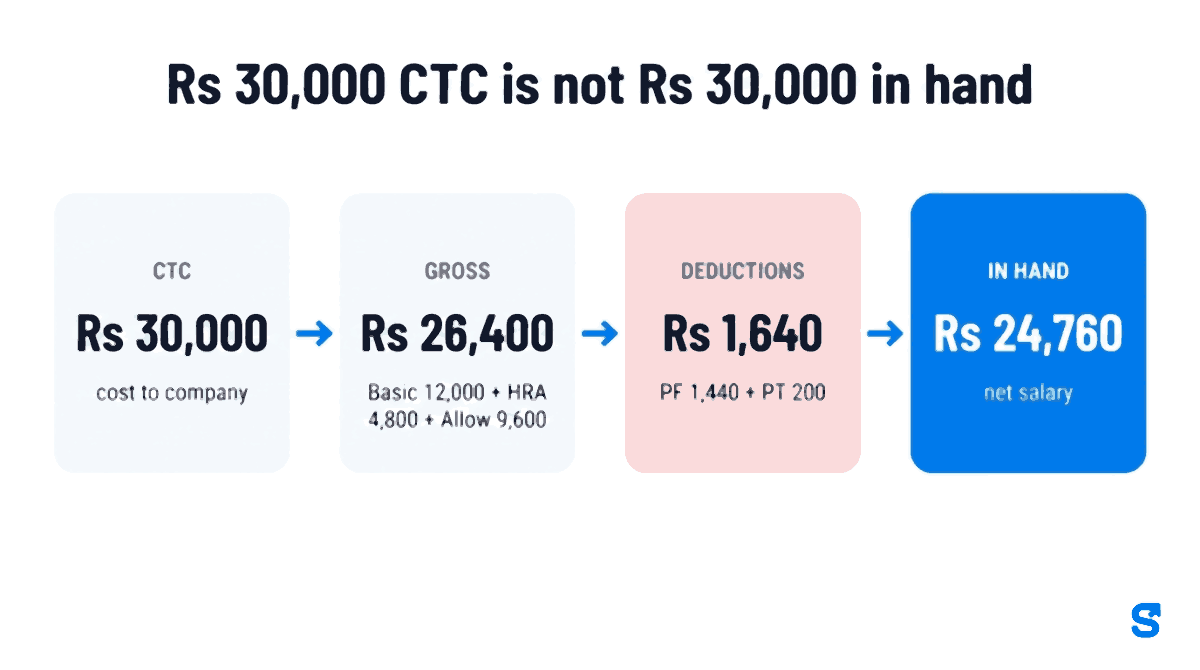
A simple example: an employee with a CTC of Rs 30,000 per month does not take home Rs 30,000. After PF deductions, Professional Tax, and possibly TDS, they may take home Rs 25,000 to Rs 27,000. If you offer "Rs 30,000 CTC" in a job offer and the candidate expects Rs 30,000 in hand, you will have a dispute on the first payslip.
Always clarify CTC versus in-hand when making salary offers.
The Standard Salary Structure in India: What Goes Into a Payslip
A typical Indian SME payslip has five components. We will use a Rs 30,000 per month CTC employee as the running example throughout this article.
| Component | Typical % | Amount (Rs 30K CTC) |
|---|---|---|
| Basic Salary | 40-50% of CTC | Rs 12,000 |
| House Rent Allowance (HRA) | 40% of Basic (non-metro), 50% (metro) | Rs 4,800 |
| Special Allowance | Residual (balancing figure) | Rs 9,600 |
| Employer PF (employer's cost) | 12% of Basic | Rs 1,440 |
| Gratuity provision (optional) | 4.81% of Basic | Rs 577 |
| Gross Salary (employee earns) | Rs 26,400 |
Note that Gross Salary (what the employee earns before deductions) is Rs 26,400, not Rs 30,000. The Employer PF (Rs 1,440) and gratuity provision (Rs 577) are costs the company bears on top of what the employee receives. They are part of CTC but never appear in the employee's hand.
Step-by-Step Payroll Calculation
Using our Rs 30,000 CTC example, here is the complete calculation:
Step 1: Establish Gross Salary
Gross = Basic + HRA + Special Allowance = Rs 12,000 + Rs 4,800 + Rs 9,600 = Rs 26,400
Step 2: Calculate Employee PF Deduction
Employee PF = 12% of Basic = 12% of Rs 12,000 = Rs 1,440
This is deducted from the employee's gross salary and deposited to EPFO on their behalf.
Step 3: Calculate Professional Tax
Professional Tax depends on the state. Below are the current rates for three major states:
| State | Monthly Gross | PT per month |
|---|---|---|
| Maharashtra | Up to Rs 7,500 | Nil |
| Maharashtra | Rs 7,501 to Rs 10,000 | Rs 175 (male); Nil (female) |
| Maharashtra | Above Rs 10,000 | Rs 200 (Rs 300 in February) |
| Karnataka | Up to Rs 24,999 | Nil |
| Karnataka | Rs 25,000 and above | Rs 200 (Rs 300 in February) |
| Delhi | Any amount | Nil (Delhi does not levy PT) |
For our Rs 26,400 gross employee in Maharashtra: PT = Rs 200 per month (Rs 300 in February).
Note: Karnataka revised its PT slabs effective 1 April 2025. The old Rs 15,000 threshold no longer applies. If your Karnataka payroll still uses the old slabs, update immediately.
Step 4: Check Whether TDS Applies
Under the new income tax regime for FY2025-26, any employee with taxable income up to Rs 12,00,000 per year pays zero income tax after the Section 87A rebate. Salaried employees also receive a standard deduction of Rs 75,000, so an employee earning up to Rs 12,75,000 annual gross salary has zero tax liability.
For our Rs 26,400 gross monthly employee: annual gross is approximately Rs 3.17 lakh, which is well below the Rs 12.75 lakh threshold. Zero TDS applies. No TDS needs to be deducted or deposited.
For most SME employees earning under Rs 12.75 lakh per year, income tax is not a monthly payroll concern. You still need to confirm the tax regime election with each employee at the start of April.
Step 5: Calculate Net Pay
| Item | Amount |
|---|---|
| Gross Salary | Rs 26,400 |
| Less: Employee PF | (Rs 1,440) |
| Less: Professional Tax (Maharashtra) | (Rs 200) |
| Less: TDS | Nil |
| Net / Take-Home Salary | Rs 24,760 |
Key Compliance Deadlines to Remember Every Month
- PF payment: 15th of the following month. Miss this by even one day and 12% per annum interest starts automatically under Section 7Q.
- ESI payment: 15th of the following month. Many older sources still say the 21st, but this was changed to the 15th in June 2017.
- TDS deposit: 7th of the following month (or 30 April for March).
- Professional Tax: Due dates vary by state. Maharashtra requires annual payment by 31 March for the prior year; monthly deposits are optional for small businesses but recommended.
- Payslip: Must be issued to every employee every month. There is no prescribed format at the central level, but it must include gross pay, all deductions itemised, and net pay.
Why Most Small Business Owners Get This Wrong in Excel
The most common errors in manual payroll spreadsheets:
- PF calculated on gross instead of basic. PF is 12% of basic wages, not gross salary. Calculating it on the full gross will overpay PF contributions and cause reconciliation problems with EPFO.
- Forgetting the February Professional Tax spike. Maharashtra and Karnataka charge Rs 300 in February instead of the usual Rs 200. Many Excel sheets hardcode Rs 200 every month and miss the February adjustment.
- Using outdated Karnataka PT slabs. The Rs 15,000 Karnataka threshold was updated to Rs 25,000 from 1 April 2025. Payrolls running on the old slab are deducting PT from employees who are now exempt.
- Not adjusting for attendance. A 26-day salary for someone who was present only 22 days must be adjusted. The per-day rate is monthly salary divided by the number of working days in that month, not divided by 26 as a fixed number.
- Missing the ESI wage ceiling. An employee promoted to Rs 22,000 gross monthly is no longer eligible for ESI. Continuing to deduct ESI from their salary is an error that has to be corrected with ESIC.
Excel Versus a Payroll App: The Honest Comparison
Before the list of things a spreadsheet gets wrong turns into an argument for buying software, the case for the spreadsheet deserves stating properly, because it is a real one. Excel is free. You already own it and you already know how to drive it. It opens without internet, on a laptop, in a power cut, with no login and no vendor. It does exactly what you tell it and nothing you did not ask for. For a stable team of eight people at one location, on fixed monthly salaries, with almost no attendance variation from month to month, a well-built payroll sheet is a perfectly reasonable answer and switching away from it would be a waste of money.
The place it breaks is not the arithmetic. It is everything around the arithmetic:
- The attendance number is typed, not observed. Days present arrive in the sheet from a register, a WhatsApp message or a manager's recollection. The sheet records what somebody reported, not what happened, and no cell in it can tell you which.
- There is no evidence behind a disputed figure. When an employee says 24 days and the sheet says 22, you have two assertions and no record with a time and a place attached to it. That is a bad position in front of a labour officer and a worse one in front of the employee.
- A formula error is invisible and silent. A range that stops one row short, a PT slab left on last year's threshold, a PF percentage applied to gross instead of basic: every one of those produces a number that looks completely normal. Nothing warns you. You discover it during an EPFO reconciliation, months later, with interest running.
- The file lives on one laptop. It travels with that machine, including into a repair shop and out of the company with whoever leaves. Salary history is exactly the thing you cannot reconstruct afterwards.
- Two branches means two files. Merging them by hand at month end creates a third file, and from then on nobody is quite certain which copy is current.
- The month-end transcription exists only because the record and the pay run are separate systems. Register, then sheet, then deductions table, then payslip: four hops, three of them re-keying. Software does not do the arithmetic better than Excel. It removes the hops.
Now the arithmetic on whether that is worth paying for. Put a value on the hour of whoever does this work, say Rs 500, whether that is a bookkeeper you pay or your own Sunday evening. The section above puts a 25-person payroll at 8 to 12 hours a month, so call it 120 hours a year at the low end. The Growth plan is Rs 5,999 a year, which at the same Rs 500 an hour is about 12 hours. So the comparison is roughly 12 hours of cost against 120 hours of work, before you count the value of not discovering a slab error six months late. If your payroll is four people and takes you an hour, that sum comes out the other way, and you should keep the spreadsheet.
One thing that is not part of this argument: a payroll spreadsheet is not illegal or non-compliant. There is no rule requiring software, and a properly maintained sheet that produces correct payslips and correct deductions satisfies the obligation entirely. The case against Excel is effort and evidence, and anyone telling you otherwise is overselling.
Which Product Runs This Payroll, and What It Costs
How Payroll Software Changes This
Payroll software that is configured for Indian statutory rules handles every calculation above automatically. It applies PF to the correct basic wage, uses state-specific PT slabs by location, adjusts for actual attendance from the attendance records, flags when an employee crosses the ESI wage ceiling, and generates the Electronic Challan cum Return (ECR) file in the format EPFO requires for online submission.
For a 25-person business, the time saving is roughly 8 to 12 hours per month, which is the time currently spent counting attendance, building the deductions table, checking PT slabs, and verifying the totals before payment. That time has a cost, even if it is the owner's own Sunday evening.
The more important saving is the compliance certainty. A correct payroll that goes out on time, every month, with the right deductions, is one fewer source of staff disputes and regulatory notices.
Keep reading
See how Shiftelio does this in practice with EPF contribution rates and the new wages basis.
Work your own numbers with the free PF and ESI calculator. No signup, no email.