How to Manage Employee Shifts Without WhatsApp, Excel, or a Whiteboard in India
In short
Rotating shifts, last-minute absences, and overtime disputes are the biggest headaches for Indian SME operations managers. Here is a practical guide to shift management that actually works.
India's MSME sector employs 34.63 crore people across 7.86 crore enterprises. Retail, manufacturing, security, logistics, hospitality, and healthcare all run on people working in shifts. And according to research published in March 2026, 80% of Indian MSMEs still struggle with shift management, not because they do not care, but because they are running shifts on WhatsApp, Excel, and handwritten rosters that break down the moment the team grows past 15 people.
This guide is for the operations manager or business owner running 2 or 3 shifts a day with 10 to 50 employees. It covers what the law says about shift work in India, what the real cost of WhatsApp-based scheduling is, and what a practical shift management system actually looks like in daily use.
Why Shift-Based Work Is the Backbone of Indian SMEs
Shifts are not only for factories and hospitals. Here is which Indian industries run on shift-based staffing and why:
| Industry | Why shifts matter |
|---|---|
| Manufacturing | 24/7 production lines; machinery downtime costs more than labour |
| BPO and IT support | Time-zone alignment with US and UK clients; 1.6 million+ night shift workers in India |
| Security agencies | Mandatory round-the-clock guard deployment; no gaps between shifts allowed |
| Retail and supermarkets | Morning, afternoon, and closing shifts; peak-hour surge staffing on weekends |
| Hospitality and restaurants | Multiple meal-service windows; 15-25% no-show rate on shifts is documented industry-wide |
| Logistics and delivery | Warehouse loading shifts, last-mile delivery windows, 24-hour cold-chain operations |
| Healthcare | Patient care never stops; nursing rotations must have zero coverage gaps |
The Real Cost of Managing Shifts on WhatsApp and Excel
Analysis from Mewurk found that for a workforce of 500 field associates, manual roster management consumes approximately 250 hours per month, worth roughly Rs 13.4 lakh in HR and management time annually. For a 50-person business, the equivalent cost is smaller but the proportional burden on the owner or manager is the same.
The specific costs are:
- No single view of the roster: The shift schedule exists as a pinned message in a WhatsApp group, a printed A4 sheet, or an Excel file on someone's laptop. When someone calls in sick at 7 AM, the manager has to remember who is available, call people individually, and update the schedule manually.
- No audit trail for swaps: Two employees informally switch days. Neither tells HR. Payroll runs against the original roster. One person gets paid for a shift they did not work; the other does not get paid for the shift they covered. Both are now unhappy.
- No visibility into overtime liability: Without a system tracking cumulative weekly hours, a manager who adds an extra shift to cover an absence does not know they are pushing an employee past 48 hours until the payroll dispute happens.
- No-show chaos: In food service, 15 to 25% of shifts see a no-show. In the absence of an automated alert, the manager finds out when the employee does not arrive, not 2 hours before when there would still be time to find a replacement.
What the Factories Act Says About Shifts and Overtime
The Factories Act 1948 sets the legal framework for shift work in India. Its key provisions apply to any factory with 10 or more workers using power, or 20 or more workers without power, and many of its principles have been carried into state-level Shops and Establishments Acts covering restaurants, retail, and services:
- Maximum daily hours: 9 hours (Section 54)
- Maximum weekly hours: 48 hours (Section 51)
- Overtime rate: Twice the ordinary wage rate for every hour worked beyond the daily or weekly limit (Section 59). There is no discretion here. 2x is the legally mandated rate.
- Rest interval: At least 30 minutes after no more than 5 continuous hours of work (Section 55)
- Spread-over limit: The total period from start to finish of a working day, including rest intervals, cannot exceed 10.5 hours (Section 56)
- Night shift definition: Work performed between 10 PM and 6 AM under the Occupational Safety, Health and Working Conditions Code 2020
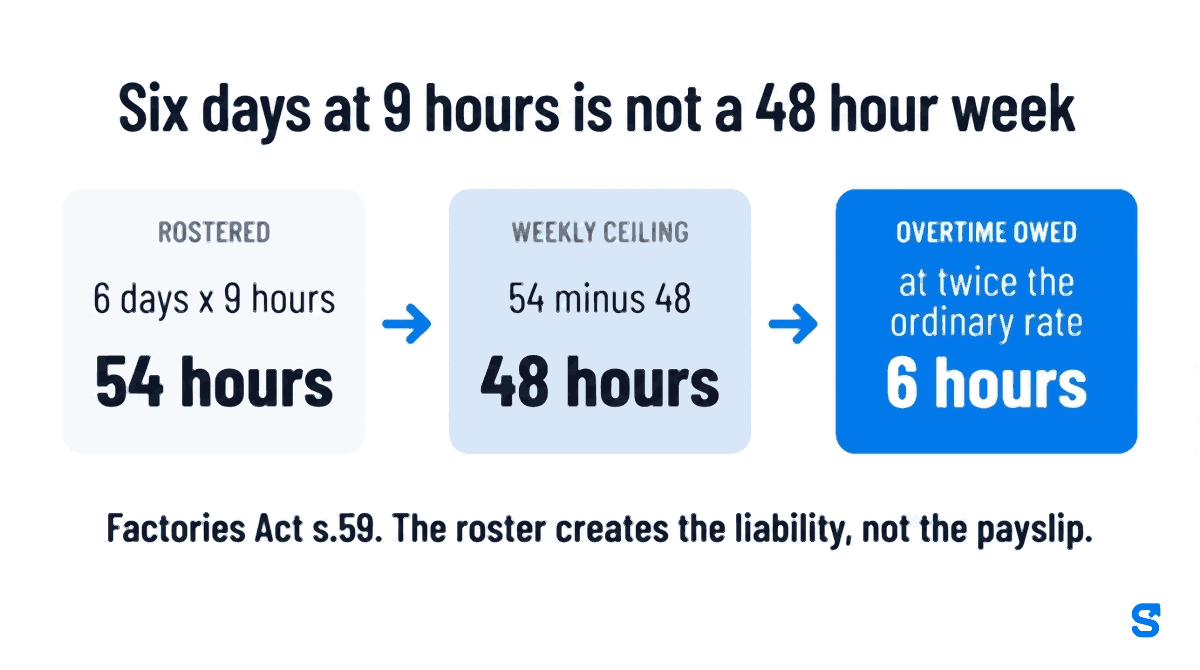
The overtime provision is the most commonly violated rule in small Indian businesses running shifts. An employee who works 6 days at 9 hours each has worked 54 hours in the week, which is 6 hours of overtime at double the daily rate. Many businesses pay a flat salary regardless, which is not legal for time-rated workers and creates a retrospective liability.
Common Shift Management Problems Indian Owners Actually Face
Here are the five situations that come up most often in shift-based Indian businesses:
- The 7 AM absence call. An employee calls in sick at 7 AM. The shift starts at 8. The manager has 60 minutes to find a replacement by scrolling through WhatsApp contacts and calling people who may or may not be available. There is no view of who has already worked extra hours this week, who has a day off, or who lives close enough to get there in time.
- The informal shift swap. Two employees agree between themselves to swap days without telling anyone. The roster shows Employee A on Tuesday but Employee B actually works it. Payroll is run against the original roster. Employee A gets paid for a day off; Employee B is short. Resolving it takes the rest of the week.
- The overtime dispute. An employee claims they worked four extra hours this month. The supervisor says it was two. The paper register or WhatsApp chat shows timestamps but no one verified that each timestamp corresponds to a real check-in from the right location. The dispute goes unresolved, the employee is paid less than they worked, and they leave.
- The double shift without consent. A manager adds an employee to a second shift to cover an absence, without checking that the employee already worked a full shift earlier that day. The spread of day exceeds 10.5 hours. The employee complains; the manager had no system to flag the conflict before publishing the updated schedule.
- The undiscovered no-show. An employee does not show up for the 2 PM shift. The manager finds out at 2:30 PM when the team calls. There was no automated check-in alert, no notification at 2:10 PM saying the employee had not yet punched in.
What Good Shift Scheduling Actually Looks Like
A functioning shift management system for an Indian SME has four components:
1. A digital roster published in advance. The weekly schedule is created on Monday for the following week. Every employee can see their own shifts in the app. No one can claim they did not know their schedule. Changes to the roster trigger automatic notifications to affected employees.
2. GPS check-in per shift. Each shift has a start time. If an employee has not checked in by a defined grace period after the shift start, the manager receives an automatic alert. This replaces the 2:30 PM discovery call with a 2:05 PM notification, when there is still time to act.
3. Automatic spread-of-day and overtime flags. Before publishing a roster, the system checks whether any employee is being scheduled beyond 48 weekly hours, with a spread exceeding 10.5 hours, or without the required 30-minute rest interval. Compliance violations are flagged before they happen, not discovered after an inspector visit.
4. Shift swap with approval trail. When two employees agree to swap, they request it in the app. The manager approves or rejects it. The roster updates automatically. Payroll runs against the actual shifts worked, not the original schedule.
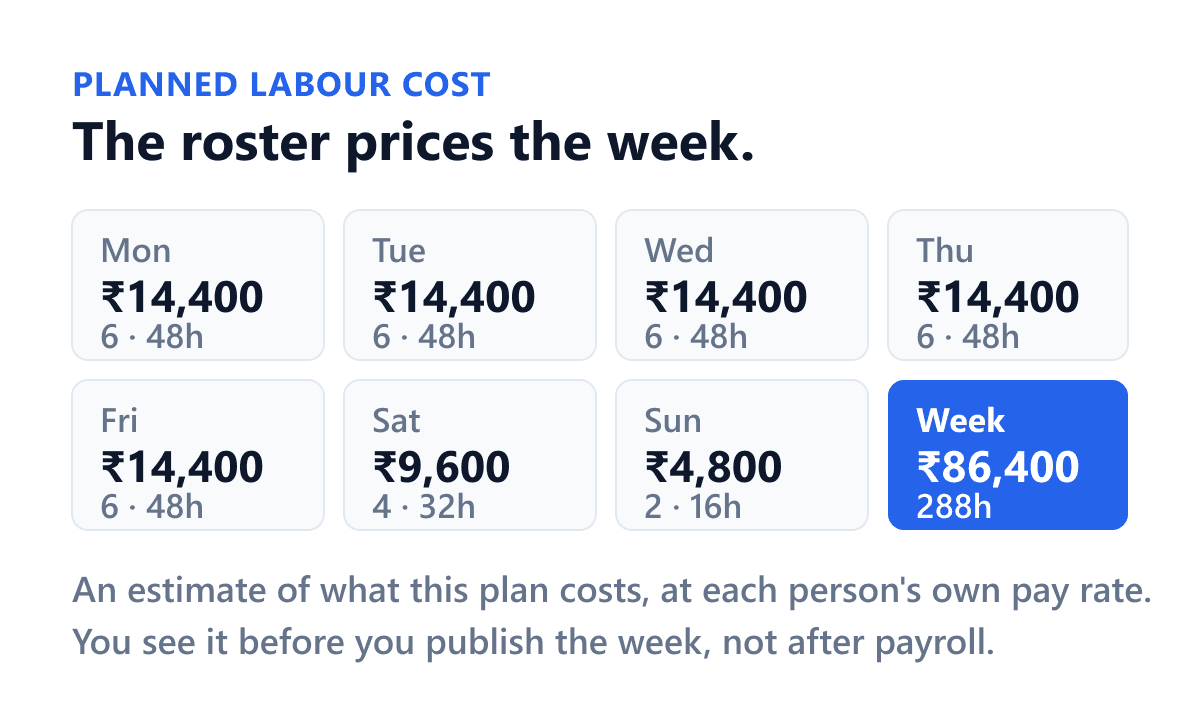
Automatic Overtime Calculation: Why It Protects Your Business
Under Section 59 of the Factories Act, overtime must be paid at twice the ordinary wage rate. For a worker earning Rs 400 per day (Rs 50 per hour on an 8-hour basis), an overtime hour costs Rs 100, not Rs 50. An employee who works 6 extra hours in a week is owed Rs 600 in overtime, not Rs 300. Many small businesses pay the straight rate and do not know they are underpaying until a labour dispute surfaces.
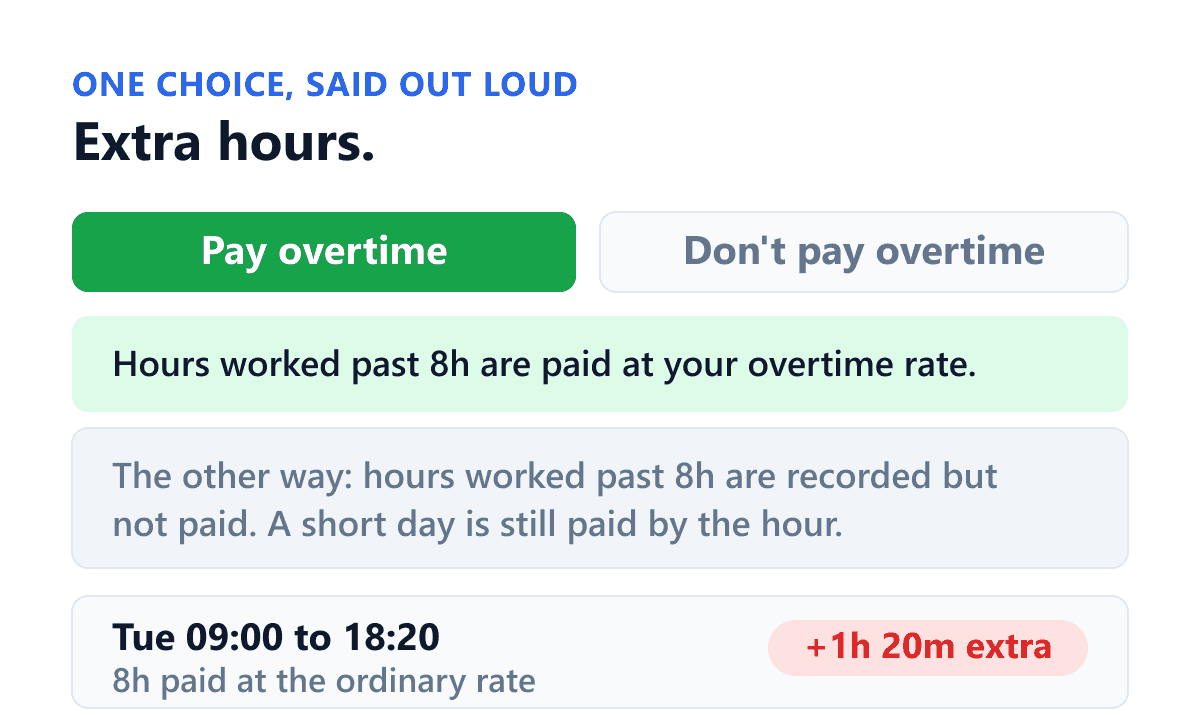
Shift management software tracks cumulative hours per employee per week in real time. Before adding a shift that would push someone past 48 hours, the manager sees a flag. If the extra shift is approved anyway, the overtime hours are calculated automatically at the correct 2x rate and included in the month's payroll. No manual calculation. No dispute about how many hours were worked.
What a Roster Tool Costs, and Who Should Not Buy One
Getting Started: Moving Your Shifts Off WhatsApp in One Week
Migrating from WhatsApp and Excel to a shift management app is a one-week process for most SMEs:
- Day 1: Add your locations, shift timings (e.g., Morning 8 AM to 4 PM, Evening 4 PM to 12 AM), and employee list with phone numbers.
- Day 2: Employees receive an invite by SMS or WhatsApp, download the app, and can see their assigned shifts immediately.
- Day 3 to 5: Run the first digital roster alongside your existing WhatsApp schedule as a parallel. Compare the two to verify accuracy.
- End of Week 1: Archive the WhatsApp group and Excel file. The app is the single source of truth for shifts and attendance going forward.
The WhatsApp group does not need to disappear. It can stay active for general team communication. What changes is that attendance and scheduling move to a system that creates a verifiable record, flags compliance issues before they become fines, and calculates payroll automatically at month end.
For a business owner who currently spends every Monday morning rebuilding the weekly roster from scratch, the first week of digital shift scheduling is the most visible change: the roster builds in 15 minutes from a template instead of 90 minutes from a blank screen.
Keep reading
See how Shiftelio does this in practice with the roster itself: publish once, swaps and per-shift rates included.
Work your own numbers with the free shift roster template. No signup, no email.