How to Manage Restaurant Staff Attendance in India (Without a Biometric Machine at the Counter)
In short
Split shifts, high turnover, and late-night closing. Discover how Indian restaurant owners track staff attendance accurately using a phone-based app with no hardware at the POS counter.
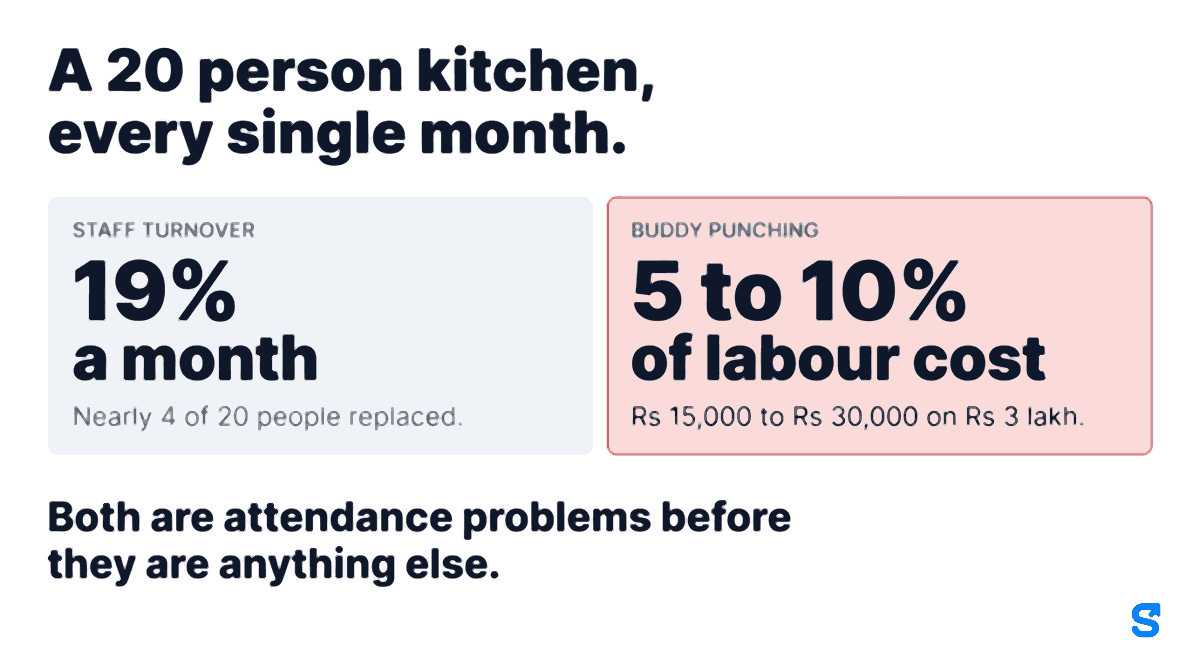
India's restaurant and food service sector employs 8.5 million people across more than 500,000 outlets, and is projected to employ 10.3 million by 2028. It is the second-largest employer in the country. It also has one of the highest monthly staff attrition rates of any industry: roughly 19% per month in quick service restaurants, which means roughly one in five of your staff leaves or joins every single month.
Running attendance in that environment on a paper register, a WhatsApp group, or a biometric machine at the counter creates specific problems that do not exist in other industries. This guide covers what those problems are, what the law requires, and what actually works for a restaurant with 5 to 30 staff across 1 to 3 locations.
Why Restaurant Attendance Is Different from Every Other Industry
Three things make restaurant attendance tracking uniquely difficult:
Split shifts. A server or floor staff member might work the lunch service from 11 AM to 3 PM, go home, and return for the dinner service from 7 PM to 11 PM. That is two separate shifts on the same day. A paper register records two sign-ins. But what the Shops and Establishments Act actually cares about is the "spread of the working day", which is the total span from the first check-in to the last check-out. If that span exceeds 10.5 hours (including the break), the employer has a compliance issue. Almost no paper or WhatsApp system captures this correctly.
Kitchen conditions.Fingerprint biometric scanners fail when hands are wet, greasy, or flour-dusted. A kitchen worker who cannot scan their finger stands at the machine for 30 seconds while the lunch rush builds behind them. Colleagues start scanning for each other as a practical workaround. Buddy punching is not always malicious in F&B. It starts as a convenience and becomes a habit.
High and fast turnover. India's restaurant sector sees 80 to 150% annual staff turnover. At 19% monthly attrition in QSRs, a restaurant with 20 staff replaces nearly 4 people every month. Every new hire needs to be enrolled in the attendance system immediately, or you have a gap in the records from their first week. A biometric machine requires a technician or manager to enroll each new fingerprint. A mobile app requires a 2-minute invitation by phone number.
The Real Cost of Getting Attendance Wrong
Buddy punching inflates restaurant labour costs by 5 to 10%, according to industry analysis. For a restaurant with Rs 3 lakh in monthly payroll, that is Rs 15,000 to Rs 30,000 in avoidable waste every month. At 12 months, Rs 1.8 lakh to Rs 3.6 lakh paid for hours that were never worked.
Incorrect overtime tracking creates a different kind of loss: you underpay an employee for extra hours worked, they notice, and they leave. Given the 19% monthly attrition rate, delayed or incorrect salary is one of the top documented drivers of F&B attrition in India. Keeping a staff member costs far less than replacing one, because replacement costs in the restaurant sector typically run 15 to 30% of the employee's annual wages in recruitment, training, and lost productivity during the transition period.
Incorrect PF and ESI deductions based on wrong attendance data compound over months and create a retroactive liability during audits.
Labour Laws Every Restaurant Owner in India Must Know
The Shops and Establishments Act applies to every restaurant and cafe in India, though the specifics vary by state. The core requirements are consistent:
- Maximum daily hours: 9 hours. Maximum weekly hours: 48 hours.
- Mandatory rest break: At least 30 minutes after no more than 5 continuous hours of work.
- Spread of working day: The total span from first check-in to last check-out, including breaks, cannot exceed 10.5 hours. This is the rule that split-shift restaurants most often violate unknowingly. A staff member who arrives at 11 AM for lunch service and leaves at 11:30 PM after dinner has a 12.5-hour spread, which is non-compliant regardless of the break in between.
- Overtime pay: Double the regular wage rate for hours exceeding the daily or weekly limit. Overtime is capped at 120 hours per employee per year under most state Acts.
- Night shift (10 PM to 6 AM): State-specific allowances or differential pay apply. For women on night shifts, employers must provide safe transport and adequate security measures.
- ESI: Mandatory for restaurants with 10 or more employees where workers earn up to Rs 21,000 per month. Employer contribution is 3.25% of gross wages; employee contribution is 0.75%.
- PF: Mandatory for restaurants with 20 or more employees. Both employee and employer contribute 12% of basic wages. Payment due by the 15th of the following month.
What Split-Shift Tracking Looks Like in Practice
Take a waiter working the lunch and dinner services:
- Check-in: 11:00 AM
- Check-out: 3:00 PM (end of lunch service)
- Check-in: 7:00 PM (start of dinner service)
- Check-out: 11:30 PM
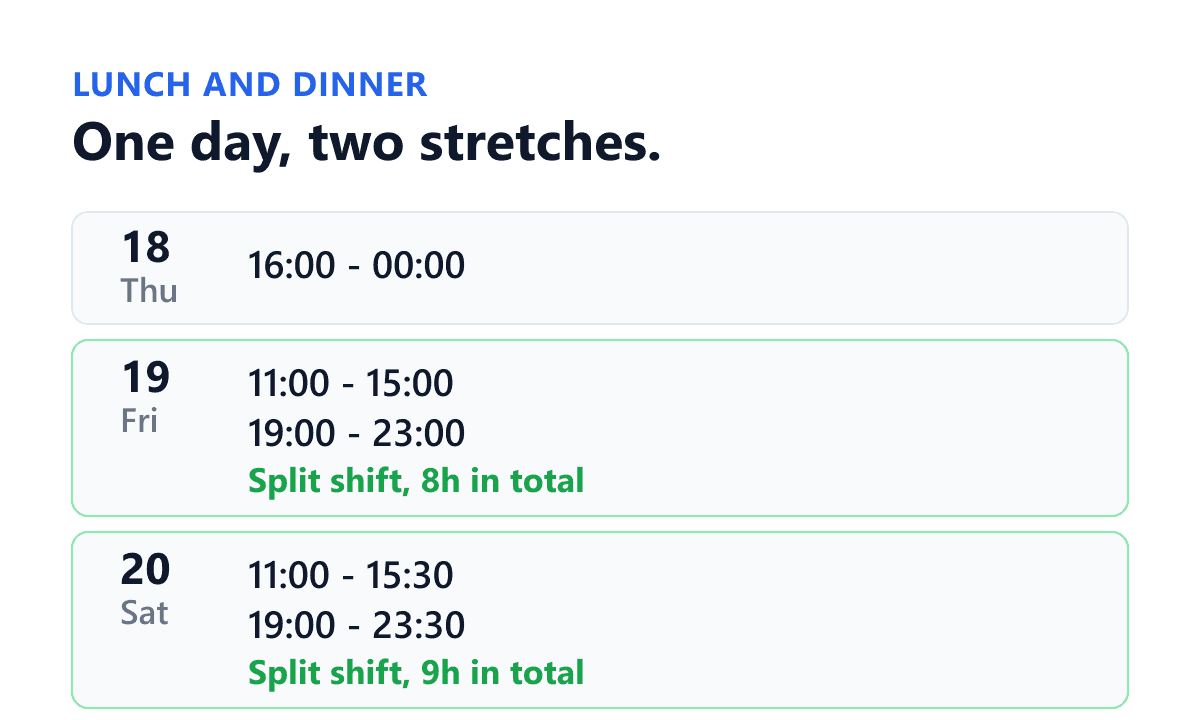
Total hours worked: 8.5 hours. Total spread of day: 12.5 hours. Under most state Shops Acts, a 12.5-hour spread is non-compliant even though the actual working time was within the 9-hour daily limit.
A paper register records four entries and leaves the spread calculation to the manager. A WhatsApp group records four messages in a chat that no one audits. A GPS attendance app records all four entries with timestamps, automatically calculates both total hours and spread-of-day, and flags when the spread approaches the limit, before the compliance violation happens rather than after the inspector visits.
GPS Punch-In: No Machine at the Counter, No Fingerprint Scanner Needed
Mobile GPS attendance works on the smartphones your staff already carry. When a chef arrives for the morning prep shift, they open the app, take a live selfie, and the phone confirms their location is within the restaurant's geo-fence. The check-in is recorded. No queue at a machine, no failed fingerprint from floury hands, no card to forget at home.
For delivery staff and cloud kitchen riders who start and end their shifts at a hub or dark kitchen, the geo-fence is set around the hub address. For a restaurant with two locations, you set two separate geo-fences and each location has its own attendance log on the same dashboard.
Because the selfie includes liveness detection and the GPS check includes fake-location detection, buddy punching is structurally blocked. A colleague cannot check in for someone else, because the selfie will not match, and because the phone has to be physically within the geo-fenced area.
Running Payroll for 5 to 30 Staff Across 1 to 3 Locations
At month end, the attendance data feeds directly into salary calculation. For a full-time server who was present 24 days out of 26 working days, the system calculates gross salary, deducts for the two absent days, adds any approved overtime at double rate, deducts PF and ESI contributions, and generates the net pay figure. No one manually counts days from a register or cross-checks a WhatsApp chat.
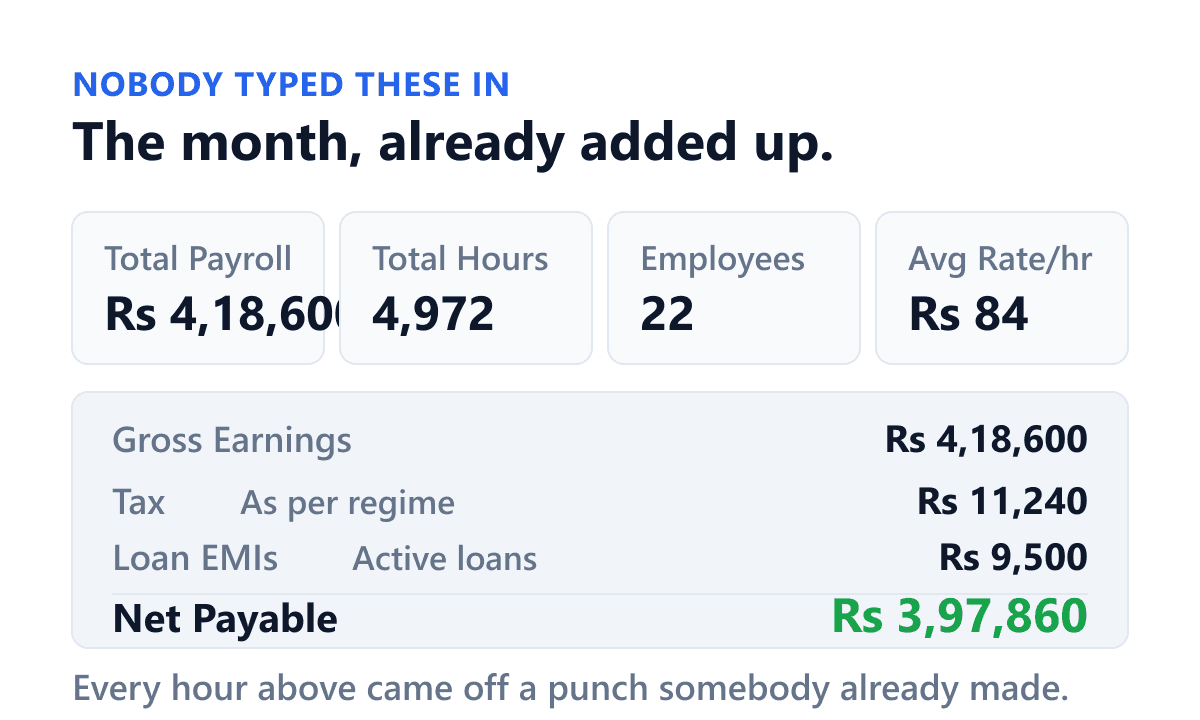
For part-time or contractual kitchen staff paid by the shift, the calculation is per-shift rather than per-day. For daily wage dishwashers or cleaning staff, it is per-day. A single attendance system that handles all three calculation types prevents the errors that come from managing them in separate spreadsheets.
Multi-location view means a restaurant group with three outlets can see the combined headcount and payroll position from one dashboard. The owner does not need to call each manager or collect three separate registers at month end.
How Faster Payroll Reduces Attrition in Your Restaurant
Delayed salary payment is one of the most consistently documented drivers of attrition in India's restaurant sector. Staff who are not paid on time leave for the first offer they receive elsewhere, even at the same or slightly lower wage. The cost of replacing that person, accounting for recruitment, notice period disruption, and the new hire's reduced productivity during their first two weeks, typically runs Rs 8,000 to Rs 25,000 depending on the role.
When attendance feeds automatically into payroll, salary processing that previously took 3 to 4 days of manual work can be completed in a few hours. Staff receive accurate payslips on time. Disputes about deductions go down because the timestamped attendance record is transparent. Retention improves not because pay went up, but because reliability went up.
Which App Does This for a Restaurant, and What It Costs
What to Look for in a Restaurant Attendance App
A checklist for evaluating attendance software for your restaurant or cafe:
- No hardware required, and it works on any Android or iOS device
- GPS geo-fencing for each location
- Live selfie check-in with liveness and fake GPS detection
- Split-shift tracking with spread-of-day calculation
- Automatic overtime flagging at the 9-hour and 48-hour limits
- Support for full-time, part-time, and daily wage staff in one system
- Automatic PF and ESI deduction calculation
- Multi-location dashboard for owners with 2 to 3 outlets
- Salary processing directly from attendance data without a manual export step
- New employee onboarding in under 5 minutes by phone number, not fingerprint enrollment
For a restaurant with 19% monthly attrition, the onboarding speed alone justifies switching from a biometric machine. You are adding and removing staff from the system multiple times per month. A 2-minute phone-number invite beats a 15-minute fingerprint enrollment session every time.
Keep reading
See how Shiftelio does this in practice with attendance and split shifts for restaurants.
Still deciding what to buy? Compare the full ranked comparison, with the annual cost of each at 25 staff.
Free to use, no signup: HR letter formats.