Company Asset Register: Who Has the Drill, and Who Pays When It Goes Missing
In short
Since 21 November 2025, deducting for a lost tool means proving it was entrusted to that person. A company asset register is where that proof lives.
- A deduction for a lost or damaged item is lawful only if the item was expressly entrusted to that person and the loss is attributable to their neglect. Memory is not entrustment.
- The Code on Wages caps such a deduction at the actual loss, requires the employee be heard first, and requires the deductions themselves to be kept in a register.
- Most small businesses have no record of who is holding what, so the question never gets as far as the law. The money is simply written off.
The drill nobody remembers handing out
A cordless drill is a few thousand rupees. On a site with fourteen men it comes out of the box at eight in the morning, passes through three pairs of hands by lunch, and at some point it stops coming back. Nobody notices for a fortnight.
The conversation that follows is always the same. The supervisor is fairly sure Ramesh had it. Ramesh is fairly sure he passed it to Suresh before he left on Thursday. Suresh remembers a drill, though possibly the other one. Nothing was written down, so the argument is about memory, and memory is not evidence of anything.
The drill gets written off. A new one is bought. The same thing happens again in March.
The money is not really the problem. The problem is that nobody can say where the other eleven are either, and the moment an owner decides to do something about it, they discover that the law has opinions about what they are allowed to do.
What the law now asks you to prove
The four Labour Codes came into force on 21 November 2025, replacing twenty-nine older statutes. For anyone who has ever thought about taking the cost of a lost tool out of somebody's wages, two sections of the Code on Wages, 2019 now matter more than they used to.
Section 18(2)(c) permits a deduction for damage to or loss of goods expressly entrusted to the employee for custody, where the loss is directly attributable to his neglect or default. Section 18(3) caps all deductions in a wage period at fifty per cent of wages. And Section 21 adds three conditions that are easy to read past.
(1) A deduction under clause (c) ... shall not exceed the amount of the damage or loss caused to the employer by negligence or default of the employee. (2) A deduction shall not be made ... until the employee has been given an opportunity of showing cause against the deduction. (3) All such deductions and all realisations thereof shall be recorded in a register to be kept in such form as may be prescribed.
Code on Wages, 2019, s.21
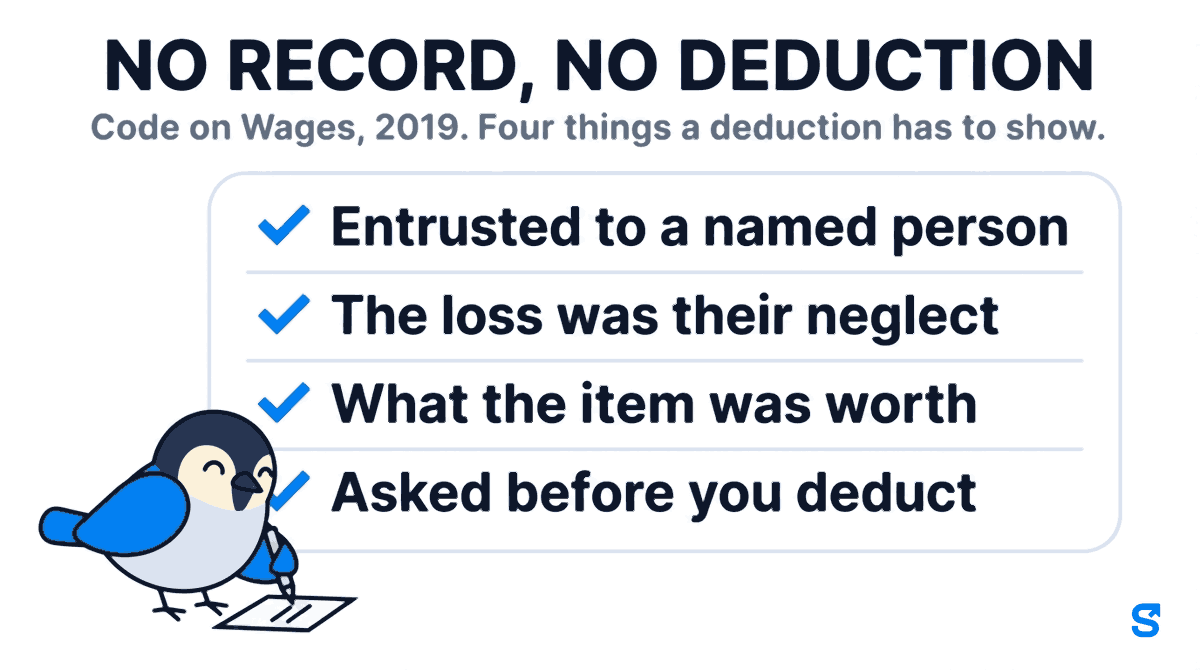
Read that as four separate things you have to be able to produce, months after the event.
- That the item was entrusted to a named person, not to a site, a shift or a crew.
- That the loss is down to their neglect, which means you need to know what condition it was in when it left the counter.
- What the item was actually worth, because you cannot deduct more than the loss.
- That you asked them about it before deducting anything, and that the deduction is written down.
None of that is difficult. All of it is impossible after the fact. "Expressly entrusted" is a statement about a moment that has already passed, and if nothing was recorded in that moment, there is nothing to say now.
This is the quiet reason most small businesses never pursue a lost tool. Not that they lack the right. They lack the paperwork to exercise it, and by the time they want it, making it would be forgery.
A log book, not a spreadsheet
The instinct is to open a spreadsheet with one row per item and a column called "with whom". It works for about six weeks.
It fails because a spreadsheet stores the present and quietly destroys the past. When Ramesh gives the drill back, somebody clears that cell. The sheet is now correct and also useless, because the one fact you will need in April, that Ramesh had it from 4 February to 19 March, has been overwritten by a keystroke nobody can see.
A register has to store the opposite thing. It has to store the movements, and work out the present from them.
That is how the item register in Shiftelio is built, and it is the single design decision everything else follows from. Nothing ever writes "who has this" directly. Every handover is one entry in a log book, and the current holder is simply read from the log book. There is no screen, no import and no bulk edit that can change one without the other. "Who has the drill now" and "the history of the drill" are physically incapable of disagreeing, because they are the same data read two ways.
The practical consequence: an item's page is not a status. It is a dated list of everything that has ever happened to it, and the status is the last line of it. You cannot tidy up the list, which is exactly what makes it worth anything in an argument.
Issue, return and transfer are three different events
This sounds pedantic until the first time it matters.
On a site, the drill goes from Ramesh's hand to Suresh's without ever touching the store. Recording that as a return followed by a fresh issue is tidy, and it is also a lie: it invents a moment when the company held the drill. That invented moment is precisely what somebody will point at when the drill turns out to be missing, because it is the gap where responsibility sits with nobody.
So a transfer is its own event. One entry, one truth: it was with Ramesh until three in the afternoon, and with Suresh after. The return date the two of them agreed follows the item rather than the person, so passing a laptop along cannot silently reset a deadline somebody committed to.
Returns are the event that carries the most weight, and they are the one most often skipped. "It was already scratched" is unanswerable a month later. A photograph taken at the counter as the item comes back answers it in one look, and that photograph is the whole reason recording returns is worth the thirty seconds it takes.
Five things a counter has to get right
A register that survives contact with a real storeroom has to handle all five of these, and most simple ones handle two.
A laptop has a serial number and exactly one holder. A box of safety helmets has forty of them and eleven holders. These need different arithmetic, not the same screen used carelessly. Issue four helmets out of a pool of forty and the register has to know that thirty-six remain, that four are with a named person, and that returning two leaves two still out.
A treadmill lives at the Andheri branch. It is not "held by" the manager there, and pretending it is makes every change of manager into a handover of gym equipment. "At this site" has to be its own state, alongside "in the store" and "with this person", or the register starts telling small lies to fit its own shape.
Somebody asks to keep the laptop another week and you agree. If the only way to record that is to fake a return and a re-issue, you have put two movements that never happened into the log book to fix a date. Changing a due date has to be an event in its own right: it moves nothing, it just records that the date changed, who changed it, and when.
"Returned, damaged" is one person's word. A photograph with a timestamp is the thing that ends the conversation. It is also the thing that protects the employee, which is worth saying out loud: a picture taken at issue is what stops somebody being charged for a dent that was already there.
The storekeeper who hands out drills every morning has no business knowing what the drill cost, and even less business knowing what the whole rack is worth. This is not squeamishness. It is the difference between a register people will actually use and one that gets restricted to two managers who are never at the counter.
That last one is worth dwelling on, because it is where most teams give up on tracking anything. Handing out an item is a fifteen-second job done thirty times a morning by whoever is standing there. Adding items, editing them and seeing what they cost is a different job done occasionally by somebody senior. If your tool treats those as one permission, you will either give the storeroom your purchase ledger or you will do the issuing yourself, and you will stop within a month.
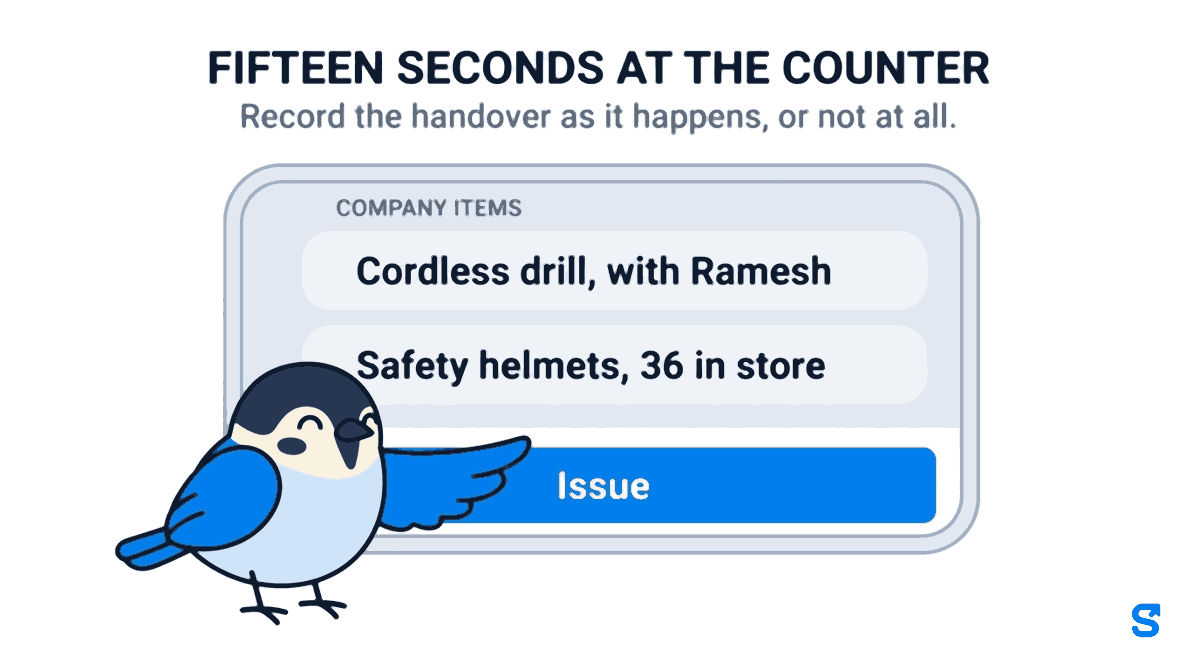
In Shiftelio these are separate ticks on a manager's role. Issue and return is the counter job: hand something over, take it back, record damage or loss. Add and edit items is the admin job. See what things cost is a third tick on its own, and without it the money columns are not hidden from view, they are never sent to the browser at all. A price that is not transmitted cannot be read out of a network tab by a curious storekeeper.
The day somebody leaves
This is the moment every asset register exists for, and the moment almost none of them are consulted.
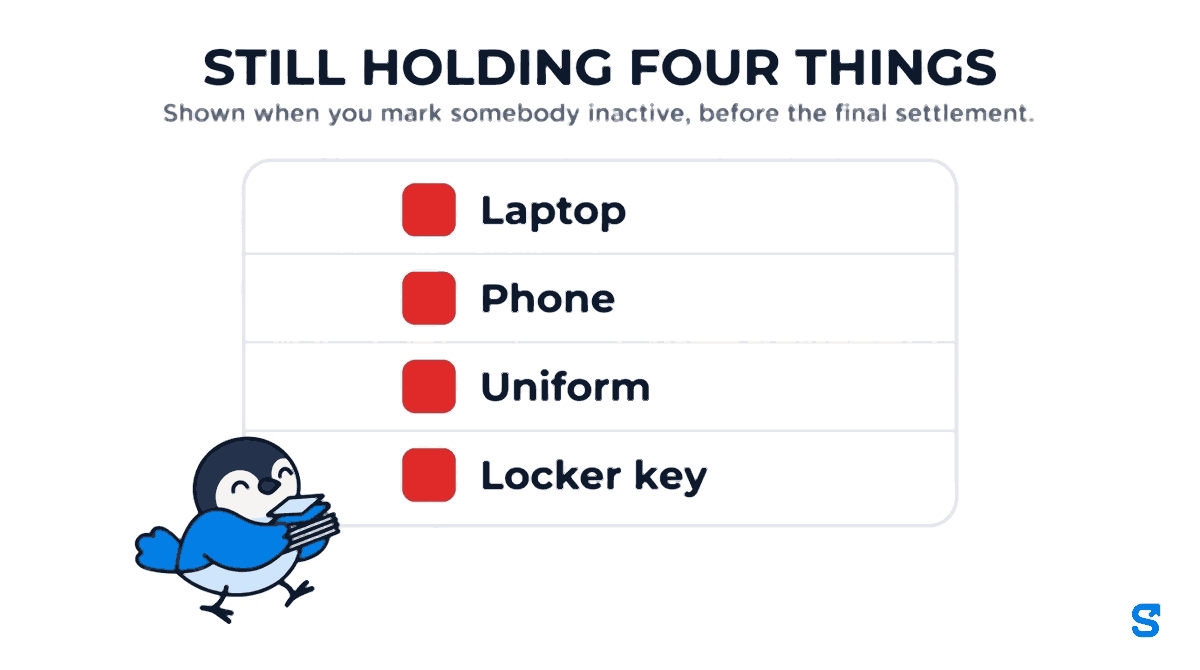
Somebody resigns. There is a final settlement to calculate, a last working day, a relieving letter. Meanwhile a laptop, a phone, a uniform, an ID card and a locker key are in a bag at their house, and the only person who knows the full list is the person leaving.
The register's job here is to turn "did they give everything back?" into a list on a screen at the moment you mark them inactive. Not a report somebody has to remember to run. A warning that appears in the way, at the one moment when you still have leverage and their last payment has not gone out.
A register that only tells you about held items when you go looking for them will never be looked at on the day it matters. Somebody processing an exit is thinking about notice period and gratuity, not about a helmet.
Two related things are worth building into the same view. First, taking everything back from one person should be one action, not a list of five boxes to tick correctly, because a list that has to be selected correctly is a list somebody can miss a row of. Second, the register should be able to tell you about people who have already left and are still holding things, counted as people rather than as items. Four helmets with one departed cleaner is one phone call, not four.
If a deduction is going to happen, this is also where the law lands. You are about to run a final settlement. Section 21 requires that the person is heard before anything is taken, and Section 18(3) caps the total at half the wages of the period. A register cannot make that decision for you, and it should not try. What it can do is put the item, the date it was entrusted, the person it was entrusted to and what it cost on one screen, so the conversation is about facts instead of about who remembers what.
Counting what is actually on the shelf
Every register eventually drifts from reality, because people are people. The fix is a stock take, and the useful version of it is done walking around a room with a phone, in a basement with no signal, comparing what is on the shelf against what the register believes.
The important thing about a count is that it is an observation, not a movement. Nothing changes hands. If counts are written into the same log book as handovers, the log book fills up with "somebody looked at this" and stops being readable as the history of where things went. Kept separate, a count is also safe to record offline and send later, because a count cannot contradict anything that happened in the meantime. It never claimed to change the world.
What a register will not do for you
Worth being straight about, because tools in this category are usually sold as if they solve the whole problem.
- It does not create a lawful deduction. Entrustment, an opportunity to show cause and a written record of the deduction are your obligations under the Code; the register supplies the evidence for the first and nothing more.
- It does not replace a signed policy. What staff are issued, what they are responsible for and what happens on exit should be in the appointment letter. A log book proves what happened, not what was agreed.
- It does not stop theft. It makes theft attributable, which is a different and more modest claim.
- It is worthless if handovers are recorded later, in a batch, by somebody who was not there. A register written from memory at the end of the week is a spreadsheet with extra steps.
Running this in Shiftelio
Shiftelio calls this Company items, and the description in the app is the whole promise: keep a log book of company property, who has the laptop, the drill, the uniform, and since when.
It is part of the platform rather than a separate purchase, it sits next to the attendance and payroll the same staff records already drive, and it is on the same phone your team already uses to clock in. That last point is the one that decides whether a register gets used: the storekeeper is not going to walk to an office computer to record a helmet.
The one thing here that competing tools generally do not do is separate issuing from pricing as two different permissions. Most asset trackers have a single "manage assets" role, which forces you to choose between letting the storeroom see your purchase ledger and doing every handover yourself. Splitting them is why a counter job can be delegated to the person actually standing at the counter.
Common questions
Can I deduct the cost of a lost tool from an employee's salary in India?
Only under conditions. Section 18(2)(c) of the Code on Wages, 2019 permits a deduction for loss of goods expressly entrusted to the employee for custody where the loss is directly attributable to their neglect or default. Section 21 then limits the deduction to the actual loss, requires that the employee be given an opportunity of showing cause first, and requires the deduction to be recorded in a register. Total deductions in a wage period cannot exceed fifty per cent of wages under Section 18(3). This is general information and not legal advice; take advice on your own facts and on the rules notified by your state.
What does "expressly entrusted" actually mean in practice?
That you can show the item was given to that specific person, and that they knew it. A dated handover record naming the person, ideally acknowledged by them, is the ordinary way of showing it. A tool signed out to "the night shift" has not been expressly entrusted to anybody.
Is a spreadsheet good enough for a company asset register?
For a very small team with a handful of items, briefly. It fails at the moment you need history, because a spreadsheet stores the current holder and overwrites the previous one. The fact you need in April, that a particular person had a particular item between two dates, is the fact a spreadsheet throws away.
Can an employee mark their own item returned?
In Shiftelio, no, and that is deliberate. A return is a handover to somebody, and a register in which the holder decides when they stopped holding it is a note rather than a record. The counter records the return, which is also the moment somebody actually looks at the item. An employee can see what they hold, report damage on it, and offer an item to a named colleague, which does not move until that colleague accepts.
What about uniforms, which are never really returned?
Mark them as not returnable. The register still records that four sets went to a named person on a date, which is what you need for issue costs, for a replacement request and for the uniform clause in a final settlement. What it stops doing is nagging you for a return that was never going to happen.
Keep reading
Free to use, no signup: Shift roster template.