Employee Advance Repayment: Getting a Pay Advance Back, Even If They Quit
In short
Repay an employee advance in equal cuts from pay, agreed in writing first. If they quit owing, check your state's rule before touching the final paycheck.
- Agree three things in writing before an advance leaves: the amount, the cut per pay period, and the first pay run it comes out of.
- Split the advance into equal cuts. One cut is easy to remember; a "pay it back when you can" is not.
- DOL's Field Operations Handbook says the principal of an advance may be deducted even below the minimum wage, but interest or admin fees may not cut into it (federal, checked on 10 October 2026).
The cleanest way to get an employee advance back is in equal cuts from their pay, agreed in writing before the money leaves: the amount, the cut, and the first paycheck it comes out of. If the employee quits before it is paid off, check your state's rule before taking anything from the final paycheck: in California, the state labor office says only one installment can come out of it, not the whole balance.
Most small US businesses hand out advances the same way: a line cook needs $600 for a car repair, the owner says yes at the pass, and the money goes out in cash or by transfer. The trouble starts later. Nobody wrote down how it comes back, the cut is forgotten for two paychecks, and then the cook gives notice with $400 still owed. This guide is for owners and managers of restaurants, retail stores, salons and cleaning crews with hourly staff. It covers how to set up the repayment, what the federal rule and California's rule say about deductions, what to do when someone leaves owing money, and how Shiftelio keeps the balance in front of you.
Why advance repayments go wrong in a small team
An advance is a small loan with no paperwork. That is why owners like giving them and why they go sideways. Three things usually happen together:
- Nobody fixed the cut. "Take it back over a few checks" means a different number to the owner, the manager who runs payroll and the employee.
- The cut depends on somebody remembering. Payroll is run on a busy Monday. If the advance lives in the owner's head or a text thread, the first cut is skipped, then the second.
- Leaving is the first time anyone adds it up. The employee gives two weeks' notice, the owner remembers the $600, and the instinct is to take whatever is left out of the last paycheck. Depending on the state, that instinct can be the wrong move.
None of this is about trust. It is about a number that was never written down where payroll can see it.
Set up the repayment before the money leaves
Picture Rosa, who owns a taqueria in Fresno, California, with 14 hourly staff. Marco, a line cook, asks for $600 in early October to fix his car. Rosa says yes, and before any money moves they agree on one page:
- The amount: $600, given on October 3.
- The cut: $200 from each month's pay, over three months.
- The first cut: the October pay run.
- What happens if Marco leaves before it is paid off: the cut that is due comes out of his last paycheck, and the rest he pays back directly.
- Both of them sign and date it, and each keeps a copy.
Equal cuts matter more than the exact number. $200 a month is something Marco can plan around and something Rosa can check at a glance. A cut that changes every month invites mistakes in both directions.
Keep the advance free of interest and fees. It is simpler to explain, and the federal rule below treats interest and admin charges differently from the advance itself.
What the federal rule and California's rule say
This guide is about running the repayment, not about law. Here is what two government agencies say about taking an advance back out of pay.
- Federal. The US Department of Labor's Field Operations Handbook, Chapter 30, section 30c10(b), says that while loans and cash advances made by an employer are not facilities, "the principal may be deducted from the employee's wages even where such a deduction cuts into the minimum wage or overtime due under the FLSA." It adds that deductions for interest or administrative costs on the loan or advance are illegal to the extent that they cut into the minimum wage or overtime pay, and that "the existence of the loan or advance shall be verified to the extent possible." Checked on 10 October 2026.
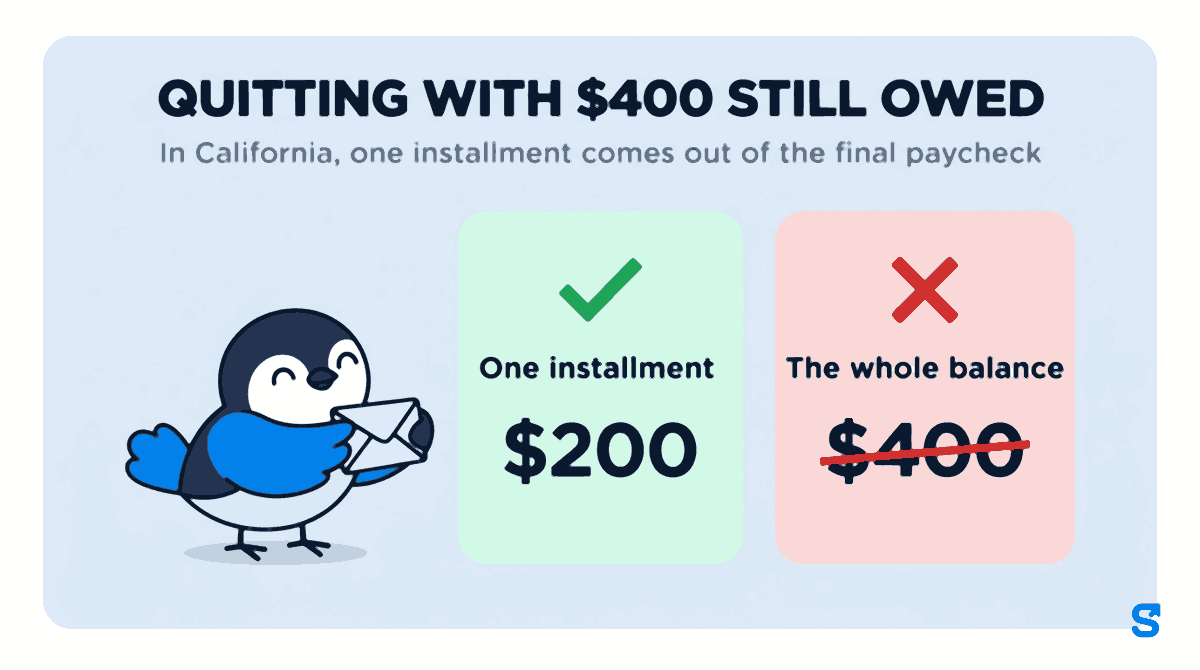
- California. The California Labor Commissioner's deductions from wages FAQ says that periodic installment payments on a loan from the employer are permissible when the employee authorized them in writing. On leaving, it says a lump-sum payment of the outstanding balance at the end of employment is not allowed, even with written consent, and that "your employer can only deduct the amount of one installment payment from your final paycheck." The same page says deductions in California are generally lawful only when required by law or expressly authorized in writing by the employee. Checked on 10 October 2026.
Other states set their own rules on wage deductions and final pay, and some are stricter than the federal one. Your state labor department's website is the place to check before you set up a deduction.
This is general information, not legal advice: check with the agency or an employment lawyer for your case.
When an employee quits still owing part of the advance
Back to Fresno. Marco's October cut went through, so he owes $400. In mid November he takes a job closer to home and gives notice. Under the California page above, the final paycheck can carry one installment, $200, and not the whole $400.
That leaves $200, and three things help:
- Look at the balance before the last pay run, not after. If you only find out at the end, the only tool left is the final paycheck, which is the one place the rule limits you.
- Ask for the rest directly, and record it when it comes. Marco offers to pay the last $200 in cash on his final Friday. Rosa records it the same day, so the balance reads zero and nobody chases him later.
- Decide in advance what you will do if it never comes back. For a small balance, many owners decide it is not worth more than a polite reminder. Whatever you decide, decide it once and apply it to everybody.
How Shiftelio handles a salary advance
Shiftelio is a scheduling, time clock and pay app for small teams with hourly staff. Advances live in the Money section, under Staff money, so they sit next to the pay run instead of in a text thread.
Open Money, then Staff money, pick the person and tap Give money. Choose Salary advance, enter the amount and the date, and set Cut in how many months. The sheet shows the cut before you save it: for Marco, $200 cut each month. Add a note, such as "car repair, signed agreement on file".
Staff can tap Ask for money in My money, choose Salary advance, enter the amount and say what it is for. The ask lands in your Waiting tab, where you give it or Say no with a reason. Nobody can give an advance to themselves: a manager's own ask has to be decided by somebody else.
Each month's pay run takes the cut on its own. It never takes more than is still owed, and never more than that month's pay. The payslip shows the cut as its own line under Deductions, so the employee sees exactly what came out and why.
On the person's Salary advance card you can Change cut to set a new amount per month or a later first cut month, use Pay part to record cash or a transfer paid back directly, and open History to see every payroll cut and every amount paid outside. Paying back the full balance closes the advance.
When you suspend or deactivate someone who still owes money, Shiftelio warns you, for example "Still owes $400 in salary advances. Settle first.", with a Settle money link. It is a warning, not a block: you decide what to do, and nothing takes the whole balance out of the last pay by itself.
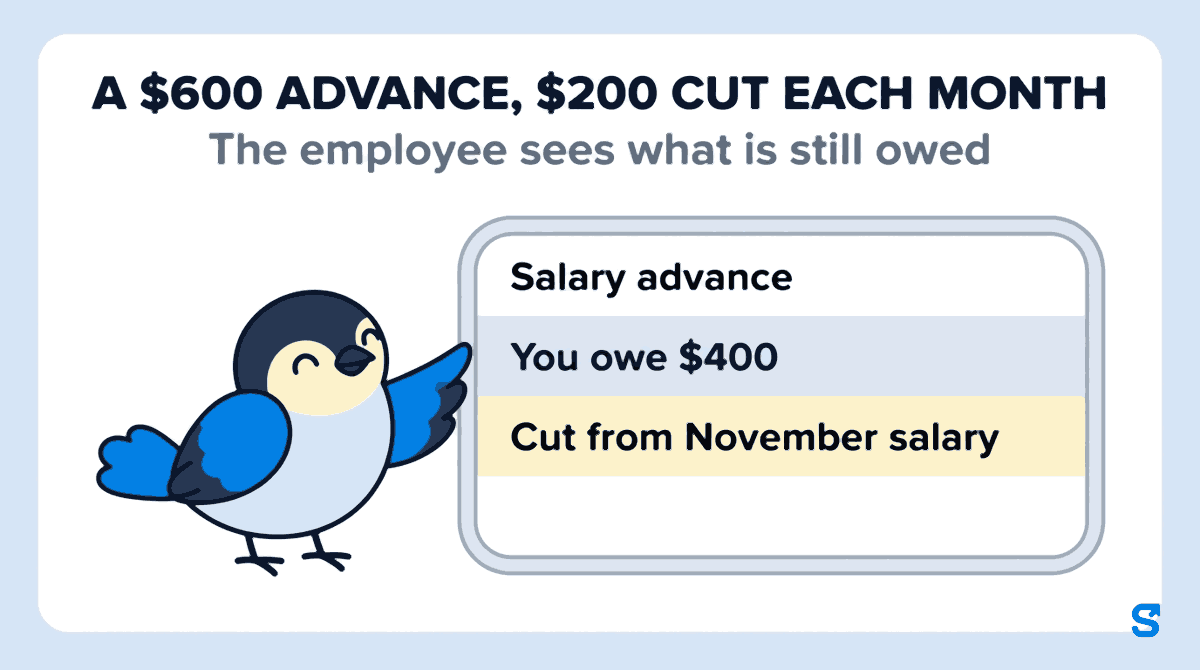
The employee sees the same numbers in the app: You owe $400, and Cut from November salary, the month the next cut comes from. That one line answers most of the "how much do I still owe?" questions before anyone asks them.
Which app tracks employee advances and takes them back through payroll?
You can see how it fits a US business on the Shiftelio US page, and the rest of the product on the features page.
Questions owners ask
How should an employee pay back an advance?
In equal cuts from pay, agreed in writing before the money leaves. Fix the amount, the cut and the first pay run, and keep a signed copy.
Can an employer deduct an advance from an employee's paycheck?
Federally, DOL's handbook says the principal of an advance may be deducted. Many states require the employee's written authorization, and some limit what can come out of a final paycheck, so check your state.
What happens if an employee quits before paying back an advance?
It depends on the state. In California, the Labor Commissioner's FAQ says only one installment can come out of the final paycheck; the rest has to be settled another way.
Should I charge interest on an employee advance?
Most small businesses do not. DOL's handbook says interest or admin fees may not cut into the minimum wage or overtime, which is one more reason to keep advances interest-free.
How big should each repayment cut be?
Small enough that the employee can still cover rent and bills, and the same every pay period. Many owners spread an advance over two to four months.
What should an employee advance repayment agreement include?
The amount, the date given, the cut per pay period, the first pay run, what happens if the employee leaves, and both signatures with the date.