Employee Asking for a Pay Advance? How to Decide Fairly and Get It Back
In short
When an employee asks for a pay advance, first sort work cash from an advance on pay, then answer every ask in writing and agree when it comes back.
- Sort every ask into work cash (money for the job, accounted for with bills) or a pay advance (their own pay early, cut from a later paycheck).
- Take the ask in writing, with an amount and a reason, never as a word in the stockroom.
- Let one person decide, and never let anybody decide their own ask.
When an employee asks for a pay advance, first decide what kind of money it really is: cash to spend on the job, or their own pay handed over early. Then get the ask in writing with an amount and a reason, let one named person answer it, give every no a reason, and agree before the money leaves exactly when and how it comes back.
Most trouble with advances in a small team comes from skipping one of those steps, not from the person asking. This guide walks through each step for owners and managers of shift and field teams, what to do when the same person keeps asking, and how Shiftelio carries an ask from the employee's phone to the payslip.
Why your staff ask for an advance
People who work shifts are rarely short because they are careless. They are short because something broke. In the US Federal Reserve's survey of household finances for 2025, 59 percent of adults had at least one major unexpected expense in the year before, and the most common was a major car repair or replacement. In the same survey, only 63 percent said they would cover a small emergency expense with cash or its equivalent. The rest would borrow, sell something or not manage it at all.
So the ask will come, in any country and any trade. The cook whose car died, the cleaner whose rent is due before payday, the technician who needs parts for tomorrow's job. The question for an owner is not whether to allow advances. It is how to answer them the same way every time, so that nobody feels singled out and nothing goes missing.
Work cash or a pay advance: two different asks
Two very different requests arrive in the same words: "Can I get some money?" Treat them as one and the books go wrong within a month.
| Work cash | Pay advance | |
|---|---|---|
| Whose money is it | The business's | The employee's own pay, early |
| What it is for | Fuel, parts, supplies for the job | Anything in their own life |
| How it comes back | Bills for what was spent, and any change | Taken off a later paycheck |
| What the employee owes | Nothing, once the bills match | The full amount, until it is cut |
| Typical asker | Field technician, site supervisor, driver | Anyone, after an unexpected expense |
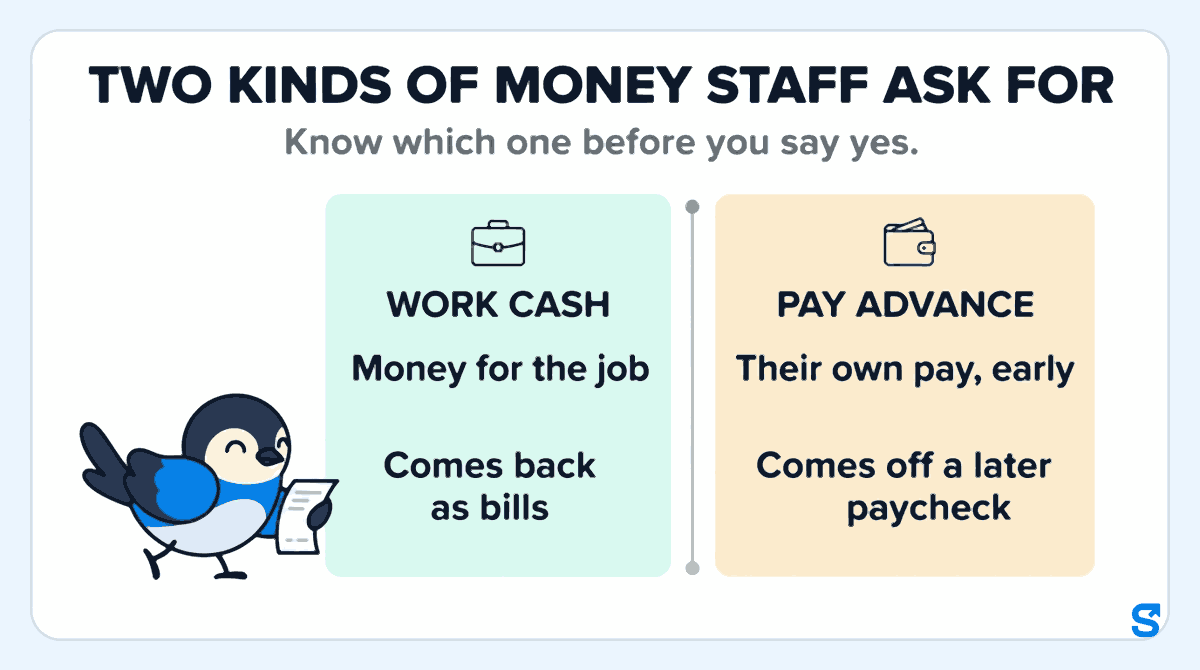
The difference matters for both sides. Work cash that is spent on the job is not a debt at all, so taking it off somebody's pay would be wrong. A pay advance is a debt, so treating it as a business cost would mean you quietly paid somebody twice. In short: work cash is money for the job and comes back as bills; a pay advance is their own pay, early, and comes off a later paycheck. Know which one before you say yes.
How to handle an employee advance request, step by step
An amount and a short reason, sent from the employee, with the date on it. A word in the stockroom is not an ask: two weeks later nobody agrees on the number. Writing it down also slows the request by ten seconds, which is often enough for somebody to ask for less.
Ask the one question from the table above: is this for the job, or for them? A technician asking for parts money is asking for work cash, even if they call it an advance. A server asking for help with a car repair is asking for a pay advance. Change the label if the employee chose the wrong one, and tell them you did.
Before you say yes, check two numbers: how much work cash this person still holds without bills, and how much of an earlier advance they still owe. A new advance on top of an old one that has not been cut yet is how a small favor becomes a debt nobody can pay back.
Name who answers money asks: the owner, or a manager you trust with it. A manager's own ask goes to the owner. The same rule you use for expense claims applies here, for the same reason.
"Not this month, you still owe half of the last one" is an answer the employee can live with. Silence, or a no in passing, is what makes people feel the decision was personal. A reason also protects you when two staff compare notes.
For a pay advance, agree which paycheck it comes off and whether it is one cut or several. For work cash, agree when the bills are due. Write it on the same record as the ask. Rules on taking money back from pay differ between countries and states, so check the rules where you operate before you set a policy, and get the employee's agreement in writing.
When an employee keeps asking for advances
"Employee keeps asking for advance" is one of the first things Google suggests when an owner starts typing about this, and the fix is rarely a flat ban. A few habits keep it under control:
- One ask at a time. Nobody can ask again while an earlier ask is still waiting for an answer. They can change the waiting one instead.
- No new advance while an old one is still owed. Make it the rule for everybody, so a no is the policy talking, not you.
- Look at the pattern, not the person. Three asks in three months from the same employee is a conversation about hours, pay or a problem at home. Have it in private.
- Keep work cash out of it. A field worker who needs money for parts every week should have a standing work cash amount, not a stream of "advances" that are really business costs.
A simple employee advance policy you can copy
- Every ask is made in writing, with an amount and a reason.
- Each ask is either work cash for the job or an advance on the employee's own pay.
- Only the owner or a named manager decides, and nobody decides their own ask.
- One ask can wait at a time; a new advance waits until the last one is cut.
- Every no comes with a reason, given to the employee.
- A pay advance comes off a named later paycheck, agreed in writing before it is paid.
- Work cash is accounted for with bills, and anything left is handed back or carried over.
How Shiftelio handles a money ask, from the phone to the payslip
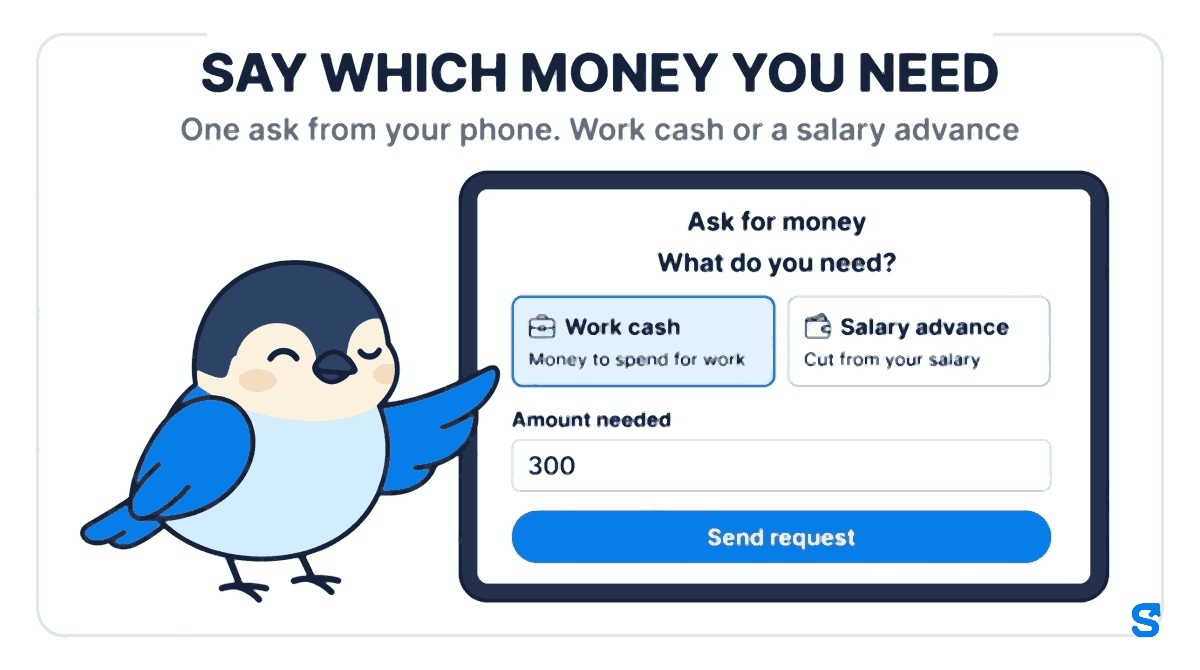
Shiftelio puts the whole policy above into the app your staff already use to clock in, so nobody has to remember it. One ask from your phone: work cash or a salary advance, and the employee says which money they need.
In My money on their phone, the employee taps Ask for money and answers What do you need? with one of two choices: Work cash (money to spend for work) or Salary advance (cut from your salary). They enter the amount, add what it is for if they want to, and tap Send request.
While the ask is waiting, they can change the amount, the reason or the kind, or cancel it. They cannot send a second ask on top of it: the app tells them they already have an ask waiting and lets them change that one instead.
The owner, and any manager you have given permission to decide that kind of money, get an alert. A manager can decide work cash, advances or both, depending on what you allow, and nobody can decide their own ask.
The Money ask sheet shows the date, the reason, how much salary advance the person still owes and how much work cash they still hold. The decider can switch the kind if the employee picked the wrong one (the employee is told), change the amount, and pick how the money is paid.
Give pays it and records it. Say no will not go through without a reason, and the employee sees that reason.
A salary advance is cut once from that month's salary and appears on the payslip as its own line, Salary advance cut. Work cash is spent against bills the employee adds from their phone, the same way as an expense claim, and their home screen shows how much work cash they have left.
Which app lets staff ask for a pay advance from their phone?
Questions owners ask
Should I give employees a pay advance?
It is your choice, but answer every ask the same way. A written policy (amount, reason, one decider, a reason for every no, payback agreed first) lets you say yes when it helps and no without it feeling personal.
What is the difference between work cash and a pay advance?
Work cash is the business's money for the job and comes back as bills. A pay advance is the employee's own pay given early, and it is taken off a later paycheck.
What should I do when an employee keeps asking for advances?
Keep one ask waiting at a time and no new advance while an old one is owed. If one person asks every month, talk to them privately about hours, pay or what is going on.
How do I say no to an advance request?
Say no in writing, with a short reason the employee can understand, such as an advance still owed. A no with a reason is accepted far more often than a silent one.
When should an advance be paid back?
Agree it before the money leaves: which paycheck it comes off, and in how many cuts. Check the rules on taking money from pay where you operate, and get the agreement in writing.
Can a manager approve their own advance?
No. A manager's own ask should go to the owner or another person allowed to decide. In Shiftelio nobody can decide their own ask.