Employee Expense Reimbursement for Canadian Trades: Receipts, US-Dollar Bills and Who Signs Off
In short
Have the tech photograph the receipt on the job, confirm the currency, and let someone other than the spender approve it, then repay it on payday.
- Get the receipt photo on the job, the same day, from the person who paid. A slip in a truck door pocket is a slip you will never see.
- A "$" on a receipt is not a currency. Ask which dollar it is, and record the rate used to turn US dollars into Canadian dollars.
- Nobody approves their own bill. The lead hand approves the crew's receipts; the owner approves the lead hand's.
The cleanest way for a Canadian trades business to reimburse staff is this: the tech photographs the receipt on the job, confirms whether a "$" means Canadian or US dollars, and somebody other than the person who spent the money approves it. The approved amount is then paid back on a set day, usually with the next pay, so nobody chases a shoebox of slips at month end.
That sounds obvious. It breaks in three places on a real plumbing, HVAC or cleaning crew: the receipt is lost before it reaches the office, a part ordered from a US supplier gets repaid as if it were Canadian dollars, and the lead hand approves their own fuel. This guide fixes all three, with one worked example from an Ontario shop.
Why expense reimbursement breaks on a trades crew
An office worker files one claim a month. A service tech files ten small ones a week: a fitting from the supply house, a fill-up between calls, two hours of parking downtown, a box of fasteners when the van runs out. Each one is small, so each one is easy to forget, and the person who paid is out on the road when the office asks about it.
Three things go wrong, again and again:
- The receipt never arrives. Thermal paper fades on a dashboard in July. A tech who has to drive back to the shop to hand in a slip will wait until there are six, and lose two.
- US-dollar bills get paid at face value. Shops near the border, and any shop that orders parts online from a US supplier, see receipts with a plain "$" on them. Repay US$84.60 as C$84.60 and your tech is short by the exchange difference, every time, without knowing why.
- The approver approves themselves. On a crew of eight, the lead hand checks everyone's receipts. Who checks the lead hand's? Usually nobody, which is not a trust problem until the day it is.
A worked example: an HVAC and plumbing shop in Windsor, Ontario
Sandra owns a nine-person HVAC and plumbing company in Windsor. Marc is her lead hand. Dev is one of her service techs. In one week:
- Dev orders a replacement valve from a US online supplier for US$84.60, on his own card, because the customer's furnace cannot wait for the Canadian distributor.
- Dev fills the van with fuel for C$71.25 between calls.
- Marc fills his own truck for C$68.40 on the way to a commercial job.
Here is what each of those should go through.
Before he leaves the counter or closes the order email, Dev opens the bill form on his phone, takes a photo (or picks the PDF invoice), and the amount, date and shop fill themselves in. He checks them, picks one of the categories the owner has set up, such as Parts or Fuel, and sends it. That is the whole job for him.
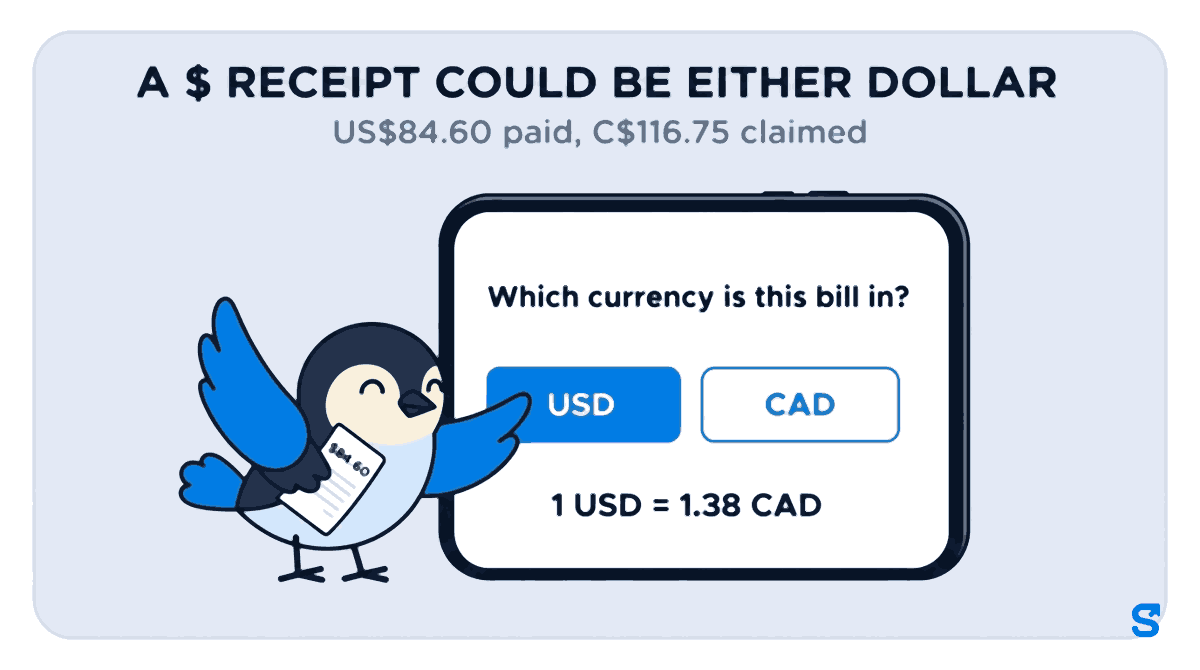
The valve invoice just says "$84.60". A receipt with a bare dollar sign could be Canadian or US, so the form asks which currency the bill is in. Dev picks USD and enters the exchange rate: 1 USD = 1.38 CAD in this example. The bill now reads US$84.60 paid, C$116.75 claimed. Which rate you use is a policy choice; many small businesses use the rate on the card statement, or the Bank of Canada daily exchange rate for the purchase date, which the Bank publishes once each business day.
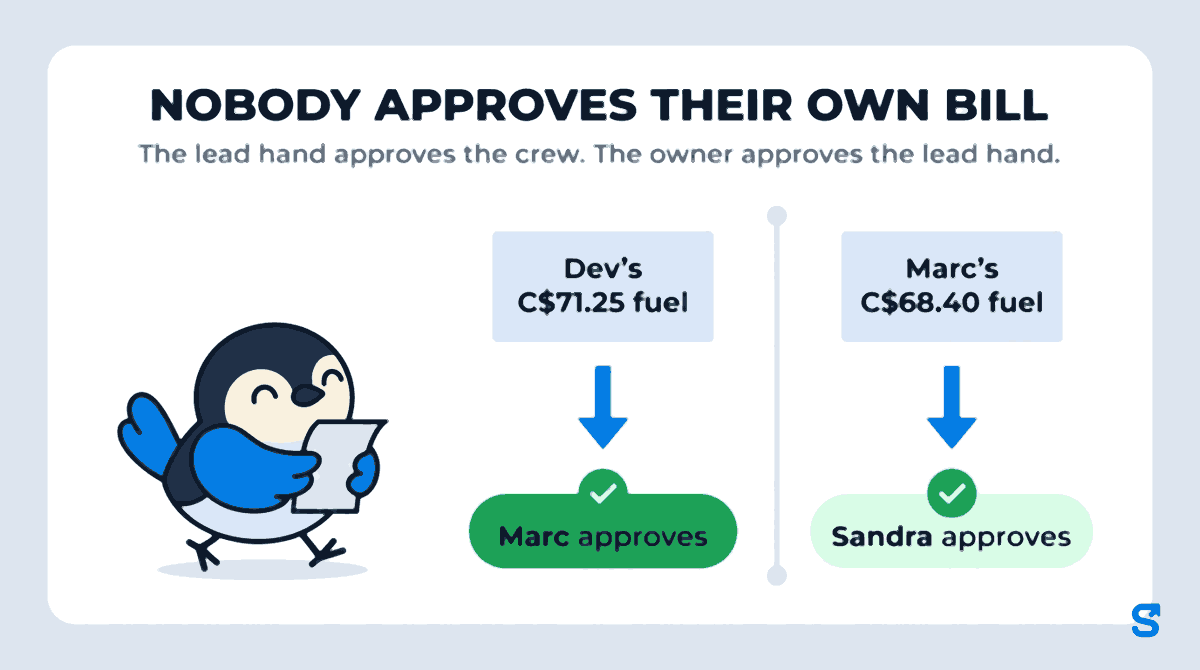
Marc sees Dev's two bills waiting for approval, with the receipt photo beside each. He can approve the full amount, approve a smaller amount, ask Dev to fix something (a missing work order number, say), or say no with a reason. He cannot approve his own C$68.40 fuel bill. That one waits for Sandra.
Sandra approves Marc's fuel. Approved bills paid with the staff member's own money show as "To pay back", and by default they are added to the next payroll run. If someone needs the money before payday, she marks the bill paid now instead.
Who approves the lead hand's receipts?
This is the question most small shops never write down, and it is the one that matters most. The rule is short: nobody approves their own bill. A manager can approve everyone else's receipts; their own go to an owner.
It protects the lead hand as much as the business. When a customer disputes a job cost or the books do not balance at year end, "Sandra approved it" is a much better answer for Marc than "I approved it myself".
What to put in a one-page expense policy
You do not need a binder. Five lines on one page, read to every new hire, cover a trades crew:
- What can be claimed: parts and materials for a job, fuel for a company or personal vehicle used on a call, parking at a job site, tools under an amount you name.
- What proof is needed: a photo of the receipt or the invoice PDF, sent the same day, with the job or customer named.
- Which currency and which rate: US-dollar bills are claimed in Canadian dollars at the rate on the card statement (or whichever rate you choose, written here).
- Who approves: the lead hand approves the crew; the owner approves the lead hand and any bill over an amount you set.
- When it is paid back: with the next pay, or the same week if the person asks.
If you give techs a float (cash or a prepaid card for small purchases) instead of having them use their own money, add one more line: how unspent float is returned.
Taking money back out of a pay cheque in Ontario
Sometimes the money moves the other way: a tech was given cash for parts, spent half, and the rest is never returned. The temptation is to take it out of the next pay. In Ontario, the province's guide to the Employment Standards Act says an employer may deduct from wages when the employee has signed a written statement authorizing the deduction, and that the authorization must specify the amount or a way of calculating it. The same page says an oral authorization or a general "blanket" statement is not enough (Ontario: Payment of wages, checked on 8 October 2026).
Other provinces have their own rules, so check your province's employment standards office if you are outside Ontario. This is general information, not legal advice: check with the agency or an employment lawyer for your case.
How Shiftelio handles it
In Shiftelio, staff file bills from the app on their phone, and owners and managers review them on the Money page, in the Expenses tab. The feature is described in the app as "Review money staff have spent and claim back", and it does exactly the four steps above:
- Receipt in, form filled. Staff take a photo or choose files, the amount, date and shop are filled in for them, and the form tells them what to check. Several bills in one photo or PDF come back as a list to tick and save in one go.
- The currency question. A bill that shows a bare "$" asks which currency it is in, and a foreign bill asks for the exchange rate, then shows what was paid and what is claimed in Canadian dollars.
- Nobody approves their own bill. A manager with the "Approve bills and give work cash" permission approves the crew; their own bills wait for an owner. Staff can only file their own bills, never someone else's.
- Paid back on payday. Approved bills paid with the staff member's own money appear under "To pay back" and go into the next payroll run, or are marked paid now. You can filter every bill by date, person, category and state, and download them as an Excel file for your bookkeeper.
The one true thing we do that a receipt-scanner app does not: the same app your crew already uses to clock in and see their schedule is where they file the bill, and the approval rule knows whose bill it is. See it on the Shiftelio for Canadian businesses page or in the full features list.
Which app lets a crew photograph receipts and stops a lead hand approving their own?
Frequently asked questions
How quickly should employees submit expense receipts?
The same day they pay. A photo taken at the counter cannot fade or get lost, and the person still remembers which job it was for.
How do I reimburse an employee for a purchase made in US dollars?
Repay it in Canadian dollars at a rate you name in your policy. Record the US amount, the rate and the Canadian amount on the claim, so the tech is not short by the exchange difference.
Can a manager approve their own expense claim?
They should not. Let managers approve their crew's bills and send their own bills to an owner. In Shiftelio this is built in: a manager cannot approve their own bill.
Can I deduct unreturned float money from an employee's pay in Ontario?
Only with the employee's written authorization for a specific amount or a way of calculating it, according to Ontario's guide to the Employment Standards Act. A verbal OK or a blanket statement is not enough.