Equal Opportunity Policy Under the RPwD Act: What Every Indian Employer Must Publish
In short
Every establishment owes an equal opportunity policy for persons with disabilities. The 20 employee line decides what goes in it, not whether you need one.
You run a business with fourteen people. Somewhere in a compliance checklist you read the line that turns up in almost every article on this subject: private establishments with twenty or more employees must publish an equal opportunity policy for persons with disabilities. Fourteen is not twenty, so you moved on.
That sentence is a fair summary of one sub-rule and a bad summary of the law. The duty to have a policy at all has no employee threshold anywhere in it. The twenty is a line between two different contents, and it is the trigger for a separate record-keeping obligation that most businesses have never heard of. If you have one employee, you owe a policy.
Here is where the number actually sits, what the policy has to say, the two steps after writing it that nearly everybody skips, and what a contravention costs.
The number everyone quotes is not the trigger
Two instruments govern this. The Rights of Persons with Disabilities Act, 2016 carries the duty, and the Rights of Persons with Disabilities Rules, 2017, notified as G.S.R. 591(E) on 15 June 2017, prescribe the manner. Read them in that order and the structure is obvious.
Section 21(1) of the Act: Every establishment shall notify equal opportunity policy detailing measures proposed to be taken by it in pursuance of the provisions of this Chapter in the manner as may be prescribed by the Central Government. Rule 8(1), which is the prescription that section points to, is one sentence: Every establishment shall publish equal opportunity policy for persons with disabilities.
Neither sentence contains a number. The word twenty appears for the first time in rule 8(3), and rule 8(3) is not about who must have a policy. It opens The equal opportunity policy of a private establishment having twenty or more employees and the Government establishments shall inter alia, contain the following, and then lists five heads. It is a content rule. It describes what goes inside a document whose existence rule 8(1) has already required.
The clincher is rule 8(4), which almost nothing published on this subject quotes: The equal opportunity policy of the private establishment having less than twenty employees shall contain facilities and amenities to be provided to the persons with disabilities to enable them to effectively discharge their duties in the establishment.The Rules are telling you, in terms, what the small establishment’s policy must contain. You cannot write a content rule for a document that does not have to exist.
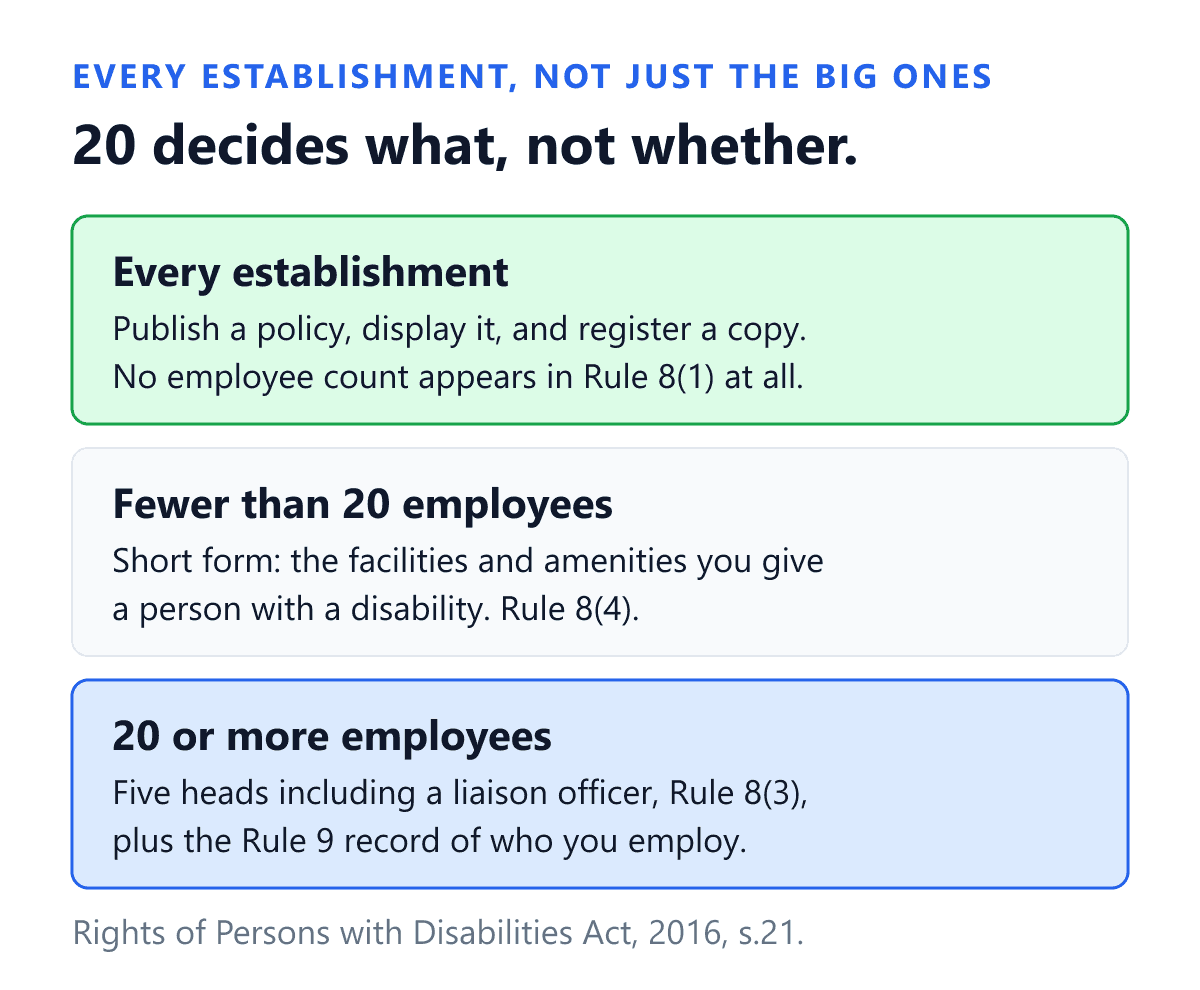
So the reading is: every establishment publishes a policy. A private establishment under twenty writes the short form. A private establishment at twenty or above, and every government establishment whatever its size, writes the long form and additionally keeps a record. The threshold is real. It simply governs a different question from the one it is usually attached to.
An establishment is broader than a factory. The Act defines it to take in a government establishment and a private establishment, and private establishment covers a company, firm, cooperative or other society, associations, trusts, agencies, institutions, organisations, unions, factories, industries or any other establishment as may be notified. A partnership running two retail counters is an establishment. So is a clinic, a school trust and a design studio.
Three duties, and almost everybody stops after the first
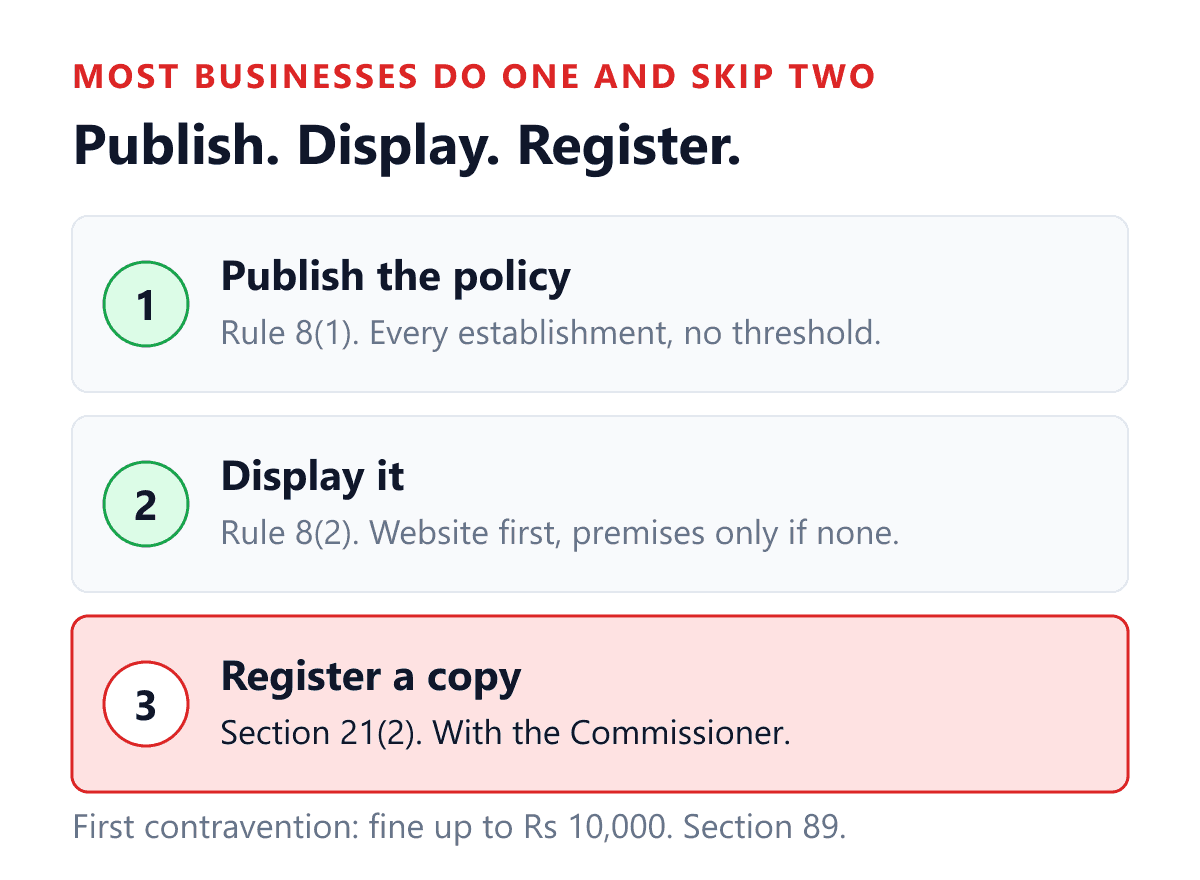
Writing the policy is one third of the obligation. The Act and the Rules impose three distinct acts, in two different instruments, and they are easy to read as one because they are usually paraphrased together.
Publish it, under rule 8(1). Display it, under rule 8(2). Register a copy, under section 21(2) of the Act: Every establishment shall register a copy of the said policy with the Chief Commissioner or the State Commissioner, as the case may be. That third one lives in the Act rather than the Rules, which is part of why summaries that work from the Rules alone lose it.
Rule 8(2) ranks the two places, it does not offer a choice
The wording is The establishment shall display the equal opportunity policy preferably on their website, failing which, at conspicuous places in their premises. That is an order of preference, not a menu. If you have a website, the policy belongs on it, and a copy pinned to the noticeboard instead is not the prescribed manner. The premises option is written for the establishment that has no site at all.
This is the cheapest item in the whole article to fix. A page on your own domain, linked from the footer, satisfies rule 8(2) permanently and is also the thing you send the Commissioner under section 21(2).
Which Commissioner the copy goes to
Section 21(2) says the Chief Commissioner orthe State Commissioner, as the case may be. The Chief Commissioner for Persons with Disabilities is the central office under the Department of Empowerment of Persons with Disabilities; each State and Union Territory has its own Commissioner. The practical rule follows the establishment: a business operating within one State registers with that State’s Commissioner, and an establishment under central jurisdiction or spread across States deals with the Chief Commissioner. Offices publish their own submission route and several now accept it by email, so check the current route for your State rather than working from an address printed in an article.
What the long-form policy must contain
Rule 8(3) lists five heads for a private establishment with twenty or more employees and for every government establishment. In the Gazette’s own order:
- The facility and amenity to be provided to persons with disabilities to enable them to effectively discharge their duties in the establishment.
- The list of posts identified suitable for persons with disabilities in the establishment.
- The manner of selection of persons with disabilities for various posts, post-recruitment and pre-promotion training, preference in transfer and posting, special leave, preference in allotment of residential accommodation if any, and other facilities.
- Provisions for assistive devices, barrier-free accessibility and other provisions for persons with disabilities.
- Appointment of a liaison officer by the establishment to look after the recruitment of persons with disabilities and provisions of facilities and amenities for such employees.
Head three is doing more work than it looks. Buried in one sub-clause are special leave and preference in transfer and posting, which are leave-policy and rostering decisions rather than statements of intent. If your leave rules are already written down, this head is asking you to say what changes in them, and our guide to leave rules and encashment under the labour codes is the baseline that special leave sits on top of.
The liaison officer is a named person
Head five is the one that most often gets written as a sentence and never implemented. Rule 8(3)(e) requires the appointment of a liaison officer, with two defined jobs: recruitment of persons with disabilities, and the provision of facilities and amenities for such employees. In a business of thirty people that is an existing manager given the role in writing, not a new hire. What it cannot be is an unfilled line in a policy document, because appointment is the act the rule asks for.
The short-form policy, for a business under twenty
Rule 8(4) asks for one head, and it is head one of the longer list: the facilities and amenities to be provided to persons with disabilities to enable them to effectively discharge their duties in the establishment. No list of identified posts, no liaison officer, no selection and promotion machinery.
In practice that is a short, specific and honest page: how someone gets into and around the premises, which workstation adjustments you will make, what you will do about assistive technology and software your systems have to work with, and who to ask. Written narrowly and truthfully it is better compliance than a copied five-page document that describes a promotion policy you do not have.
The reservation does not apply to you. The four per cent reservation in identified posts under section 34 of the Act binds governmentestablishments. It is the single most common thing private employers wrongly believe they are on the hook for, and it is the reason some of them assume the whole chapter is somebody else’s problem. The policy duty under section 21 makes no such distinction: it says every establishment, and it means yours.
The record under rule 9, which is where twenty really bites
Rule 9(1) opens Every establishment covered under sub-rule (3) of rule 8 shall maintain records containing the following particulars. Sub-rule (3) of rule 8 is the twenty-plus tier and the government establishments, so this is the obligation the number genuinely triggers. Five particulars:
- The number of persons with disabilities who are employed, and the date from when they are employed.
- The name, gender and address of persons with disabilities.
- The nature of disability of such persons.
- The nature of work being rendered by such employed person with disability.
- The kind of facilities being provided to such persons with disabilities.
Then rule 9(2): Every establishment shall produce for inspection on demand, records maintained under these rules, to the authorities under this Act and shall supply such information which may be required for the purpose of ascertaining whether the provisions have been complied with. Note that 9(2) says every establishment, not every establishment covered by rule 8(3). Section 22(2) of the Act puts it the same way from the other side: the records shall be open to inspection at all reasonable hours by persons authorised by the appropriate Government.
Four of those five particulars are fields you already hold for every employee: date of joining, name, gender, address and job. Two are not, and they are the two the register exists for. If your employee records are a system rather than a stack of files, this duty is a filtered report rather than a new book to open, which is the same argument our piece on statutory registers and wage slips under the labour codes makes about the wider register set. Shiftelio keeps the joining date, job and contact details on the employee record for the same reason: the register that has to be produced on demand should be a query, not an archaeology project.
Nature of disability is health data, and that cuts both ways
Particular three is the sensitive one, and it deserves care rather than enthusiasm. The nature of a person’s disability is health information about an identified individual. For an establishment inside rule 8(3), rule 9(1) requires you to hold it, which gives you a clear reason to. For an establishment below twenty, no rule requires the register, and starting one anyway means collecting health data about your staff with no legal obligation behind it.
That is a poor trade. The safeguards are ordinary and worth stating: collect the particulars rule 9 names and nothing beyond them, keep the file restricted to whoever actually administers it, and do not let a disability field leak into rosters, group chats or anything a colleague can browse. Our article on the DPDP Act and employee data works through the consent and purpose-limitation questions this raises.
What a contravention costs
Section 89 of the Act is a general penalty and it covers a failure under section 21 or 22 like any other. Any person who contravenes any provision of the Act, or of any rule made under it, is punishable for a first contravention with a fine which may extend to ten thousand rupees, and for any subsequent contravention with a fine of not less than fifty thousand rupees which may extend to five lakh rupees.
| Contravention | Fine under section 89 |
|---|---|
| First | Up to Rs 10,000 |
| Any subsequent | Not less than Rs 50,000, up to Rs 5,00,000 |
The step between the two is the point. A first fine is a nuisance; the floor on the second is five times the ceiling of the first, which is how the Act treats an employer who was told and did not act. Section 90 then reaches the individuals: where an offence is committed by a company, every person who at the time was in charge of and responsible to the company for the conduct of its business is deemed guilty, with a defence for anyone who proves the offence happened without their knowledge or that they exercised all due diligence to prevent it.
Fines are the visible cost and usually the smaller one. The Chief Commissioner and the State Commissioners have powers to look into complaints of deprivation of rights and to take up matters with the appropriate authorities, and a complaint from a candidate or an employee is a far more likely route to a compliance problem than a proactive inspection.
The labour codes did not absorb any of this
Worth stating because the assumption is everywhere in 2026. The four labour codes consolidated twenty-nine central labour enactments. The RPwD Act, 2016 is not one of them. It sits alongside the codes as a separate statute with its own Commissioners, its own Rules and its own penalty section, and nothing in the codes displaces section 21, section 22 or rule 8.
Practically, that means the equal opportunity policy is a separate document from everything the codes ask for. It is not a clause in your standing orders and not a paragraph in the appointment letter, though the letter is now compulsory in its own right, as our piece on the appointment letter the labour codes made mandatory sets out. If you are auditing your obligations end to end, the labour code compliance checklist for 2026 covers the code side and this article covers the piece it does not reach.
What to do this week
- Count your employees. Twenty or more, or a government establishment, means the five heads of rule 8(3) and the rule 9 record. Under twenty means the single head of rule 8(4) and no register.
- Write the policy for the tier you are in. Short and true beats long and copied, and a copied long-form policy commits you to machinery you do not operate.
- Put it on your website and link it from the footer. Only if you have no website does the noticeboard become the answer.
- Register a copy with your State Commissioner, or the Chief Commissioner if you are centrally regulated, and keep the acknowledgement with your other statutory filings.
- Name the liaison officer in writing if you are at twenty or above, and tell them what the two duties are.
- Start the rule 9 record only if rule 8(3) covers you, with the five particulars and nothing more, access restricted.
- Diarise a review for the day your headcount crosses twenty, because that is the day the policy has to grow four heads and the record has to begin.
Sources
The Rights of Persons with Disabilities Rules, 2017 were read from the Gazette notification G.S.R. 591(E) of 15 June 2017, published by the Ministry of Social Justice and Empowerment, Department of Empowerment of Persons with Disabilities, in the Gazette of India Extraordinary, Part II, Section 3, Sub-section (i). Rules 8(1) to 8(4) and 9(1) to 9(2) are quoted from that text, and the five heads of rule 8(3) and the five particulars of rule 9(1) appear in the order the Gazette prints them.
Sections 21(1) and 21(2) of the Act are reproduced verbatim by the Office of the Chief Commissioner for Persons with Disabilities, which also sets out the rule 8(3) heads. The Act, the Rules and the list of State Commissioners are published by the Department of Empowerment of Persons with Disabilities, Ministry of Social Justice and Empowerment. Section 22, section 89 and section 90 were each checked against two independent reproductions of the bare Act before being used here.
This is general information about Indian law as it stands in September 2026, not legal advice. Several States have their own rules and their own Commissioner’s office with its own submission route, the definition of a private establishment is extendable by notification, and headcount thresholds are read against your own establishment’s facts. Check the current position for your State, or take advice, before finalising a policy or a filing.
Keep reading
See how Shiftelio does this in practice with the employee record a rule 9 return is produced from on demand.
Free to use, no signup: Payroll calculators.