Is an Experience Certificate Mandatory in India? What the 2026 Labour Codes Actually Require
In short
Three duties, three duty-holders. Contract labour gets Form XXIII on demand. A service certificate is due in ten days, but only above 300 workers.
A fabrication workshop in Rajkot gets a WhatsApp message on a Tuesday. A welder who left fourteen months ago needs an experience letter for a Gulf visa application. They worked there for three years. Nobody disputes it. But they were engaged through a labour contractor, the contractor has since moved on to another site, and the workshop owner has no idea whether this is their problem, a courtesy, or a legal duty.
That single question - is an experience certificate actually mandatory in India - has three different answers in 2026, and which one applies to you depends on facts that have nothing to do with how good an employee somebody was.
It depends on whether they were on your rolls or a contractor’s. It depends on whether your headcount touched three hundred on any single day in the last year. And in the most common case of all, a business under three hundred people with everybody on its own payroll, the honest answer is one that almost no article on this subject will give you.
The short answer is three answers
Here is the whole thing before the detail, because most readers only need one of the three rows.
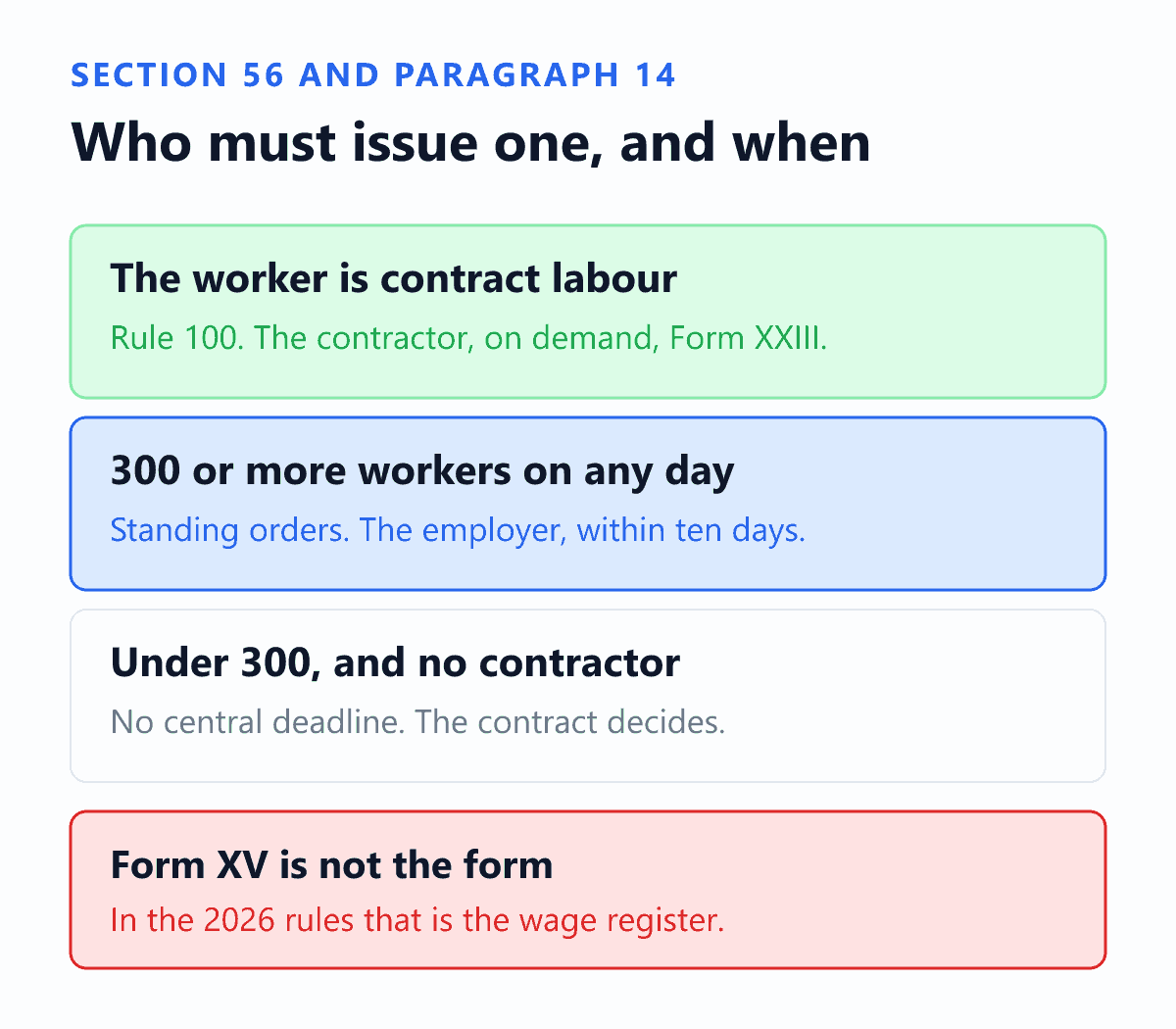
Notice what is noton that picture. There is no single national statute that says "every employer shall issue an experience certificate to every departing employee". People assume there is, because the practice is universal. The practice is universal because employers need one another to issue them, not because a section commands it.
Contract labour: section 56, and the rule that names the form
This is the clearest of the three, and it is the one that answers the Rajkot workshop. Section 56 of the Occupational Safety, Health and Working Conditions Code, 2020 reads in full:
"Every concerned contractor shall issue, on demand, experience certificate, in such form as may be prescribed by the appropriate Government, to the contract labour giving details of the work performed by such contract labour."
One sentence, and three things in it decide the whole question.
The duty is the contractor’s.Not the principal employer’s. The workshop that hosted the welder for three years is not the person section 56 addresses. The labour contractor who employed them is. That is a genuinely awkward outcome, because the contractor is the party most likely to have vanished, and we come back to it below.
It runs on demand. There is no deadline anywhere in section 56 or in the rule under it, and the reason is structural rather than sloppy: the worker asking is the trigger. A contractor who has never been asked has never been in breach. A contractor who has been asked is in breach from a point nobody has defined.
The form is prescribed by the appropriate Government.Not by the Code. So the answer to "what does it have to look like" is not in the Code at all, and it is different depending on whether the Centre or your State is the appropriate government for your establishment.
Where the Centre is the appropriate government, rule 100 of the Occupational Safety, Health and Working Conditions (Central) Rules, 2026 supplies it:
"100. Experience Certificate.- Every concerned contractor shall issue on demand, experience certificate in FORM-XXIII to the contract labour giving details of the period, work performed, experience gained in various fields performed by such contract labour."
Read the two side by side and the rule quietly does more than prescribe stationery. The Code says details of the work performed. The rule says details of the period, work performed, experience gained in various fields. Two extra contents that are not in the parent section: how long, and what they got good at. A certificate that says only "worked as a welder" satisfies section 56 and does not satisfy rule 100.
The Ministry of Labour and Employment answers this directly in its own FAQ on the OSH Code, updated to 13 March 2026. Question 8 asks whether a contract labour worker can be issued an experience certificate. The answer: "Yes. As per Section-56 of OSH&WC Code, it is mandatory that the contractor will issue on demand, experience certificate to contract labours." There is not much room left to argue about it.
The form number almost everyone gets wrong
Search for the form and you will be told, repeatedly and confidently, that it is Form XV. It is not, and this is worth spending a paragraph on because it is the most checkable error in the secondary literature on this topic.
Form XV was the experience certificate in the draft Central Rules published in 2020. Those drafts sat unfinalised for five and a half years while everybody wrote explainers off them. The final Central Rules were notified on 8 May 2026, the forms were renumbered, and in the notified rules Form XV is the Register for wages, overtime and deductions, prescribed by rule 72(1)(iii). The experience certificate moved to Form XXIII, which is what rule 100 says in its own text, twice.
If you are handed a compliance checklist that says "Form XV - experience certificate", it was written against the 2020 draft. Treat everything else on that checklist with the same suspicion. The form numbers around it moved too: Form XIII is now the employee register and Form XIV is the attendance register-cum-muster roll.
Whose problem is it when the contractor has gone
Here is the uncomfortable part, stated as an observation rather than as settled law, because it is not settled.
The duty in section 56 and rule 100 sits on the contractor. But the OSH Code’s general penalty, section 94, is addressed differently. It applies "save as otherwise expressly provided" wherever there is a contravention of the Code or the rules made under it, and it makes "the employer or the principal employer of the establishment, as the case may be" liable to a penalty of not less than Rs 2 lakh, extending to Rs 3 lakh, with a further Rs 2,000 for each day the contravention continues after conviction.
No specific penalty is attached to section 56 or rule 100 by name, so section 94 is the operative route. Whether an inspector-cum-facilitator would in practice pursue a principal employer for a certificate the contractor failed to issue is untested, and no authority on it was found while writing this. What is safe to say is that the drafting does not obviously insulate you, and that the cheap defensive move is not a legal opinion. It is to make sure the underlying record exists on your side too, so that whoever ends up issuing the certificate can.
The wider allocation of liability between principal employer and contractor is the same pattern the PF liability rules for contract workers follow, and it is worth reading the two together if you use contract labour at any scale.
The ten-day service certificate, and the gate nobody mentions
The second duty is the one that produced a wave of "employers must now issue a service certificate within 10 days" posts in mid-2026. The clause is real. It comes from the Model Standing Orders, 2026, notified as S.O. 2312(E) on 8 May 2026 under section 29(1) of the Industrial Relations Code, 2020, and it appears identically in all three schedules - A for mining, B for manufacturing, C for services.
Paragraph 14 is headed Service record. Sub-paragraph (1)(ii) reads:
"every worker shall be entitled to a service certificate, specifying the nature of work, designation and the period of employment (months, years) at the time of discharge, termination, retirement or resignation from service to be issued by the employer within ten days of such instance"
Four contents, four triggers, ten days, and the duty is the employer’sthis time, not a contractor’s. It is a genuine step change from the old position, where a service certificate on exit was a matter of custom for most establishments.
And now the part the syndicated posts leave out.
Model standing orders do not apply to every employer.They reach an establishment through Chapter IV of the Industrial Relations Code, and section 28(1) applies that chapter to "every industrial establishment wherein three hundred or more than three hundred workers, are employed, or were employed on any day of the preceding twelve months". A 40-person design studio is not under paragraph 14. A 12-person clinic is not under paragraph 14.
Two qualifications on that threshold, both of which catch people out.
First, it is any day, not an average. A retail chain that runs at 240 people for eleven months and staffs up to 330 for Diwali is inside Chapter IV, and several widely republished summaries describe the test as "average workforce strength", which flips the answer for every seasonal business. The full working of that count is in our piece on the 300-worker standing orders threshold.
Second, "worker" is a defined term and it is narrower than headcount. Section 2(zr) of the IR Code excludes apprentices, anybody employed mainly in a managerial or administrative capacity, and supervisory staff drawing more than Rs 18,000 a month. So a 320-person company with 30 managers may be a 290-worker establishment and outside the chapter entirely.
You may already be governed by this text without having adopted it
If you are over three hundred, there is a second surprise waiting. Section 29(2) of the IR Code provides that from the date the chapter becomes applicable until your own standing orders are certified under section 33, the model standing orders shall be deemed to be adopted in the establishment.
Doing nothing is not a gap. It is a choice of text. An establishment that crossed three hundred, never drafted standing orders and never certified anything is, on the face of section 29(2), operating under the Centre’s model - paragraph 14 and its ten days included.
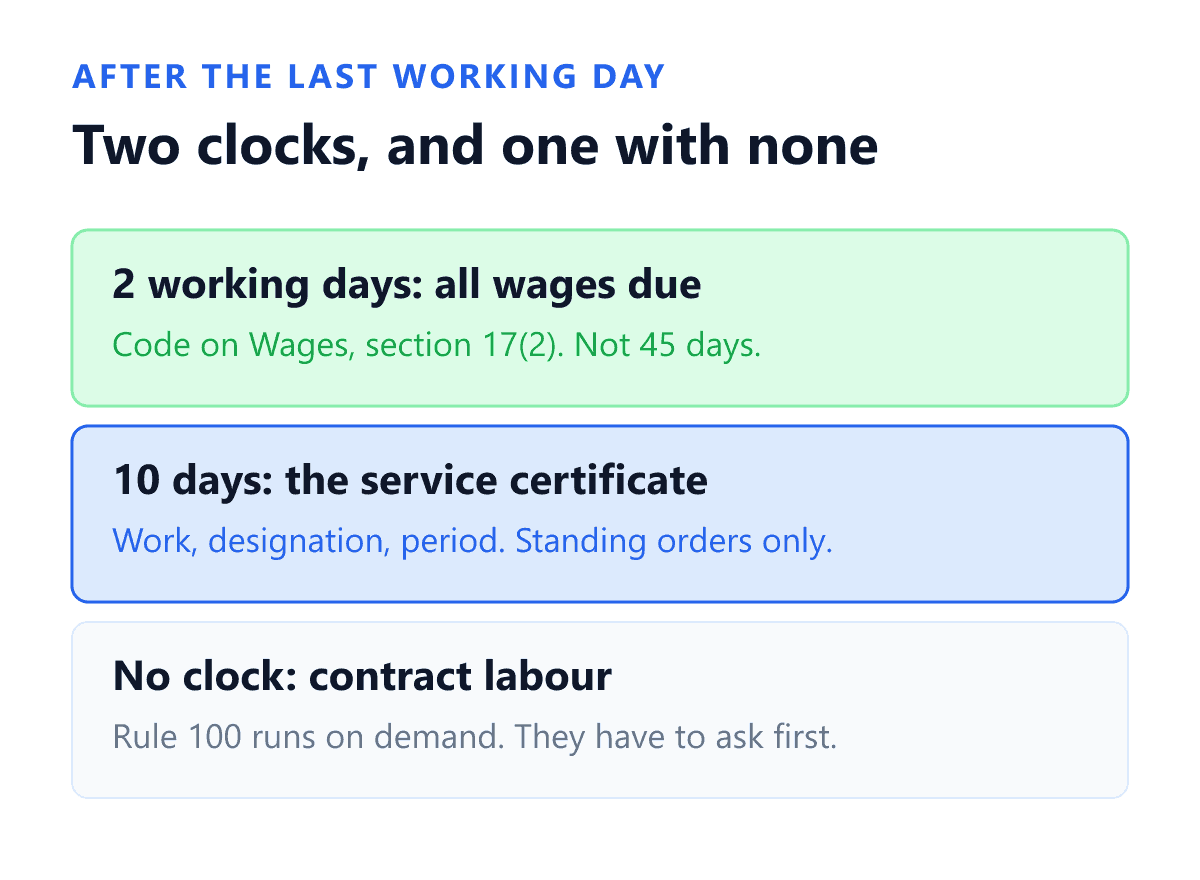
That two-working-day figure is not a typo and it is not the forty-five days everybody quotes. It is section 17(2) of the Code on Wages, 2019, and it is worked through properly in our guide to full and final settlement rules. The point of putting the three side by side is that they are independent. Paying the money on time does not discharge the certificate duty, and issuing the certificate does not buy time on the wages.
The service card duty nobody writes about
Sub-paragraph (1)(ii) got all the attention. Sub-paragraph (1)(i), immediately above it, is the one that actually changes day-to-day work:
"every industrial establishment shall maintain a service card in respect of each worker electronically or in manual form, wherein particulars of that worker shall be recorded with the knowledge of that worker in Form (ii) and shall be updated periodically"
With a proviso: where the card is kept manually, the record must be attested by an authorised officer together with the date.
Three things follow. The record is per worker, not a register of everybody. It must be kept with the knowledge of that worker, which is a transparency obligation rather than a filing one. And it must be updated periodically, so it is a living record, not a joining-day form.
This matters because the ten-day certificate is downstream of it. A service card that has been maintained continuously makes the certificate a two-minute job. A service card that has not been maintained makes it an archaeology project, on a ten-day deadline, at exactly the moment the person who knows the answers has left.
What if you are under 300, with nobody on contract?
This is most Indian employers, and it deserves a straight answer rather than a comfortable one.
No central statutory provision was found that requires such an employer to issue an experience certificate to a departing employee, and none is asserted here. Section 56 is about contract labour. Paragraph 14 reaches you through a three-hundred-worker gate. Neither applies.
Several sources will tell you that your State Shops and Establishments Act fills the gap. That claim was checked for this article against the Delhi Act of 1954, the Maharashtra Act of 2017 and the Karnataka Act, and no such section surfaced in any of them. It may well exist in some States, and this is exactly the kind of provision that varies. Read your own State’s Act rather than a summary of somebody else’s, and if a consultant tells you it is there, ask for the section number.
What is left is not nothing. Three things still bind a sub-three-hundred employer:
- Your own contract of employment. If the appointment letter promises a service or experience certificate on exit, that is enforceable as a contractual term, independent of any statute. Since the labour codes made the appointment letter itself mandatory, more employers now have a written document making exactly that promise than had one two years ago, often without having noticed the clause.
- Your own standing orders, if you have certified any. An establishment that certified standing orders when it was larger, or voluntarily, is bound by the text it certified.
- The withholding problem. Refusing a truthful certificate to a person who worked for you, as leverage in a dispute over notice or dues, is a bad position to be in and a worse one to defend. The document costs you nothing and its absence is a lasting harm to the other person.
Three documents that are not the same document
Most of the confusion in this area is vocabulary. These get used interchangeably and they are not interchangeable.
| Document | What it says | Statutory basis in 2026 |
|---|---|---|
| Experience certificate | The period, the work performed, and the experience gained in various fields | Section 56 of the OSH Code and rule 100 of the Central Rules, for contract labour only. The contractor issues it, on demand, in Form XXIII |
| Service certificate | Nature of work, designation, and period of employment in months and years | Paragraph 14(1)(ii) of the Model Standing Orders, 2026, where standing orders apply. The employer issues it within ten days |
| Relieving letter | That the employment has ended, on a stated date, and that the person is free of obligations to you | None. It is a market convention, driven by the next employer’s onboarding checklist, not by any section |
The practical consequence: a relieving letter is the one a candidate is most often asked for and the only one of the three with no statutory backing at all. If you are going to be strict about issuing exactly what the law requires and no more, be aware that you are withholding the document that actually blocks somebody’s next job.
What to actually put on it
Take the two statutory lists together and you get a certificate that satisfies both, which is the sensible thing to issue regardless of which duty applies to you.
- Full name, and the identifier you used internally - employee number or identity card number. Not required by either provision, but it is what makes the certificate verifiable later.
- Designation - required by paragraph 14(1)(ii).
- Nature of work - required by paragraph 14(1)(ii), and the "work performed" limb of section 56.
- Period of employment, stated in months and years - paragraph 14(1)(ii) is explicit about the unit, and rule 100 requires the period too.
- Experience gained in various fields - rule 100 only, and the one line most templates omit. For a worker who moved between trades or sites, this is the substantive part.
- Date of issue, and signature of an authorised person, on your letterhead.
What not to put on it: the reason for leaving, any performance assessment, and any conduct comment. Neither provision asks for it, and a certificate of service that editorialises is a document you will be asked to justify.
Where the record actually comes from
Every field on that list is a fact about a person that had to be recorded while they were still working for you. None of it can be reconstructed accurately from memory fourteen months later, which is why the Rajkot workshop is stuck.
Designation and dates are the easy ones. The hard one is nature of work and experience gained in various fields, because in the businesses where this duty actually bites - construction, facility management, manufacturing, hospitality - people move between sites, trades and shifts constantly, and the only honest source for what somebody actually did is the attendance and roster history.
That is the connection worth drawing between paragraph 14(1)(i) and paragraph 14(1)(ii). The service card duty and the certificate duty are the same duty at two points in time. If the card is real, the certificate writes itself.
This is where Shifteliois useful and it is worth being precise about how, because "we generate letters" is the shallow version. The employee record, the attendance history and the site or department the person was rostered to all sit in one place, so the period of employment and the nature of work are read out of the same system rather than assembled from three. Experience and relieving letters generate as A4 PDFs on your letterhead from that record, which means the ten-day clock is a click rather than a project. And because the record is maintained continuously rather than at exit, it does the paragraph 14(1)(i) job at the same time - a per-worker card, kept electronically, updated as things change.
If you engage contract labour, the same records are what let you answer a contractor’s failure rather than inherit it. The attendance register-cum-muster roll is Form XIV in the same set of rules, and it is the document that proves who was on site, for how long, doing what.
Questions employers ask
Is an experience certificate legally mandatory in India?
For contract labour, yes. Section 56 of the OSH Code, 2020 requires every concerned contractor to issue one on demand, and the Ministry of Labour and Employment confirms this in question 8 of its FAQ on the Code. For an establishment’s own employees, a service certificate is mandatory within ten days of exit under paragraph 14(1)(ii) of the Model Standing Orders, 2026, but only where standing orders apply, which under section 28(1) of the IR Code means three hundred or more workers on any day of the preceding twelve months. For a smaller employer with no contract labour, no central statutory duty was found, and what binds you is your own contract of employment.
What is the time limit for issuing an experience certificate?
It depends which duty you are under. The service certificate under the Model Standing Orders is ten days from discharge, termination, retirement or resignation. The experience certificate for contract labour under section 56 and rule 100 has no time limit at all, because it is issued on demand- the worker’s request starts the obligation, and the provisions do not say how long you then have.
Is the experience certificate Form XV or Form XXIII?
Form XXIII, where the Central Government is the appropriate government. Rule 100 of the OSH (Central) Rules, 2026 names it explicitly. Form XV in the final rules is the Register for wages, overtime and deductions under rule 72(1)(iii). The widespread "Form XV" answer comes from the 2020 draft rules, which were superseded when the final rules were notified on 8 May 2026 and the forms were renumbered. Where your State is the appropriate government, section 56 defers to the form your State prescribes.
Can an employer refuse to give an experience letter?
Where a statutory duty applies, no. A contractor refusing a contract worker’s demand is contravening section 56 and rule 100, and the OSH Code’s general penalty in section 94 runs from Rs 2 lakh to Rs 3 lakh with a further Rs 2,000 a day for a continuing contravention. An employer inside standing orders refusing the ten-day service certificate is contravening the standing orders that govern the establishment. Where no statutory duty applies, refusal is lawful unless your own appointment letter promised one, which many now do.
Does a fixed-term employee get a service certificate?
Yes, where standing orders apply. Paragraph 14(1)(ii) speaks of "every worker" and lists fixed term employment as one of the classes of worker, with a proviso that such workers are eligible for all statutory benefits available to a permanent worker doing the same work. Completion of the fixed term is a termination for this purpose, and the ten-day clock runs from the last day. The related question of what else the fixed-term relationship attracts is covered in our piece on gratuity for fixed-term employees.
Is a relieving letter the same as an experience certificate?
No. An experience or service certificate states what somebody did and for how long. A relieving letter states that the employment has ended and that the person is free of further obligation to you. Only the first has any statutory basis in India. The relieving letter is a convention of the hiring market, which is precisely why withholding it is more damaging to the individual than withholding the certificate the law actually names.
Do we have to keep a service card for every worker?
Where standing orders apply, yes. Paragraph 14(1)(i) requires a service card per worker, electronically or manually, in Form (ii), recorded with that worker’s knowledge and updated periodically. A manually kept card must be attested by an authorised officer with the date. It is the ongoing half of the same obligation whose exit half is the ten-day certificate.
The short version
- There is no single Indian law requiring every employer to issue an experience certificate. There are two specific duties, and they land on different people.
- Contract labour: section 56 of the OSH Code puts the duty on the contractor, on demand, in the form the appropriate government prescribes.
- Under the Central Rules that form is Form XXIII, per rule 100. It is not Form XV; that is the wage register, and the Form XV answer comes from the dead 2020 draft.
- Rule 100 requires more than the Code does: the period, the work performed, and the experience gained in various fields.
- Own employees: paragraph 14(1)(ii) of the Model Standing Orders, 2026 requires a service certificate within ten days of discharge, termination, retirement or resignation, stating nature of work, designation and period in months and years.
- That ten-day duty is gated at three hundred workers on any day of the preceding twelve months, by section 28(1) of the IR Code. Most employers are outside it and the syndicated summaries do not say so.
- If you are over three hundred and never certified your own standing orders, section 29(2) deems the model text adopted anyway.
- Paragraph 14(1)(i) separately requires a per-worker service card, kept with the worker’s knowledge and updated periodically. The certificate is easy if the card is real.
- The wage clock is different and shorter: two working days under section 17(2) of the Code on Wages.
- A relieving letter has no statutory basis at all, and is the document that actually blocks somebody’s next job.
Position as at 7 September 2026. Section 56 and section 94 are quoted from the text of the Occupational Safety, Health and Working Conditions Code, 2020. Rule 100 and rule 72(1)(iii) are quoted from the OSH (Central) Rules, 2026, G.S.R. 345(E) of 8 May 2026. Paragraph 14(1) is quoted from the Gazette of India text of the Model Standing Orders, 2026, S.O. 2312(E) of 8 May 2026, where the clause is identical in Schedules A, B and C. The Central Rules apply where the Central Government is the appropriate government; most private employers fall under their State, and States prescribe their own forms under section 56. No State Shops and Establishments Act provision requiring a service certificate was located while writing this, and none is asserted. This is general information and not legal advice for a particular establishment.
Sources
- Ministry of Labour and Employment, FAQ on the OSH&WC Code, 2020, as on 13 March 2026- question 8 confirms the section 56 experience certificate duty in the Ministry’s own words, and question 7 sets out the principal employer’s welfare obligations to contract labour under section 53.
- Ministry of Labour and Employment, Model Standing Orders, 2026 - S.O. 2312(E) of 8 May 2026, the three schedules and paragraph 14 on the service record.
- PRS Legislative Research, The Occupational Safety, Health and Working Conditions Code, 2020 - the Code as enacted, including section 56 and the section 94 general penalty.
- Ministry of Labour and Employment, Labour Codes - the four codes in force from 21 November 2025 and the Central Rules notified on 8 May 2026.
Keep reading
See how Shiftelio does this in practice with employee records and letters that generate from the attendance history behind them.
Free to use, no signup: Payroll calculators.