Full and Final Settlement in India: The Two-Working-Day Rule Every Employer Now Has to Meet
In short
Section 17(2) of the Code on Wages makes final wages due within two working days of exit, not 45. What counts, what does not, and how SMEs actually hit it.
For as long as most Indian business owners have been running payroll, the final settlement of a departing employee has been a slow, informal affair. The employee resigns, serves notice, hands over, and then waits. Thirty days. Forty-five days. Sometimes until the next payroll cycle closes, sometimes until someone remembers to chase it. The phrase "F&F is under process" has done a lot of heavy lifting in Indian HR.
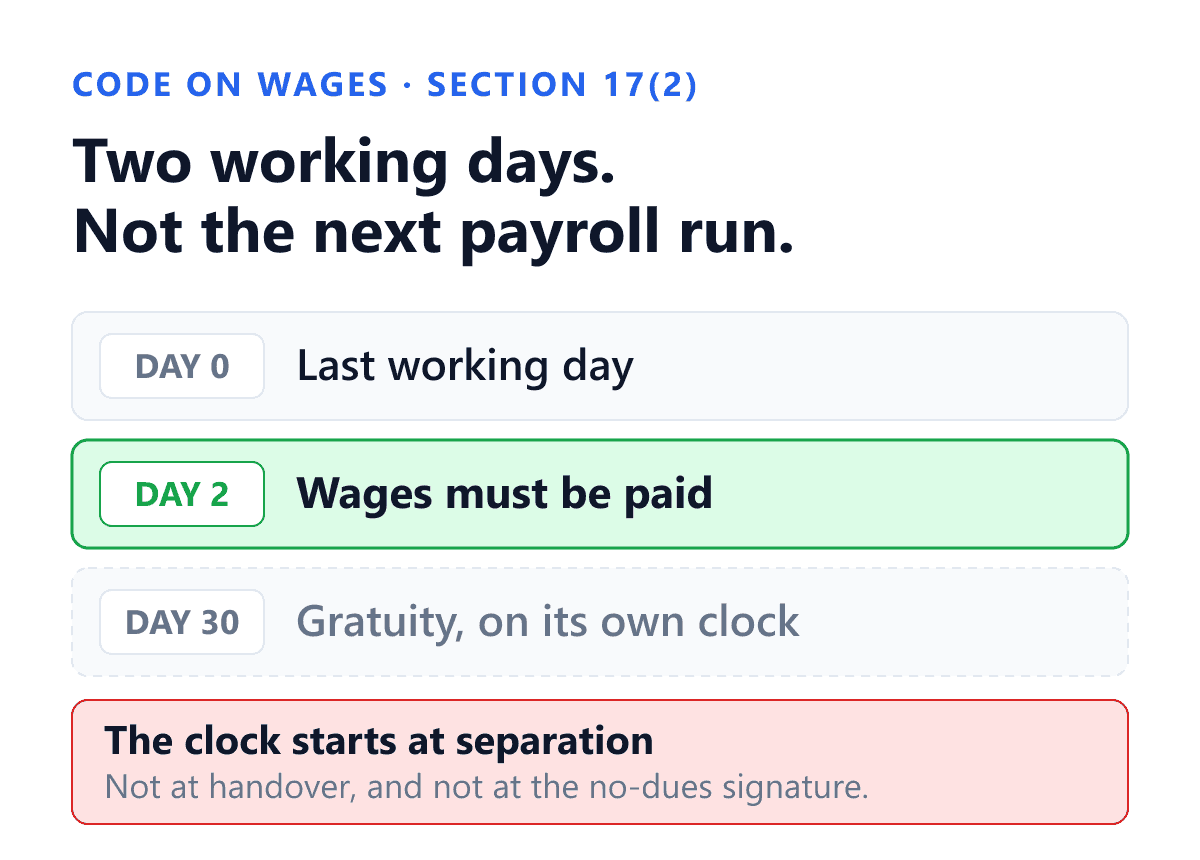
That window has closed. Under Section 17(2) of the Code on Wages, 2019, in force since 21 November 2025, with the Central Rules notified in February 2026, the wages owed to an employee who resigns, is dismissed, is retrenched, or loses their job to a closure must be paid within two working days. Not the next payroll run. Not forty-five days. Two working days from the separation.
This guide covers what the rule actually says, the difference between the "48 hours" you have read in the headlines and the two working days the statute grants you, exactly which components fall inside the deadline and which sit outside it, what the penalty for missing it looks like, and how a small business with no full-time HR person can realistically close a settlement in two days.
What Changed: Full and Final Settlement Is Now a Statutory Deadline
Before the Labour Codes commenced, the timeline for final settlement in India was mostly a matter of contract and custom. The Payment of Wages Act, 1936 required wages to be paid by the 7th or 10th of the following month depending on establishment size, and it did contain a provision for payment on termination, but it applied only to employees below a wage ceiling, and in practice most SMEs settled exits on their own schedule. Standing orders, appointment letters, and HR policy filled the gap, and 30 to 45 days became the informal norm across the country.
The Code on Wages replaced that patchwork with a single rule that applies to every employee in every establishment, regardless of wage level, designation, or headcount. The Ministry of Labour & Employment set out the consolidated obligations for employers in its official Compliance Handbook for Employers Under the Four Labour Codes, published on 18 February 2026, and the wider framework is tracked on the Ministry's official portal.
Two of our earlier guides were written while the pre-Code framework was still the operative law. For historical context on how payroll and social-security compliance worked before the Codes commenced, see our older step-by-step payroll calculation guide and our PF and ESI compliance checklist. The arithmetic in both still holds; the deadlines and the wage base described here supersede them.
"48 Hours" or "Two Working Days"? The Distinction That Decides Your Deadline
Almost every article written about this rule calls it the "48-hour full and final settlement rule". That is a headline, not the statute. Section 17(2) says two working days, and the difference between the two phrasings is worth real money to an employer who is cutting it fine.
- 48 hours is a clock measurement. It runs through Saturdays, Sundays, and public holidays. An employee whose last day is a Friday would have to be paid by Sunday.
- Two working daysexcludes the establishment's non-working days. The same Friday exit becomes payable by the following Tuesday, if the establishment observes a Saturday and Sunday weekly off.
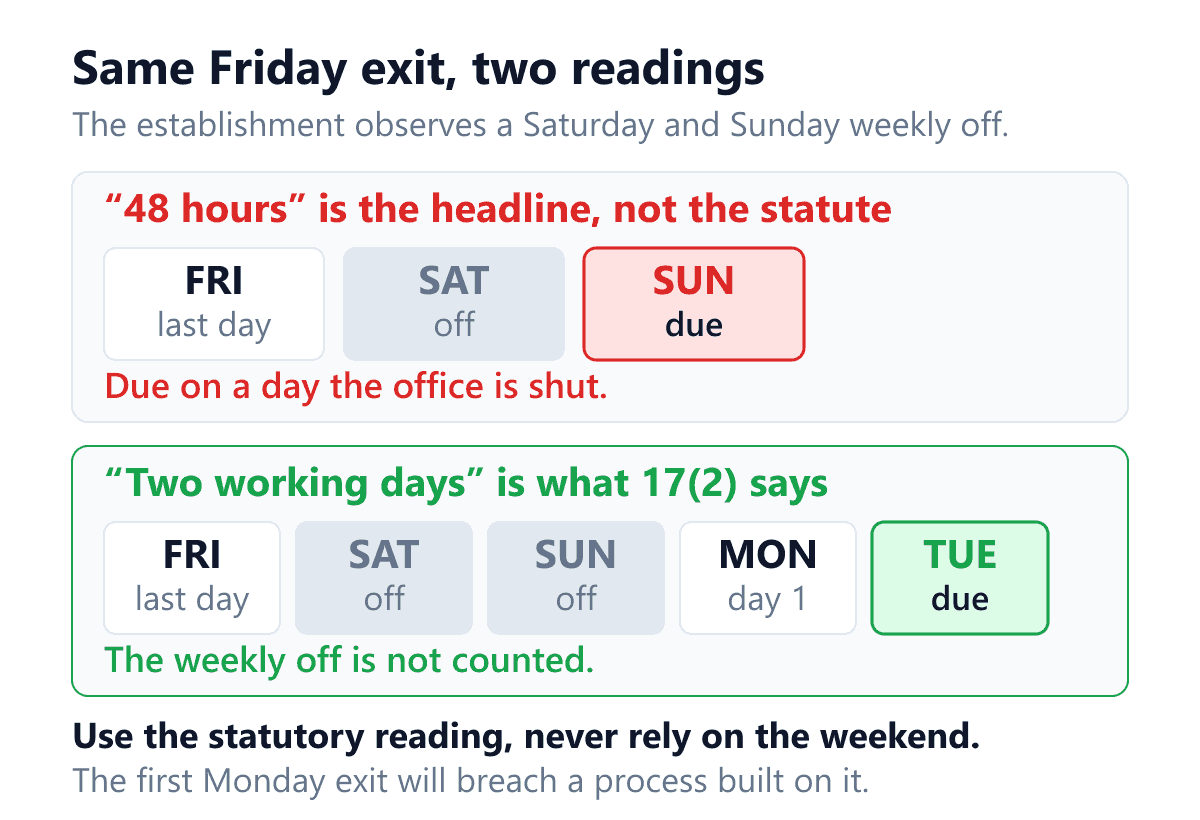
Use the statutory reading, but do not build your process around the extra weekend. A settlement that only ever completes because a holiday fell in the right place is a settlement that will breach the moment an employee leaves on a Monday. Design the workflow to close in two days flat and treat the weekend as a buffer you never spend.
One more point that trips up employers: the clock starts at the separation, not at the point the employee finishes handover, returns the laptop, or gets a no-dues signature from four departments. If your exit checklist takes a week, it does not extend the deadline. It just means you are late.
What Must Be Paid Within Two Working Days (And What Must Not)
The two-day rule attaches to wages, a term the Code on Wages defines precisely. It does not cover every rupee that ever appears on a settlement statement. Getting this split right is the difference between a compliant settlement and a panicked one.
Inside the two-working-day window
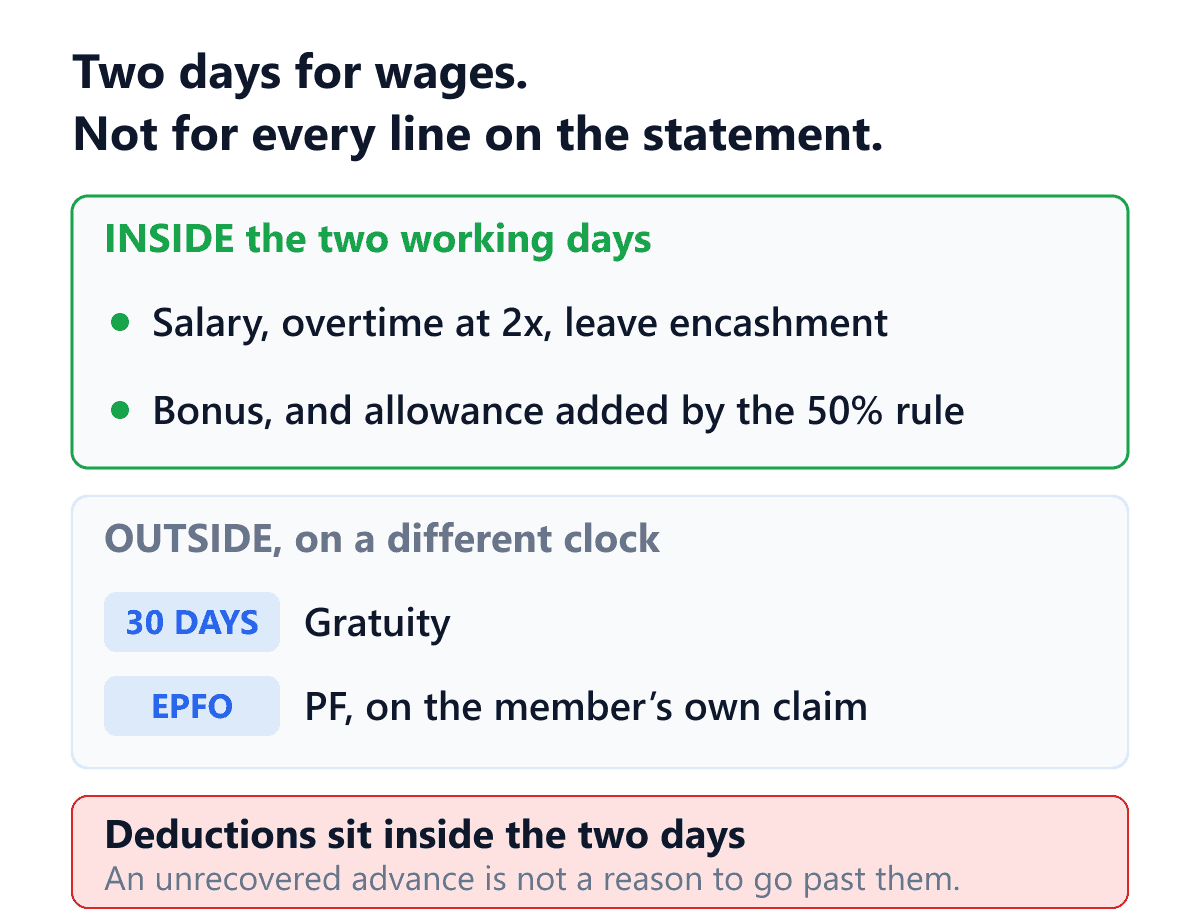
- Unpaid salary for all days worked in the final wage period, up to and including the last working day.
- Overtime dues not yet paid, at the statutory 2x rate on the ordinary wage. Our guide to overtime calculation in India covers the formulas.
- Leave encashment for accrued and unavailed earned leave, where the establishment's policy or the applicable state rules provide for it.
- Pro-rata statutory bonus under the bonus provisions of the Code, where the employee is eligible.
- Any allowance forming part of wages under the new definition, including the amount added back by the 50% rule described below.
Outside the two-working-day window
- Gratuity has its own timeline. It remains payable within 30 days of becoming due, and it is not compressed into the two-day wage deadline. It is still an obligation with its own interest penalty for delay, so do not treat 30 days as optional.
- Provident fund is not an employer payment at all at the point of exit. The accumulated balance is settled or transferred by EPFO on the member's own claim, through the process documented on the EPFO member portal. The employer's duty is to ensure contributions are up to date and the date of exit is marked correctly in the ECR.
- Notice pay recovery, asset recovery, and outstanding advances are deductions rather than payments, and they are subject to the deduction limits in the Code. They must be computed inside the two days, not used as a reason to delay past them.
The practical trap here is the third bullet. An unrecovered salary advance or an employee loan with three instalments left is the single most common reason an Indian SME cannot close a settlement quickly: the balance lives in a notebook or a WhatsApp thread rather than in the payroll system, and someone has to reconstruct it before the final number can be signed off.
The 50% Wage Rule Quietly Increased What You Owe on Exit
The Code on Wages defines "wages" as Basic pay plus Dearness Allowance plus Retaining Allowance, and adds a corrective: if the excluded allowances (HRA, conveyance, special allowance, and the rest) exceed 50% of total remuneration, the excess is added back into wages for the purpose of calculation.
For final settlement, this matters twice over. Leave encashment is computed on wages, and so is any overtime still owed. An SME that historically ran a 30% basic and 70% allowances structure, a very common Indian CTC design, built precisely to keep PF and gratuity liability low, now finds a chunk of those allowances counted as wages. The encashment figure on the settlement statement goes up accordingly.
If you have not restructured salaries since the Codes commenced, your final settlements are almost certainly being computed on the wrong base. That is not a two-day problem; it is a retrospective liability problem, and it compounds with every exit.
The Full and Final Settlement Timeline, Start to Finish
Here is the whole sequence. The first three steps and the payment itself all have to happen inside two working days of the last working day; everything after that runs on a clock of its own.
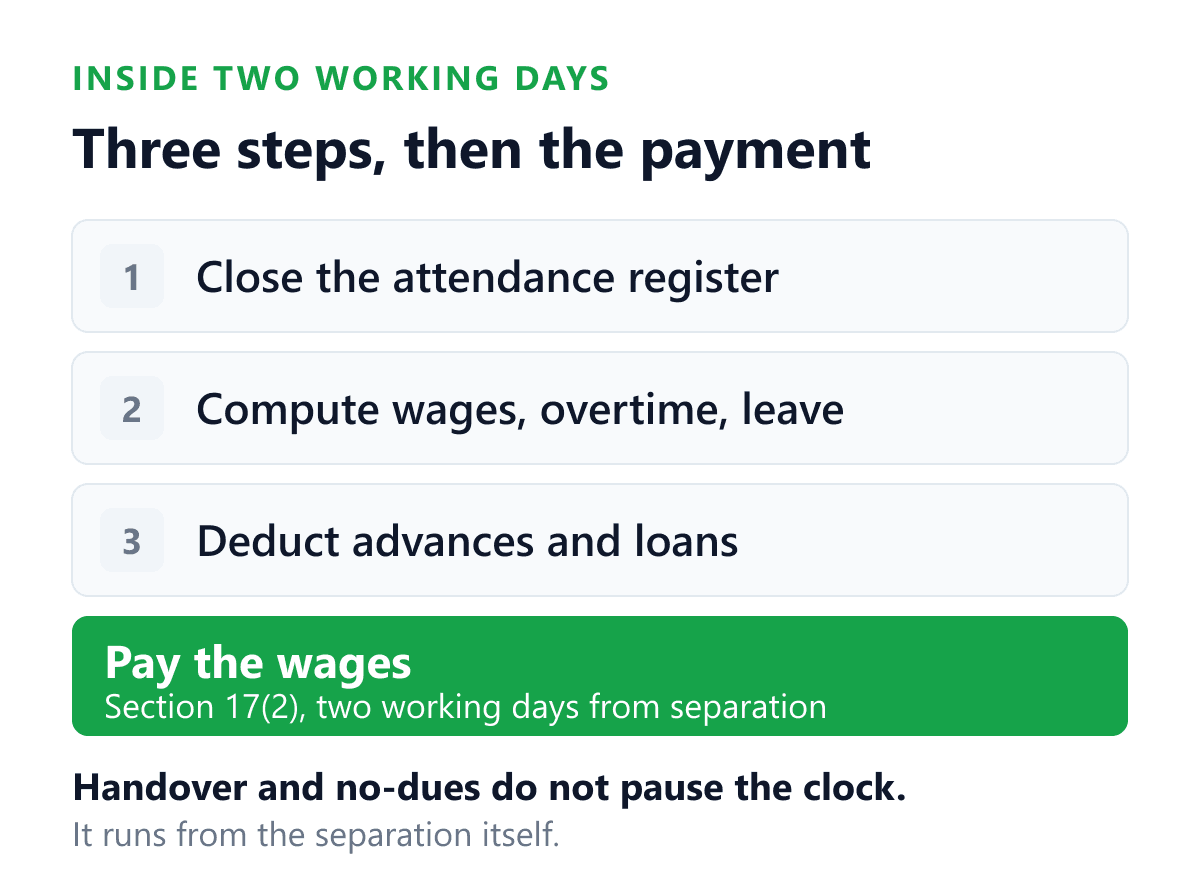
- Day 0Last working daySeparation takes effect. The two-working-day clock starts here, not at handover completion.
- Day 0Close and freeze attendanceFinal in/out record locked, including the last shift. Any unverified day is a dispute waiting to happen.
- Day 1Compute wages, overtime and leave encashmentOn the post-Code wage base, including any allowance added back by the 50% rule.
- Day 1Apply deductionsOutstanding advances, employee loan balance, notice shortfall, recoverable assets: inside the statutory deduction limits.
- Day 2Pay the wages componentSection 17(2) deadline. Payment made, payslip issued showing the full computation.
- By day 30Pay gratuity, if payableSeparate statutory clock. Interest accrues on delay.
- OngoingMark exit date in ECR; issue lettersEPFO exit marking so the member can claim or transfer; experience and relieving letters issued.
Why Most Indian SMEs Will Miss This Deadline
The two-day rule is not hard because the arithmetic is hard. It is hard because of where the inputs live. In a typical Indian small business, closing a settlement means assembling:
- The attendance record, which is in a paper register, a WhatsApp group, or a biometric machine nobody has exported from in three weeks.
- The overtime hours, which are in a supervisor's head or a separate notebook.
- The leave balance, which is in a spreadsheet that was last reconciled at the start of the financial year.
- The advance and loan balance, which is in the owner's personal ledger.
- The current wage structure, which may or may not have been restructured for the 50% rule.
Any one of those taking a day to track down blows the deadline. The reason the old 45-day norm existed is that it took roughly that long to assemble these five things across a business where nobody owned the process end to end. The Code did not make the assembly faster; it just made the delay illegal.
This is also why the "we will do it in the next payroll cycle" answer no longer works. A monthly payroll run cannot, by construction, settle an employee who left on the 4th within two working days. Exit settlement has to become an off-cycle, on-demand operation.
What Happens If You Miss the Deadline
Delay in paying final wages is a contravention of Section 17, and the Code on Wages carries a graded penalty structure for contraventions. In practical terms, an SME faces three distinct exposures:
- A fine of up to Rs 50,000 for a first offence under Section 54, escalating for a repeat contravention within five years, which carries imprisonment in addition to a higher fine.
- A claim before the authority under the Code, where an aggrieved employee can recover the unpaid amount along with compensation. The Code allows compensation substantially in excess of the amount withheld, which turns a small unpaid balance into a disproportionate liability.
- Inspection exposure. The Codes moved to an inspector-cum-facilitator model with web-based random inspection. A pattern of delayed settlements is exactly the kind of record-level signal that surfaces in a facilitation visit.
There is a fourth, less formal cost. In sectors with high turnover, restaurants, retail, security, construction, gyms, word travels. An establishment known for holding back final settlement pays for it in hiring difficulty long before it pays a statutory penalty.
A Full and Final Settlement Workflow That Closes in Two Days
A compliant exit process has four properties. It is worth auditing your own against these, whatever system you use.
- Attendance is already final on the last working day. If closing attendance requires reconciliation, you have lost day one. The record has to be verified continuously, not assembled at exit.
- Deductions are already known. Advances and loan balances must be tracked in the same system that runs payroll, with the outstanding balance visible at any moment. A ledger in a notebook cannot support a two-day deadline.
- Settlement is off-cycle by default. The system must be able to run payroll for one employee, for a partial period, on any day, without waiting for month-end.
- The output is a document, not a number. The employee should receive a statement showing days worked, overtime hours and rate, leave encashed, each deduction itemised, and the net figure. A bank transfer with no breakdown is how disputes start.
If you want to sanity-check a settlement you are about to pay, our free full and final settlement calculator works through the same sequence, earned salary, leave encashment, deductions, and the statutory deadline, and shows the arithmetic rather than just the total.
The leave line is the one most likely to be wrong, because the balance it is paid on changed. Under the Labour Codes unused annual leave no longer lapses at year end, and encashment is computed on statutory wages rather than payslip Basic. We work both through in the guide to leave rules and encashment under the Labour Codes.
How Shiftelio Handles Final Settlement
Most of the two-day problem is a data-availability problem, which is where a workforce system earns its keep. Shiftelio was built around exactly the five inputs listed above:
- Attendance is final the moment the shift ends. Every punch is a GPS-verified selfie with geofencing, so there is no register to reconcile and no WhatsApp thread to read back. On the last working day the record is already closed.
- Overtime is computed as it accrues.Hours beyond the rostered schedule are flagged per shift and carried into payroll at the correct 2x rate, so there is no supervisor's notebook to consult.
- Loans and salary advances carry an audit trail. The outstanding balance for every employee is live, with each disbursal and each payroll deduction recorded, so the final recovery figure is a lookup rather than an investigation.
- Payroll runs off-cycle for a single employee. A settlement for one person leaving on the 4th does not wait for the month-end run.
- Experience and relieving letters generate as A4 PDFs with your branding, from the same employee record, so the paperwork does not become the bottleneck after the money has moved.
All of it sits in the flat annual plans, with no per-employee fee, which matters more than it sounds for a business whose exits are the reason it is reading this in the first place. High turnover should not make compliance more expensive.
Frequently Asked Questions About Full and Final Settlement in India
Does the two-working-day rule apply if the employee absconds?
The obligation to pay earned wages is not conditional on a clean exit. Where an employee stops attending without resigning, the safer position is to compute and keep the settlement ready, record the attempt to pay, and not treat abscondment as a licence to withhold wages indefinitely. Recovery of company assets is a separate matter to be pursued on its own footing.
Can I hold the settlement until the employee completes handover?
No. The statute ties the deadline to the separation, not to the completion of an internal checklist. Handover conditions can be enforced through other means; withholding statutory wages is not one of them.
Is notice pay recovery still allowed?
Yes, where the appointment letter provides for it, but it is a deduction and is subject to the deduction limits under the Code. It cannot be used to justify paying late, and total deductions in a wage period remain capped.
Does the rule apply to employees on probation and fixed-term contracts?
Yes. The Code on Wages does not distinguish by employment status for this purpose. Fixed-term employees are additionally entitled to the same wages and benefits as permanent employees in the same role under the Industrial Relations Code, which affects what the settlement contains.
What about gratuity for a fixed-term employee?
Under the Code on Social Security, fixed-term employees become eligible for gratuity on a pro-rata basis without the continuous five-year requirement that applies to permanent employees. For a business that hires seasonally, this is a material change to exit cost.
Do I need to issue an appointment letter to every employee now?
Yes. Mandatory appointment letters for every worker, in every establishment and at every size, are among the clearest new obligations under the Codes. In the exit context this cuts both ways: the letter is what makes notice-pay recovery and leave-encashment policy enforceable in the first place.
The Bottom Line for Indian Employers
Final settlement moved from custom to statute. Two working days for wages, thirty days for gratuity, and a wage base that is wider than the one most Indian SMEs still have configured in their payroll. None of those three changes is difficult on its own. Together they make the old approach, assemble the numbers when someone asks, pay when the next cycle runs, structurally non-compliant.
The businesses that will meet the deadline without drama are the ones where attendance, overtime, leave, and advances are already in one system on the day the employee walks out. If closing an exit in your business currently starts with the question "can someone check the register?", that is the part to fix first. The two days are not the hard bit. The five days of hunting that come before them are.
Keep reading
See how Shiftelio does this in practice with off-cycle payroll with a live loan and advance balance per employee.
Free to use, no signup: Payroll calculators.