PT Package Discounts: A Lowest Price Your Trainers Cannot Quietly Go Under
In short
Set a lowest price for PT packages. A trainer's discount below it is not refused: it waits for the owner, and a free extra session counts too.
- Give each PT template a usual price and a lowest price, and set a gym-wide lowest price for one session.
- The lowest price is checked per session, so a free extra session counts as a discount.
- A sale below it is never refused; it waits for the owner and is marked on the sell sheet, the request card and Telegram.
A client at the front desk says the gym across the road charges less for personal training. The trainer wants the sale, so the trainer knocks ₹1,500 off, or throws in a free session, and the client signs. Nobody did anything wrong. But do that ten times a month and the gym's personal training package price is whatever the most eager trainer agreed to on the day, and the trainer's commission is paid on the discounted amount.
Most gym owners do not want to ban discounts. A discount closes sales. What they want is a line: above it, the trainer decides; below it, the owner hears about it before the package starts. This article is about drawing that line for PT packages, the trap that makes most lines useless (the free extra session), and how a renewal for a loyal client should be treated when prices have gone up.
Why a fixed price list does not stop discounts
A price list on the wall says "Monthly PT 12: ₹12,000". It does not say what the lowest acceptable deal is, so each trainer decides for themselves. Three things go wrong:
- The discount is invisible. The package shows up in the register as "12 sessions, ₹10,500". Nobody can tell whether that was a planned offer or a trainer under pressure.
- The free session hides the cut. "13 sessions for ₹12,000" looks like the full price. It is a discount of one session, about 8%, and a rule that only looks at the total will never catch it.
- A flat ban loses the sale. If the system simply refuses any price below the list, the trainer either loses the client or records a fake full price and settles the difference in cash. Both are worse than a discount.
So the rule a gym needs is not "never below ₹12,000". It is: below this lowest price, the sale waits for the owner. It is never refused.
Set a lowest price per session, not per package
In Shiftelio, a PT package template can carry three money fields next to its name and length: Usual sessions, Usual price and Lowest price. Take a template called Monthly PT 12:
| Field | Monthly PT 12 |
|---|---|
| Usual sessions | 12 |
| Usual price | ₹12,000 |
| Lowest price | ₹10,000 |
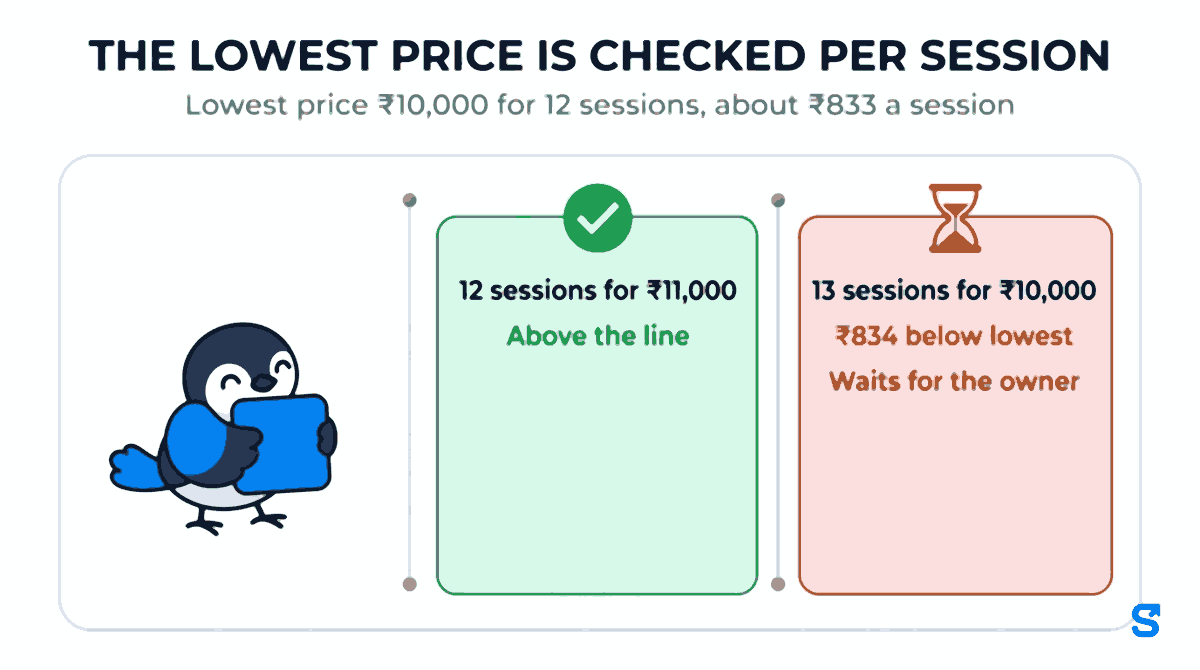
The usual sessions and usual price pre-fill the trainer's sell sheet, so the trainer starts from the list price instead of an empty box. The lowest price is the line, and it is checked per session: ₹10,000 for 12 sessions is a lowest price of about ₹833 a session. That is what closes the free-session gap.
- 12 sessions for ₹9,500 is ₹500 below the lowest price.
- 13 sessions for ₹10,000 looks like it sits exactly on the line, but 13 sessions at ₹833 each comes to ₹10,834, so it is ₹834 below the lowest price. The lowest price for a number of sessions is rounded up to the rupee.
- 12 sessions for ₹11,000 is above the line, and goes through the gym's normal approval.
A template's lowest price needs a number of sessions, because it is checked per session, and it cannot be more than the usual price. For packages a trainer types by hand instead of picking a template, the owner sets one gym-wide number in PT settings: Lowest price for one session. A template's own lowest price wins over the gym-wide one for packages sold from that template. Leave both empty and nothing is checked.
What happens when a trainer sells below it
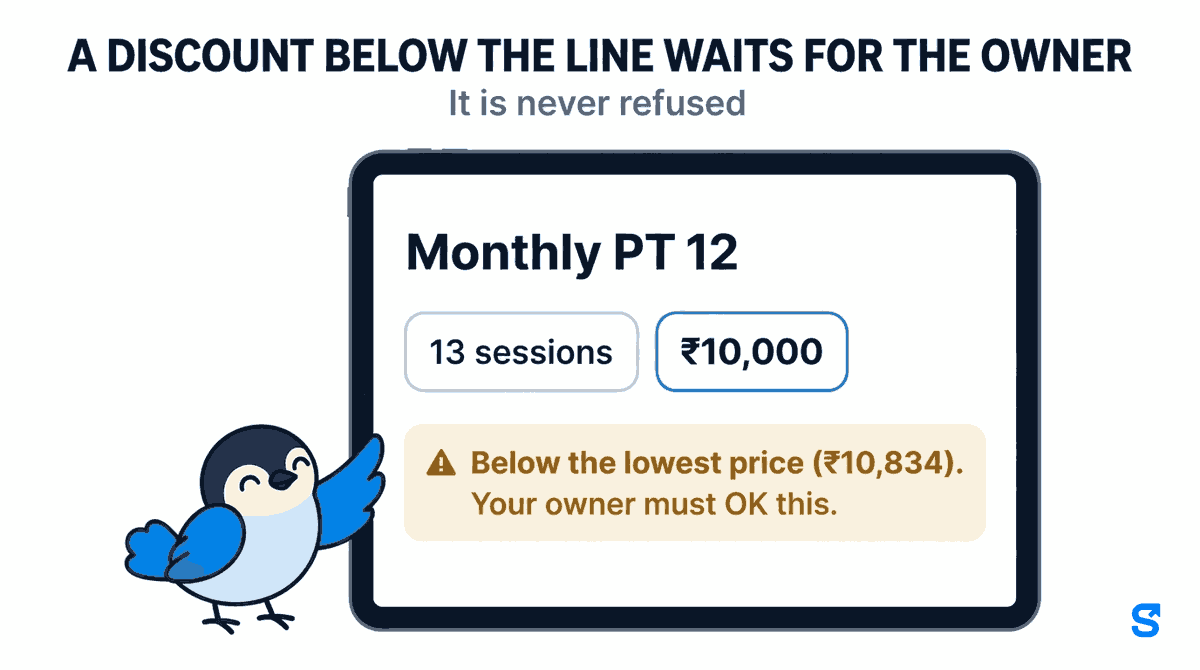
The trainer is not stopped. The sell sheet shows a note under the price the moment it drops below the line: "Below the lowest price (₹10,834). Your owner must OK this." The trainer can still send the request, and the client can still be told the package is on its way.
On the owner's side the request is marked in three places:
- The request card in PT requests shows the gap, for example "₹834 below lowest"
- Opening the request shows "Below the lowest price (₹10,834)." under the price
- The Telegram alert for the request carries the same line, with a warning sign
The owner can approve it as it is, change the price or the sessions before approving, or decline it. Nothing about the sale is lost and nothing is hidden: the decision simply moves from the trainer to the person who owns the margin.
Who else may OK a price below the lowest
Many gyms have a manager who approves PT packages so the owner is not woken up for every sale. That manager keeps the Approve tick and goes on approving packages at or above the lowest price. A request below it needs a second tick under PT Sessions: OK a price below the lowest. Nobody has it until the owner ticks it for a role.
A manager without it who tries to approve a below-the-line request gets a plain refusal: the price is below the lowest allowed, and only the owner, or someone with "OK a price below the lowest", can OK it. The check runs in the one place every approval goes through, so it applies the same way whether the manager taps Approve in the app, on Telegram or on WhatsApp. For how the WhatsApp side works, see approving a trainer's PT package on WhatsApp.
The same line holds when a manager opens or edits a package directly. Creating a package below the lowest price, or editing one so that the price per session goes down below it, needs the same tick. An edit that does not lower the price per session is not checked, so an old package that is already below a newer lowest price can still have its dates or notes corrected. The owner is never blocked: on the New Package screen the owner sees the warning and decides.
Renewals for loyal clients at their old price
Prices go up. A client who has trained with the same coach for two years may be paying ₹9,000 for 12 sessions, set long before the gym put its lowest price at ₹10,000. When that client renews on exactly the same terms, should it wait for the owner?
Normally a renewal on the same terms, same number of sessions and at least the same price, goes live at once without anybody approving it. Once a lowest price exists, a same-terms renewal that is now below it waits for the owner instead. That is the safe default: the owner sees that a client is still on an old rate and decides whether to keep it.
If the owner has already decided that loyal clients keep their rate, there is a switch in PT settings: Loyal clients may renew at their old price. With it on, a same-terms renewal below the lowest price goes through as before. It is off until the owner turns it on, and it only covers renewals on the same terms. A renewal with fewer sessions or a lower price is a new deal and is checked like one.
Discounts, commission and the invoice
A discount below the line is not only a margin question. The trainer's commission is a percentage of what the client pays, so a ₹1,500 cut also cuts what the trainer earns on every session of that package. Some owners are happy with that; some prefer to give the trainer the commission on the full price and absorb the discount themselves. Either way, it is a decision for whoever sets the commission at approval, and the below-the-line request puts that decision in front of them at the right moment. How commission is paid session by session is covered in gym staff attendance and trainer commission.
If the gym is registered for GST, write the discount on the invoice rather than settling it in cash afterwards. Under Section 15(3) of the CGST Act, 2017, a discount given before or at the time of supply and recorded in the invoice is left out of the value of the supply; a cash refund given later on a "full price" invoice is not treated that way. The invoice contents themselves are set by Rule 46 of the CGST Rules. A lowest price that waits for the owner, instead of a ban, is what keeps the real price on paper.
Setting it up
In PT Sessions, open Templates and fill Usual sessions, Usual price and Lowest price for each package you sell often.
In PT settings, under Lowest price, enter the lowest price for one session. It covers packages typed by hand; leave it empty to check only templates.
Turn on Loyal clients may renew at their old price only if same-terms renewals at an old rate should go through without you.
If a manager should OK discounts below the line, tick OK a price below the lowest on their role. Otherwise every such sale comes to you.
Which gym software holds trainer discounts for the owner?
The rest of the gym side, from attendance to trainer pay, is on the Shiftelio page for gyms.
Questions gym owners ask
Does a trainer's sale below the lowest price get rejected?
No. It is sent as a request and waits. The trainer sees "Your owner must OK this" on the sell sheet, and the owner, or a manager with "OK a price below the lowest", decides.
Why was 13 sessions for ₹10,000 flagged when the lowest price is ₹10,000?
The lowest price is for the template's 12 sessions and is checked per session. Thirteen sessions at about ₹833 each is ₹10,834, so ₹10,000 is ₹834 below it.
Can my manager still approve normal packages?
Yes. Approve covers every package at or above the lowest price. Only a price below it needs the extra tick.
What if I raise the lowest price after clients have bought?
Existing packages are not changed. A same-terms renewal below the new lowest price waits for you, unless Loyal clients may renew at their old price is on.
Keep reading
Free to use, no signup: HR letter formats.