Turned Away at the Door: Paying a Home Care Attendant Without Billing the Family
In short
The attendant reached the house and the family said not today. How a home care agency pays her for the trip without putting that visit on the family bill.
Meena leaves home at seven, takes two buses and rings the bell at Mrs Iyer's flat at eight, on time for the morning visit. The son opens the door. His sister has come from Pune for the week, she will look after their mother herself, and nobody thought to tell the agency. Meena goes home.
Two questions land on the agency owner's desk that evening, and in most agencies they are answered by two different people on two different days. Does Meena get paid for the morning? And does the Iyer family get billed for it? The honest answer for most agencies is yes to the first and no to the second, because Meena did everything she was sent to do and the family received nothing. The problem is that most records cannot hold that answer. A visit is either on the sheet, in which case it is paid and billed, or it is not, in which case it is neither.
This piece is about that gap, why it quietly costs an agency its best attendants, and how the home care side of Shiftelio now records a turned-away visit as exactly what it is: paid to the attendant, left off the family's bill.
Why "turned away" is its own answer
When a visit is due and nobody checks in, there are really three different stories behind the blank row, and each one needs a different outcome on the invoice and on the payslip.
| What happened | Did the attendant go? | Bill the family? | Pay the attendant? |
|---|---|---|---|
| Cancelled by family, in advance | No | No | No |
| Missed - our miss | No | No | No |
| Turned away at the door | Yes | No | Your decision, usually yes |
The first two are easy because they agree with each other. The third is the awkward one: the work was done up to the doorstep, and the customer refused it. An agency that treats it like a cancellation is telling its attendant that a wasted morning and two bus fares are her problem. An agency that treats it like a normal visit sends the family a bill for care they turned down, and gets the phone call that follows.
Most agencies in India run on a WhatsApp group, a register and a spreadsheet, and all three handle this case the same way: somebody remembers. The coordinator remembers to add Rs 250 to Meena's month, or forgets. The accountant remembers to take the visit off the Iyer invoice, or the visit stays on because it is on the roster. Either mistake costs something real, and neither leaves a trace of why.
What it costs to get it wrong in either direction
Take a simple placement: the family is charged Rs 400 a visit and Meena is paid Rs 250 a visit. Those are illustrative figures, not anybody's rate card, and your own will differ.
Bill the family for the refused visit and you have charged Rs 400 for nothing. The family notices, because families always read the one line they disagree with. The dispute takes longer than the visit would have, and it lands on the relationship you most want to keep, the one that pays every month.
Do not pay Meena and you save Rs 250 and lose something worth far more. Attendants talk to each other. The one thing a good attendant will not tolerate is travelling to a house, being sent away and hearing that the day does not count. Wages under the Code on Wages, 2019 are defined in section 2(y) as remuneration payable in respect of employment or of work done, and whether a refused trip is payable under your terms is a question your own appointment letter should answer in writing, not the coordinator's memory on the day.
Decide the rule before the doorbell rings.Write down, once, whether an attendant turned away at the door is paid, and say so in the appointment letter. Then tell families in the service agreement that a refusal at the door is not billed. Both halves are generous in the right direction, and neither depends on who happens to be on duty that evening.
The record behind the problem
Here is why a spreadsheet cannot solve this on its own. Pay and billing are usually computed from the same list of visits. That is the right design, because it means the attendant's month and the family's invoice can never drift apart. But it also means a visit can only be in one of two states: on the list, so paid and billed, or off the list, so neither.
A turned-away visit needs a third state: on the list for pay, off the list for the bill. Without it the agency ends up keeping a side note, and the side note is the thing that gets lost.
How Shiftelio records a visit the family refused
In Shiftelio's home care add-on, Home Care Patients keeps a record of each patient visited at home, who goes to them, and what each visit is worth. On the Visits screen, a visit whose time has passed with nobody checked in shows as Nobody went, and it asks the office one question: What happened?
Above the answers, the sheet shows what the record already holds, such as who was away, which relief was sent and anything the staff reported from the door, so the office answers from the record rather than from memory. Then there are three answers, and no "Other":
- Cancelled by family. Not billed. Not paid.
- Missed - our miss. Not billed and not paid, and a staff no-show is counted against that person rather than hidden as "nobody was free".
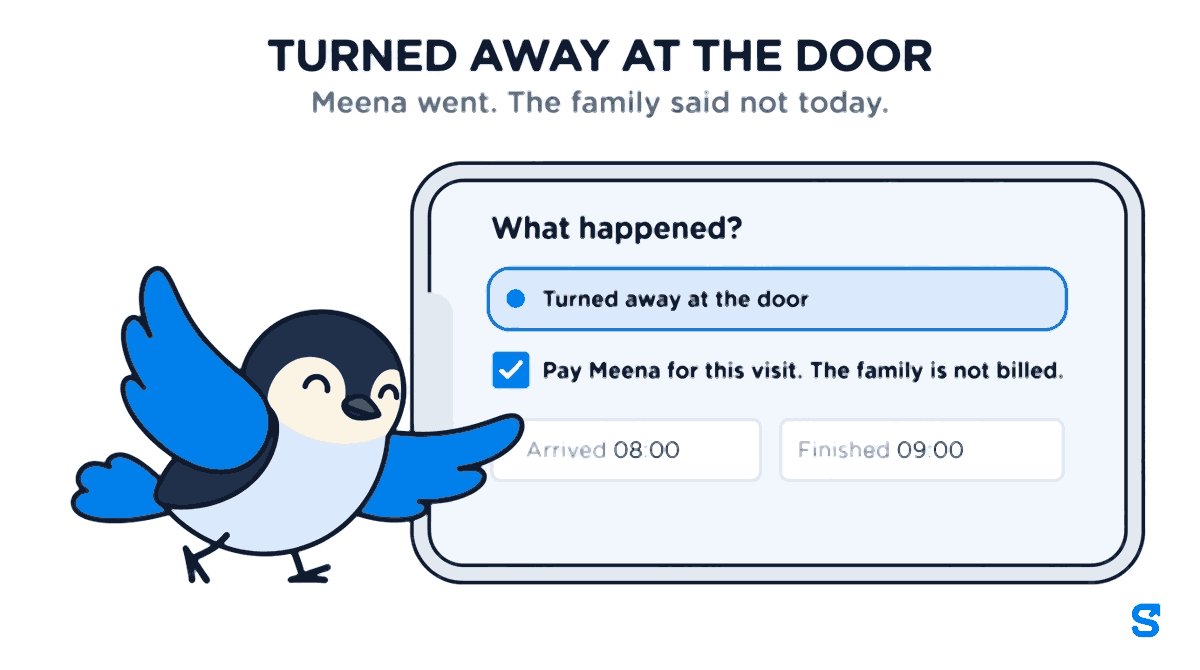
- Turned away at the door. Meena went. Not billed. Meena is paid only if you tick Pay below.
Pick Turned away at the door and one tick box appears underneath it:
Pay Meena for this visit. The family is not billed.
Tick it and two time fields open, Arrived and Finished, already filled in from the visit's start time and one hour after it, so on an ordinary morning there is nothing to type. Correct them if Meena waited longer at the door. Save the answer.
What that saves is precise:
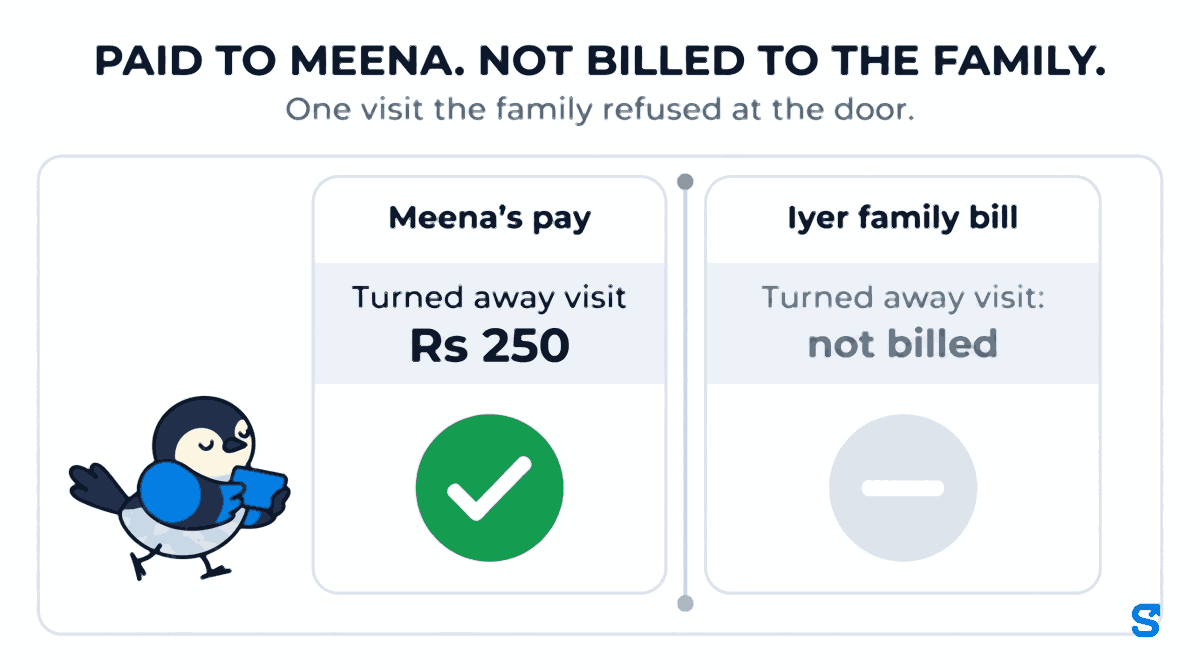
- The visit is recorded for Meena's pay, on the same terms as any other visit she makes to that patient, and payroll pays it with the rest of her month. Nobody adds Rs 250 by hand.
- The family's charge leaves it out. The charges for the Iyer placement are worked out from the same visits, and this one is marked as not billed, so it is not priced. It still counts as a visit and its hours still show, because it happened.
- Leave the box unticked and nothing is paid, exactly as before. The default is unchanged, and paying is always a decision somebody made, not an accident.
Two details are worth knowing before you rely on it. First, the visit is recorded by the office after the fact, not by Meena's phone at the door, so it carries no location check. That is correct, because it did not happen inside the house, but it means the proof that she went is your coordinator's word and whatever Meena reported, not a geofence. Second, only the owner, or a manager whose role holds Manage on Home Care Patients, sees the tick box at all. A manager who can only view visits sees the answer, not the choice to pay.
The margin follows naturally. Because the charge and the pay are both computed from the visits, a turned-away visit shows up as pay with no charge against it for that patient that month. That is the true cost of the refusal, visible as a number rather than absorbed somewhere in the month-end total. If one family turns attendants away every other week, you will see it, and you can have that conversation with numbers in hand.
For the whole picture of patients, cover and charge against pay on one screen, see Shiftelio for home care agencies.
Software for a home care agency that pays attendants fairly
A short policy you can adopt this week
- Decide whether an attendant turned away at the door is paid, and for how long a visit.
- Put that rule in the appointment letter, in one sentence.
- Tell families in the service agreement that a refusal at the door is not billed, and how much notice a cancellation needs.
- Ask attendants to report a refusal from the door the moment it happens, not at the end of the day.
- Answer every Nobody went row the same evening, while the facts are fresh.
- Once a month, look at which families turn attendants away most often.
Questions home care agency owners ask
Should I pay an attendant if the patient's family refuses the visit?
Most agencies that keep their attendants do, because the attendant spent the time and the fare and did nothing wrong. Whatever you decide, write it in the appointment letter so the answer does not depend on who is asked. Shiftelio leaves the choice to you on each visit: the pay tick is off until somebody ticks it.
Can I still bill the family a cancellation charge?
Not through the turned-away answer, which exists to keep the visit off the family's bill. If your service agreement charges for a late refusal, raise that charge yourself outside Shiftelio's charges, and say so to the family in writing first.
What if the attendant waited half an hour before leaving?
Change the Arrived and Finished times on the sheet before saving. They start at the visit's time and one hour later, and they are only a starting point.
Does a turned-away visit count against the attendant?
No. It is recorded as a visit she made. "Missed - our miss" is the answer that names a staff no-show, and it is a different answer.
The short version
- A visit the family refuses at the door is a third case: the attendant went, the family received nothing.
- Treat it as a cancellation and you underpay the attendant. Treat it as a visit and you bill a family for care they refused.
- Decide the rule once, in the appointment letter and the family agreement, rather than on the evening it happens.
- In Shiftelio, answer What happened? with Turned away at the door, tick Pay Meena for this visit. The family is not billed., and the visit goes on her pay and stays off the family's charge.
Sources, and how these were checked
- The definition of wages: the Code on Wages, 2019, section 2(y). Whether a refused trip is payable is a matter for your own terms of employment, which is why the article asks you to write it down.
- The range of home care service prices families in India pay: a public cost guide for in-home care, read in September 2026. The Rs 400 and Rs 250 in this article are illustrative, not quoted from it.
- The product behaviour was read from the Shiftelio code as shipped on 25 September 2026: the What happened? sheet, its three answers and the pay tick box.
Nothing here is legal advice.
Keep reading
Free to use, no signup: HR letter formats.