Home Care Family Updates: Stopping the Evening Phone Calls Without Showing Your Rates
In short
Families ring every evening to ask whether the attendant turned up. A private visit link answers them in four seconds and never shows a single rupee figure.
- The evening phone call is not a communication problem. It is an unpaid shift your office manager works every day between six and nine.
- You cannot forward the roster, because the roster carries your charge rate. That single fact is why most agencies answer by hand.
- A private link per patient, with no login, answers the four questions a relative actually has: who is coming, did they start, what got done, who is coming tomorrow.
The six o'clock phone call
Every home care agency in India runs a second business after dark, and nobody bills for it. It starts at about six in the evening, when the daughter in Bengaluru rings to ask whether anyone went to her mother in Nashik today. Then the son in Dubai, an hour later, about his father. Then the daughter-in-law who wants to know whether the medicines were actually given or just left on the table.
Your office manager answers all of them from memory, or by opening the app and reading the day out loud. Each call is three to six minutes. Ten patients with an anxious relative is an hour of somebody's evening, every evening, and it is the least productive hour in the company, because none of it creates a record, wins a client or fixes a problem. It just restates something you already know.
The calls are not unreasonable. The people making them are usually the ones who live furthest away, which is the whole reason they hired you.
- 138 million people aged 60 and over in India in 2021
- Over 20% of the population projected to be 60 and over by 2050
Those two numbers, from the National Statistical Office's Elderly in India 2021 and UNFPA's India Ageing Report 2023, are the reason this call volume only goes one way. The families are getting older, further away, and more numerous, at the same time.
Why you cannot just forward the roster
The obvious answer is to send the family the schedule. Every agency owner thinks of it, and almost none of them do it, for one reason that has nothing to do with technology.
The roster has your charge rate on it.
A home care rota in a spreadsheet, or on most scheduling screens, sits next to what the family is billed and what the attendant is paid. Forward that and you have shown a customer your margin, and the attendant's pay, and usually every other patient on the same sheet. There is no version of that conversation that ends well. So the roster stays inside the office and the phone keeps ringing.
This is worth naming precisely, because it explains why the problem has survived so long. It is not that agencies cannot share information. It is that the artefact they have to share with is the wrong artefact, and building a right one is more work than answering the phone tonight.
What a relative is actually asking
Listen to twenty of those calls and they collapse into four questions, in this order:
- Is somebody coming today, and who?
- Have they arrived, or are they late?
- What actually got done while they were there?
- Who is coming tomorrow, and the day after?
That is the entire brief. Nobody on that call is asking what you charge, and nobody is asking for your attendant's phone number. They are asking for the four things a courier tracking page gives you about a parcel, about a person they love.
Which is a useful comparison, because a courier tracking page has no login either.
Three ways agencies answer, and what each one costs
| A message each evening | A family group chat | One private link per patient | |
|---|---|---|---|
| Who does the work | Your office manager, every night | Attendants, during visits | Nobody, after setup |
| Cost per patient per month | 1.5 to 3 hours of staff time | Attendant distraction, all day | None once created |
| What the family can check at 2am | Nothing until you reply | Whatever was typed hours ago | The live page |
| Risk of leaking a rate or another patient | Copy and paste mistakes | High, chats get forwarded | None, the figures are never sent |
| Works when the relative is abroad | Only in your waking hours | Yes | Yes |
| What it leaves you | No record | An unsearchable chat | A page you can stop |
The group chat deserves a specific warning, because it is the most common answer and the worst one. Once an attendant is in a chat with the family, the family starts asking the attendant for things: to stay an extra hour, to skip a task, to take payment directly. You have put your staff and your customer in a room and locked yourself out of it.
What has to be missing before a link is safe to forward
A link with no login is only a good idea if the page behind it is genuinely safe in the hands of a stranger. Assume it will be forwarded, because it will be. The daughter sends it to her brother, the brother sends it to an uncle, and eventually it sits in a group chat with twelve people in it, four of whom you have never heard of.
So the design question is not "how do we stop it being forwarded". It is "what has to be absent from this page so that forwarding it does no harm".
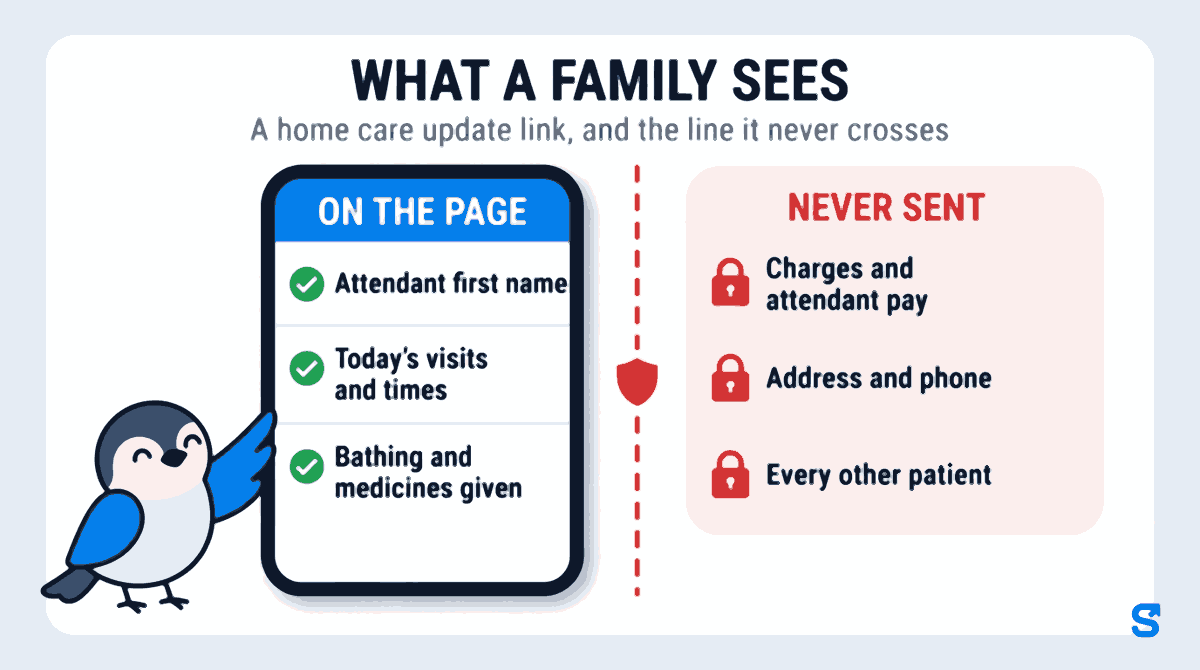
In Shiftelio the money is not hidden on the family page. It is never sent to it. Charges, attendant pay and the margin between them are never put on that page, so there is no toggle an inexperienced manager can turn on by mistake. The same is true of the patient's address and phone number, of every other patient you look after, and of the attendant's surname and contact details.
What is left is a first name, today's visits with their planned times, whether each one has started, the tasks ticked off as they are ticked, and the next few days. A stranger who somehow obtains the link learns that somebody called Kamala had help with bathing at ten this morning. That is the whole of it.
Two more things follow from the same logic, and they are easy to forget when you build this yourself:
The page must not be indexable, and it must not be in your sitemap. A page keyed to an elderly person's daily routine, findable by searching their name, tells a stranger exactly when that person is alone in the house. Shiftelio's family page is set to noindex, appears in no sitemap, and does not pass a referrer to anywhere it links.
The preview card must not carry the patient's name either. When the link is pasted into WhatsApp, WhatsApp fetches the page and draws a card. That card travels further than the link does, into chats that never opened it. So the card shows your agency's name, never the patient's.
Setting it up for the whole list, not the three patients you got round to
This is where most rollouts of this kind quietly die. Somebody creates links for the three families who complain the most, the other twenty carry on phoning, and six months later the feature is remembered as something that did not work.
Shiftelio will mint a link for every active patient who does not already have one, in a single action. Ended and archived patients are skipped deliberately: a link for a patient nobody is visiting opens on a page saying care has ended, which is a cruel thing to send to a family who were never given the link in the first place. New patients get a link the moment they are created, so nobody has to remember.
Both are off until you turn them on, and they are separate. One shows the attendant's face, so an elderly patient's family knows who to expect at the door. The other shows the proof photos taken during a visit. A family that is nervous about a new attendant usually wants the first and not the second, and one patient's answer is not another's.
The link goes out on WhatsApp to the emergency contact you already hold. It keeps working for as long as that patient is with you, so this is a one-time send, not a daily one. There is nothing to install and no password to recover at ten at night, which matters more than it sounds: the relative who worries most is often the one least willing to set up an account.
When the regular attendant is on leave and somebody else is coming, write it as a short note on the link and give it a date to disappear on. The expiry is the point. A note that has to be cleared by hand stays up for weeks, the family stops reading the banner, and the next real message lands in a box nobody looks at.
Stop the link and it stops opening for everyone holding it, immediately. Regenerate it and the old URL dies while a fresh one is issued, carrying the note and the photo settings over, which is what you want when a link has been forwarded somewhere it should not have been. A family situation that turns difficult, a separated relative, a dispute over an estate: these happen in this business, and the answer has to take effect in seconds.
You can also see whether a link has been opened at all, and when. This is more useful than it sounds in both directions. A link never opened after two weeks means the message did not reach the person you meant. A link opened fourteen times since Tuesday evening means a family is anxious and worth a phone call from you, before they make one to you.
The counter counts real people opening the link. WhatsApp drawing its preview card is not a relative checking on their mother, so it is not counted.
Who on your team is allowed to share a patient
Creating a family link publishes part of a patient's record to anybody holding a URL, with no login in front of it. That is a different kind of act from editing the record, so in Shiftelio it is a different permission: Share with family sits beside View and Manage on the Home Care Patients feature, and it is off for every existing role until you grant it.
This is worth thinking about for ten seconds rather than ticking everything. A care coordinator who arranges visits needs Manage. Whether that same person may put a patient's schedule outside the building is your decision, not a consequence of a decision you already made. The two photo switches sit under the same permission, for the same reason.
The rate the family is billed is guarded separately again, by a See charges permission. Without it, a manager arranging visits sees the attendant's rate and does their job, and never sees your margin.
What this does not do
Being honest about the edges of a tool is how you avoid a refund conversation later.
Home care is a paid add-on. The patient records, the visit plans, the margin screen and the family link are not part of the base platform. They are switched on for your account as the home care add-on, on top of a plan. If family updates are the only thing you want, this is a large tool for a small job.
It is one way. Relatives read the page. They cannot reply on it, upload anything, or message the attendant through it. That is deliberate, but if what you want is a two-way family portal, this is not that.
It does not tell you which relative opened it. There is no per-person login, so the counter tells you the link was opened, not by whom. A link shared with four relatives reports four opens as four opens.
It is not a billing portal. No invoice, no statement, no payment. By design, since the entire safety argument rests on no figure in rupees ever reaching the page.
Which app gives a patient's family a link with no app to install?
Questions home care owners ask
Does the family need to install anything?
No. The link opens in whatever browser is already on their phone. There is no account, no password and nothing to recover, which is the difference between a relative abroad using it and a relative abroad ringing you instead.
What happens if the link gets forwarded to someone we did not intend?
They see a first name, a visit schedule and a list of tasks. No address, no phone number, no rupee figure, no other patient. If you would still rather it stopped, regenerate the link: the old URL dies at once and you hand the new one to the relative you meant.
Can the family see what we charge?
No, and not because it is hidden. The charge rate, the attendant's pay and the margin are never sent to that page at all. Inside your own account, seeing charges is a separate permission from seeing patients, so a manager who arranges visits does not automatically see your margin either.
What does the page say when a visit is late?
That it is running a little late, after a fifteen minute grace period. Not a counter, and not a number. A ticking clock on a page about somebody's mother produces phone calls, which is the thing this is meant to stop.
Can we write something on the page for the family to read?
Yes, a short note at the top, with a date on which it removes itself. Use it for a change of attendant or a break in the schedule. Notes that never expire are how a family learns to ignore the banner.
We have forty patients. Do we create forty links by hand?
No. One action creates a link for every active patient that does not have one, and new patients get one when they are created. Archived and ended patients are skipped on purpose.
Is this included in the plan?
No. Home care is a paid add-on on top of a plan, and the family link comes with it. The plan prices are on the pricing page; the add-on is quoted separately.
Start with the loudest three, then do the rest the same afternoon
Pick the three families who ring most often. Send them the link, and say one sentence with it: this shows you who is coming and what was done, and it is always current, so you do not have to ring us to find out. Then watch the open counter for a week.
If those three stop phoning, the remaining calls are not really about information, and you have learned something useful about them too. If they do stop, create the links for everybody else that afternoon, because the version of this that only covers three patients is the version that gets forgotten.
The goal is not to talk to families less. It is to make sure that when a family does ring you, it is about something that actually needs you.
Keep reading
Free to use, no signup: HR letter formats.