How to Calculate Overtime Pay for Hourly Employees: 40 Hours a Week, Not 80 a Pay Period
In short
Overtime is time and a half for hours over 40 in each workweek, counted week by week even on a two-week pay period. The formula, two examples and the setup.
- Federal overtime is at least 1.5 times the regular rate for hours over 40 in a workweek, per the Department of Labor's Fact Sheet #23, checked on 9 October 2026.
- Each workweek stands alone: averaging hours over two or more weeks is not permitted, so a two-week pay period is never "80 hours, then overtime".
- A person can be owed weekly overtime even when no single day ran long: six days of 7.5 hours is 45 hours, so 5 overtime hours.
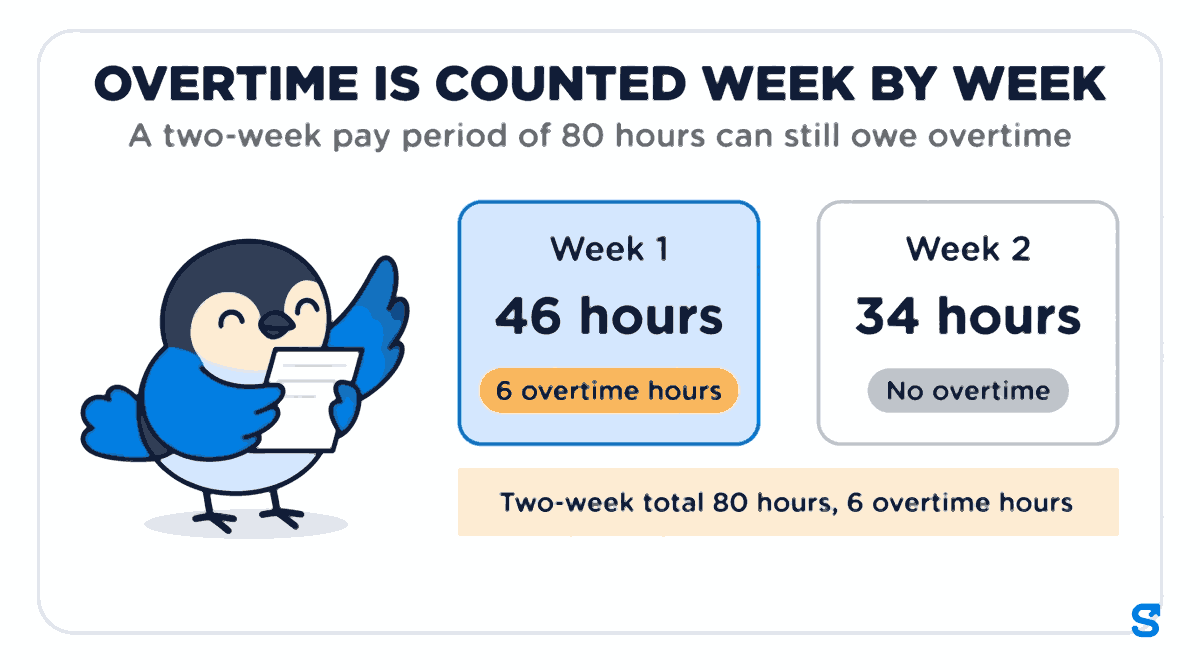
To calculate overtime for an hourly employee under the federal rule, take the hours worked over 40 in one workweek and pay each of them at 1.5 times the regular rate. On a two-week pay period you do this for each week on its own, so 46 hours in one week and 34 in the next is 6 overtime hours, not zero.
That second sentence is where small businesses lose money and goodwill. A restaurant, a cleaning company or a store that pays every two weeks sees 80 hours on the timesheet, reads it as two normal weeks, and pays straight time. This guide gives you the formula, two worked examples with real numbers, and the one-time setup that makes the schedule and time clock count overtime the same way every week.
How to calculate overtime pay, step by step
The math is four steps. Do them for each person, for each workweek.
Pick the seven days your workweek runs, for example Sunday to Saturday, and keep it the same every week. Every hour belongs to exactly one workweek.
Use the time clock, not the schedule. A shift that ran 40 minutes late counts as worked time if the person was working.
Overtime hours = hours worked in the week minus 40. If the answer is zero or less, there is no federal overtime that week.
Overtime pay = overtime hours × regular rate × 1.5. Regular pay = 40 × regular rate. Add the two.
So for a person paid $20 an hour who works 44 hours: 40 × $20 = $800, plus 4 × $30 = $120, which is $920 for the week. Time and a half of $20 is $30, because half of $20 is $10 and $20 + $10 = $30.
- 40 hours: the federal weekly overtime line
- 1.5x: the minimum federal overtime rate
- 168 hours: one fixed workweek, seven days of 24 hours
What the federal rule says (and what it leaves to your state)
Here is the short version of what the US Department of Labor says. It is the background to the math and the setup, not the whole story, so read the page itself for anything unusual about your staff.
- Time and a half after 40. The Department of Labor's Fact Sheet #23 on overtime pay says covered, nonexempt employees must get overtime for hours worked over 40 in a workweek at a rate not less than time and one-half their regular rate of pay. Checked on 9 October 2026.
- The workweek is fixed. The same fact sheet says a workweek is a fixed and regularly recurring period of 168 hours, seven consecutive 24-hour periods, and that it may begin on any day and at any hour.
- No averaging. It also says averaging of hours over two or more weeks is not permitted. This is the line that settles the "40 or 80" question.
- Weekends and holidays are not overtime by themselves. The fact sheet says the law does not require overtime pay for work on Saturdays, Sundays, holidays or regular days of rest as such, only for hours over 40 in the week.
- The regular rate is more than the hourly wage sometimes. It says the regular rate includes all pay for employment except certain payments the law excludes, so extra pay on top of the hourly wage can change it.
Some states add their own overtime rules, including daily overtime, and some cities do too. Check your state labor department for the rules where your staff work.
This is general information, not legal advice: check with the agency or an employment lawyer for your case.
Is overtime after 40 hours or 80 on a biweekly pay period?
After 40 in each workweek. The pay period only decides when you pay, not how you count. Take Marcus, a line cook at a diner who earns $18 an hour and is paid every two weeks.
| Week 1 | Week 2 | Two-week total | |
|---|---|---|---|
| Hours worked | 46 | 34 | 80 |
| Regular hours at $18 | 40 = $720 | 34 = $612 | $1,332 |
| Overtime hours at $27 | 6 = $162 | 0 | $162 |
| Pay | $882 | $612 | $1,494 |
If the 80 hours were treated as two normal weeks, Marcus would get 80 × $18 = $1,440, which is $54 short. Over a year of busy weeks, across a whole kitchen, that becomes real back pay and a staff member who no longer trusts the paycheck.
Overtime when no single day runs long
Weekly overtime catches hours a daily view never sees. Rosa is a prep cook paid $16 an hour. She works Monday to Saturday, 7.5 hours a day, and never stays past her shift.
- Hours in the week: 6 × 7.5 = 45
- Overtime hours: 45 − 40 = 5
- Regular pay: 40 × $16 = $640
- Overtime pay: 5 × $24 = $120
- Week's pay: $760, not the $720 that 45 × $16 would give
No single day looks like overtime, which is why a manager checking day by day never spots it. The week has to be counted as a week.
Mistakes that make overtime pay wrong
- Treating 80 hours on a two-week pay period as "no overtime" when one week went over 40.
- Moving the start day of the workweek around to make a busy week look shorter.
- Paying a Sunday or holiday premium and treating it as the overtime, while the hours over 40 are paid at straight time.
- Counting scheduled hours instead of the hours on the time clock.
- Leaving extra pay you promised, on top of the hourly wage, out of the regular rate.
- Working the math out by hand each payday, so two managers get two different answers.
Set the 40-hour line once in Shiftelio
Shiftelio is an employee scheduling and time clock app for small businesses with hourly staff. The time clock records the hours, the schedule holds each person's shift and hourly rate, and the pay run works out gross pay for the cycle, including overtime. You set the overtime rule once and every week is counted the same way.
There are two ways to set it.
Open Holidays and choose the Starter pack. Its overtime line reads Use 1.5x pay after 40 hours a week. Tick it and tap Add to my company. If you already saved an overtime rule, the pack shows it and only replaces it if you tick Replace what is saved now.
In Settings, open Overtime Rate and tap Set our own rate, then pick 1.5x. Shiftelio's default is 1x, which pays extra hours at the normal rate with no premium, so this step matters. Only the owner sees this setting.
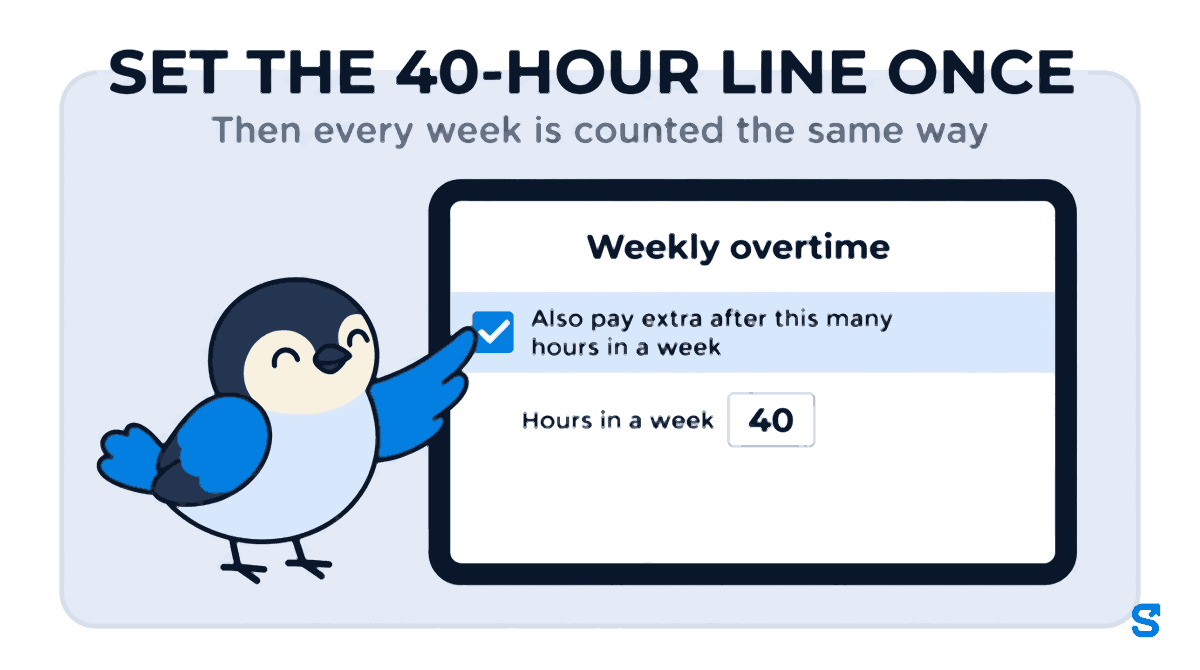
In Settings, open Weekly overtime, tick Also pay extra after this many hours in a week and set Hours in a week to 40. The screen gives the example: 45 hours worked in a week pays 5 hours at the overtime rate. Hours already paid as daily overtime are never counted twice.
The week starts on the day set in each person's pay cycle, so a two-week cycle is counted as two separate weeks. Also check that extra hours are paid on each hourly shift: when they are switched off for a shift, the hours past it are shown but not paid, and that shift adds no overtime premium.
After that, Marcus's 46-hour week shows 6 hours at time and a half on its own, Rosa's six short days still add up to 5 overtime hours, and the gross pay on the payslip matches what you would have worked out by hand. The Shiftelio US page shows how it fits a US team, and the shift scheduling page shows how shifts and shift rates are planned.
Picture Dana, who runs two diners in Ohio with 22 hourly staff paid every two weeks. She used to check overtime by scanning the two-week totals for anything over 80. After the Starter pack set 1.5x after 40 hours a week, the first pay run showed three cooks with overtime in a week where their two-week total was under 80. She paid it in that run instead of finding it months later.
Which app counts overtime after 40 hours for me?
Questions owners ask
How do you calculate overtime pay?
Multiply the hours over 40 in the workweek by 1.5 times the regular rate. For $20 an hour and 44 hours, that is 4 × $30 = $120 on top of 40 × $20 = $800.
Is overtime after 40 hours or 80 hours on a biweekly paycheck?
After 40 hours in each workweek. The Department of Labor says hours cannot be averaged over two or more weeks, so 46 and 34 hours is 6 overtime hours.
How do you calculate time and a half?
Add half of the hourly rate to the hourly rate. Time and a half of $18 is $18 + $9 = $27 for each overtime hour.
Is working on a Sunday or a holiday overtime?
Not by itself under federal law. Only hours over 40 in the workweek are federal overtime, whichever day they fall on. Some states and employers add their own premiums.
Does Shiftelio pay overtime at 1.5x by default?
No. The default is 1x, the normal rate. Set 1.5x in Settings under Overtime Rate, or tick Use 1.5x pay after 40 hours a week in the US Starter pack.
Does Shiftelio count overtime even when no day ran long?
Yes, once Weekly overtime is on. Six days of 7.5 hours is 45 hours, and with the line at 40 it pays 5 hours at the overtime rate.