Holiday Entitlement for Part-Time Workers: Give Each Group Its Own Allowance
In short
Part-time staff get 5.6 weeks pro rata, so 3 days a week is 16.8 days. Put each group on its own leave plan and every person gets the right number.
- gov.uk says part-time workers on regular hours get at least 5.6 weeks' paid holiday, so 3 days a week is 16.8 days (checked on 12 October 2026).
- Days worked a week × 5.6 = days a year; statutory paid holiday is capped at 28 days.
- In Shiftelio, a leave plan gives one group (some departments, some sites or hand-picked people) its own days per year, with Standard for everyone else.
Part-time workers on regular hours get the same 5.6 weeks of holiday as full-time staff, worked out pro rata: someone on 3 days a week gets at least 16.8 days a year, against 28 for a 5-day week. The sum is easy. Keeping it right for every person on a mixed team of full-timers, three-day staff and weekend staff is where small businesses slip.
Most cafés and shops end up with one holiday allowance in the system, 28 days for everybody, and a note on the wall saying who really gets what. Then a Saturday-only student books a week off against a 28-day balance, and nobody notices until the rota falls apart.
How much holiday does a part-time worker get in the UK?
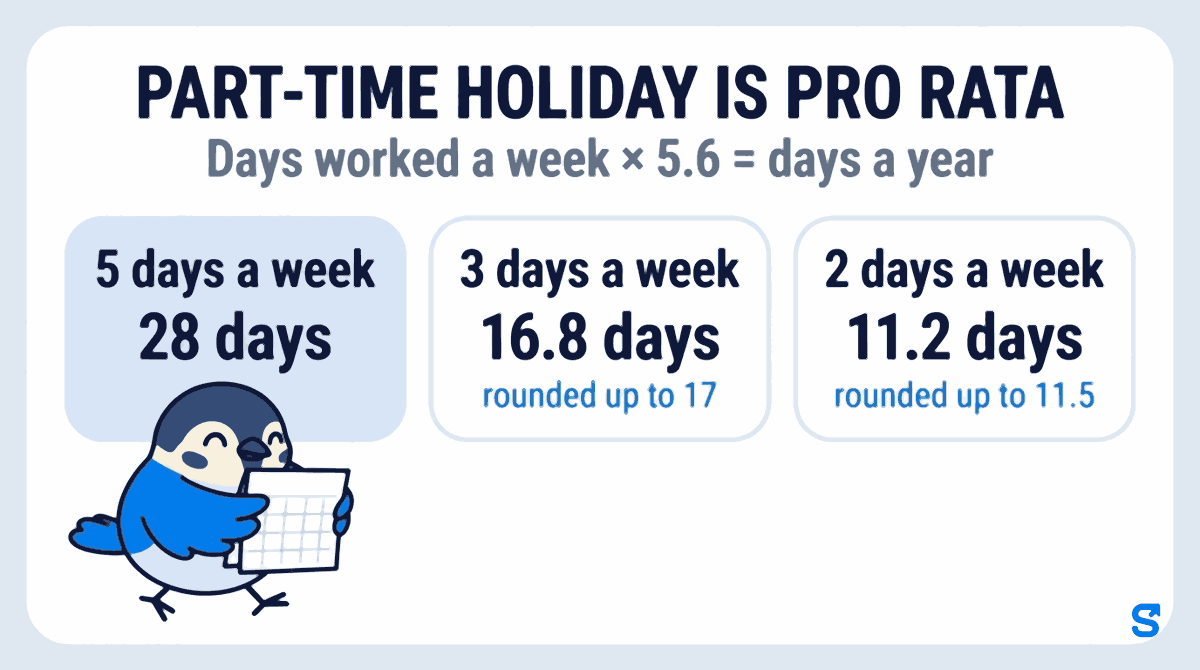
Part-time holiday is pro rata: multiply the days they work each week by 5.6. That is the whole formula for someone on the same days every week for the whole year:
- 5 days a week: 5 × 5.6 = 28 days
- 4 days a week: 4 × 5.6 = 22.4 days
- 3 days a week: 3 × 5.6 = 16.8 days
- 2 days a week: 2 × 5.6 = 11.2 days
The number is the minimum. Many owners round it up to a half or whole day so it is easier to book: 16.8 becomes 17, 11.2 becomes 11.5.
What gov.uk says about part-time holiday
This is background to the set-up, not advice on your contracts. Everything below is from gov.uk's holiday entitlement guide, checked on 12 October 2026. The statute behind it is the Working Time Regulations 1998.
- 5.6 weeks for almost everyone. gov.uk says almost all workers are legally entitled to 5.6 weeks' paid holiday a year, and most workers on a 5-day week get at least 28 days.
- Part-time is pro rata. gov.uk says part-time workers who work regular hours for the whole year are entitled to at least 5.6 weeks' paid holiday, and gives the example of 3 days a week: at least 16.8 days (3 × 5.6).
- A 28-day cap. gov.uk says statutory paid holiday entitlement is limited to 28 days.
- Bank holidays. gov.uk says bank holidays do not have to be given as paid leave, and an employer can choose to include them as part of statutory annual leave.
- Irregular hours are different. gov.uk says people working irregular hours or part of the year are entitled to up to 5.6 weeks, and has separate guidance on how that is worked out. The days-a-week sum above is for regular hours.
This is general information, not legal advice: check with gov.uk, Acas or an employment lawyer for your case.
Why one holiday allowance for everybody goes wrong
The sum is not the problem. The problem is that most apps hold one number per leave type, so a café with full-timers and part-timers has three choices, all bad:
- Give everyone 28. The part-timers' balances are too high, and a three-day barista can book 28 days off without anyone seeing it.
- Fix each part-timer by hand. It works until somebody new joins, changes their days or the year rolls over, and then the hand-fixed numbers quietly go back to 28.
- Keep a spreadsheet beside the app. Now there are two answers to "how many days have I got left", and staff believe the bigger one.
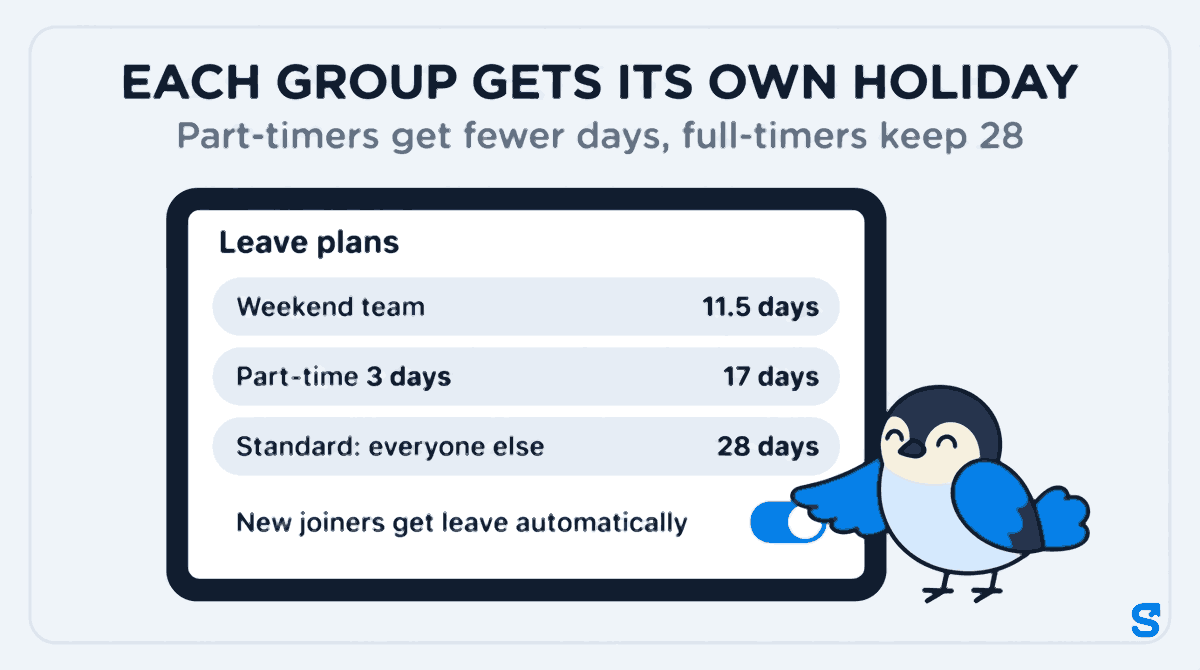
What you want is that each group gets its own holiday: part-timers get fewer days, full-timers keep 28. One allowance per group, decided once, that the new year and every new starter follow on their own.
Set up a leave plan for each group in Shiftelio
Shiftelio is a staff rota, clocking in and leave app for small businesses. A leave plan decides how many days a group of people gets for each leave type. Everyone who is not on another plan stays on Standard, which uses each leave type's own days per year, so your full-timers on 28 need nothing new.
Go to Leaves, then Leave settings. The Leave plans card lists your plans, with Standard last and how many people are on each.
Give it a name staff will recognise, such as Part-time 3 days. Names are for you: the app does not work out the days from the name.
Under Who is on this plan, pick Departments, sites, or Hand-picked people with a search by name. Part-timers rarely sit in one department, so hand-picked people is usually the right choice for a café or shop.
Under Days per year for Annual leave, type the number you worked out, such as 17. Days go in steps of half a day, so 16.8 becomes 17 and 11.2 becomes 11.5. Leave a type empty and the plan uses that leave type's own days per year.
Someone who matches two plans gets the one higher in the list, so use Move up and Move down to put the narrower plan first. A hand-picked weekend plan above a whole-site plan is the usual order.
What a saved plan changes, and when
Saving a plan changes nobody's days today. It decides what people get when days are next given out:
- When you first set up leave, the leave setup wizard's last step, Check and give, shows each person, their leave plan and the days they will get before anything is saved.
- When the next leave year opens, each person's new days come from their plan.
- When someone new joins, the New joiners get leave automatically switch gives them their plan's days for the rest of the year. Days are counted from their joining date, by full months left, rounded to half a day.
If someone already on your books moves from 5 days to 3 days in the middle of the year, add them to the part-time plan for next year, and correct this year's number with Give leave days or Adjust on their balance.
A worked example: a café in Leeds
Priya runs a café in Leeds with nine staff and a January to December leave year:
- Five full-timers on 5 days a week stay on Standard: Annual leave 28 days, bank holidays included.
- Three part-timers on 3 days a week go on a plan called Part-time 3 days, hand-picked, with Annual leave at 17 days.
- One student on Saturdays and Sundays goes on a plan called Weekend team, with Annual leave at 11.5 days.
She puts Weekend team at the top, then Part-time 3 days, then Standard. When Jack, a second weekend student, starts on 1 July, she adds him to Weekend team, and because New joiners get leave automatically is on, his days arrive by themselves. July to December is six months, so he gets half the plan's days: 5.75, rounded to 6.
In January the new leave year opens on its own. The five full-timers get 28, the three part-timers get 17, the two students get 11.5, and nobody has to remember who was meant to be on what.
Which app gives part-time staff a different holiday allowance?
If you are setting up holiday for the first time, start with UK holiday entitlement and bank holidays in one go, and when the year ends see who keeps and who loses days at holiday year end. How it fits a UK business is on the Shiftelio UK page.
Questions owners ask
How do I work out holiday for a part-time worker?
Multiply the days they work each week by 5.6. gov.uk's example is 3 days a week, which gives at least 16.8 days a year, for someone on regular hours for the whole year.
Do part-time workers get bank holidays?
gov.uk says bank holidays do not have to be given as paid leave, and an employer can include them in statutory annual leave. How you treat them for part-timers belongs in the contract. In Shiftelio a holiday can be given to one site or one department instead of everybody.
Is part-time holiday capped at 28 days?
Yes for the statutory part. gov.uk says statutory paid holiday entitlement is limited to 28 days. You can give more than that in the contract if you choose.
Can I give different holiday allowances to different staff in Shiftelio?
Yes. A leave plan gives a group its own days per year for each leave type, picked by department, site or by name. Everyone else stays on Standard.
What happens if someone matches two leave plans?
They get the plan higher in the list. Use Move up and Move down on the Leave plans card to put the narrower plan, such as a hand-picked weekend team, above a whole-site plan.