PM Viksit Bharat Rozgar Yojana: Why the Employer Incentive Is Never Rs 3,000 a Head
In short
PM-VBRY pays employers for extra jobs, but the amount is pro rata against net additional employment. One resignation among your old staff cuts the whole cheque.
A packaging unit in Vasai hired four people last October. All four were first-time EPF members, all four are still there, and between them their wage slabs are worth Rs 5,900 a month under Part B of the Pradhan Mantri Viksit Bharat Rozgar Yojana. The owner did the sum the way everybody does the sum: four new people, roughly six thousand a month, about seventy thousand rupees a year of government money for hiring people he was going to hire anyway.
In the same month a storekeeper who had been there since 2019 resigned. Nothing to do with the four new hires, a different department, a personal reason. That resignation cost the business Rs 1,475 of the October incentive, and nobody in the office will ever connect the two events.
This is the part of PM-VBRY that almost every published explanation of the scheme leaves out. The headline everyone repeats is up to Rs 3,000 per additional employee per month. The scheme document does not pay that way. It pays pro rata against net additional employment, and net additional employment has your own attrition inside it.
What the scheme actually is, in two paragraphs
PM-VBRY is the Employment Linked Incentive scheme announced in the 2024-25 Budget, approved by the Union Cabinet on 1 July 2025 with an outlay of Rs 99,446 crore, and run by the Ministry of Labour and Employment through EPFO. It has two halves and they pay two different people.
Part A pays the employee. A first-time EPF member gets one completed month of EPF wage, capped at Rs 15,000, in two instalments. Part B pays you. An establishment that creates sustained additional employment gets a monthly amount per additional employee, for two years in every sector and four years in manufacturing, paid as a lump sum every six months. The registration period for both runs from 1 August 2025 to 31 July 2027, and only employees who join inside that window count.
If your establishment already had an EPFO code, you are deemed registered under PM-VBRY with effect from 1 August 2025. You did not have to sign up. But you do have to give EPFO your PAN or TAN, your GSTN, and a PAN or TAN linked bank account, or there is nowhere to send the money.
The number that decides everything is your baseline
Part B does not pay for hiring. It pays for additional employment, and additional is measured against a fixed number called the baseline. Get the baseline wrong and every other calculation in this article is wrong with it.
Registered with EPFO before 31 July 2024
Your baseline is the average number of employees shown in the ECRs you filed over the twelve months from 1 August 2024 to 31 July 2025. Not your headcount today, not your headcount in July 2025, an average across twelve returns. Averages are rounded to the nearest integer.
Registered between 1 August 2024 and 31 July 2025
Your baseline is the average number of employees per the ECRs you filed up to 31 July 2025, over however many months that is.
Registered on or after 1 August 2025
You are a New Establishment, and here is the thing several summaries get wrong. Your baseline is not zero. It is 20, because twenty is the EPFO criterion for mandatory registration and the scheme assumes a new establishment that had to register had twenty people. Only jobs created above twenty are considered. If you are a nine-person startup that registered voluntarily in 2026, Part B has nothing for you until your twenty-third employee.
The door that shut on 31 January 2026
One case is already closed. An establishment registered with EPFO before 1 August 2025 that had not been filing ECRs for a year or more had to file every ECR for August 2024 to July 2025 by 31 January 2026 to be treated as an Existing Establishment. If that was you and the deadline went past, you are now treated as a New Establishment for Part B, which means a baseline of 20 whatever your real history was.
There is a second freeze worth knowing: the baseline is not open to change after six months from the start of the scheme, although revised ECRs filed inside those six months showing a higher number were taken into account. Both of those windows are behind us. Your baseline is what it is.
The threshold: two more people, or five
Before any money moves, the establishment has to clear a threshold on top of the baseline, and the threshold depends on the size of the baseline itself.
| Your baseline | You must be at | What that means in practice |
|---|---|---|
| Below 50 | Baseline plus at least 2 | A baseline of 14 means you need 16 before Part B starts |
| 50 or more | Baseline plus at least 5 | A baseline of 60 means you need 65 |
Two details in that table matter more than the numbers. The threshold is tested on a rolling average, not on a single good month. And when you fall below it, the incentive stops for those months and restarts when you are back above, with no extension to the two-year or four-year window at the end. A bad quarter is not deferred. It is gone.
Net additional employment, and why your attrition is in the formula
Here is the definition, from the scheme itself, and it is the sentence the whole article turns on:
"Net Additional Employment during the month = (Number of Old employees in respect of whom ECR has been filed for that wage month + Number of Eligible Employees - Baseline) OR number of Eligible Employees, whichever is lower."
Three words in there are technical terms with definitions of their own.
- Old employee means anyone for whom you filed an ECR for the wage month of July 2025. They can never earn you an incentive. They exist in the formula only as a count.
- Eligible employee means someone who joined during the registration window and for whom EPF contributions have been made by both you and the employee for at least six months.
- Baseline is the fixed number from the section above.
Now read the formula as arithmetic rather than as legal text. Your old employees are in it with a plus sign, and the baseline is in it with a minus sign. Every old employee who walks out of the building takes one off the left-hand side of that subtraction. The new people you hired did nothing wrong, and their number is unchanged, but the figure the scheme pays on has fallen.
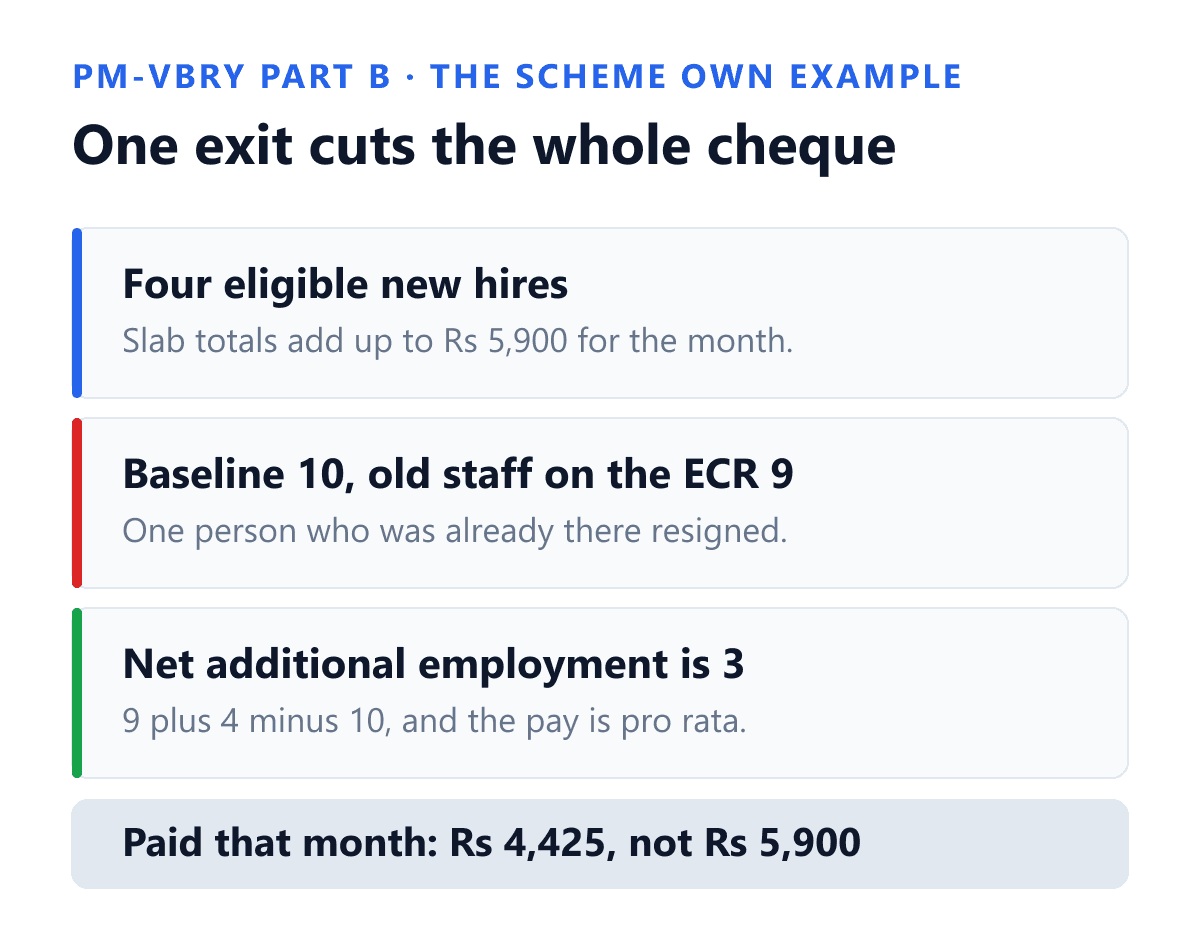
That is the Vasai unit. Baseline 10. Four eligible new hires carrying Rs 5,900 of slab incentive between them. Nine old employees still on the ECR because one resigned. Net additional employment is nine plus four minus ten, which is three, and not the four people the owner actually added.
The pro rata line every explainer leaves out
Net additional employment is not the number of people you get paid for. It is a multiplier. The scheme computes the establishment incentive like this:
Establishment's Incentive = (Total slab-wise incentive of eligible employees) x (Net Additional Employment) / (Total eligible employees)
Run it. Rs 5,900 multiplied by 3, divided by 4, is Rs 4,425. The four hires generated Rs 5,900 of entitlement and the business is paid three quarters of it, because one unrelated person resigned. Over a full six-month block at that rate the gap is Rs 8,850, and over the two years of Part B it is more than a month of somebody's salary.
Turn it around and the same formula is the argument for keeping people. If nobody had left, net additional employment would have been 4, the cap set by the number of eligible employees, and the month would have paid the full Rs 5,900. In a business where staff turnover is treated as an unavoidable cost of doing business, PM-VBRY quietly puts a rupee figure on it, per month, for two years.
The slabs, and the two ways a hire earns you nothing
The slab is set by the employee's EPF wage, which the scheme derives by reverse calculation from what you actually remitted: total contribution multiplied by 100, divided by 24 where the rate is 12 per cent each side, or by 20 where the concessional 10 per cent applies.
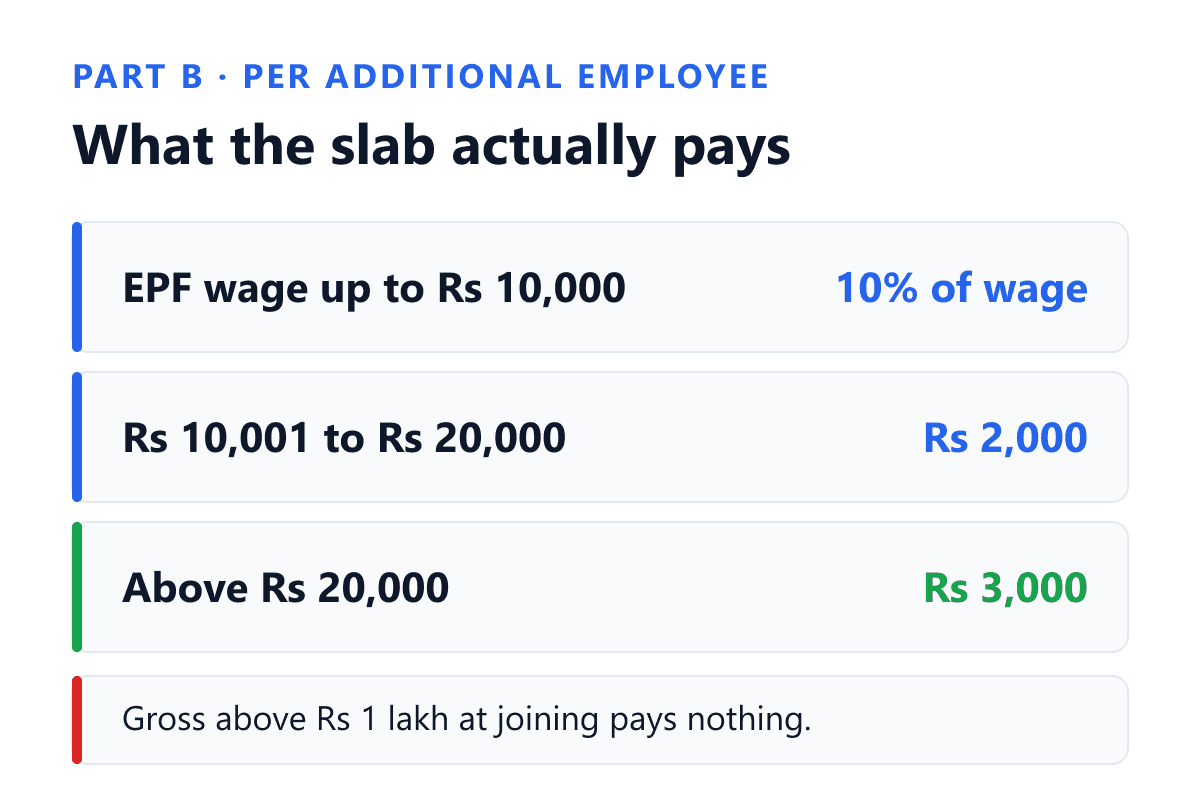
The bottom slab is the one people misread. It is not Rs 1,000. It is 10 per cent of EPF wage, so an EPF wage of Rs 9,500 pays Rs 950, and an EPF wage of Rs 6,000 pays Rs 600. Rs 1,000 is only the ceiling of that band.
And there are two ways a person you genuinely hired earns you nothing at all:
- Gross wage above Rs 1 lakh a month at the time of joining. No incentive for that person, ever. But read the note carefully, because it cuts both ways: that person still counts when net additional employment is worked out. They dilute the pro rata fraction without adding to the slab total.
- Contributions not actually received. The ECR definition says members for whom contribution is not received are not considered for benefits under either Part, and then adds that they are counted towards ascertaining the baseline. An unpaid month raises the number you have to beat and pays you nothing for the person it raised it with.
Six months is the unit, and it has to be continuous
Nothing in Part B is paid monthly, despite every rate in the scheme being expressed per month. Payment happens on a lump sum basis after every six months, and only after you have filed ECRs with contributions for six completed wage months. Once you qualify, disbursal is within 45 days, by DBT to the PAN or TAN linked bank account of the employer.
A "completed wage month" has its own rule that decides which month a joiner starts counting from, and it is a five-day rule:
- Date of joining on or before the 5th of a month: that month is the first completed wage month.
- Date of joining after the 5th: the next month is the first completed wage month.
So a joiner starting on 4 October and a joiner starting on 8 October are a full month apart in the eyes of this scheme, and their six-month clocks finish in different blocks. For a business hiring in ones and twos, moving a start date by four days is the cheapest scheduling decision available.
Part A: what your new joiner gets, and the two things that block it
Part A is the employee's money, not yours, but it fails on your paperwork, so it is your problem. A First Timer is somebody who was never a contributing EPF member before this scheme commenced, who joins between 1 August 2025 and 31 July 2027, and whose gross wage at joining was up to Rs 1 lakh.
| Instalment | How much | What unlocks it |
|---|---|---|
| First | Up to Rs 7,500, being half of the average EPF wage across six continuous completed months | Six completed months of ECRs filed with contributions |
| Second | The average of twelve completed months of EPF wage, less the first instalment, with the total capped at Rs 15,000 | Twelve completed months of ECRs, plus the employee completing the Financial Literacy course. Held in a savings instrument for a period the Ministry will specify. |
Two things block it, and both are administrative:
- The UAN must be authenticated by Face Authentication on the UMANG app. Part A is not admissible otherwise. This is a five-minute job on the employee's own phone at induction, and an impossible job to chase eleven months later when half the batch has changed numbers.
- Twelve months of ECRs must be filed within eighteen months of the joining date. A backlog you intend to regularise later can run out of runway.
One more thing worth telling a new joiner honestly: if a First Timer leaves the employment, on their own volition or otherwise, the incentive ceases. Neither of you gets the rest of it.
What has to be true in your records every single month
Strip the scheme down and it reads your ECR. The ECR reads your payroll. Your payroll reads your attendance. Which means the thing standing between a small business and this money is not an application form, it is whether the business knows its own headcount in the month it changes rather than in the quarter it reconciles.
Three questions decide the cheque, and all three are record questions:
- How many of the July 2025 people are still here? That is the plus sign in the formula. A business that finds out about a resignation when the salary run is short has already lost the month.
- Has every eligible hire got six unbroken months of contributions? Not six months of employment. Six completed wage months with the contribution actually received, by both sides.
- Are we above baseline plus threshold on a rolling average? Two below in one month is not a rounding error, it is a block that pays nothing and a window that does not extend to compensate.
A joining and exit record kept from the daily attendance answers all three without anybody assembling a spreadsheet in the week the ECR is due. The labour law guide sets out the registers the Codes expect from the same record, and the free PF and ESI calculator is the quickest way to check the EPF wage a slab will actually be read from.
Dates that matter from here
- Now. Confirm EPFO has your PAN or TAN, your GSTN and a PAN linked bank account. Deemed registration is not deemed payment, and there is nowhere to send the money without these.
- Now. Get the Face Authentication UAN done at induction for every new joiner, not at the six-month mark.
- 31 July 2027. The last date a hire can join and still be counted. Jobs created after it are outside the scheme regardless of anything else.
- Two years from 1 August 2025 for existing establishments, or from your EPFO registration date if you are a new one. Four years if you are in manufacturing as defined by section 2(72) of the CGST Act and as shown on your GSTN certificate. Interruptions do not extend it.
- Every sixth month. That is the settlement rhythm, and the block is the unit of loss. Watch the rolling average inside the block, not at the end of it.
Frequently asked questions
How much does an employer actually get under PM-VBRY?
Between 10 per cent of EPF wage and Rs 3,000 per additional employee per month, and then multiplied by net additional employment and divided by the number of eligible employees. The Rs 3,000 figure quoted everywhere is the top slab rate before that pro rata step, not the amount most establishments receive.
What is the baseline under PM-VBRY?
For an establishment registered with EPFO before 31 July 2024, it is the average number of employees in the ECRs filed from 1 August 2024 to 31 July 2025. For one registered between August 2024 and July 2025, it is the average across the ECRs filed up to 31 July 2025. For an establishment registered on or after 1 August 2025 it is fixed at 20.
Is the baseline zero for a new company?
No. That is the most common error in circulation. Paragraph 5.2 of the scheme sets the baseline for a New Establishment at 20, being the EPFO criterion for mandatory registration, and says only jobs above that number count.
Does an employee resigning affect the incentive?
Yes, and in two separate ways. If an old employee resigns, net additional employment falls and the pro rata incentive for that month falls with it. If a First Timer resigns, the incentive in respect of that person ceases altogether.
Do I get anything for hiring somebody on a high salary?
Not under either Part. The gross wage ceiling is Rs 1 lakh a month at the time of joining. The scheme does note that such employees are still counted for the calculation of net additional employment, so they affect the arithmetic without adding to the amount.
When is the employer incentive paid?
As a lump sum after every six months, once ECRs with contributions have been filed for six completed wage months, and then within 45 days of the eligibility condition being met, by DBT to the PAN or TAN linked bank account of the employer.
What happens if we fall below the threshold for a few months?
Incentives stop for the months in which the establishment is not eligible and restart when it is eligible again. The overall two-year or four-year window does not extend to make up the difference, so months lost are lost permanently.
Can we claim PM-VBRY along with other schemes?
The scheme states that incentives under PM-VBRY are in addition to incentives under any other scheme. It also notes that separate instructions will be issued for establishments with pending inquiries under section 7A or under ABRY.
Is the incentive taxable?
The scheme subjects the incentives to the Income Tax Act, 1961 unless a specific exemption order is issued by the competent authority. Treat it as taxable receipts unless and until such an order exists, and take advice on your own facts.
What counts as manufacturing for the four-year period?
Activities as defined in section 2(72) of the Central Goods and Services Tax Act, 2017, and as shown on the establishment's GSTN certificate. It is decided by your GST registration, not by a description of what you do.
The short version
- PM-VBRY runs on jobs created between 1 August 2025 and 31 July 2027. Part A pays the first-time employee up to Rs 15,000. Part B pays the employer for two years, or four in manufacturing.
- The employer rate is 10 per cent of EPF wage below Rs 10,000, Rs 2,000 between Rs 10,001 and Rs 20,000, and Rs 3,000 above Rs 20,000. Gross above Rs 1 lakh at joining pays nothing.
- That rate is then scaled: the incentive is the slab total multiplied by net additional employment and divided by the number of eligible employees.
- Net additional employment counts your surviving July 2025 staff, adds the eligible new ones, subtracts the baseline, and is capped at the number of eligible employees. Your attrition is inside the formula.
- Baseline is the twelve-month ECR average to 31 July 2025 for older establishments, and a flat 20 for anything registered from 1 August 2025. It is not zero.
- Threshold is baseline plus 2 below fifty, baseline plus 5 at fifty and above, tested on a rolling average.
- Six completed wage months with contributions actually received is the unit for everything. Members with contributions unpaid still raise your baseline and earn nothing.
- No UAN authenticated by Face Authentication on UMANG means no Part A for that employee, whatever else is in order.
Position as at 7 September 2026. The amounts, definitions, baseline rules, thresholds and formulas above are taken from the PM-VBRY scheme document published by EPFO on the scheme portal, and the worked figures are recomputed from the formula in paragraph 7.2.5 rather than copied from a summary. Guidelines and standard operating procedures that the scheme says will be issued separately, including the savings instrument for the second Part A instalment and the comprehensive penalty clause, had not been issued in the form read for this article and nothing is claimed about them. The Rs 2,400 crore disbursement of 19 June 2026 is as reported by the Government of India. This is general information about a central scheme and not advice on any particular establishment's eligibility.
Sources
- Pradhan Mantri Viksit Bharat Rozgar Yojana, Employees Provident Fund Organisation - the official scheme portal, carrying the scheme document from which the definitions, the baseline rules, the wage slabs and the pro rata formula in this article are taken.
- PM-VBRY Frequently Asked Questions, EPFO - the baseline of 20 for new establishments, the 31 January 2026 ECR cut-off, cessation on resignation, and the 45-day disbursal.
- Ministry of Labour and Employment, Government of India - the scheme is administered by the Ministry through EPFO, and the guidelines still to be issued will appear here.
- Press Information Bureau, Government of India - the Cabinet approval of 1 July 2025, the outlay of Rs 99,446 crore, and the target of more than 3.5 crore jobs.
Keep reading
See how Shiftelio does this in practice with a joining and exit record behind every ECR you file.
Work your own numbers with the free PF and ESI calculator. No signup, no email.