Shram Suvidha Registration Update Deadline: 8 November 2026, and What Happens If You Miss It
In short
Your Form-I update on Shram Suvidha is due 8 November 2026. Section 3(7) of the OSH Code bars an unregistered establishment from employing anyone at all.
A logistics company outside Chennai has held the same registration since 2013. It was issued under the Contract Labour (Regulation and Abolition) Act, 1970, it is framed behind the reception desk, and nobody has thought about it since. The Act it was issued under no longer exists. It was repealed on 21 November 2025.
That is not, by itself, a problem. The Occupational Safety, Health and Working Conditions Code, 2020 carries a rule that treats establishments already registered under a repealed central labour law as registered under the Code. What the company has to do is tell the registering officer, electronically, that the registration exists and what its particulars are. There is a window for that, and for establishments in the central sphere it closes on Sunday 8 November 2026.
Miss it and the consequence is not the one most people are bracing for. It is not a fine.
What actually changed on 8 May 2026
The four labour codes commenced on 21 November 2025. That put the OSH Code into force, but a code without rules is a set of duties with no form to discharge them on. The Occupational Safety, Health and Working Conditions (Central) Rules, 2026 were notified by G.S.R. 345(E) dated 8 May 2026 and came into force the same day. That notification is what created the registration route: an electronic application in Form-I on the Shram Suvidha portal, carrying the particulars of the establishment along with its existing registration documents and proof of identity and address, answered by a certificate in Form-III.
Two clocks start from there, and they are not the same clock. One runs sixty days from the date the Code becomes applicable to a new establishment. The other runs six months from the day the Rules commenced, and it is the one that catches every business that was already trading.
Four positions, and one of them is yours
Almost every explainer of this deadline collapses into a single instruction: register on Shram Suvidha. That is not useful, because the duty is different depending on when the establishment came into existence and whether it already held a registration. There are four positions.
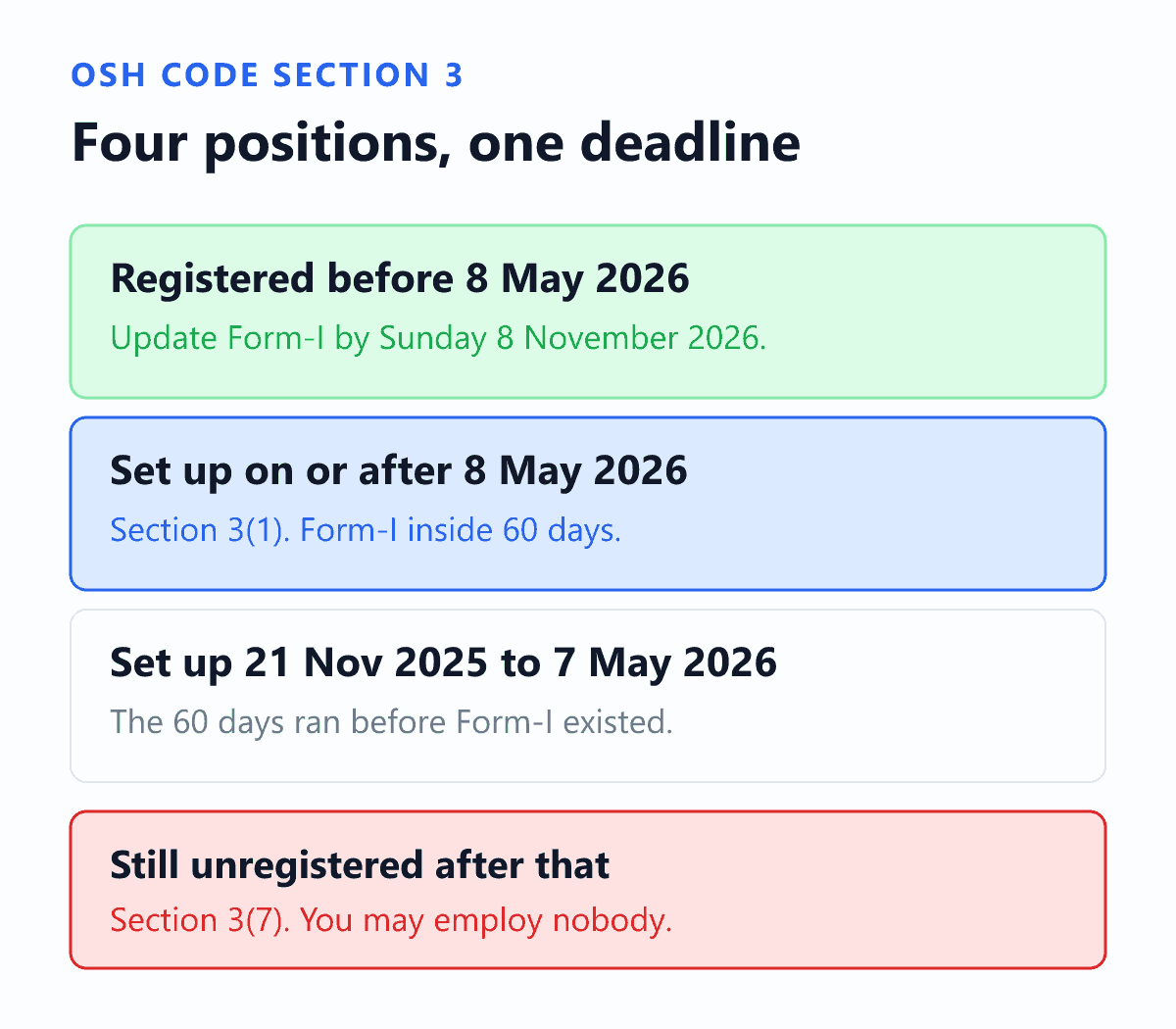
| Where you stand | What the Code asks | By when |
|---|---|---|
| Registered under a central labour law that the Code repealed | Give the registering officer your registration details electronically, in Form-I | Six months from 8 May 2026, so 8 November 2026 |
| Came into existence on or after 8 May 2026 | Fresh application in Form-I under section 3(1) | 60 days from the date the Code applies to you |
| Came into existence between 21 November 2025 and 7 May 2026 | The same fresh application | Already expired, against a form that did not exist. See below. |
| Never registered under anything, trading before 21 November 2025 | Fresh application in Form-I | Do it now. You have no transition to rely on. |
The threshold that pulls an establishment into the Code at all is ten or more workerson any day of the preceding twelve months. The Ministry’s own FAQ on the Code is explicit that the raised factory definition did not narrow this: safety and welfare provisions apply to establishments having ten or more employees regardless of what counts as a factory. Mines, docks and hazardous work are covered irrespective of headcount.
Section 3(7) is not a penalty clause
Here is the part that gets left out. Section 3(7) says that an employer of an establishment who has not registered it, or who has not appealed against a cancellation or revocation of the certificate, or whose appeal has been dismissed, shall not employ any employee in such establishment.
Read that as an operating restriction rather than a fine, because that is what it is. It does not say the employer pays. It says the employer may not employ. Cyril Amarchand Mangaldas flagged this within weeks of the Code being passed, and the phrasing is worth quoting: failure to obtain registration “takes away the ability of an employer to employ any employee”, and the ramifications are broader than a prosecution because they curtail the ability to carry on business at all.
Why this matters more than the number.A penalty is a cost you can budget for and argue down. A bar on employing anyone is a defect that sits underneath every employment contract, every contractor arrangement and every piece of due diligence somebody runs on you. It is the kind of thing a buyer, a lender or a large customer’s vendor audit finds, and it does not get resolved by writing a cheque.
What section 94 adds on top
The money is real too. Section 94 provides that where an establishment contravenes the Code, the employer or principal employer is liable to a penalty of not less than Rs 2,00,000 and up to Rs 3,00,000, and where the contravention continues after conviction, a further penalty of up to Rs 2,000 for each day it continues. Obtaining registration by misrepresentation or by suppressing a material fact is itself deemed a contravention for the purposes of that section, which is a reason to be accurate in Form-I rather than fast.
The deadline that was already impossible
Section 3(1) gives a new establishment sixty days from the date the Code becomes applicable to it. Apply that literally to the transition and the arithmetic breaks. An establishment set up on, say, 20 December 2025 had until roughly 18 February 2026 to file an electronic application in a form that was not notified until 8 May 2026, on a portal route that did not yet accept it.
LiveLaw published exactly this argument in September 2026, and it names the three things that answer it. First, no late fee has been prescribed for the period in question, so the mechanical consequence of lateness has no number attached to it. Second, the registering officer under the Central Rules has power to direct an employer to comply rather than to treat the default as final. Third, and most usefully, the Code requires that an employer be given thirty days to comply before prosecution is initiated for a first contravention that has not caused an accident.
The practical reading, and the one worth acting on: if your establishment came into existence in that window, file now and file completely. The defence is that compliance was impossible, not that it is optional, and the defence gets weaker every month you leave it.
Before any of this applies to you: whose rules are yours?
This is the section that most coverage of the November deadline leaves out, and it changes the answer for the majority of Indian businesses reading it.
The OSHWC (Central) Rules, 2026 are rules made by the Central Government. They govern where the Central Government is the appropriate government under section 2(1)(c) of the Code. Clause (i) of that definition lists establishments carried on by or under the authority of the Central Government, specified controlled industries, railways including metro, mines, oil fields, major ports, air transport services, telecommunication services, banking companies, insurance companies established by a Central Act, central public sector undertakings and their subsidiaries, and contractors working for them.
Clause (ii) puts the rest under the State Government, and it opens by naming a factory, alongside motor transport undertakings, plantations, newspaper establishments, and establishments relating to beedi and cigar.
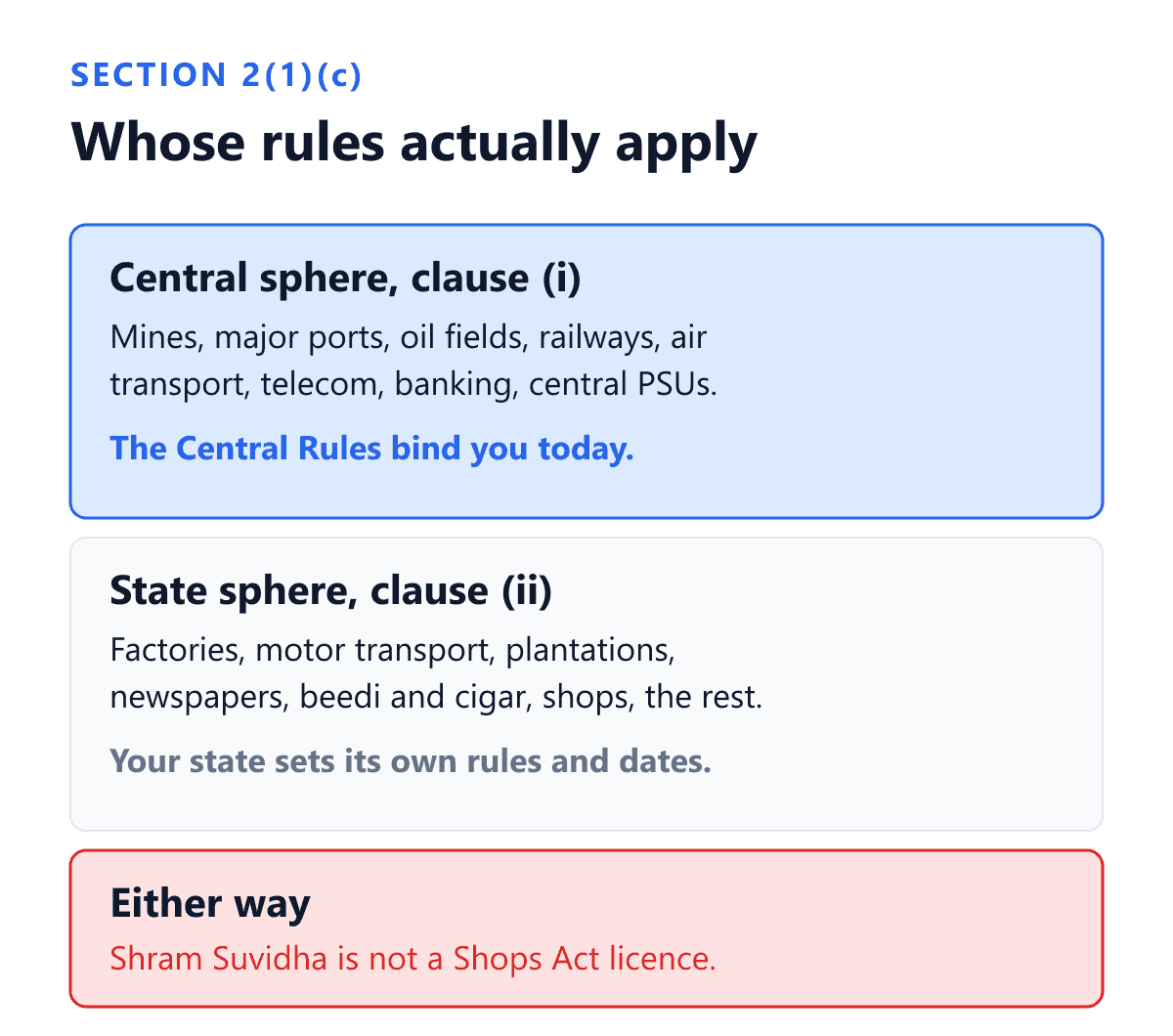
So a garment unit in Tiruppur, a restaurant group in Bengaluru, a hospital in Jaipur and a three-branch retail chain in Gujarat are all looking at their own state government for the rules, the forms and the transition dates. Several states notified draft or final rules through 2026; several had not. The instruction for a state-sphere employer is therefore not “file by 8 November”. It is: find out whether your state has notified its OSH rules, and what date they set.
And the thing that catches multi-state employers. A Shram Suvidha entry is not a registration under a state Shops and Establishments Act, and it does not replace one. States have not uniformly migrated shops, professional tax and state factory systems into the central identifier, so an employer with sites in three states is running central and state compliance in parallel, not one instead of the other.
Deemed registration cuts in your favour
One genuine improvement is worth knowing before you file, because it changes how you should treat the seven days after submission.
Where the application in Form-I is complete in all respects, the certificate of registration is to be issued electronically in Form-III, and in any case not later than seven days from the date of submission. If the officer does not issue it in that window, the certificate is auto-generated and the establishment is treated as registered. Deemed approval also applies on the cancellation side, where the officer has sixty days.
Two consequences. Silence after seven days is not a rejection, so do not resubmit and create a duplicate. And “complete in all respects” is doing the work in that sentence: an incomplete application never starts the clock, which is why the wrong headcount or a missing address proof costs you more than the ten minutes it takes to get them right.
The duty that does not end when you file
The November date is a transition. The obligation it transitions you into is continuous, and it is the part that will quietly go stale in 2027 while everybody congratulates themselves on having filed.
Section 3(4) requires that any change in the ownership or management of the establishment, or in any of the particulars contained in the registration, be intimated electronically to the registering officer within thirty days of the change. Section 3(5) requires intimation of closure within thirty days, accompanied by a certification that all dues to workers have been paid, after which the officer cancels the registration within sixty days.
In an ordinary small business, the thirty-day duty is triggered by things nobody files paperwork for: a new registered address, a partner leaving, a change of manager, an additional site, a shift in the nature of work. Each of those is a Form-I amendment with its own clock.
What to do with the time that is left
- Settle whose rules apply. Central sphere under clause (i), or state sphere under clause (ii). Everything below depends on the answer, and for most private employers it is the state.
- Find every registration you already hold and the Act each was issued under: Factories Act, CLRA, ISMW, BOCW, Motor Transport Workers, Shops and Establishments. Most of the central ones are repealed and are exactly what the deemed-registration route wants details of.
- Fix your headcount before you fill the form, not after. Form-I asks for particulars of the establishment, and the ten-worker test looks at any day in the preceding twelve months, not at today.
- Confirm somebody can actually log in. A portal account nobody holds credentials for is the commonest reason a filing that everyone believed was done was not.
- File complete, then wait seven days. Do not resubmit into silence.
- Diarise the thirty-day rule for changes in particulars, and the annual return. The OSH Rules provide for an annual return in Form XVII, furnished electronically.
Where this quietly becomes an attendance problem
Every step above has the same dependency and it is not legal. It is knowing, defensibly, how many people worked for you and when.
The Code applies at ten or more workers on any day of the preceding twelve months. That is a historical question, not a present one, and a business that peaked at fourteen workers during a festival season and sits at eight today is inside the Code and usually does not know it. Contract workers on your premises count towards obligations that are yours as principal employer, which we cover separately in the guide to principal employer PF liability for contract workers. The thirty-day amendment duty needs you to notice a change in the particulars in the first place. The Form XVII annual return needs the year in a form you can total.
None of that is answerable from a WhatsApp group or a register that gets written up at month end. It is answerable from a system that records who checked in, where, and on which date, and keeps that record for as long as the twelve-month lookback is going to be asked about. That is the whole reason Shiftelio records attendance against a date and a location rather than a monthly total: the same log that closes payroll is the one that answers “how many workers did you employ on 14 October” without anybody reconstructing it. If you want to see what the statutory register looks like before you decide, the free attendance register template is the same shape an inspector asks for.
Common questions
We are registered under the Factories Act. Do we register again from scratch?
No. The deemed-registration route in section 3(8) exists precisely for you. What is asked is that you provide the details of the existing registration to the registering officer electronically. In the central sphere that is the Form-I update due by 8 November 2026. A privately owned factory, though, is in the state sphere under clause (ii), so check your state’s rules for the equivalent date before you work to the central one.
Is the LIN the same as the registration certificate?
Not quite. The Labour Identification Number is the single identifier the Shram Suvidha portal uses to tie your online filings, inspections and returns together. The registration certificate under the OSH Code is Form-III, the document that evidences registration. You can hold a LIN from an earlier central filing and still owe the Form-I particulars.
We have branches in two states. One registration or several?
The Code contemplates a single registration for an establishment, and a common licence covering more than one licensable activity, which is a real simplification against the old position. It does not merge two state governments into one. Where the appropriate government differs by site, expect the compliance to differ by site, and treat any advice that a single central filing covers everything as something to verify against your own state rules.
Nothing has changed at our establishment since 2019. Do we still have to file?
Yes, if you are in the central sphere. The transition is not conditional on anything having changed. It exists so that registrations issued under repealed Acts are carried onto the electronic register under the Code, which cannot happen unless somebody tells the registering officer they exist.
Is 8 November or 9 November the deadline?
Work to 8 November. The notification G.S.R. 345(E) is dated 8 May 2026 and the Rules come into force on that date, which puts six months at 8 November. Some commentary counts from the 9 May gazette publication and reports 9 November. Since 8 November 2026 is a Sunday, the practical last working day is Friday 6 November, and filing then is correct under either reading.
The short version
- The OSHWC (Central) Rules, 2026 were notified by G.S.R. 345(E) dated 8 May 2026 and came into force that day. They created the Form-I registration route on Shram Suvidha.
- Establishments already registered under a repealed central labour law have six months to give their registration particulars in Form-I, which lands on 8 November 2026.
- A new establishment gets sixty days from the date the Code applies to it, under section 3(1).
- Establishments born between 21 November 2025 and 7 May 2026 had that sixty days run out before Form-I existed. No late fee is prescribed for it, the registering officer can direct compliance, and a first contravention carries thirty days to comply before prosecution.
- Section 3(7) is the real consequence. An employer who has not registered may not employ any employee in the establishment. It is a bar on employing, not a fine.
- Section 94 adds Rs 2,00,000 to Rs 3,00,000, and up to Rs 2,000 a day if the contravention continues after conviction.
- A complete Form-I earns a Form-III certificate within seven days, or the certificate auto-generates and registration is deemed. Silence is not rejection.
- The Central Rules bind only the central sphere. Section 2(1)(c) clause (ii) puts a factory, motor transport undertaking, plantation, newspaper establishment and beedi and cigar establishment under the State, along with everything not in clause (i).
- Most private Indian employers are therefore waiting on state rules, not the 8 November central date.
- Any change in ownership, management or registered particulars must be intimated within thirty days, permanently. Closure gets thirty days too.
- The Code applies at ten or more workers on any day of the preceding twelve months, which is a question about your records, not about today’s roster.
Position as at 8 September 2026. Sections 2(1)(c), 3, 94 and the thirty-day compliance provision are from the Occupational Safety, Health and Working Conditions Code, 2020, in force from 21 November 2025. The Form-I, Form-III, seven-day and six-month provisions are from the Occupational Safety, Health and Working Conditions (Central) Rules, 2026, notified by G.S.R. 345(E) dated 8 May 2026. The gazette text of those Rules could not be retrieved directly during drafting, so the six-month transition and the registering officer’s power to direct compliance are described on the authority of the practitioner summaries linked below and are deliberately not given a rule number here. Whether the Central Rules apply to your establishment at all depends on section 2(1)(c); for most private employers the appropriate government is the State, and the State’s own rules under the Code govern the form, the fee and the date. This is general information and not legal advice for a particular establishment.
Sources
- Ministry of Labour and Employment, FAQs on the Occupational Safety, Health and Working Conditions (OSH) Code, 2020- the Government’s own answers, including that health, safety and welfare provisions apply to establishments having ten or more employees irrespective of the raised factory definition.
- Cyril Amarchand Mangaldas, The Occupational Safety, Health and Working Conditions Code, 2020 - the analysis of section 3, including single registration within sixty days, the thirty-day intimation of changes, deemed approval, and the finding that failure to register removes the ability to employ any employee at all.
- LiveLaw, Did OSH Code 2020 Create An Impossible Registration Deadline? - the gap between the Code commencing on 21 November 2025 and Form-I arriving with the Central Rules, and the three answers available to an establishment caught in it.
- SCC Online, OSH Central Rules 2026: Key Highlights and Compliance Guide - the Form-I and Form-III mechanics, the seven-day deemed registration, the six-month window for existing registrants and the thirty-day rule for changes in particulars.
- Mondaq, India’s Labour Codes Enter The Compliance Phase: Key Implications Of The Central Rules, 2026 - that the Central Rules apply only where the Central Government is the appropriate government, and the annual return in Form XVII.
- LiveLaw, Is Definition Of ‘Appropriate Government’ Under OSH Code, Appropriate? - clause (ii) of section 2(1)(c), which places a factory, motor transport undertaking, plantation, newspaper establishment and beedi and cigar establishment under the State Government.
- Ministry of Labour and Employment, Shram Suvidha portal - the portal on which Form-I is filed and the Labour Identification Number is issued.
Keep reading
See how Shiftelio does this in practice with a headcount record that answers the twelve month lookback.
Work your own numbers with the free attendance register template. No signup, no email.