Labour Inspection in India 2026: When You Get a Warning, and When You Do Not
In short
An inspection now ends in a written direction, not a prosecution. Except for underpaid wages, which are excluded, and the IR Code, which has no such clause.
Somebody from the labour department is standing at your reception. They have asked for the attendance register for the last six months, the wage slips for three named workers, and the register of accidents. You have some of it. The rest is in a WhatsApp group, a supervisor’s notebook, and a spreadsheet nobody has opened since March.
The good news is real and it is written into the statute. Since the four Labour Codes came into force on 21 November 2025, the first thing you get in most cases is a piece of paper telling you to fix it, not a summons. The bad news is that almost everybody stops reading after that sentence. The written direction does not cover the breach you are most likely to be committing, one of the four Codes does not offer it at all, and on the face of the text it protects you from a courtroom rather than from a bill.
The Inspector-cum-Facilitator is a legal office, not a slogan
The Codes abolished the inspector and created the Inspector-cum-Facilitator. It is not a rebrand. Section 51(5) of the Code on Wages, 2019 lists two functions in one sentence: to give "advice to employers and workers relating to compliance" and to inspect. Advice comes first in the drafting, and the enforcement provisions downstream are built on the assumption that advice was given.
Three things follow that most employers have not registered.
The visit may be allocated by a computer. Section 51(2) lets the appropriate Government notify a web-based inspection scheme, and section 51(3) allows for randomised selection of establishments for inspection. Being picked is not evidence that somebody complained about you.
The officer can take the record away. Section 51(6)(c) lets them "search, seize or take copies of such register, record of wages or notices" they consider relevant to an offence they have reason to believe was committed. Section 51(8) applies the search and seizure provisions of the Code of Criminal Procedure to it.
Almost nobody else can start a prosecution. Under section 52(1) of the Code on Wages a court takes cognizance only on a complaint by or under the authority of the appropriate Government, an authorised officer, an employee, a registered trade union, or the Inspector-cum-Facilitator, and no court below a Metropolitan Magistrate or a Judicial Magistrate of the first class may try it. The Industrial Relations Code, 2020 is narrower still: section 87(1) allows a complaint only by or under the authority of the appropriate Government, with no employee route at all. And under the OSH Code, 2020, section 110(2) requires the complaint to be filed by the Inspector-cum-Facilitator, within six months of the date the offence came to their knowledge.
Where the second chance is actually written down
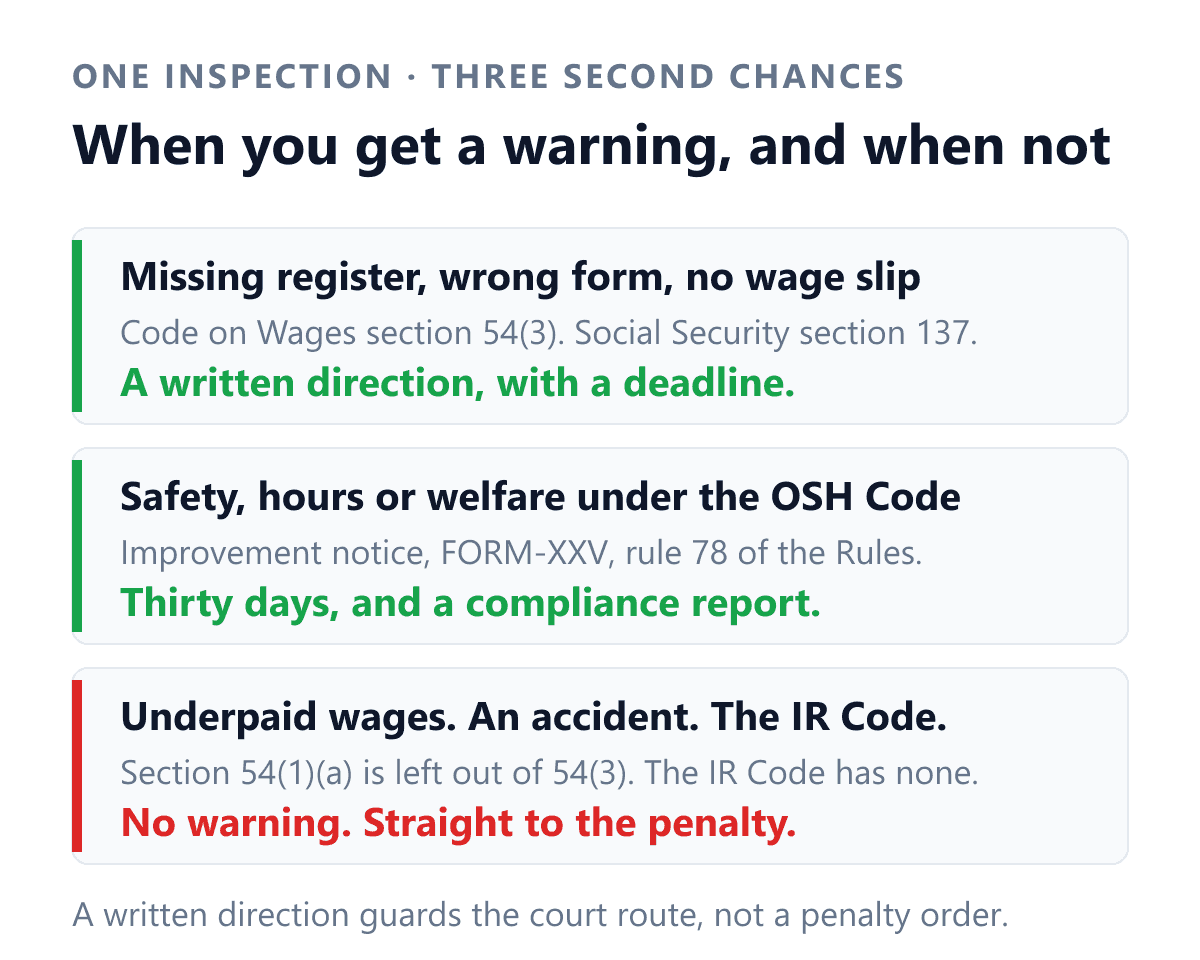
Three of the four Codes carry an opportunity-to-comply provision. They are not the same provision, they do not give the same amount of time, and one Code does not have one.
| Code | Provision | What you get | How long |
|---|---|---|---|
| Code on Wages, 2019 | Section 54(3) | A written direction to comply | Whatever period the direction lays down |
| Code on Social Security, 2020 | Section 137 | A written direction to comply | Whatever period the direction lays down |
| OSH and Working Conditions Code, 2020 | Section 110(1), with rule 78 and FORM-XXV | An improvement notice, plus a compliance report you must file | Thirty days from the date of the notice |
| Industrial Relations Code, 2020 | None | Nothing | Not applicable |
Note what the first two do not say. Neither section 54(3) nor section 137 mentions thirty days. Both say the direction "shall lay down a time period for such compliance". The thirty days everybody quotes is the OSH Code’s number, in section 110(1), and it has been copied across the other two Codes by people who did not open them. Under the Code on Wages and the Social Security Code, the deadline is whatever the officer writes on the paper.
FORM-XXV: the compliance report is the compliance
Rule 78 of the OSH and Working Conditions (Central) Rules, 2026, notified as G.S.R. 345(E) on 8 May 2026, tells the Inspector-cum-Facilitator to issue an improvement notice in FORM-XXV after an inspection where one is needed. The operative paragraph of that form is one sentence, and it catches people out:
"You are hereby directed to rectify the contraventions / irregularities observed during inspections and submit compliance report (through speed post / electronic mode / designated portal) within 30 days from the date of issue of this notice, failing which necessary action will be initiated as per the relevant provisions of the statute without making any further correspondence in this regard."
Two traps in there. The clock runs from the date of issue, not the date it reached you, so postal delay comes out of your thirty days. And fixing the breach is not enough on its own: the form requires a compliance report to be submitted. An employer who quietly repairs the guard rail and files nothing has, on the face of the notice, not complied. The last clause removes any expectation of a reminder.
Rule 78(2) closes the loop. At each inspection the officer is to ascertain how far the shortcomings notified at the previous inspection have been rectified, and record what they find. The file follows you.
The three things the second chance does not cover
Underpaid wages are excluded by the opening words
This is the most important paragraph in the article. Section 54(3) of the Code on Wages begins:
"Notwithstanding anything contained in clause (c) of sub-section (1) or sub-section (2), the Inspector-cum-Facilitator shall, before initiation of prosecution proceeding for the offences under the said clause or sub-section, give an opportunity to the employer to comply…"
Read the list. Clause (c) of sub-section (1) is the catch-all: contravening any other provision of the Code, fine up to Rs 20,000. Sub-section (2) is the records offence: non-maintenance or improper maintenance, fine up to Rs 10,000. Those two get the written direction.
Clause (a) of sub-section (1) is not in the list. That clause covers an employer who "pays to any employee less than the amount due to such employee under the provisions of this Code", and it carries a fine which may extend to Rs 50,000. Underpaying somebody is the single commonest finding at a small-business inspection, whether through a wrong overtime rate, a deduction that is not permitted, a bonus not paid, or the wage definition applied to the wrong base. It is deliberately outside the second chance.
If you want to see how easily the wage definition alone produces an underpayment, our piece on the fifty per cent wage definition works that through. It is the same money seen from the other end.
An accident switches the opportunity off
The proviso to section 110(1) of the OSH Code is short and absolute: "no such opportunity shall be accorded to an employer in case of an accident". Every safety breach that comes to light through a routine inspection is inside the thirty-day regime. Every safety breach that comes to light because somebody was hurt is outside it, including breaches that had nothing to do with the injury but were found while the officer was on site.
The Industrial Relations Code has no such clause
Go through the offences chapter of the IR Code and there is nothing between the penalties and the courtroom. Section 86 sets the penalties, section 87 deals with cognizance, section 88 with offences by companies, section 89 with composition. No opportunity to comply, no written direction, no improvement notice.
And unlike the other three Codes, its penalties carry minimums:
| What it is | Provision | Penalty |
|---|---|---|
| Retrenchment, lay-off or closure done wrongly (sections 78, 79, 80) | Section 86(1) | Not less than Rs 1,00,000, up to Rs 10,00,000 |
| Failing to submit draft standing orders, or modifying them wrongly | Section 86(10) | Not less than Rs 50,000, up to Rs 2,00,000, plus Rs 2,000 a day while it continues |
| Acting against certified standing orders | Section 86(11) | Not less than Rs 1,00,000, up to Rs 2,00,000 |
| An unfair labour practice in the Second Schedule | Section 86(5) | Not less than Rs 10,000, up to Rs 2,00,000 |
| Contravening sections 67, 70, 73 or 75 | Section 86(3) | Not less than Rs 50,000, up to Rs 2,00,000 |
A minimum matters more than a maximum. A magistrate cannot go below Rs 1,00,000 on a wrongful retrenchment however sympathetic the facts are. Our retrenchment guide covers what makes one lawful in the first place. This is what the other outcome costs.
Thirty days keeps you out of court, not out of a penalty
This is the part of the design nobody writes about, and it is visible in the first four words of section 111 of the OSH Code:
"Notwithstanding anything contained in section 110, for the purpose of imposing penalty under sub-section (3) of section 12 or sections 94, 96, 97, 99, 106 and sub-section (3) of section 114, the appropriate Government may appoint any officer not below the rank of Under Secretary… for holding enquiry…"
Section 110 is the thirty-day opportunity. Section 111 says it applies notwithstanding that. On the face of the text, the second chance protects you from a prosecution before a magistrate. It does not stop an officer of Under Secretary rank holding an enquiry and imposing the penalty administratively.
The Code on Wages has the same machinery at section 53, for offences under clauses (a) and (c) of section 54(1), section 54(2), and section 56(7). Its opening words are "Notwithstanding anything contained in section 52", which is the cognizance section rather than the opportunity section. But section 54(3) limits itself by its own words to what happens "before initiation of prosecution proceeding", and a section 53 enquiry is not a prosecution proceeding.
There is drafting evidence for the reading. In the OSH Code, sections 96 and 97 say a person "shall be liable to penalty". Sections 95 and 98, neither of which is in the section 111 list, say "shall be punishable". That is the language of an administrative penalty set against the language of a criminal punishment, and the two lists line up with it.
Stated as a reading, not as settled law. As at September 2026 no reported ruling has decided whether an authority may impose a section 111 or section 53 penalty on an employer who was never given the opportunity under section 110 or section 54(3). The contrary argument is available and respectable: that the opportunity provisions govern the whole enforcement scheme, and the notwithstanding clause is aimed only at the choice of forum. What is not available is the assumption that thirty days is a complete shield, because the text does not say that.
If a penalty order does land, section 111 gives you a route out: an appeal within sixty days to an appellate authority not below Deputy Secretary rank, who must decide it within sixty days of receiving it. Ignore the order instead and section 111(5) applies. Failing to pay within ninety days of receiving the copy is punishable with a fine of not less than Rs 25,000 and up to Rs 2,00,000, on top of the penalty. What is collected goes to the Social Security Fund under section 115.
The clock runs from the violation, not from the notice
All three opportunity provisions withdraw the second chance for a repeat. The wording is nearly identical in each, and it is worth reading slowly, because it does not say what people assume it says.
"…no such opportunity shall be accorded to an employer, if the violation of the same nature of the provisions under this Code is repeated within a period of five years from the date on which such first violation was committed…" (Code on Wages, section 54(3). The OSH and Social Security versions read the same at three years.)
Three things fall out of that sentence.
It runs from the violation, not from the notice. Not the date you were told, not the date of the inspection, not the date of any order. The date the first violation was committed, which may well be a date nobody identified at the time.
It needs no conviction. Compare it with the escalation clauses in the same Codes, which all begin with the words "having been convicted": sections 54(1)(b) and 54(1)(d) of the Code on Wages, section 96(2) of the OSH Code, section 134 of the Social Security Code. The repeat bar on the opportunity does not use that language. A finding is enough.
The windows disagree with each other. One establishment, one inspection, three different memories:
| Code | Repeat window | Runs from | Conviction needed |
|---|---|---|---|
| Code on Wages, section 54(3) | Five years | Date the first violation was committed | No |
| OSH Code, section 110(1) proviso | Three years | Date the first violation was committed | No |
| Social Security Code, section 137 | Three years | Date the first violation was committed | No |
The practical consequence is a filing habit, not a legal strategy. Keep every written direction, improvement notice and compliance report you have ever received or sent, with dates, for at least five years. The question "is this the same nature of violation as the one in 2027" is one you want to answer from a folder rather than from memory, because the officer will be answering it from the rule 78(2) record.
The same missing register, priced under two Codes
Here is where the four-Codes design produces a result that looks like a drafting accident and is worth planning around.
An attendance register that has not been maintained is an offence under the Code on Wages, section 54(2): "for the offences of non-maintenance or improper maintenance of records in the establishment, the employer shall be punishable with fine which may extend to ten thousand rupees". Up to Rs 10,000, no minimum, and it is one of the two offences section 54(3) protects, so a written direction comes first.
The same failure under the OSH Code is section 96, and it reads completely differently. Failing to maintain a register or document, failing to file a return, or failing to produce one when required, makes a person "liable to penalty which shall not be less than fifty thousand rupees but which may extend to one lakh rupees". On a repeat it is up to Rs 2,00,000.
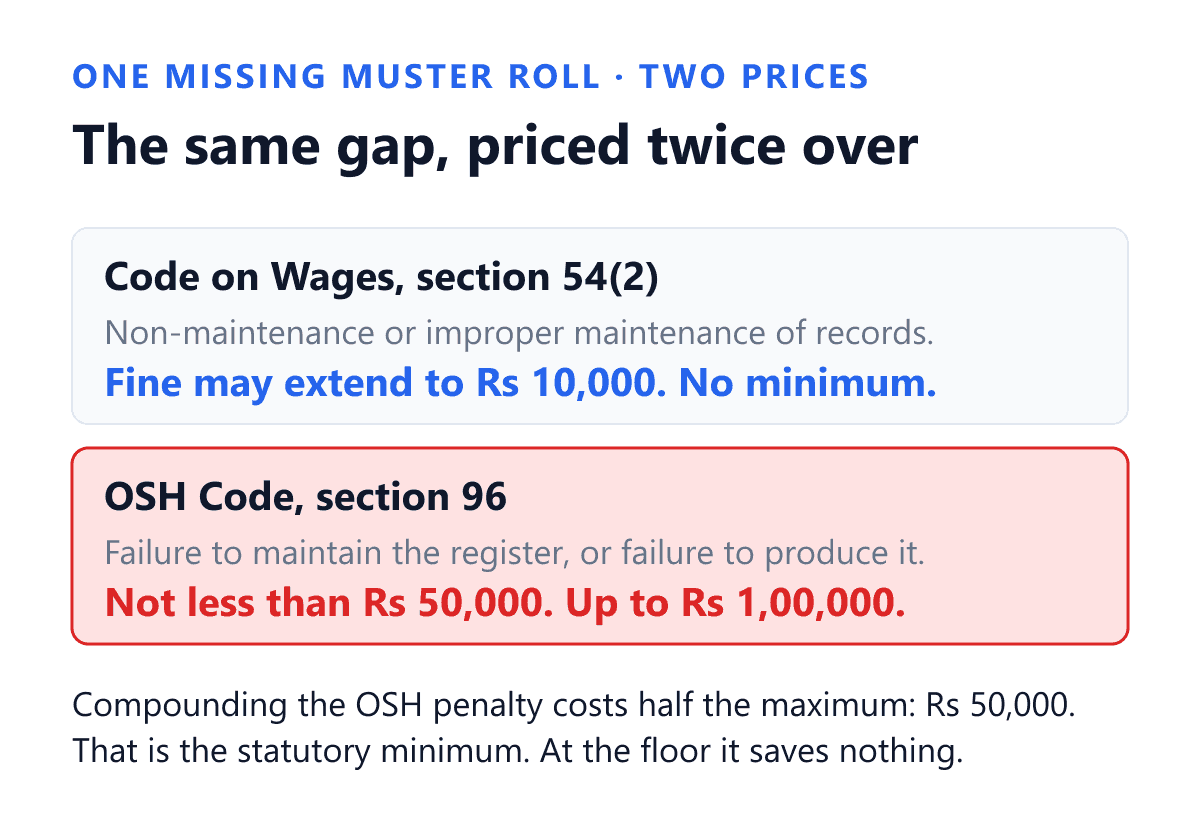
A factor of five, resting on which set of rules requires that particular record. Registers required under the wage rules sit in the first row; registers required under the OSH rules, including the accident register and the register of leave with wages, sit in the second. Our guide to statutory registers and wage slips sets out which record belongs where and how long each has to be kept.
And section 96 is in the section 111 list, which brings the previous section back around: it is exactly the flavour of breach that can arrive as an administrative penalty order rather than as a summons.
Compounding: what it costs, and when it saves nothing
Compounding is paying a fixed proportion of the maximum to make the matter go away without a conviction. All four Codes allow it, at different rates, and the 2026 Rules now set out the paperwork.
| Code | Provision | Rate | Not available if |
|---|---|---|---|
| Code on Wages | Section 56 | 50% of the maximum fine | The offence is punishable with imprisonment only, or imprisonment and fine; or it is a second similar offence within five years |
| Industrial Relations Code | Section 89 | 50% where the offence is fine only; 75% where it carries imprisonment up to one year, or fine | Same exclusions; second similar offence within three years |
| OSH Code | Section 114 | 50% of the maximum penalty; 75% of the maximum fine for an offence | A second penalty or offence within three years |
| Code on Social Security | Section 138 | As prescribed, and only for a first-time offence | Anything not punishable with fine only, or with imprisonment of not more than one year and also fine |
Now put section 114(1)(a) of the OSH Code against section 96 of the same Code. Compounding a penalty costs fifty per cent of the maximum penalty. The maximum under section 96 is Rs 1,00,000. Half of that is Rs 50,000. And Rs 50,000 is the section 96 minimum.
At the floor, compounding a missing-register penalty saves you nothing. An employer offered the minimum penalty and then offered composition is being offered the same number twice. Composition still buys something real, because section 114(2) discharges the matter with no further proceedings for that offence. But it is not a discount.
PF arrears cannot be compounded
Section 137 of the Social Security Code gives the written direction for an offence under its Chapter on offences, and failure to pay contributions under section 133(a) is in that Chapter. So the second chance is available. Compounding is not.
Section 138 compounds a first-time offence only where it is punishable with fine only, or with imprisonment of not more than one year and also with fine. Section 133(a) is punishable with imprisonment which may extend to three years, and where the employer deducted the employee’s own share and did not deposit it, with imprisonment of not less than one year and a fine of Rs 1,00,000. That is outside section 138 on both limbs.
So for unpaid PF the route is to pay, with damages, and the damages side has its own machinery. Our piece on the Vishwas 2026 scheme covers what EPFO will settle and by when.
The fifteen-day clock in rule 182
Rule 182 of the OSH Central Rules, 2026 sets out the sequence, and it is tighter than the statute alone suggests:
- You apply in FORM-XXVI, either before or after the enquiry, and either before or after prosecution is instituted.
- The notified officer issues a compounding notice electronically in Form-XXVII.
- You apply in Part-III of Form-XXVII and deposit the entire compounding amount within fifteen days of receiving the notice. Not a first instalment. The whole sum.
- The officer issues the composition certificate in Part IV within ten days of receiving the money.
- Miss the fifteen days and prosecution is instituted one month after the last date of the specified time, for the offences the notice covered.
And if you compound and then do not comply with the order, section 114(3) adds a penalty of twenty per cent of the maximum on top. The Code on Wages does the same at section 56(7), and the IR Code at section 89(7).
Refusing to hand over the record is its own offence
There is a version of this that employers talk themselves into: the register is not ready, so nothing is produced today and something better is produced next week. Every Code treats that as a separate and heavier offence than the gap it was meant to hide.
| Code | Provision | What it costs |
|---|---|---|
| Code on Wages | Section 51(7) | You are deemed legally bound to produce, within the meaning of sections 175 and 176 of the Indian Penal Code |
| OSH Code | Section 95(1) | Obstruction, refusing entry, failing to produce a document or to comply with a requisition: up to three months, or up to Rs 1,00,000, or both |
| OSH Code, repeat | Section 95(2) | Up to six months, or not less than Rs 1,00,000 and up to Rs 2,00,000, or both |
| Code on Social Security | Section 133(k) | Failing to produce on demand any register or document: up to six months, or up to Rs 50,000, or both |
Compare the numbers. Under the OSH Code, not maintaining the register is a penalty of Rs 50,000 to Rs 1,00,000 under section 96. Refusing to produce it puts three months of imprisonment on the table under section 95. The gap is cheaper than the refusal, and unlike the gap, the refusal is not something section 110 gives you thirty days to fix.
What the inspector asks for is a day-by-day record
Strip the section numbers out and every clock in this article is the same demand: produce, for a period that has already closed, a record of who worked which day and what they were paid for it. Thirty days from a FORM-XXV. Fifteen days from a Form-XXVII. Whatever period a written direction lays down. On the day itself, immediately, under section 51(6)(c).
That is a records problem before it is a software problem, and it is worth being blunt about it. A business with an honest paper muster roll that gets closed and signed every single day is in far better shape than one with an app full of gaps. What software changes is whether producing eleven months of attendance is a query or an excavation. Shiftelio holds one check-in per person per day with the leave type and any loss of pay attached, so a look-back is exported rather than reconstructed, and the same record answers the wage side because the payroll was computed from it.
Two habits are worth more than any tool here. First, treat the retention obligation as a backup policy rather than a storeroom: the repeat-violation window under the Code on Wages is five years, so the record that proves the 2027 finding was a different nature of violation has to still exist in 2032. Second, keep the compliance report you filed against every improvement notice, not just the notice itself. Rule 78(2) means the next officer is going to be checking exactly that.
If you want the underlying list of what has to exist before any of this comes up, the labour code compliance checklist is the place to start, and the free attendance register template is a lawful starting format if you are keeping it on paper.
Frequently asked questions
Do employers really get 30 days to fix a violation before prosecution?
Only under the OSH Code. Section 110(1) gives thirty days from the date of the notice. Under the Code on Wages (section 54(3)) and the Social Security Code (section 137), the written direction lays down whatever period the Inspector-cum-Facilitator decides, which may be shorter. Under the Industrial Relations Code there is no opportunity to comply at all.
What is an improvement notice under the labour codes?
It is FORM-XXV under rule 78 of the OSH and Working Conditions (Central) Rules, 2026: a written notice from the Inspector-cum-Facilitator listing the contraventions found at an inspection. It requires you to rectify them and to submit a compliance report within thirty days of the date of issue, by speed post, electronic mode or the designated portal.
Is there any warning before a penalty for underpaying wages?
No. Section 54(3) of the Code on Wages extends the written direction only to section 54(1)(c) and section 54(2). Paying an employee less than the amount due sits in section 54(1)(a), which is excluded, and carries a fine which may extend to Rs 50,000.
What is the penalty for not maintaining an attendance register in India?
It depends which Code requires that register. Under the Code on Wages, section 54(2), a fine which may extend to Rs 10,000, with no minimum, and a written direction first. Under the OSH Code, section 96, a penalty of not less than Rs 50,000 and up to Rs 1,00,000, rising to Rs 2,00,000 on a repeat.
Can labour code offences be compounded?
Most can. The rate is fifty per cent of the maximum fine under the Code on Wages, fifty or seventy five per cent under the IR Code depending on the offence, and fifty per cent of the maximum penalty under the OSH Code. Nothing punishable with imprisonment only, or with imprisonment and also fine, can be compounded, and a second similar matter inside three years, or five under the Code on Wages, is barred.
Can unpaid PF be compounded?
No. Section 138 of the Social Security Code reaches only a first-time offence punishable with fine only, or with imprisonment of not more than one year and also fine. Failure to pay contributions under section 133(a) carries imprisonment which may extend to three years, and a minimum of one year where the employee’s own deducted share was not deposited.
How long does a labour violation stay on your record?
Five years under the Code on Wages, three years under the OSH and Social Security Codes. In all three the period runs from the date the first violation was committed, and no conviction is required for it to count against you.
What happens if you ignore an improvement notice?
FORM-XXV says action will be initiated "without making any further correspondence in this regard". In practice that means a complaint under section 110(2), or a penalty enquiry under section 111 for the offences in its list. And fixing the breach without filing the compliance report is not compliance with the notice.
The short version
- Three Codes give you a written second chance. The IR Code gives none, and its penalties carry minimums of Rs 50,000 to Rs 1,00,000.
- Thirty days is the OSH number only. Under the Code on Wages and the Social Security Code, the direction sets its own deadline.
- Underpaid wages are excluded. Section 54(3) covers only sections 54(1)(c) and 54(2). Section 54(1)(a), up to Rs 50,000, gets no warning.
- An accident switches the OSH opportunity off entirely.
- Section 111 opens notwithstanding section 110, so on the face of the text thirty days guards the court route, not a penalty order. Not settled by any ruling.
- The repeat clock runs from the date of the first violation, needs no conviction, and is five years under Wages, three under OSH and Social Security.
- The same missing register is up to Rs 10,000 under one Code and not less than Rs 50,000 under another.
- Compounding an OSH penalty costs 50% of the maximum, which at the section 96 floor is exactly the minimum penalty.
- PF arrears cannot be compounded at all.
- FORM-XXV needs a compliance report, not just a fix. Form-XXVII needs the whole amount in fifteen days.
- Refusing to produce a record is worse than not having it: three months on the table under OSH section 95.
This article states the position as at 6 September 2026. Sections 51 to 56 of the Code on Wages, 86 to 89 of the Industrial Relations Code, 133 to 138 of the Code on Social Security, and 94 to 115 of the OSH and Working Conditions Code were read from the printed gazette text, as were rules 78 and 182 and FORM-XXV, FORM-XXVI and FORM-XXVII of the OSH and Working Conditions (Central) Rules, 2026. State rules under the same Codes may add forms, portals and timelines of their own, and several States have not yet notified theirs. Whether a section 111 or section 53 penalty can be imposed on an employer who was never given the opportunity to comply is stated above as a reading of the text, and is not settled law. This is not legal advice, and a notice already sitting on your desk is worth an hour of a professional’s time.
Sources
- The Code on Wages, 2019 (Act 29 of 2019), sections 51 to 56, read from the gazette text. egazette.gov.in.
- The Occupational Safety, Health and Working Conditions (Central) Rules, 2026, G.S.R. 345(E), notified 8 May 2026: rule 78, rule 182, FORM-XXV, FORM-XXVI and FORM-XXVII. egazette.gov.in.
- The Industrial Relations Code, 2020 (Act 35 of 2020), the Code on Social Security, 2020 (Act 36 of 2020) and the Occupational Safety, Health and Working Conditions Code, 2020 (Act 37 of 2020), read from the printed text of each. India Code.
- Ministry of Labour and Employment, for the four Codes, the commencement date of 21 November 2025, and the Central Rules made under them. labour.gov.in.
Keep reading
See how Shiftelio does this in practice with a day by day record you can produce for a period that has already closed.
Work your own numbers with the free attendance register template. No signup, no email.