Retrenchment Rules in India 2026: Two Payments of Fifteen Days, and a Ten Day Clock Most Employers Never Start
In short
Section 70 has no minimum headcount, so a twelve person business owes notice and compensation too. And the re-skilling fund is a second fifteen days on a different base.
Almost every Indian employer believes retrenchment is something that happens at a factory, to hundreds of people at once, and needs government permission. Two of those three beliefs are wrong for most businesses, and the third is wrong for all but a narrow slice of them.
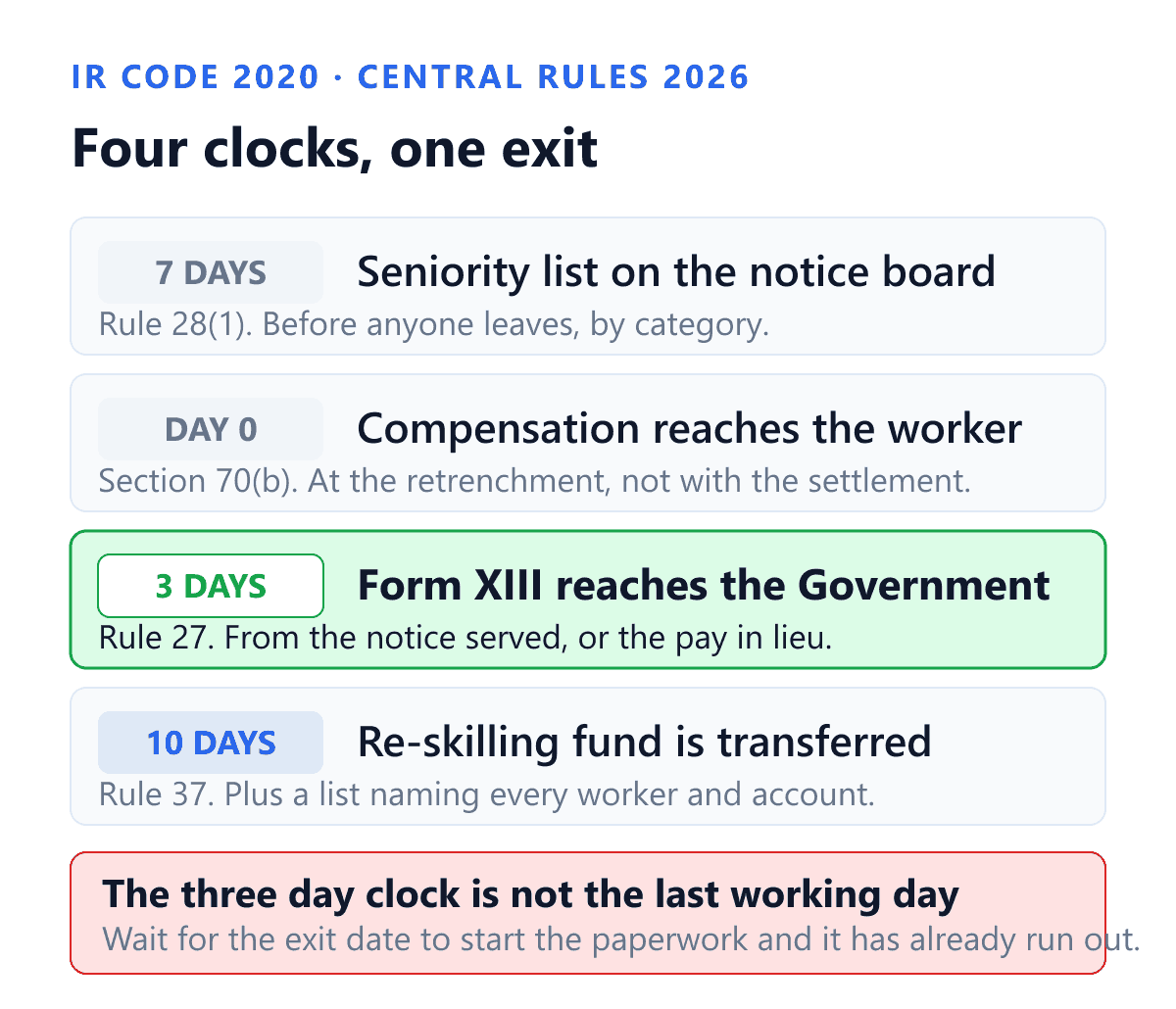
Under the Industrial Relations Code, 2020, retrenchment is a defined word, it is very wide, it has no minimum headcount, and it attaches to the single quiet exit far more often than to the mass one. The Code commenced on 21 November 2025 and the Industrial Relations (Central) Rules, 2026 followed on 8 May 2026. Between them they created two separate payments of fifteen days each, sitting on two different bases, with three separate deadlines, one of which is three days long and one of which is ten.
This article works out what a business of any size actually owes when it ends someone's service, in the order the obligations fall due.
Retrenchment is a defined word, and it is much wider than you think
Section 2(zh) of the IR Code, from the gazette text:
"retrenchment" means the termination by the employer of the service of a worker for any reason whatsoever, otherwise than as a punishment inflicted by way of disciplinary action, but does not include (i) voluntary retirement of the worker; or (ii) retirement of the worker on reaching the age of superannuation; or (iii) termination of the service of the worker as a result of the non-renewal of the contract of employment ... on its expiry or of such contract being terminated under a stipulation in that behalf contained therein; or (iv) termination of service of the worker as a result of completion of tenure of fixed term employment; or (v) termination of the service of a worker on the ground of continued ill-health.
Start from "for any reason whatsoever" and work backwards. The definition is a catch-all with five holes cut in it. If the employer ended the service, it is retrenchment unless it lands in one of the five holes or it was a punishment imposed through a disciplinary process.
That sweeps in a great deal of ordinary business. A role that is no longer needed. A restructuring. A branch that closes. A performance exit handled as a conversation rather than a charge sheet and an enquiry. A cost decision taken in a bad quarter. None of those is a punishment inflicted by way of disciplinary action, and none of them is on the list of five.
Where employers place themselves in the wrong box
Three patterns come up repeatedly, and each one is an attempt to reach a carve-out that is not really available.
The distinction between clause (iv) and an ordinary termination is worth holding on to, because fixed term employment is doing more work under the Codes than it used to. Our piece on gratuity for fixed term employees covers the other half of that bargain: a fixed term worker earns pro-rata gratuity at one year rather than five, which is the price of the clause (iv) exit being clean.
The classification, in the order the Code asks it
The one year gate is an attendance question, and the number is 240
Everything in Chapter IX hangs off "continuous service for not less than one year". Section 66 defines it, and the definition has a second life that catches people out. The main limb is uninterrupted service, including service interrupted by sickness, authorised leave, an accident, a legal strike, a lock-out, or a cessation of work not due to the worker's fault.
Then Explanation 1 does something different. Where a worker is not in continuous service for a year, they are deemed to be, if during the twelve months preceding the date of calculation they have actually worked for not less than 240 days. For work below ground in a mine the figure is 190. There is a parallel six month limb at 120 days, and 95 below ground.
A worker whose service is broken, seasonal, or interrupted by a gap you thought reset the clock is still a one year worker if the days add up to 240 in the look-back window. The deeming provision runs in the worker's favour and it runs on a count you can only settle from records.
What counts as a day actually worked
Explanation 2 to section 66 adds four categories to the days actually worked:
- Days the worker was laid off under an agreement or as permitted by the Code or any other applicable law.
- Days on leave on full wages earned in the previous years. Note the qualifier. Leave taken on full wages that was earned in a previous year counts. It is narrower than "any paid leave".
- Days absent due to temporary disablement caused by an accident arising out of and in the course of employment.
- For a female worker, days on maternity leave, capped at the period specified in the Maternity Benefit Act, 1961.
Weekly offs and public holidays are conspicuously not on that list. Neither are they excluded.
The weekly off question has no settled answer, and it moves the line by weeks
Whether a Sunday or a declared holiday counts as a day "actually worked" has been litigated repeatedly and the High Courts have gone both ways. Reported summaries of the case law show decisions holding that weekly and public holidays must be added to the days actually worked, and decisions holding they must not. No judgment was read in full for this article, so no case is named here and the honest description is that the point is unsettled.
What is not unsettled is how much it matters. Take a worker on a six day week who was physically present for 216 days in the look-back year.
The same worker, the same year, and one reading owes nothing while the other owes a full retrenchment package. An employer who cannot produce the day-level record cannot even find out which side of the line they are on.
This is the same structural problem the Codes create everywhere. Our piece on the creche rules at fifty employees works through a threshold where one payroll produced 58 under one count and 49 under another, and the standing orders piece works through a 300 that is a single day rather than an average. A number in the Codes is worthless until you know exactly what it is counting, and here the thing being counted is a year of attendance.
What an ordinary retrenchment costs: section 70
Section 70 sets three conditions precedent. Until all three are met, the worker cannot lawfully be retrenched.
| Section 70 | What it requires | The detail that gets missed |
|---|---|---|
| (a) Notice | One month's notice in writing indicating the reasons for retrenchment, expired; or wages for the notice period in lieu. | The reasons must be in the notice. A bare one line notice does not satisfy the clause. |
| (b) Compensation | Fifteen days' average pay for every completed year of continuous service, or any part thereof in excess of six months, paid at the time of retrenchment. | Paid at the time of retrenchment, not with the final settlement whenever it clears. And the part-year rounds up at six months and one day. |
| (c) Government notice | Notice served on the appropriate Government or its specified authority, in the prescribed manner. | This is a duty even for a single retrenchment at a small business. Under the Central Rules it is Form XIII, due within three days. |
The base: average pay, and the divisor the Code does not give you
Section 2(d) defines average pay as the average of the wages payable to the worker in the three complete calendar months preceding, for a monthly paid worker; four complete weeks for a weekly paid worker; twelve full working days for a daily paid worker. Where that calculation cannot be made, it is the average over the period actually worked.
Wages is a defined term at section 2(zq) and it carries the same one-half proviso that has reshaped Indian payroll since the Codes commenced: where allowances excluded from wages exceed one-half of all remuneration, the excess is added back into wages. That is the rule our piece on the new salary structure works through in full, and it applies here exactly as it applies to gratuity and PF. Retrenchment compensation itself is excluded from wages by clause (k), so it does not compound.
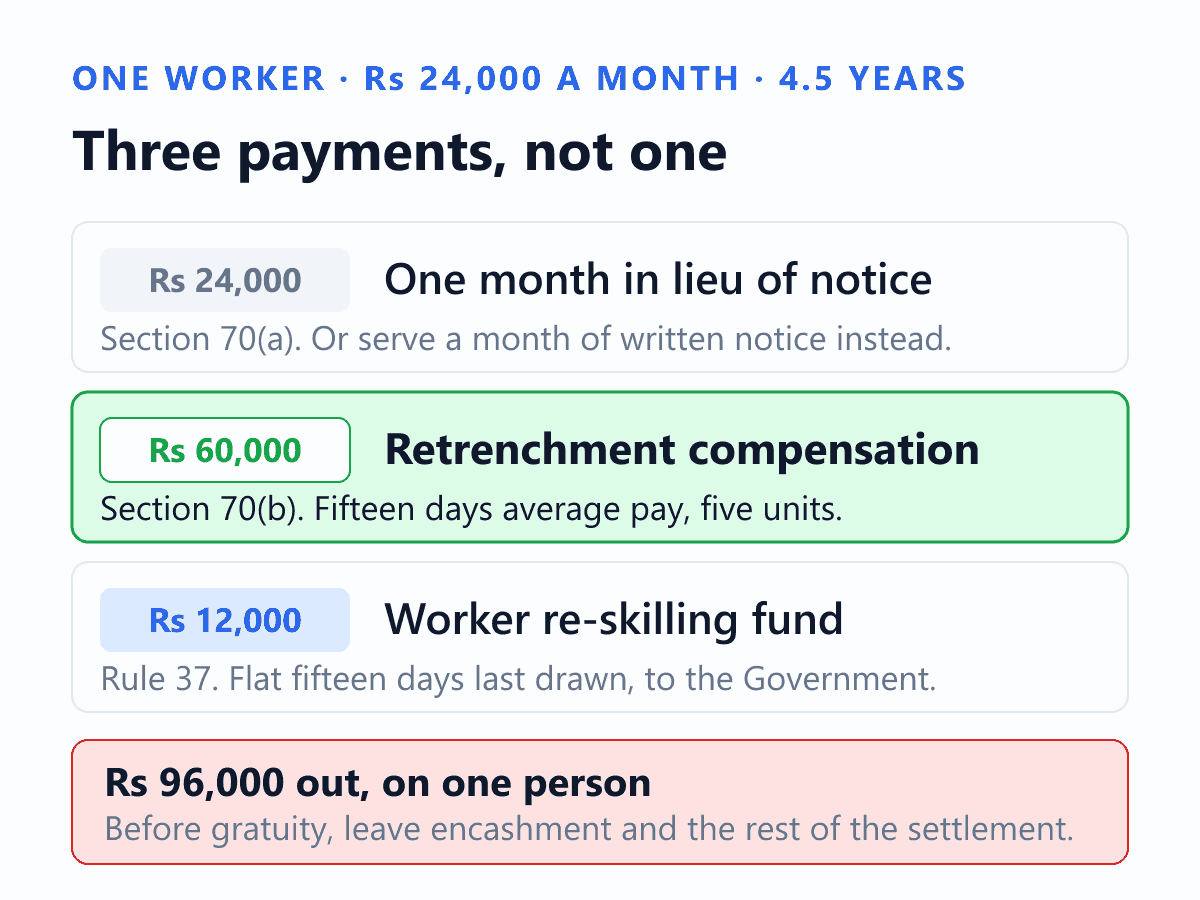
What the Code does not supply is the divisor. "Fifteen days' average pay" for a monthly paid worker whose average pay is a monthly figure has an obvious reading, half a month, and a competing practice of dividing the month by 26 and multiplying by 15. The Code settles neither. On a worker with monthly wages of Rs 24,000 and four and a half years of service, which is five units after the six month round-up:
Rs 9,231 apart on one person, and the gap widens with every year of service. This is the same divisor problem that makes two correct overtime answers differ, worked through in the overtime piece. Pick a basis, document why, and take advice before applying it across a group.
The second fifteen days: the worker re-skilling fund
This is the obligation most likely to be missed outright, because it did not exist before the Codes and it is not paid to the worker by the employer.
Section 83 sets up a worker re-skilling fund. The employer's contribution is an amount equal to fifteen days wages last drawn by the workerimmediately before the retrenchment, for every retrenched worker, in the case of retrenchment only. The fund is then used by crediting fifteen days wages to the retrenched worker's own account within forty-five days of the retrenchment.
Rule 37 of the Industrial Relations (Central) Rules, 2026 supplies the plumbing, and it is where the short deadline lives. Every employer who has retrenched a worker must, within ten days from the date of such retrenchment, electronically transfer fifteen days of last drawn wages into the account maintained by the Chief Labour Commissioner (Central) or the relevant Deputy, Regional or Assistant Labour Commissioner office, with the account details published on the Ministry of Labour and Employment and Chief Labour Commissioner websites. Sub-rule (3) requires the employer to also submit a list naming each retrenched worker, the amount, and their bank account details.
Two amounts, two bases, two clocks
| Retrenchment compensation | Re-skilling fund contribution | |
|---|---|---|
| Authority | Section 70(b) | Section 83(2)(a), rule 37 |
| Base | Fifteen days average pay, the three month average | Fifteen days wages last drawn |
| Multiplied by | Every completed year, part over six months rounding up | Nothing. One flat amount per worker |
| Paid to | The worker | A Labour Commissioner account, which then pays the worker |
| By when | At the time of retrenchment | Ten days from the retrenchment |
Coverage that reports a single "15 days' wages" obligation has merged two different payments. On the Rs 24,000 example above, the fund contribution is a further Rs 12,000 on the half-month reading, on top of the Rs 60,000 compensation and the Rs 24,000 paid in lieu of notice.
Rs 96,000 of cash out on one Rs 24,000-a-month employee, before gratuity, leave encashment and any statutory dues in the final settlement. And Rs 12,000 of it leaves within ten days, to a government account, with a worker list and bank details attached.
The rest of the exit payment sits in the final settlement, and that has its own clock. Our piece on full and final settlement works through the two working day deadline in section 17(2) of the Code on Wages, which is a great deal shorter than the forty-five days most handbooks still quote.
The three day clock: Form XIII
Section 70(c) requires notice to the appropriate Government "in such manner as may be prescribed". Rule 27 of the Central Rules prescribes Form XIII, served on the Central Government and on the concerned Deputy Chief Labour Commissioner (Central) by email or speed post, and it gives three different deadlines depending on how the retrenchment was carried out.
- Prior notice given to the worker under section 70(a): Form XIII within three days from the date the notice was served on the worker.
- No prior notice, one month's wages paid in lieu: Form XIII within three days from the date those wages were paid.
- Retrenchment under an agreement specifying a termination date: Form XIII must reach the Government at least one month before that date. If the agreed date falls within thirty days of the agreement, then within three days of the agreement.
Three days is short enough that it is missed by default rather than by decision. It runs from an event the HR team is already handling, not from the worker's last day, so a business that waits for the exit date to start paperwork has already missed it.
These are the Central Rules. They bind establishments in the central sphere. Every state government makes its own rules under the same sections and the form numbers and service methods can differ. Check the rules for the state your establishment sits in before you file anything.
The seniority list, seven days before anyone leaves
Two obligations run ahead of the retrenchment itself and are easy to breach because they happen while the decision is still confidential.
Section 71 sets last in, first out by category. Where a worker who is an Indian citizen is to be retrenched from a particular category, and there is no agreement to the contrary, the employer shall ordinarily retrench the worker who was the last person to be employed in that category, unless the employer records reasons for retrenching someone else. Deviating is permitted. Deviating without recording the reasons is not.
Rule 28(1) then requires the employer to prepare a list of all workers in the category from which retrenchment is contemplated, arranged by seniority of service in that category, and to paste a copy on a notice board in a conspicuous place in the premises at least seven days before the actual date of retrenchment.
A seniority list by category, correct to the day, posted publicly a week in advance. That is a hiring-date and continuous-service record for every worker in the category, not just the one leaving, and it goes up where everyone can check it against what they know.
Section 72 and rule 28(2) to (4) then carry the duty forward for a year. If a vacancy arises within one year of a retrenchment, retrenched workers who are Indian citizens and have expressed willingness get preference by seniority. Rule 28(3) requires the vacancy details to be displayed on the notice board at least fifteen days before the vacancy is filled and sent by speed post or email to every eligible retrenched worker at the address they last gave. Where the vacancies are fewer than the retrenched workers, informing the senior-most workers numbering double the vacancies is enough. Vacancies lasting under a month are exempt.
Chapter X and the 300 workers: probably not you
This is the part of the law that gets written about, and it is the part that applies to the fewest readers.
Section 77(1) applies Chapter X to an industrial establishment, not seasonal and not one where work is performed only intermittently, in which not less than three hundred workers were employed on an average per working day in the preceding twelve months. Section 77(3) then defines industrial establishment for the chapter exhaustively:
(i) a factory as defined in clause (m) of section 2 of the Factories Act, 1948; (ii) a mine as defined in clause (j) of sub-section (1) of section 2 of the Mines Act, 1952; or (iii) a plantation as defined in clause (f) of section 2 of the Plantations Labour Act, 1951.
A factory, a mine, or a plantation. That is the whole list. An IT services company with 900 people, a hospital group, a retail chain, a logistics operator, a BPO or a facility management firm is outside Chapter X no matter how large it becomes, because none of them is a factory within the meaning of the Factories Act. Summaries that say "establishments with 300 or more workers need prior government permission" and stop there send exactly the wrong readers looking for a permission process that does not apply to them.
The same 300, counted two different ways in one Code
Worth noticing, because it is a genuine drafting difference and not a typo. Section 28(1), which decides whether the standing orders chapter applies, counts workers "employed on any day of the preceding twelve months". Section 77(1), which decides whether the permission regime applies, counts workers employed "on an average per working day in the preceding twelve months".
One establishment, one number, two chapters, opposite answers. Both counts need twelve months of day-level headcount history to settle, which is the point the standing orders piece ends on.
What Chapter X adds where it does apply
- Section 79: three months' notice in writing with reasons, or wages in lieu, and prior permission of the appropriate Government. Rule 33 makes the application Form XIV, filed electronically, copied to the concerned workers and displayed at the main entrance.
- Deemed permission at sixty days. If the Government does not communicate an order within sixty days of the application, permission is deemed granted. An order once made stands for one year.
- Compensation on permission: section 79(9) gives fifteen days average pay per completed year, part over six months rounding up, the same measure as section 70(b).
- Section 78: lay-off also needs prior permission, except for shortage of power, natural calamity, and in a mine fire, flood, excess inflammable gas or explosion.
- Section 80: closure needs permission applied for at least ninety days ahead. Under Chapter IX, section 74 requires sixty days' notice of intended closure, and does not apply where fewer than fifty workers were employed on any day in the preceding twelve months, or to construction projects.
- Illegality is the sanction. Retrench without applying, or after refusal, and section 79(7) deems the retrenchment illegal from the date the notice was given, with the worker entitled to all benefits as if no notice had been given.
Lay-off is a different thing, and its evidence is the daily record
Lay-off is not a soft word for retrenchment. Section 2(t) defines it as the failure, refusal or inability of an employer, on account of shortage of coal, power or raw materials, accumulation of stocks, breakdown of machinery, natural calamity or any other connected reason, to give employment to a worker whose name is on the muster rolls and who has not been retrenched. The employment relationship survives. The work does not.
Unlike section 70, the lay-off compensation provisions do have a size floor. Section 65 says sections 67 to 69 do not apply to establishments to which Chapter X applies, nor to establishments with fewer than fifty workers on average per working day in the preceding calendar month, nor to seasonal or intermittent ones. And the Explanation to section 65 restricts "industrial establishment" for those sections to a factory, mine or plantation. So statutory lay-off compensation under Chapter IX is a factory, mine and plantation obligation at fifty or more, while retrenchment under section 70 has no such limit.
Where it does apply, section 67 sets compensation at fifty per cent of the total of basic wages and dearness allowance that would have been payable, for all days laid off, excluding intervening weekly holidays. Beyond forty-five days in any twelve months, compensation stops only if there is an agreement to that effect between worker and employer. After those forty-five days the employer may retrench under section 70, and lay-off compensation paid in the preceding twelve months may be set off against the retrenchment compensation.
Two hours, one entry, half a day
The Explanation to section 2(t) is where lay-off becomes an attendance problem measured in minutes:
A worker on the muster rolls who presents himself at the appointed time during normal working hours on any day and is not given employment within two hours is deemed to have been laid off for that day. If instead of being given work at the start of a shift he is asked to present himself in the second half and is given work then, he is deemed laid off for one-half of that day.
Section 69 runs the other way and withholds compensation from a worker who refuses suitable alternative work at the same wages within eight kilometres, or who does not present himself for work at the establishment at the appointed time at least once a day, or where the lay-off is caused by a strike or go-slow elsewhere in the establishment.
Put those together and the liability for a single laid-off day turns on whether a specific person stood at a specific place at a specific time, and on whether work was offered within two hours. Which is why sections 68 and 81 impose a standalone duty, in identical words, on every employer whose workers have been laid off: maintain a muster roll for the purposes of the chapter, and provide for the making of entries in it by workers who present themselves for work at the appointed time during normal working hours.
The Code requires an attendance record for people who are not working.A payroll system that records who was paid cannot produce it, because a laid-off worker who presented himself and was sent home is owed half or all of a day's compensation and appears nowhere in a payroll run.
What this costs when it goes wrong
Section 86 sets the penalties, and the two tiers are far apart.
| Contravention | First offence | Repeat |
|---|---|---|
| Sections 67, 70, 73, 75 (lay-off compensation, retrenchment conditions, transfer, closure compensation) under section 86(3) | Fine not less than Rs 50,000, up to Rs 2,00,000 | Rs 1,00,000 to Rs 5,00,000, or imprisonment up to six months, or both |
| Sections 78, 79, 80 (Chapter X permission for lay-off, retrenchment, closure) under section 86(1) | Fine not less than Rs 1,00,000, up to Rs 10,00,000 | Rs 5,00,000 to Rs 20,00,000, or imprisonment up to six months, or both |
Section 76 adds the rule that decides most arguments about which document governs. Chapter IX has effect notwithstanding anything inconsistent in any other law, including standing orders, but where any other Act, rule, order, standing order, award or contract gives the worker more favourable benefits on a matter, the worker keeps the more favourable benefit on that matter even while receiving Chapter IX benefits on others. A contract cannot go below the Code. It can go above it, and then it binds.
Where the records have to be, before you need them
Read as a sequence rather than a list of sections, Chapter IX asks an employer for six things and five of them are attendance and employment history:
- Days actually worked in the preceding twelve months, per person. Section 66 and the 240 day test. Needed to know whether anything at all is owed, and needed on both counts while the weekly off question is unsettled.
- Continuous service in completed years with the part-year visible. Section 70(b), where six months and one day rounds up to a full unit.
- Seniority within a category, by date of employment. Section 71 and rule 28(1), posted publicly seven days before the retrenchment.
- Last drawn wages and the three month average. Two different figures for two different payments, both computed on the section 2(zq) wage base with the one-half add-back.
- A muster roll that records people who presented themselves and were not given work. Sections 68 and 81, and the two hour rule in the Explanation to section 2(t).
- And one that is not a record at all: the reason, written into the notice under section 70(a), and written down under section 71 whenever you depart from last in, first out.
None of that is exotic. All of it is a check-in and a check-out per person per day, kept for at least twelve months and readable as a report rather than reconstructed from a WhatsApp group at the moment somebody is leaving. That is what Shiftelio holds: attendance per person per day with the joining date and the employment record attached, so a 240 day count, a seniority list by category and a three month wage average are queries rather than an archaeology project. Businesses arrive at that need from the other direction, usually after the attendance group stops being usable, and then find the compliance answer was in the same data all along.
The order matters though, and it is worth being blunt about it. This is a records problem first. An employer who keeps a reliable daily attendance trail on paper is in a far better position under Chapter IX than one who keeps an unreliable one in software. What the software changes is whether the twelve month look-back is a report or a fortnight of reconstruction, and whether the seven day seniority list can be produced in time to be accurate.
The short version
- Retrenchment means almost any employer-initiated exit that is not a disciplinary punishment and not one of five carve-outs. It is not a factory word.
- Section 70 has no minimum headcount. A twelve person business retrenching one person with a year of service owes notice, compensation and a government notice.
- The one year gate is a 240 day count from attendance records, and whether weekly offs count is genuinely unsettled.
- There are two fifteen day amounts: compensation at fifteen days average pay per year to the worker, and a flat fifteen days last drawn wages to a government account within ten days.
- Form XIII is due within three days of the notice or of the payment in lieu, under the Central Rules.
- The seniority list goes on the notice board seven days before anyone leaves.
- The 300 worker permission regime is factories, mines and plantations only. Most large service businesses are outside it entirely.
- Penalties start at Rs 50,000 for Chapter IX and Rs 1,00,000 for Chapter X, and repeat offences carry imprisonment.
This article states the law as at 5 September 2026 and quotes the Central Rules. It is not legal advice, state rules differ, and the classification of any particular exit turns on its own facts. Take advice before acting on a group of exits.
Sources
- The Industrial Relations Code, 2020, gazette text. PRS Legislative Research. Sections 2(d), 2(r), 2(t), 2(zh), 2(zq), 65 to 83 and 86 were read from this file.
- The Industrial Relations (Central) Rules, 2026, notified 8 May 2026. PRS Legislative Research. Rules 27, 28, 33 and 37 were read from the gazette PDF linked there.
- Ministry of Labour and Employment, FAQ on myths and realities of the Industrial Relations Code. labour.gov.in.
Keep reading
See how Shiftelio does this in practice with a check-in per person per day, kept long enough that a twelve month look-back is a report rather than an archaeology project.
Work your own numbers with the free full and final settlement calculator. No signup, no email.