VISHWAS 2026: The 28 December Window to Settle Old PF Damages at a Fraction of the Rate
In short
EPFO reprices pre-2024 PF damages at 0.25 to 1% a month. The slabs, the interest that is not waived, the 15 day clock, and the cost worked through.
If you have an old provident fund damages order sitting in a file, or an appeal that has been grinding through a tribunal for three years, or a notice you never answered because the number on it looked impossible, there is a window open until 28 December 2026 that reprices it.
It is called VISHWAS, 2026. Almost everything written about it calls it an amnesty. It is not an amnesty, nothing is forgiven, and an employer who applies expecting a waiver will be rejected at the first step. What it actually does is narrower, more mechanical and, for a business that has been carrying a long default, worth considerably more than the coverage suggests.
What VISHWAS 2026 actually is
VISHWAS stands for Voluntary Initiative for Settlement of Historical and Welfare-Related Assessment and Settlement. It took effect on 29 June 2026 and runs for six months, which closes it on 28 December 2026. The operational circular followed on 9 July 2026.
It settles one thing only: damages levied under section 14B of the Employees’ Provident Funds and Miscellaneous Provisions Act, 1952, and the corresponding section 128 of the Code on Social Security, 2020. Damages are the penalty charged for paying contributions late. They are not the contributions themselves and they are not the interest on them.
Three things VISHWAS does not do. It does not waive the arrears of contribution. It does not waive or reduce interest under section 7Q. And it does not reopen anything already recovered in full. If the department has already collected the damages, the case is outside the scheme entirely.
Three EPFO schemes in 2026, and only one of them is yours
EPFO launched three initiatives alongside the new EPF Scheme, 2026, which replaced the 1952 Scheme with effect from 1 July 2026. Coverage routinely blends them into a single "PF amnesty", which is how employers end up reading about a deadline that is not theirs. They solve three unrelated problems.
| Scheme | The employer it is for | Window |
|---|---|---|
| EEC 2026 Employees’ Enrolment Campaign | You have staff who were never enrolled in PF at all and are still employed. Damages fall to a notional Rs 100. | Until 31 October 2026 |
| VISHWAS 2026 | Your people were enrolled, but contributions went in late, and damages have been assessed, disputed or noticed. | Until 28 December 2026 |
| AMNESTY 2026 | You run your own exempted provident fund trust and need its exemption regularised retrospectively. | Until 28 December 2026 |
For most small and mid-sized employers the live question is the first two, and they are not mutually exclusive. If some workers were never enrolled and other contributions went in late, those are two separate applications under two separate schemes with two separate deadlines, and the earlier one is the enrolment campaign. Our piece on the Employees’ Enrolment Campaign and its 31 October window works that side through, including the waived employee share.
Why the 14 June 2024 cut-off exists
VISHWAS applies only to defaults from periods before 14 June 2024. That looks arbitrary until you know what happened the following day.
Until then, Paragraph 32A of the EPF Scheme priced damages on a four band table that got steeper the longer the default ran. Every rate on it was expressed per annum:
Less than two months: 5% per annum. Two months and above but less than four: 10% per annum. Four months and above but less than six: 15% per annum. Six months and above: 25% per annum.
With effect from 15 June 2024, the Ministry of Labour and Employment replaced all four bands with a single rate: 1% of the arrears per month, or part of a month, regardless of how long the default ran. The same change was made to the pension and insurance schemes on the same day.
So VISHWAS is not a special dispensation invented for 2026. It is the June 2024 reform applied backwards, to periods that the reform itself could not reach, with an extra discount bolted on at the short end. Its deepest slab is 1% a month, which is precisely the rate an employer defaulting today already pays.
The conversion nobody prints
Here is the part that every summary of this scheme leaves out, and it is a single arithmetic step. The old table is quoted per year. The new rate and the VISHWAS rates are quoted per month. Until you put them in the same unit they cannot be compared at all, and once you do, the story inverts.
| Length of default | Old rate | Old rate, per month | Rate today | Under VISHWAS |
|---|---|---|---|---|
| Under 2 months | 5% a year | 0.417% | 1.000% | 0.25% |
| 2 to under 4 months | 10% a year | 0.833% | 1.000% | 0.50% |
| 4 to under 6 months | 15% a year | 1.250% | 1.000% | 1.00% |
| 6 months and over | 25% a year | 2.083% | 1.000% | 1.00% |
Read the third and fourth columns against each other. For a default of under four months, the old rate was cheaper than the flat 1% that replaced it. The June 2024 reform, presented everywhere as relief, more than doubled the price of a one month delay and raised the price of a three month one. It only becomes relief at four months, and it becomes dramatic relief at six.
That is exactly why the VISHWAS table has two slabs below 1%. For short defaults, the current rate is worse than the old one, so simply back-applying it would have handed those employers a bill increase. The 0.25% and 0.50% slabs undercut both tables. For defaults of four months or more, VISHWAS gives you the current rate and nothing further.
The practical consequence: if your exposure is a handful of months each a few weeks late, VISHWAS is the only place relief exists for you at all. If it is one long default that ran most of a year, VISHWAS roughly halves it.
What one late month actually costs
Take a business with about twenty five people and total PF arrears of Rs 4,00,000 for a single wage month sometime in 2022. Damages accrue on the arrears for the period the money was outstanding.
Remitted one month late, the old table charges 5% a year for one twelfth of a year, which is Rs 1,667. VISHWAS charges 0.25% for one month, which is Rs 1,000. Remitted three months late, the old table charges 10% a year for a quarter of a year, Rs 10,000, against 0.50% a month for three months, Rs 6,000. Remitted eight months late, the old table charges 25% a year for two thirds of a year, Rs 66,667, against 1% a month for eight months, Rs 32,000.
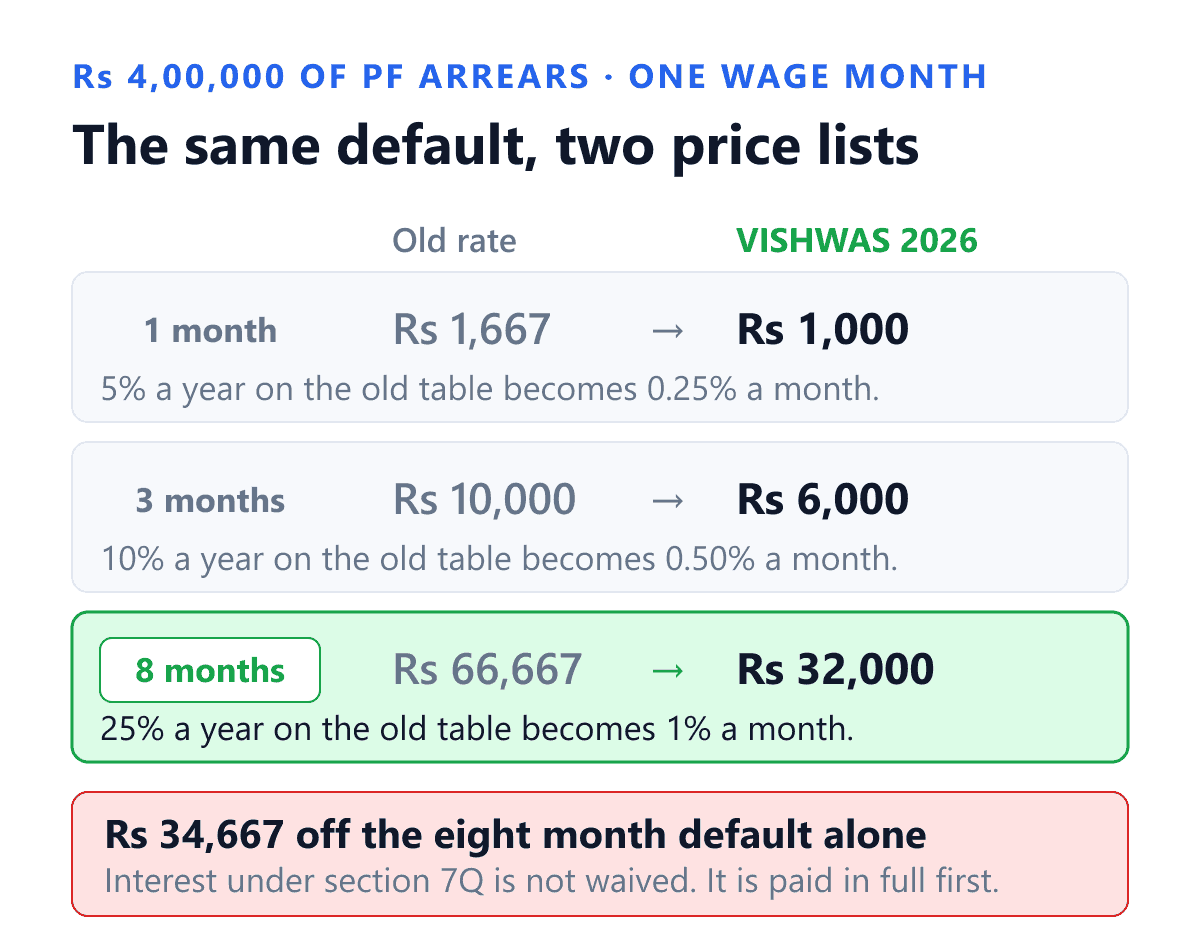
Rs 34,667 on one month, for one mid-sized default. An employer carrying six such months is looking at a six figure difference, and that is before the appeal costs stop accruing.
One ceiling is worth knowing because it is statutory rather than administrative. Section 14B permits damages "not exceeding the amount of arrears". Whatever the rate table produces, the damages cannot exceed the contribution that was late. On a very old default the cap, not the rate, may be what is actually binding.
Who can apply
The scheme reaches four situations, and the useful thing about the list is how early it starts. You do not need an order against you. You do not even need a notice.
That fourth category is the one worth pausing on. An employer who knows about an old delay and has been waiting to see whether the department notices can fix it now at a known number, instead of waiting for an assessment computed at 25% a year.
What disqualifies an application
- Damages already recovered in full. There is nothing left to settle, and no refund is available if what you have already paid exceeds the revised figure.
- Fraud, misappropriation or falsification of records. Excluded outright. This is a scheme for lateness, not for dishonesty.
- Unpaid interest. If the section 7Q interest for the default period is not fully paid, the application does not qualify. This is the one that catches people, so it gets its own section below.
How to apply, and the order that matters
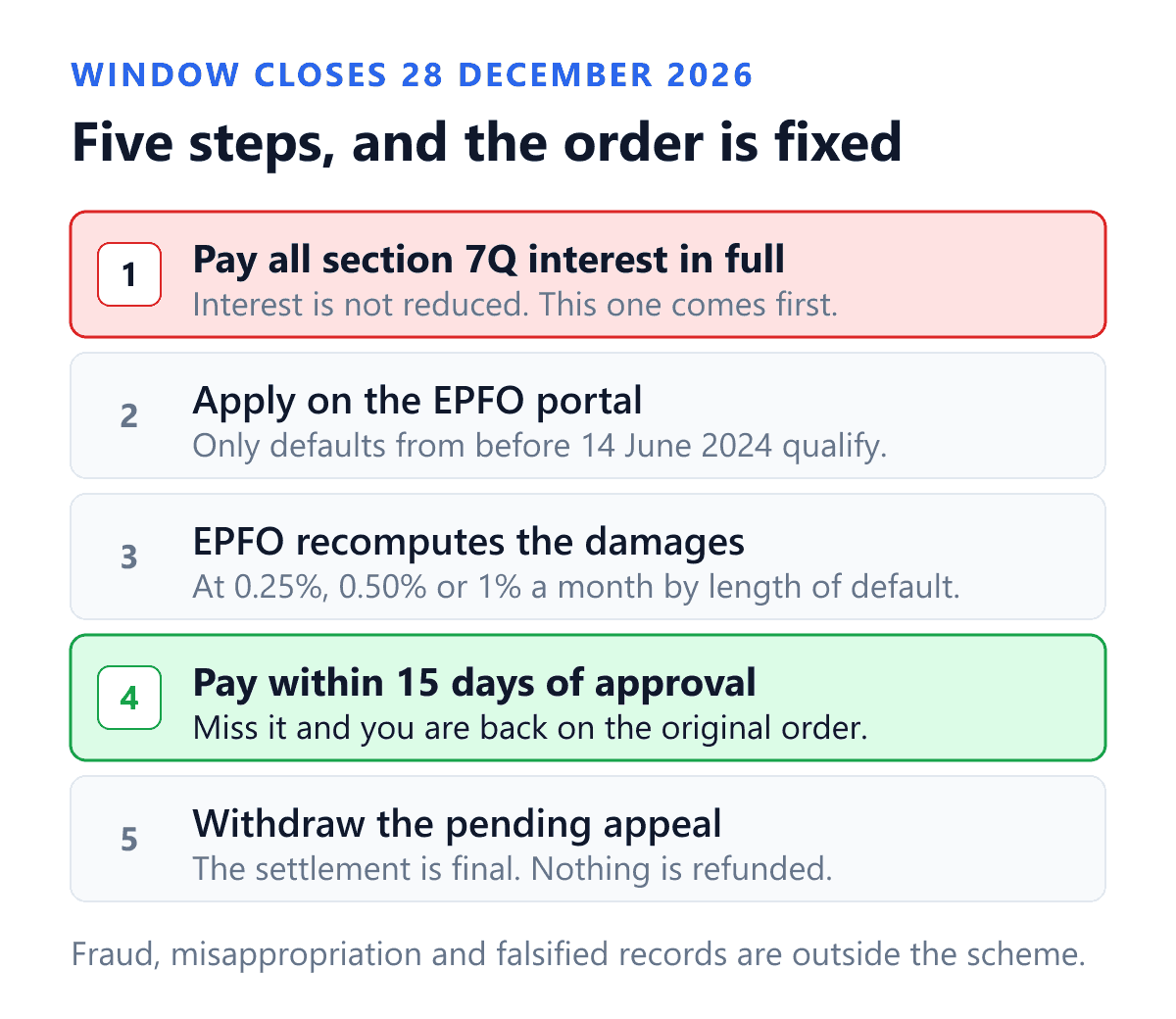
The sequence is not negotiable, and it starts with a payment rather than a form.
- Clear section 7Q interest in full, first. Interest under section 7Q of the 1952 Act, or section 127 of the Code on Social Security where that applies, is compensation for the department being out of its money. VISHWAS does not touch it. It has to be paid before the application, not alongside it.
- Apply through the EPFO portal within the window, identifying the periods and the orders or notices concerned.
- EPFO recomputes the damages at the concessional slab for each default, crediting anything already recovered or deposited.
- Pay the revised amount within 15 days of approval. This is a short clock and it is the one that undoes an otherwise complete application.
- Withdraw the appeal, and undertake not to pursue it. The settlement is final. Where you have already paid more than the revised figure, the excess is not returned; where you have paid less, the difference is due.
The asymmetry in that last point is deliberate and it should shape the decision. Settling caps your downside at the revised number but forfeits any prospect of the appeal succeeding outright, and it will not claw back an over-recovery. If your appeal is strong on the merits, that is a real trade rather than a free one.
The part VISHWAS does not fix
Damages under section 14B are charged for delay. Not for underpaying, not for getting the wage definition wrong, not for missing an enrolment. Purely for the money arriving after the due date, which for the electronic challan cum return is the 15th of the month following the wage month.
In a small business the reason that date gets missed is almost never the cash. It is that the month is not closed. Somebody is still working out who was absent on the 22nd, whether the site team’s half day counted, and which two people were on unpaid leave. Until the loss of pay days are settled you cannot compute PF wages, and until you can compute PF wages the challan cannot be filed. The money was available on the 12th. The attendance was not.
That is a records problem, and it is worth being blunt that it is a records problem before it is a software problem. An employer with a reliable paper register that closes on the 1st is in better shape than one with unreliable data in an app. What software changes is whether closing the month is a report or a week of chasing people: Shiftelio holds attendance per person per day with leave and loss of pay attached, so the PF wage figure for a month is a query rather than a reconstruction. Businesses usually arrive at it from the other direction, after the attendance group stops being usable, and then find the compliance answer was in the same data. If you want to sanity check what the contributions themselves should have been, the PF and ESI calculator works a month through, and the PF and ESI compliance checklist covers the due dates in full.
VISHWAS is a one-time clean-up of a past that is now priced. The 15th arrives twelve more times a year, and every one of those is charged at 1% a month with no scheme behind it.
Frequently asked questions
Is VISHWAS 2026 an amnesty?
No. The contributions remain payable in full and the section 7Q interest remains payable in full. Only the section 14B damages are recomputed, at 0.25%, 0.50% or 1% a month depending on how long the default ran.
What is the VISHWAS 2026 deadline?
The scheme took effect on 29 June 2026 and runs for six months, closing on 28 December 2026. Because the notification is worded as a period from a date rather than as a fixed calendar deadline, an application left to the last fortnight is an unnecessary risk, particularly given that the 7Q interest has to be paid and reconciled before it is filed.
Does VISHWAS cover defaults after June 2024?
No, and there would be no point. Defaults from 15 June 2024 onwards are already charged at 1% a month, which is the deepest VISHWAS slab. There is no concession left to give.
Can I apply if no notice has been issued to me?
Yes. One of the four eligible categories is expressly a pre-adjudication case where no damages notice has yet issued, which lets an employer regularise a known old delay voluntarily.
What happens if I miss the 15 day payment window after approval?
The concession is contingent on paying the revised amount within that period. Missing it puts you back on the original assessment, which for a long default is roughly double.
How is VISHWAS different from the Employees’ Enrolment Campaign?
Different problem, different deadline. The enrolment campaign is for workers who were never put on PF at all and closes on 31 October 2026. VISHWAS is for contributions that were made but made late, and closes on 28 December 2026. An employer can need both.
The short version
- VISHWAS 2026 reprices section 14B damages only, for defaults from before 14 June 2024. It is not an amnesty.
- The slabs are 0.25%, 0.50% and 1% a month, by length of default.
- The old table was 5%, 10%, 15% and 25% per annum. Converted to months that is 0.417%, 0.833%, 1.25% and 2.083%.
- The 15 June 2024 flat rate of 1% a month made short defaults more expensive and long ones much cheaper. VISHWAS is the only relief available for the short ones.
- Section 7Q interest is not waived and must be paid in full before applying. This is the most common reason an application fails.
- You can apply even if no notice has been issued to you.
- Pay the revised damages within 15 days of approval, withdraw the appeal, and expect no refund of anything over-recovered.
- Fraud, misappropriation and falsified records are excluded. So are cases already recovered in full.
- The window closes 28 December 2026.
This article states the position as at 5 September 2026. EPFO’s own circulars could not be retrieved directly while writing it, so every figure here is drawn from the professional summaries listed below, which agree with one another. Verify the slab applicable to your own periods against the circular or with your PF consultant before applying. This is not legal advice.
Sources
- KPMG, India: EPFO Releases Operational Aspects of Vishwas and Amnesty Provisions, flash alert 2026-199. kpmg.com. The damages slabs, the 29 June 2026 effective date, the 7Q pre-condition and the circular references were taken from this note.
- The Employees’ Provident Funds and Miscellaneous Provisions Act, 1952, sections 7Q and 14B. India Code. Section 14B is the source of the ceiling of "the amount of arrears".
- Employees’ Provident Fund Organisation, for the portal and the circulars themselves. epfindia.gov.in.
- SCC Online Blog, EPFO launches VISHWAS 2026 damages settlement scheme, 15 July 2026, and SGCMS and Nexdigm on the same circular, used to cross-check the slabs and the four eligibility categories.
- Khaitan & Co and Fox Mandal on the Employees’ Provident Funds (Amendment) Scheme, 2024, for the pre-amendment Paragraph 32A table and the 15 June 2024 change to a flat 1% a month.
Keep reading
See how Shiftelio does this in practice with attendance that closes the month in time to file the challan by the 15th.
Work your own numbers with the free PF and ESI calculator. No signup, no email.