Staff Expenses Policy: Why No Manager Should Approve Their Own Claim
In short
No manager should approve their own expense claim. Put that one line in your staff expenses policy and have the owner sign off the manager's claims.
- The rule is simple: whoever spends the money never signs it off. Accountants call it segregation of duties.
- A manager can approve the team's expense claims, but their own claims go to the owner.
- gov.uk says HMRC may ask for evidence of how you accounted for each expense, so a clear approval trail helps.
No manager should approve their own expense claim. Write that one line into your staff expenses policy, let the manager approve everybody else's receipts, and keep the manager's own claims for the owner to sign off.
It sounds like a rule for big companies with a finance team. It is not. In a café, a shop or a cleaning firm the person who buys the milk, the bin bags and the fuel is usually the same person you trust to approve everyone else's receipts. That is exactly the gap. This guide explains why the rule matters in a small team, how to write it down, and how Shiftelio applies it for you so nobody has to remember it.
Why a small business needs this rule more, not less
In a company of 500 people, expenses go through a finance team. In a café with eight staff, they go through whoever is on shift with the card. That person is usually your assistant manager, and you have given them the power to approve receipts because you cannot be there every day.
Nobody is accusing your manager of anything. The rule protects them as much as you:
- It removes the awkward question. If a claim looks high, nobody has to wonder whether it was approved because the approver wanted the money back.
- It catches honest mistakes. A receipt claimed twice, or a personal sandwich on the same receipt as the team's milk, is easy to miss when you check your own paperwork.
- It keeps the record clean. Every claim has two names on it: the person who spent and the person who approved. That is what an accountant, or HMRC, expects to see.
Accountants call this segregation of duties, or separation of duties: the person who spends the money and the person who signs it off are never the same. In a big firm it is a whole policy. In a small one it comes down to this single line.
What to write in your staff expenses policy
A staff expenses policy for a small business does not need to be long. One page is plenty. Make sure it answers these five questions.
List the usual things: supplies bought for work, fuel or parking on a work trip, cleaning products for a client site. Say what is not claimable, such as meals on a normal shift.
A photo of the receipt for every claim. No receipt, no claim, except where you agree otherwise in advance.
Name the role. "The shift manager or the owner approves staff claims."
This is the line most small policies forget. "Nobody approves their own claim. A manager's claims are approved by the owner."
Say whether claims are paid straight away by bank transfer or added to the next pay run, so nobody chases you for £12.
A worked example: Tom's milk run
Here is how it plays out in a small café that runs on Shiftelio. Tom is the assistant manager. Most mornings he opens up, and twice a week he picks up supplies on the way in.
- Tuesday, 7.40am: Tom buys milk and takeaway cups for £23.40. In the Shiftelio app on his phone he opens My Expenses, taps Add Expense and photographs the receipt. The amount and the shop are read off the photo, and he checks them before sending.
- Tuesday, 9.15am: a barista, Priya, claims £8.60 for parking when she collected a cake order. Tom has the role tick to approve bills, so he opens Money, sees Priya's claim under Waiting, and taps Approve £8.60.
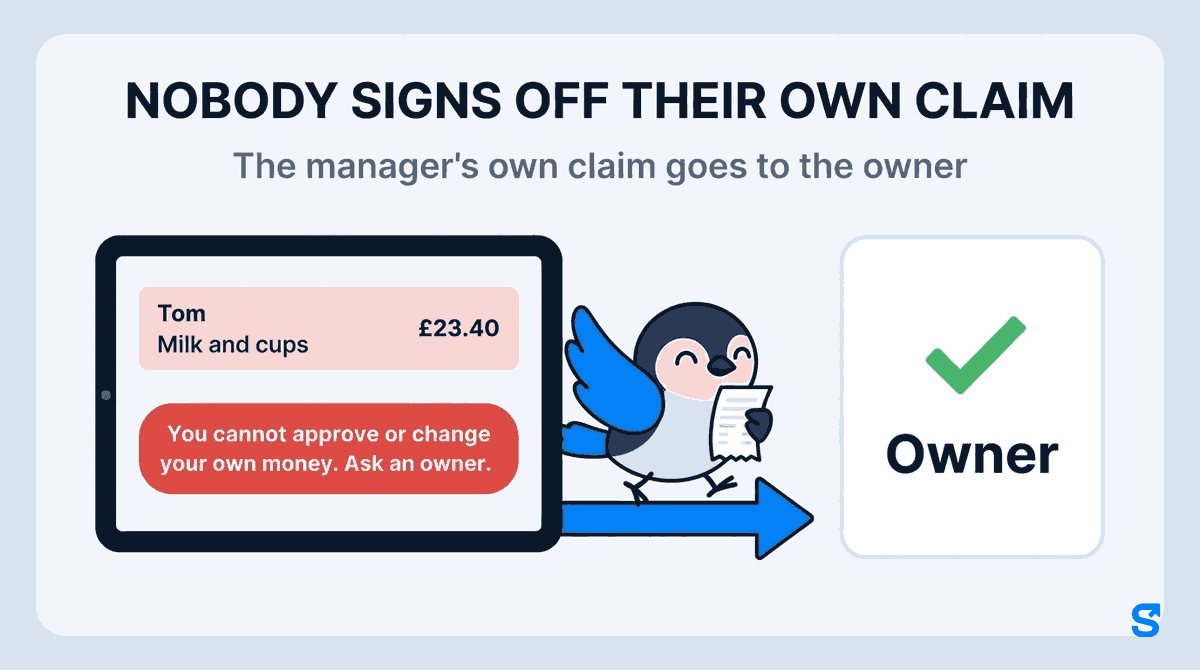
- Tuesday, 9.16am: Tom's own £23.40 claim is in the same list. If he taps approve on it, Shiftelio refuses and shows: You cannot approve or change your own money. Ask an owner. The same goes for sending it back with Ask to fix or turning it down with Say no.
- Tuesday evening: the owner opens Money, sees Tom's claim waiting with the photo of the receipt, and approves it.
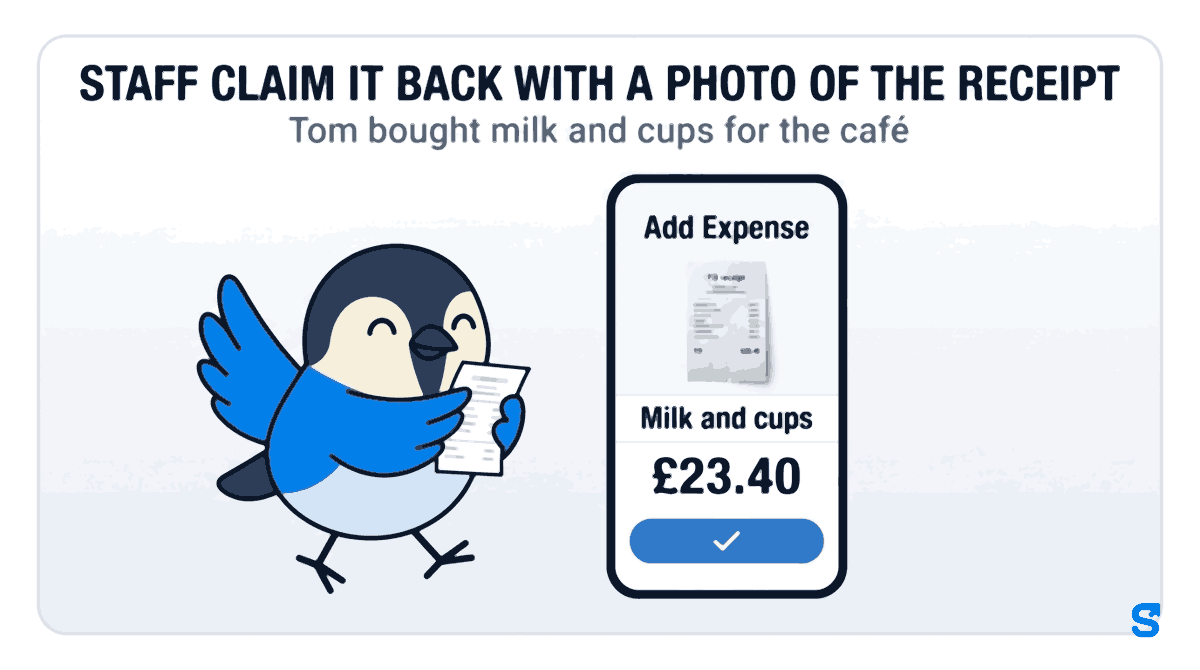
Nobody had to remember the rule. Tom approved Priya's claim in two taps, and his own claim waited for the owner without anybody needing to spot it.
Setting it up in Shiftelio
You do not switch this rule on. It is always there for every business. What you choose is who can approve claims at all.
- Give the right people the approval tick. In the roles screen, the expense permission called Approve bills and give work cash lets a manager approve or turn down staff bills. Give it only to the people who should have it.
- Leave the manager's own claims to you. Anyone with that tick can approve other people's bills, never their own. If they try, the app tells them to ask an owner.
- Owners can approve their own. If you, or a co-owner, also buy supplies and claim them back, you can approve your own claims. It is your money in the end, and many small owners also sit on the payroll.
- Pay it back the way you prefer. An approved claim can be marked paid once you have transferred it, or queued onto the next pay run, where it is added to the person's pay as Reimbursement Due.
The same rule covers more than receipts. A manager also cannot hand themselves work cash, approve their own request for money up front, or change their own salary advance. Anything that would put money in their own pocket waits for an owner.
What gov.uk says about keeping expense records
Law is not the point of this article, and we are not lawyers. These are the lines from the official HMRC guidance that matter for a staff expenses policy.
The gov.uk guide Expenses and benefits for employers: keeping records (checked on 7 October 2026) says HMRC "may ask for evidence of how you accounted for each expense or benefit at the end of the tax year", and that records are kept "for 3 years from the end of the tax year they relate to".
The same guide's page on exemptions (checked on 7 October 2026) lists business travel, phone bills, business entertainment expenses, and uniform and tools for work among the business expenses an employer does not have to report, where the employer is paying back the employee's actual costs or paying an approved flat rate. Other expenses and benefits are reported to HMRC as normal.
This is general information, not legal advice: check with the agency or an employment lawyer for your case.
A photo of the receipt, the name of the person who claimed and the name of the person who approved is the kind of record that answers those questions without a search through a drawer of crumpled paper.
Which app stops a manager approving their own expenses?
You can see what else the owner's app covers on the features page, or start from Shiftelio for UK businesses.
Questions owners ask
Should a manager approve their own expenses?
No. The person who spent the money should never be the one who signs it off. In a small business the owner usually approves the manager's claims.
What is segregation of duties in a small business?
It means splitting a money task between two people, so the one who spends is never the one who approves. For expenses, it comes down to one line in your policy.
What should a staff expenses policy include?
What staff can claim, what proof is needed, who approves claims, who approves the approver's own claims, and how and when the money is paid back.
Can the owner approve their own expense claims in Shiftelio?
Yes. Owners and co-owners can approve their own claims, because it is their money. The rule stops managers, not owners.
What happens if a manager tries to approve their own claim in Shiftelio?
The app refuses and shows: You cannot approve or change your own money. Ask an owner. The claim stays waiting until an owner decides.
How long should I keep expense receipts?
The gov.uk keeping records guidance says records are kept for 3 years from the end of the tax year they relate to. Keeping the receipt photo with each claim makes that easy.