The Signature Sheet Is Not a Training Record
In short
A signed sheet proves attendance, not learning. How to run staff training on a phone, assess whether it landed, and keep a record that survives an inspection.
- A signature proves attendance. Clause 24.3 of FSS Schedule 4 asks for an assessment of effectiveness, which is a different thing.
- FoSTaC covers your Food Safety Supervisor. Training the other food handlers, and evidencing it, is still yours.
- The same gap exists under POSH section 19(c) and in any trade that briefs staff by WhatsApp.
Every restaurant owner in India has the same folder. Inside it is a sheet of paper with a date at the top, a topic written in biro, and eleven signatures down the right-hand side. Some of the signatures are thumbprints. The sheet is the whole of the training record, and it has been there since the trainer came in February.
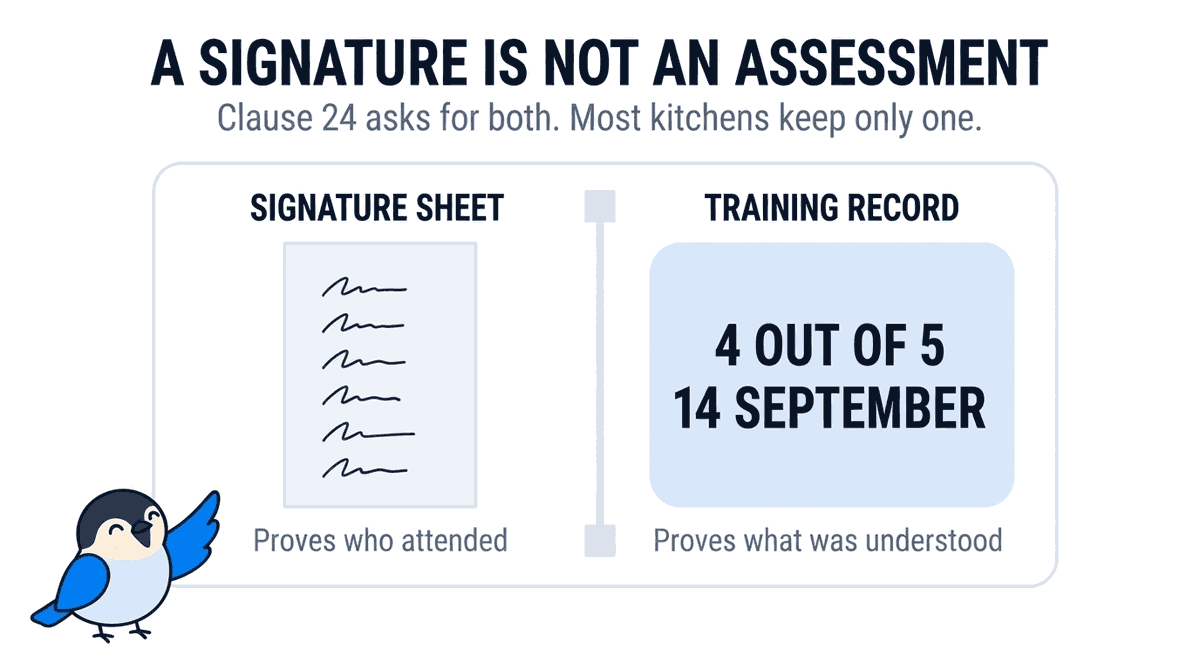
It proves that eleven people were in a room. It does not prove that any of them learned anything, and increasingly that is the thing being asked for.
What the rule actually asks for
Schedule 4 of the Food Safety and Standards Act is the part that governs hygienic and sanitary practice, and its clause 24 is about training. Two sub-clauses in it are the ones that catch people out.
24.3 Periodic assessments of the effectiveness of training as well as routine supervision and checks to ensure that food hygiene and food safety procedures are being carried out effectively. [...] 24.4 Training programmes shall be routinely reviewed and updated wherever necessary. Records of training shall be kept.
FSS (Licensing and Registration of Food Business) Regulations, Schedule 4, clause 24
Read 24.3 again. It does not say run a training session. It says assess the effectiveness of the training. That is a test, whatever else you call it, and a signature is not one.
There is a second confusion worth clearing up, because it costs restaurants money every year. FoSTaC, the FSSAI training and certification programme, covers the Food Safety Supervisor. It is an external course, run by FSSAI-approved training partners, ending in a certificate valid for two years. Clause 2.1.20 of the licensing regulations requires you to put your supervisor through it.
It does not cover the other twenty-four people in your kitchen. Clause 24.2 says every food handler must be instructed and trained, commensurate with their work. That training is yours to run, yours to assess, and yours to evidence. A FoSTaC certificate on the wall answers a different question from the one an inspector asks when they open the folder.
It is not only food
The same shape turns up in trades with no connection to food at all, which is the tell that this is an operational problem wearing a compliance hat.
A retail chain with ten or more employees has a duty under section 19(c) of the Sexual Harassment of Women at Workplace Act, 2013 to organise awareness workshops at regular intervals. The government's own SHe-Box portal is where the complaints land when they do not. Ask most chains for evidence of the last one and you get a photograph of a projector and a circulated PDF.
A home care agency changes its patient-handling protocol after an incident. Thirty attendants are told, in a WhatsApp group, across four shifts. Two weeks later the question is not whether the message was sent. It is whether the attendant on the night shift at the address where it matters ever opened it.
A store rolls out a new returns policy on the first of the month. The area manager briefs six store managers. Whether it reached the Sunday part-timer is nobody's job to find out until a customer argues about it at the counter.
Three trades, three rules, one gap: trained, evidenced and understood are three different claims, and most businesses can only make the first one.
Why the classroom model fails frontline staff
The method everyone inherits is a person standing in front of a room. For an office it more or less works. For staff who do not have desks it fails in five predictable ways.
- They are on shift. The people who most need the session are the ones who cannot leave the counter to attend it.
- The trainer comes once. Everyone hired after that date has no training at all, and nothing in the process notices.
- There is no work email. The follow-up PDF goes to a manager's inbox and stops there.
- The material is in English. A Delhi kitchen runs in Hindi and Bengali; a Bengaluru store runs in Kannada and Tamil. Handing that room an English deck is theatre.
- Nothing is measured. At the end of it you have a sheet of signatures, which is where we came in.
The last one is the load-bearing failure. Everything else is inconvenient. That one means you genuinely do not know whether the thing you trained people on is understood, and you will find out from an incident rather than from a record.
What has to happen instead
Five steps, and none of them require software to describe. They do require software to actually do at thirty people across four shifts.
Not in a room, not in an inbox. On the device the person already carries. Whatever you were going to present, that file is the training.
A handful of questions drawn from the material you just gave them. This is the step clause 24.3 is asking for and the step almost nobody does.
A module nobody is assigned to is a document. The unit that matters is person plus module plus due date, because that is the only thing that can be overdue.
Completed is weaker than it sounds. Completed with 4 out of 5 on the 14th, second attempt, is a record. It survives being asked about a year later.
The protocol changes, the policy changes, the statute changes. Training that is not re-issued decays into a date in a folder.
Doing it in Shiftelio
Shiftelio's wording for this is plain: build training modules and see who has completed them. Here is what that involves in practice.
You upload the material you already have. PDF, PowerPoint, Word, an image of a printed SOP, or a YouTube link. The text is read out of the file so the rest of the process has something to work from; for a YouTube video it reads the captions, which is also why a video with captions turned off is the one case that will not work.
The quiz is generated from your material, not from the internet. Four-option questions with an explanation attached to each. You choose how many the bank holds and how many any one person is shown, so two staff sitting together do not get an identical paper. You can mark a particular file as reference-only and keep it out of the question set.
You approve the quiz before a single employee sees it. A freshly generated quiz sits at pending approval and is invisible until you release it. Edit a question and it drops back to pending approval, deliberately. This is the step that makes a machine-written quiz safe to put in front of staff, and it is not optional or skippable.
It is translated into eleven languages. English, Hindi, Marathi, Tamil, Telugu, Bengali, Gujarati, Punjabi, Kannada, Malayalam and Urdu. The employee picks their own. You can also attach a particular material file to a particular language, so the Tamil speakers get the Tamil SOP and everyone gets the diagram.
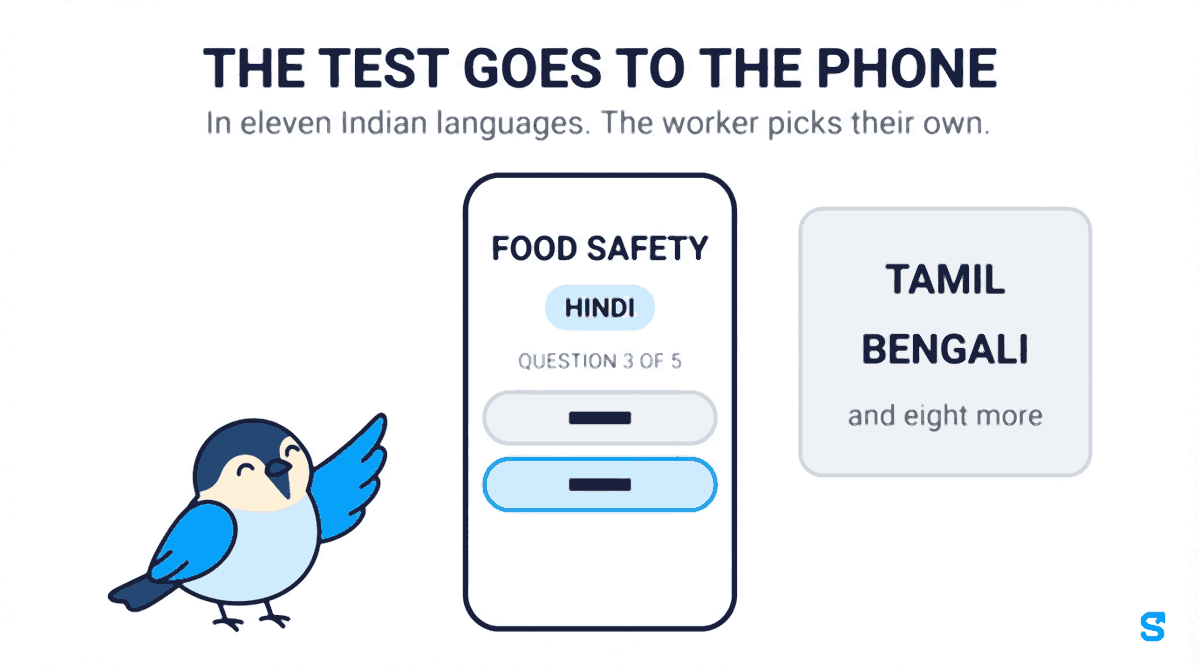
The quiz does not unlock until every material has been opened. You cannot skip to the test.
An answer locks the moment it is checked. The lock stays with the person's account. Refreshing the page, switching language mid-quiz, closing the app or reopening it on another phone does not hand anybody a second attempt at a question they have already answered. Scoring is done from the stored answers, against exactly the subset of questions that person was shown.
You set the pass mark, whether retakes are allowed, and the default due window. The register then shows, per person: not started, in progress, completed or failed, best score, number of attempts, and whether they are past the date.
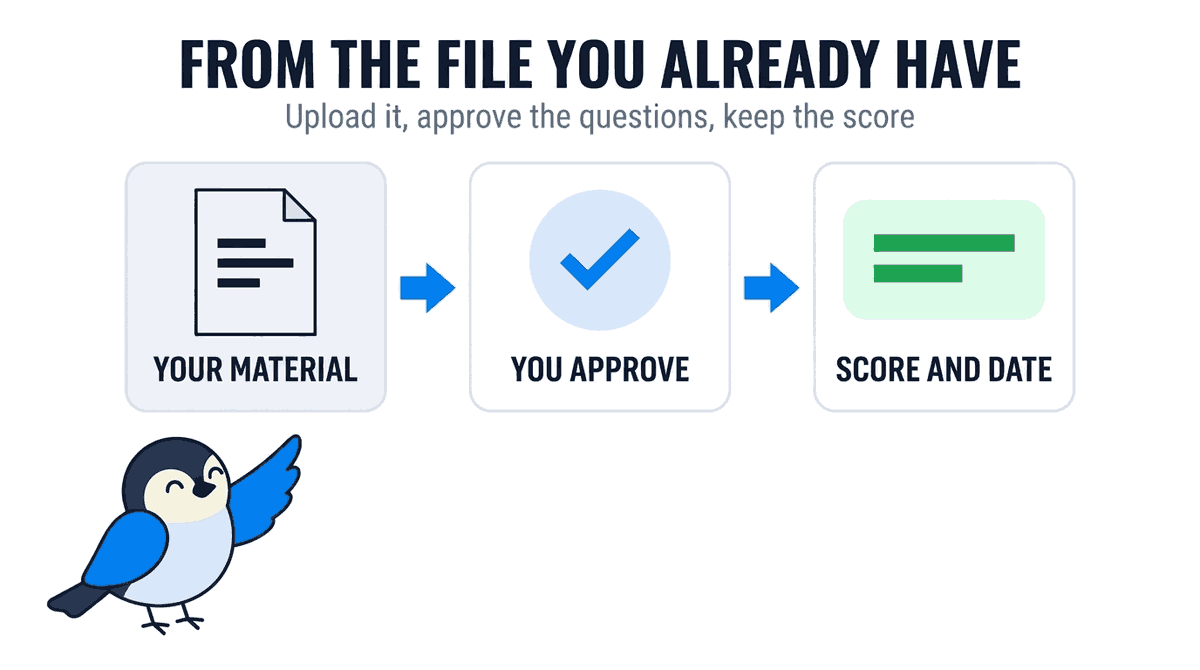
That last screen is the answer to the folder. It is not a sheet of signatures from February. It is a named person, a named module, a score and a date, and it is still there when somebody asks in October.
Where this is the wrong tool
Worth being straight about, because the gap costs more than the feature saves.
It is not FoSTaC and cannot be. FoSTaC is an FSSAI-approved course delivered by approved training partners, ending in a certificate FSSAI recognises. No software issues that. Shiftelio covers the food handlers around the supervisor, not the supervisor's certificate.
It is not a full learning management system. There is no branching curriculum, no video hosting, no sealed certificates, no SCORM package. If you are running a hundred-hour accredited syllabus, buy an LMS.
The questions are machine-written from your file. That is the point of them being cheap enough to make for every SOP you own, and it is also exactly why the approval step exists. If you approve a quiz without reading it, the tool has not failed, you have.
The short answer
Is a quiz actually required, or am I over-reading the rule?
Clause 24.3 requires periodic assessments of the effectiveness of training. It does not prescribe a format, so a quiz is one way to satisfy it and not the only one. What it clearly is not satisfied by is a list of signatures, which records attendance and says nothing about effectiveness.
Does this replace FoSTaC certification?
No. FoSTaC is delivered by FSSAI-approved training partners and ends in a certificate valid for two years. You still need it for your Food Safety Supervisor. This covers the food handlers that certificate does not.
Our staff do not read English. Is a translated quiz any good?
The questions and the explanations are translated into eleven Indian languages and the worker chooses theirs. Switching language mid-quiz does not reset or unlock answers already given, so somebody cannot use the language switch to get another go at a question.
What stops one person doing the quiz on everyone's behalf?
Each person answers inside their own account on their own phone, and each answer locks the moment it is checked. The larger protection is the question bank: you can hold ten questions and show five, so two people sitting together are not answering the same paper.
How long does it take to set one up?
The slow part is the material, and you usually already have it. Upload the SOP or deck you use today, let the questions generate, read them, fix any you do not like, approve, assign. The reading-and-approving step is the one to actually spend time on.
Keep reading
Free to use, no signup: Shift roster template.