Buddy Punching: How to Stop It With the Phones Your Hourly Staff Already Carry
In short
Buddy punching is one worker clocking in for another. Stop it by tying each clock-in to the worker's own phone, a selfie and the store's location.
- Buddy punching is one employee clocking in or out for a coworker who is late, gone early or not there at all, so you pay for hours nobody worked.
- A shared time clock, a PIN pad or a tablet by the door cannot tell who is standing in front of it, which is why buddy punching survives on them.
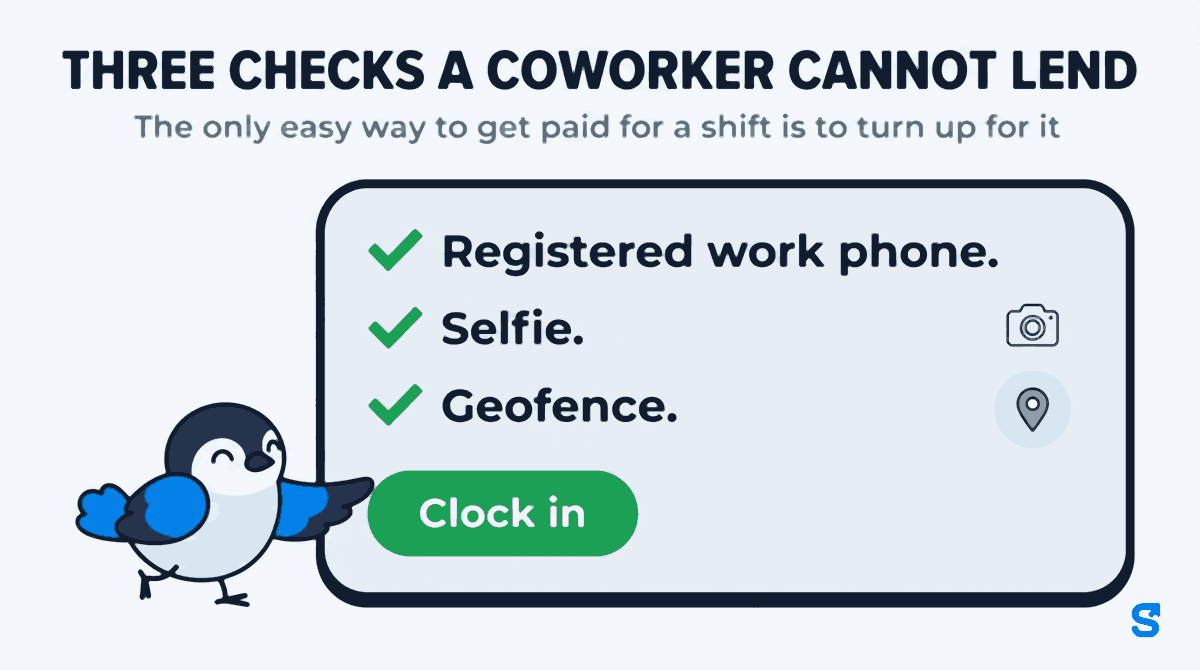
- Tie every clock-in to three things a coworker cannot lend: the worker's own registered phone, a selfie taken at that moment, and the store's location.
Buddy punching is when one employee clocks in or out for a coworker who is not there, so the timesheet shows hours nobody worked and you pay for them. You stop it by making every clock-in prove three things a friend cannot borrow: the worker's own phone, the worker's face, and the place of work.
That is the whole fix. The rest of this guide is how to put it in place at a restaurant, a store or a cleaning crew without buying a fingerprint clock, and how to do it without treating your honest staff like suspects.
What buddy punching looks like on a normal Tuesday
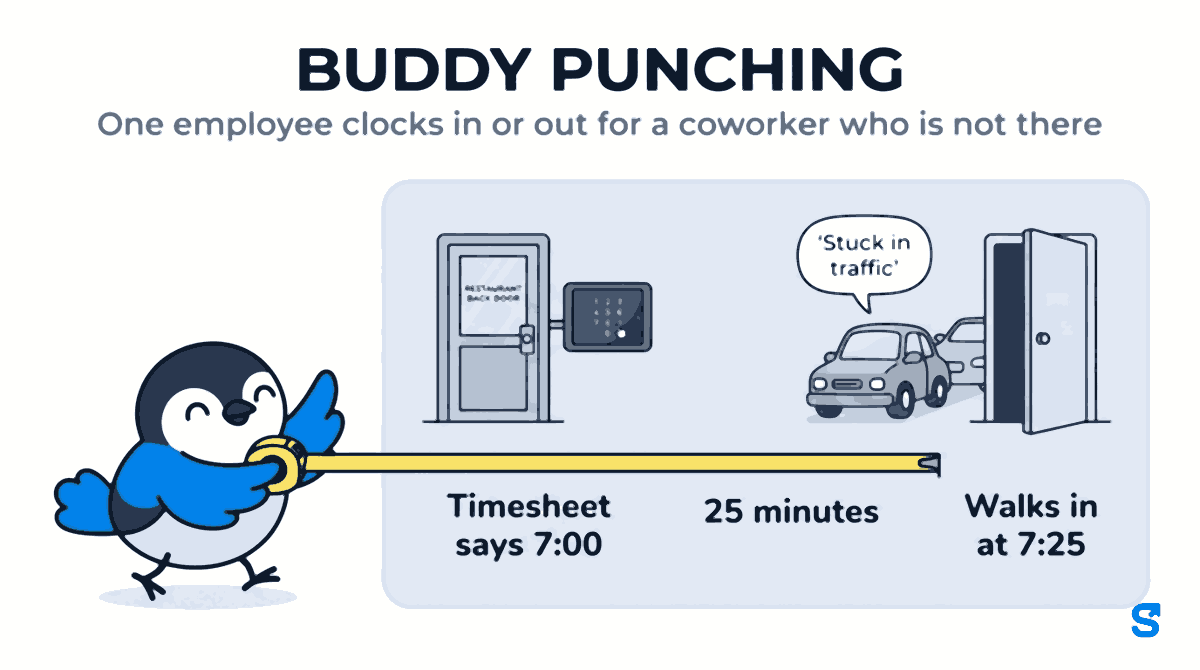
It is rarely dramatic. A line cook texts at 6:50 that he is stuck in traffic. His friend on the morning shift taps his PIN on the tablet by the back door, and the timesheet says he started at 7:00 sharp. He walks in at 7:25. Nobody is stealing a paycheck. Twenty five minutes just moved from his pocket to yours.
The same thing happens in the other direction at closing: one server leaves at 9:30, a coworker clocks her out at 10:15 with the closing crew. A retail associate on a split shift has a coworker punch the second half while she finishes an errand. A cleaning crew of four has one person who arrives at the office building and punches the whole van in from the lobby kiosk.
Each one is small. Here is why it still matters, using round numbers you can swap for your own:
- 25 minutes: a late start covered by a friend's punch
- 3 times a week: how often it happens on one schedule
- $17 an hour: an example hourly wage
- about $1,100 a year: what that one habit costs, for one employee
That figure is 25 minutes, three times a week, for 52 weeks, at $17. It is an example, not a survey. The point is the shape: it is one person, and buddy punching is never one person, because the friend who covers for you expects to be covered back.
Why a shared time clock cannot stop it
A punch clock, a PIN pad, a swipe card and a tablet by the door all answer one question: was this code entered? None of them answers the question you care about: was this person here?
A PIN can be shared in a text message. A swipe card fits in a friend's apron. A tablet kiosk accepts any finger. Fingerprint clocks were sold as the answer, but they cost money per location, flour and grease defeat the scanner, and many small owners would rather not hold their staff's fingerprints at all.
The fix is to stop asking a shared device to identify people, and let each person clock in on their own phone, with checks a coworker cannot fake on their behalf.
Three checks a coworker cannot lend
Each worker is tied to one registered work phone. Clocking in from a friend's handset is not the same as clocking in from their own, and you are told when a new phone appears in somebody's name. Genuine phone changes happen (a cracked screen, an upgrade) and you approve them with one tap.
The clock-in takes a selfie photo, stored on the attendance record. A coworker who borrows the phone still has to put their own face in front of it, and you can see whose face it was.
Each store or site has a geofence, a circle you draw around the address. You choose what happens when somebody clocks in outside it: allow it and tell you, or block it.
Any one of the three can be worked around. All three together mean the only easy way to get paid for a shift is to turn up for it.
Write the policy before you change the clock
The first flagged punch should not be the first time anybody hears about the rule. A buddy punching policy can fit on one page:
- The rule in one sentence: you clock yourself in and out, on your own phone, and never anybody else.
- What counts: clocking in or out for a coworker, sharing a PIN or login, and asking somebody to do it for you. Both people are covered.
- How we check: your registered work phone, a selfie at clock-in and the store's location. Say this plainly; it is a deterrent before it is a control.
- What happens if you are running late: text or call the manager. A late arrival recorded honestly is a scheduling conversation, not a disciplinary one.
- New phone or lost phone: tell the manager, who approves the new phone the same day.
- What happens if it is found: state your own consequence, the same for both people, and apply it the same way every time.
Have each person sign or acknowledge it. Then switch the checks on. Staff who were never doing it notice nothing except that clocking in now happens on their own phone.
Choose how strict to be
The phone rule has three settings, and you do not have to start at the strictest:
| Setting | What happens when a second phone shows up for one person |
|---|---|
| Do nothing (default) | Nothing. Use this until your policy is signed. |
| Tell me, but never stop anyone | The change is recorded and you are told. Nobody is ever refused a clock-in. |
| Tell me, and pause the second change until I approve | A first phone change always goes through. A second unapproved change waits for you. |
Most restaurants and stores start on the middle setting for a month. You learn who changes phones and why, nobody is ever stuck at the door at opening, and the record builds up on its own. Pair it with the geofence set to "allow it and tell you" for the same month, then tighten either one if the alerts show a pattern.
If some staff currently clock in from a browser on the office computer, also ask everybody to use the app instead. A browser can be opened by anybody at that desk, while the app on a registered phone belongs to one person. You can still allow the browser for the people you name, such as a manager who works from the back office.
What federal law says about your time records
Buddy punching is a timekeeping problem, and the federal rule on timekeeping is short. Under the Fair Labor Standards Act, the US Department of Labor's Fact Sheet #21 on recordkeeping says every covered employer must keep records for each non-exempt worker, including hours worked each day and total hours worked each workweek, and that "the law requires this information to be accurate."
The same page says employers "may use any timekeeping method they choose," such as a time clock, a timekeeper, or workers writing their own times, and that any plan "is acceptable as long as it is complete and accurate." It also says time cards and work schedules should be kept for two years. (Checked on 6 October 2026.)
So the federal rule does not pick your clock for you. It puts the record of hours worked on the employer. Many states add their own rules on top of the federal ones; your state labor department's website is the place to read them.
This is general information, not legal advice: check with the agency or an employment lawyer for your case.
Which app ties the clock-in to the person
The checked clock-ins then become the attendance record you review before payday, so the record you keep is the one you checked. If you also schedule shifts in the app, see shift scheduling for how the planned shift and the clock-in line up.
Questions owners ask
What does buddy punching mean?
Buddy punching means one employee clocks in or out for a coworker. The coworker gets paid for time they were not at work, usually a late start or an early finish covered by a friend.
Is buddy punching illegal?
No federal law is named after it; most employers treat it as time theft under their own written policy. What federal law does say is that the employer's record of hours worked must be accurate.
How do you prevent buddy punching without a fingerprint clock?
Have each worker clock in on their own registered phone, with a selfie and a geofence around the store. A coworker cannot easily supply someone else's phone, face and location all at once.
Will honest staff feel watched?
Not if you explain it first. The checks only run at clock-in and clock-out, the policy says why, and an honest worker's day looks the same as before.
What about staff who do not have a smartphone?
A supervisor can clock them in from one device. That punch is marked as made by the supervisor, so you can see it was not the worker's own clock-in.