Vacation Entitlement in Ontario After 5 Years: Give Long-Serving Staff Three Weeks Without a Second Spreadsheet
In short
In Ontario, staff get two weeks of vacation a year until five years of employment, then three. A leave plan keeps both numbers on one leave year.
- Ontario's guide says two weeks of vacation time a year under five years of employment, and three weeks from five years. For someone on a five-day week, that is 10 working days and then 15.
- The trouble is not the rule. It is remembering who crossed five years this year, and changing their number without touching anybody else's.
- In Shiftelio, a leave plan holds the second number. Standard stays at 10 days for everyone else, and a plan called Five years and over gives 15.
In Ontario, the province's Employment Standards Act guide gives employees two weeks of vacation time a year while they have under five years of employment, and three weeks once they have five years or more. So a small business with a mix of new and long-serving staff has to keep two vacation numbers running side by side, and move each person from the first to the second at the right moment.
Why the five-year step goes wrong in a small business
Picture a 14-person restaurant in Hamilton. Most of the kitchen and floor staff joined in the last three years. Three people have been there longer: Priya on the line, Rosa who runs the floor on weekends, and Daniel, a server who reaches five years in November.
The owner keeps vacation in a spreadsheet with one column: 10 days each. Priya and Rosa were bumped to 15 by hand a while ago. Daniel's anniversary comes and goes during a busy month, and nobody changes his cell. In spring he asks for a third week and is told he has none left. Now there is an argument about a number nobody wrote down, and the only record is a spreadsheet anybody could have edited.
Three things go wrong in that story, and none of them is the law:
- Two numbers live in one column, so the exception is invisible. You cannot see who is on 15 and who is on 10 without reading every row.
- The change is a hand edit, so there is no trace of when it happened or who made it.
- Changing the number can disturb what was already taken, because one cell holds both the allowance and the balance.
What Ontario's guide says about vacation after five years
This section is the supporting background. The rule is set by each province, and this article quotes Ontario's only. Other provinces publish their own numbers.
Ontario's guide to the Employment Standards Act, vacation chapter (checked on 13 October 2026) says:
Employees with less than five years of employment are entitled to two weeks of vacation time after each 12-month vacation entitlement year. Employees with five or more years of employment are entitled to three weeks of vacation time.
The same page says the three weeks apply when the employee's period of employment is five years or more on the completion of the vacation entitlement year. It describes a standard vacation entitlement year as a recurring 12-month period starting on the date of hire, and an alternative one as a 12-month period the employer picks to start on another date. For an employee without a regular work week, it says the employer works out the average number of days worked each week and multiplies it by two to get the vacation days. It also sets vacation pay at no less than four per cent of gross wages under five years of employment and six per cent from five years, which is money and a separate question from the days.
This is general information, not legal advice: check with the agency or an employment lawyer for your case.
Two vacation numbers on one leave year: how a leave plan works
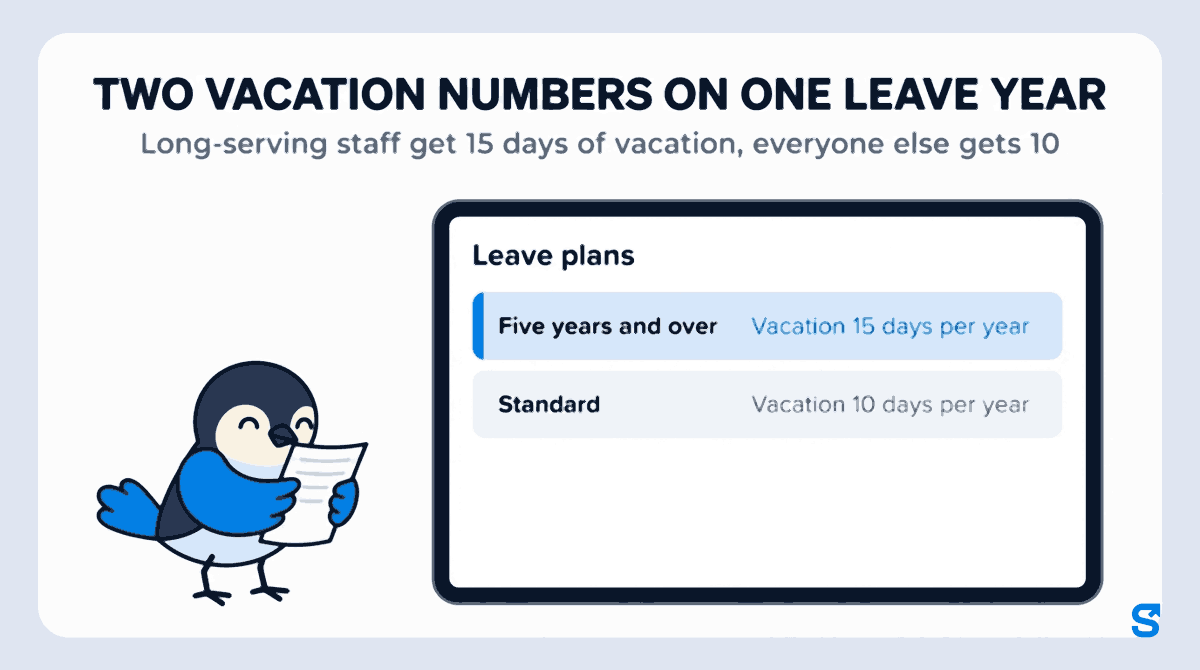
A leave plan in Shiftelio is a named group with its own Days per year for each paid leave type. Everyone who is not on another plan stays on Standard. That gives the restaurant exactly the two numbers it needs, both visible on one screen:
- Standard: Vacation, 10 days per year. Everyone else.
- Five years and over: Vacation, 15 days per year. Priya, Rosa and Daniel.
Long-serving staff get 15 days of vacation, everyone else gets 10, and both numbers run on the same leave year.
A plan decides who is on it in three ways, and you can mix them: Departments, Sites, or Hand-picked people. For the five-year step you hand-pick, because length of employment is about the person, not the team they work in.
One honest limit up front: Shiftelio does not work out when somebody passes five years and does not move them for you. You pick the people. A short calendar note for each anniversary is enough to keep that from slipping.
Setting it up in Shiftelio
Everything below is under Leaves, then Settings.
In Leave types, tap Add leave type, name it Vacation, answer Is this leave paid? with Paid, and set Days per year to 10. Choose whether the days are given all on the first day of the leave year or earned every month, and what happens to unused days at year end.
In Leave year, choose when the company leave year starts. Most small businesses use January. A group that genuinely runs on another year can be given its own on a plan, but you do not need that for the five-year step.
In Leave plans, tap Add leave plan. Give it a plan name such as Five years and over. Under Who is on this plan, open Hand-picked people, search by name and tick Priya, Rosa and Daniel. Under Days per year for Vacation, type 15. Keep Leave year on the company leave year, then tap Save plan.
Someone who matches two plans gets the one higher in the list. If you also keep a plan by department, use Move up so Five years and over sits above it, and Daniel cannot fall back to the department's number.
Saving a plan changes nobody's days on the spot. The plan's number is used for new joiners and the next time days are given, so a new leave year opening in January hands Priya, Rosa and Daniel 15 days without anybody remembering to.
When somebody passes five years in the middle of the year
That is Daniel in November. You want his new number in place now, not next January. Saving the plan alone will not do it, and that is deliberate: it stops a settings change from quietly rewriting balances.
On the Leaves home, Balances lists everyone with their days left. Tick Daniel. If two people passed five years this month, tick both.
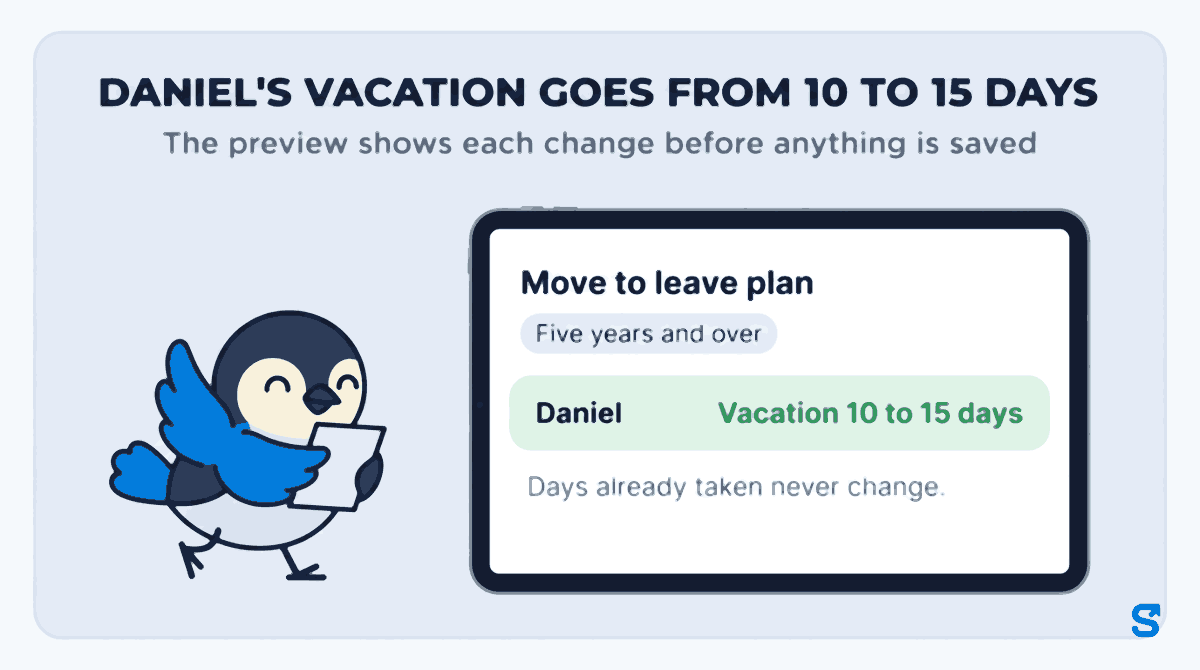
With him selected, the bar that appears offers Move to leave plan. Pick Five years and over.
The preview shows each change before anything is saved: Daniel's Vacation goes from 10 to 15 days for this leave year. Days already taken never change, and his new number is never set below what he has already used.
Daniel sees his new balance in the app the next time he opens his leave screen, so the conversation in spring never happens.
What about part-time staff?
Ontario's guide counts vacation days for someone without a regular work week from the average number of days they work each week. If your weekend staff average two days a week, a separate plan is the clean way to give them their own number, for example a Weekend team plan picked by department, while the full-time kitchen stays on Standard. The arithmetic for each person is yours to check against the province's page; the plan just makes sure each group's number is written down once and applied the same way every time.
If you switch on New joiners get leave automatically on the Leave plans card, a new hire gets days counted from their joining date, by full months left, rounded to half a day. They land on Standard unless a department or site plan picks them up.
Vacation days are not vacation pay
Shiftelio counts vacation days. It does not calculate the vacation pay percentage your province sets, and it does not run Canadian payroll deductions. If you pay vacation pay on each cheque or at the time vacation is taken, that stays with your payroll provider or accountant. What Shiftelio gives them is a clean record of who had how many days, who took what and when.
Which app keeps two vacation numbers straight
You can see the rest of what the app does on the features page, or start from Shiftelio for Canadian teams.
Frequently asked questions
How much vacation do employees get in Ontario after five years?
Ontario's guide says three weeks of vacation time a year once an employee has five or more years of employment, up from two weeks before that. Check the province's vacation page for how the year is counted.
How many vacation days is three weeks?
For someone on a five-day week, three weeks is 15 working days and two weeks is 10. For staff without a regular work week, Ontario's guide uses the average days worked each week instead.
Does Shiftelio move staff to three weeks automatically at five years?
No. You hand-pick who is on the Five years and over plan, and use Move to leave plan when someone crosses the line mid-year. The app shows the change before saving it.
If I change a leave plan's days, does everyone's balance change at once?
No. Saving a plan changes nobody's days on the spot. The new number applies to new joiners and the next leave year, unless you choose to give it now.
Can one person be on two leave plans?
No. Someone who matches two plans gets the one higher in the list, and you can reorder the list with Move up and Move down.
Does Shiftelio calculate Ontario vacation pay?
No. Shiftelio counts vacation days, not vacation pay. The four or six per cent vacation pay stays with your payroll provider.