Expense Reimbursement for Service Technicians: Fuel and Spare Parts
In short
AC and appliance technicians pay for fuel and parts out of pocket. A simple expense reimbursement policy, with limits the app enforces and a clean approval.
- Fuel and spare parts are two different kinds of bill. Fuel is the cost of reaching the customer; a part usually goes back on the customer's invoice. Give them separate categories with separate limits.
- Put the per-claim limit in the app, not in a WhatsApp message. A claim above the limit cannot be submitted at all, so nobody has to say no later.
- The approver should see the bill photo, the place the claim was added from and any rule it broke, and be able to approve less than was asked.
A technician's day costs money before it earns any
An AC service business in peak summer runs on small cash. Ravi, one of eight technicians, leaves at nine with a toolbag and a scooter. By evening he has done five calls across the city, filled petrol twice, bought a run capacitor from a market shop because the customer's had blown, and paid for a gas top-up the van did not carry. None of it came out of the company's pocket. All of it came out of his.
At month end he hands the office a folded bundle of bills, some faded, one handwritten, and a number he has added up himself. The owner has three choices, all bad: pay it without looking, argue line by line, or pay part of it and leave Ravi feeling cheated. Multiply that by eight technicians and it is a day of the owner's month, every month.
This is the problem an expense reimbursement process exists to solve. It is not about scanning paper. It is about agreeing the rules before the money is spent, so the month end is a check and not a negotiation.
Two kinds of bill, two different rules
Most service businesses lump everything into "conveyance". That is where the arguments start, because the two biggest costs behave nothing alike.
| Fuel | Spare parts | |
|---|---|---|
| What it pays for | Getting to the customer | Something fitted at the customer's home |
| Who ends up paying | The business, as a running cost | Often the customer, on the service invoice |
| Typical bill | Petrol pump slip, often small and faded | Shop bill with a part name, sometimes a GSTIN |
| How to limit it | A cap per claim, per day of travel | A cap per claim, with a photo of the bill every time |
| What goes wrong | Round numbers with no slip | A part bought, not fitted, and kept |
Two practical consequences. A fuel slip from a pump carries no GST you can claim back, because petrol and diesel are still outside GST under Section 9(2) of the CGST Act. A part from a GST-registered dealer can, if the bill shows the dealer's GSTIN and the tax split. So it is worth knowing which bill is which before it reaches the accounts.
The other is that a reimbursed bill is not salary. The Code on Wages, 2019, in its definition of wages in Section 2(y), leaves out travelling allowances and sums paid to cover special expenses the job itself causes. Ravi's petrol is the cost of doing his job, not a raise. Keeping it on its own line, rather than folding it into an "allowance", keeps that clear. The Ministry's labour codes page has the current text.
Write the policy as limits the app enforces
A reimbursement policy written on paper is a policy enforced by the owner's mood. Written into the app, it is enforced the same way for every technician, every day.
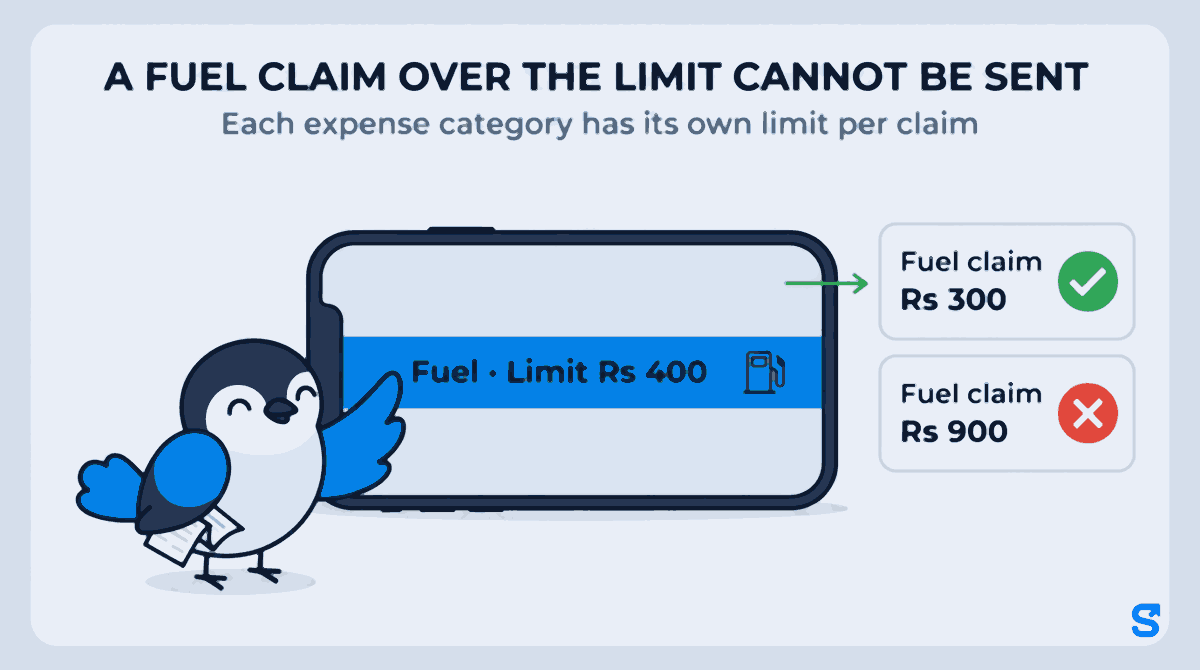
In Shiftelio this lives under Expense Settings. Every business starts with categories such as Travel and Equipment; rename or add your own, so a service business might set up Fuel and Spare parts and switch off the ones it never uses. Each category takes a Spending Limit per claim. Set Fuel at Rs 400 and a Rs 300 fuel claim goes straight to the approver, while a Rs 900 fuel claim cannot be submitted at all: the app stops it with a message naming the limit, before it ever reaches anybody.
- Fuel, with a per-claim limit that matches one day's realistic travel in your city.
- Spare parts, with a higher limit, because a compressor relay costs more than a fuse.
- A Require Receipt spending policy on Spare parts, so any parts claim without a bill photo arrives already flagged.
- A Max Amount spending policy on Fuel set below the hard limit, so a claim that is allowed but unusually high still arrives with a flag beside it.
- Switch off categories you never use, so a technician is not choosing between seven.
The difference between the two kinds of limit matters. The category limit is a wall: above it, nothing is submitted. A spending policy is a flag: the claim goes through, and the approver sees a warning on it. Use the wall for the number you would never pay, and the flag for the number you would pay with a question.
The claim, made where the money was spent
The technician opens the app, taps to add the bill photo, and the amount, the shop and the date are read off it. He checks the numbers, picks Fuel or Spare parts, adds a line such as "capacitor, Sector 21 call", and submits. If the bill photo will not read, he types the amount himself; the photo is still attached for the approver.
Three things happen without anybody doing them:
- The place is recorded. The claim carries the area the phone was in when it was added, so the approver sees "Sector 21, Gurugram, Haryana" next to a parts bill for the Sector 21 call.
- A double tap is caught. The same amount, for the same day, from the same person within five minutes is refused as a likely duplicate, so one bill tapped twice is not claimed twice.
- The policies are checked. A missing receipt or an amount over the policy threshold puts a flag on the claim that the approver cannot miss.
What the approver sees, and the four answers they can give
Claims arrive on the owner's Expenses screen, or on a manager's if the owner has given that manager's role the Expenses approve permission. Each one shows the bill photo, the amounts read from it, the place, and any flags.
The approver has four honest answers:
- Approve as asked.
- Approve less. The approved amount is editable, so a Rs 520 parts bill that included Rs 70 of tea becomes Rs 450 approved, and the technician sees the figure that was approved.
- Request changes, when the bill photo is unreadable or the category is wrong, rather than rejecting a real expense.
- Reject, with a reason the technician can read, so "no" comes with an explanation instead of silence.
From approved to paid
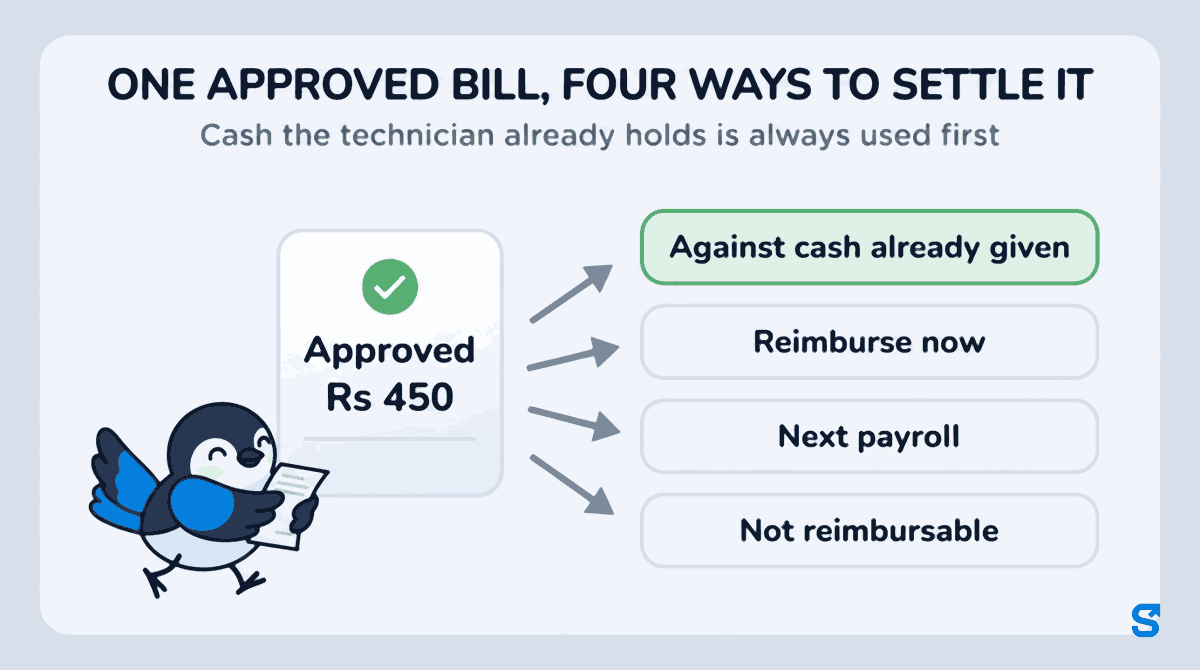
An approved bill is not yet money in Ravi's hand. Shiftelio asks how it should be settled:
- Against cash already given. If the technician is holding money the business gave him, the approved amount comes off that first, automatically. If it covers the whole bill, nothing more is owed.
- Reimburse now. Paid today, by cash, UPI, bank transfer or cheque.
- Next payroll. The default. It is added to the next salary as its own line, which is usually the right answer for small daily bills.
- Not reimbursable. Accepted as a real cost but not paid back, for example a part the customer was charged for directly.
The cash-already-given step is what stops a technician being paid twice: once out of the float you handed him on Monday, and again on his payslip. If you hand technicians money for parts at the start of the week, read how an approved claim comes off the advance first before you set this up.
Where this is the wrong tool
Be clear about the edges before you rely on it.
- It does not bill the customer for the part. If spare parts go on the service invoice, your invoicing tool still has to do that; Shiftelio records what the technician spent and what the business paid back.
- It does not track fuel by kilometre. The claim is the bill, not a per-km rate worked out from distance. A business that pays a fixed rate per kilometre needs that rate and a distance record, which is a different policy.
- It does not issue fuel cards or hold a spend wallet. The money still moves the way it does today.
- The bill reader is good, not perfect. A faded thermal slip or a handwritten bill may need the amount typed in by hand.
Which app handles technician expense reimbursement and approval?
If your technicians are already checking in to jobs from their phones, expense claims sit in the same app. See how it works for field service teams.
What is a fair fuel reimbursement limit for an AC technician?
There is no single figure. Take one ordinary busy day in your own city, the number of calls and the distance, and set the per-claim limit a little above that day's fuel cost. Then add a lower spending-policy threshold so unusually high but allowed claims arrive with a flag.
Can a technician claim without a bill?
Yes, the bill photo is optional by default. Add a Require Receipt spending policy to a category and every claim in it without a photo arrives flagged for the approver.
Can a manager approve claims instead of the owner?
Yes. The owner can give a manager's role the Expenses approve permission. The owner can always approve.
What if the technician submits the same bill twice?
The same amount, for the same day, from the same person within five minutes is refused as a likely duplicate. A genuinely separate bill for the same amount can be added a few minutes later.
Is a reimbursement counted as salary?
A bill paid back to cover the cost of doing the job is not wages under Section 2(y) of the Code on Wages, 2019. In Shiftelio it is added to the payslip as its own line, separate from salary.
Keep reading
Free to use, no signup: HR letter formats.