PT Payment Part Cash, Part UPI: Who Holds the Money at a Gym
In short
A PT client pays half in cash and half to the trainer's own UPI. How a gym records one split payment, knows who holds each rupee, and clears the desk cash.
- A split payment goes missing when it is written as one total with no holder.
- Record each part with its amount, its method and who holds it now: the gym, the desk or the trainer.
- Money with a trainer is not the gym's until it is handed in, and earns no commission until then.
Neha renews her personal training package for Rs 3,000. She has Rs 1,500 in cash in her bag and pays the other Rs 1,500 by UPI, and because the trainer is standing next to her with his phone out, the UPI goes to the trainer's own number, not the gym's. The trainer puts the cash in his pocket, meaning to give it to the front desk after his next client. He writes "Neha paid" in the group chat.
A week later the owner checks the drawer and the bank app. There is no Rs 1,500 in the drawer, because the trainer handed the cash to the evening receptionist, who kept it in a separate envelope. There is no Rs 1,500 in the gym's UPI, because it went to the trainer. The package says paid. Nobody is lying, and nobody can say where Rs 3,000 is.
This is the most ordinary money problem a gym with personal trainers has, and it is not solved by a better register. It is solved by writing down, at the moment the money is received, how much came in each way and who is holding each part. This article works through that rule and then shows how Shiftelio's PT packages record it.
Why a split payment goes missing
A client paying part cash, part UPI is normal in India. The trouble is that a single line in a register, "Neha, Rs 3,000, paid", hides three separate facts:
- How much came by each method. Cash is counted in the drawer. UPI is checked in a bank app. One total cannot be checked against either.
- Who holds each part right now. The gym's UPI, the trainer's own UPI, the trainer's pocket or the desk drawer are four different places.
- Whether the owner has actually received it. Cash handed to the desk is not the same as cash the owner has taken from the desk.
A payment that is "paid" but has no holder is the gap. The client has paid, the trainer has done nothing wrong, and the gym still cannot find the money, because nobody wrote down where it went.
Personal trainers taking UPI to their own number is not a fraud problem in most gyms. It is a convenience: the gym's QR code is at the front desk, the trainer is on the floor, and the client wants to pay now. The fix is not to ban it. It is to record it as money the trainer is holding, so it stays visible until it is handed in.
The rule: one payment, one line per part, one holder per line
Write a split payment as parts. Each part has its own amount, method and holder.
| One total in a register | Two separate entries | Parts with a holder | |
|---|---|---|---|
| Neha's Rs 3,000 | One line, "paid" | Two lines, often on different days | One payment, two parts |
| Cash checked against the drawer | Cannot be | Only if both were written | Yes, the cash part alone |
| UPI to the trainer's own number | Invisible | Written, but looks like gym money | Shown as with the trainer |
| Cash given to the desk | Looks the same as cash in the owner's hand | Looks the same | Listed at the desk until the owner takes it |
| Trainer commission | Paid on money the gym may not have | Same | Only once the money reaches the gym |
Three holders cover almost every gym:
- The gym. The gym's own UPI, a card machine, a bank transfer, or cash the owner already has.
- The desk. Cash given to the front desk, waiting for the owner to take it.
- The trainer. Cash still in the trainer's hand, or UPI paid to the trainer's own number.
The third one matters most. Money held by a trainer should not count as received by the gym, and it should not earn that trainer commission, until it is handed over. That is not a punishment. It is the same rule a shop applies to a salesman who collects on delivery.
Where each rupee ends up
Here is Neha's Rs 3,000 with the rule applied at the moment she pays.
- Rs 3,000 : one payment for the renewal
- Rs 1,500 : cash, given to the desk
- Rs 1,500 : UPI to the trainer's own number
- Rs 0 : commission earned on the trainer's part until it is handed in
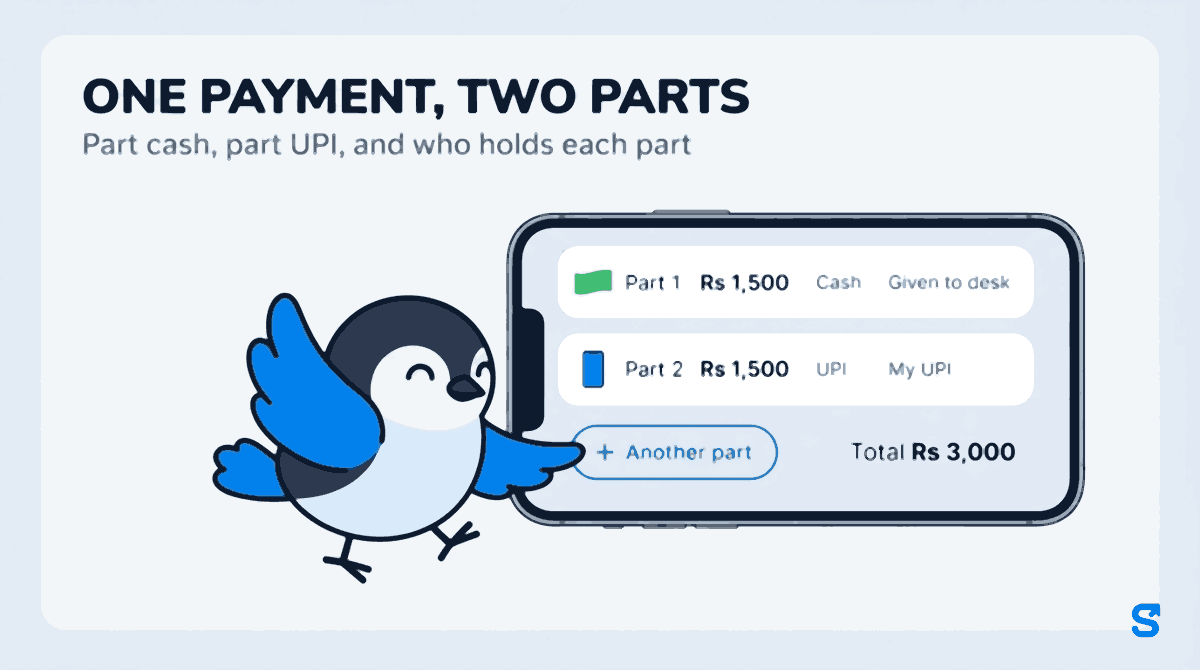
The cash part goes into the desk's drawer and waits there for the owner. The UPI part is listed as with the trainer, not handed in. Nothing is lost, and the owner can see both halves on one screen.
How Shiftelio records a split PT payment
Shiftelio's PT packages already count sessions down and pay the trainer's commission through payroll. Since September 2026 a payment on a package can be recorded in parts.
The trainer, or anyone at the desk, opens the client's package and taps Add payment. They type the money received today and choose how it was paid: Cash, UPI, Card or Other. For cash the app asks Where is the cash now?, Given to desk or Still with me. For UPI it asks Which UPI?, Gym's UPI or My UPI. Card and Other always land with the gym.
Under the first part the sheet says "Paid part cash, part UPI? Add another part." Tapping Another part adds a second set of the same questions, and the sheet shows the total as it grows. A payment can have up to four parts. It is saved in one go, but each part stays its own entry, because cash is checked in the drawer and UPI in the bank app.
A payment recorded by a trainer waits as pending until the owner, or a manager whose role has the Confirm payments tick, agrees it arrived. Each part is confirmed or rejected on its own, so the owner can confirm the cash after counting the drawer and the UPI after checking the bank app. The front desk can be given Record payments without Confirm payments, so writing money down and signing it off stay in different hands.
When the owner records a payment themselves, the questions are shorter: UPI is the gym's, and cash asks At the desk or With me, because the person recording it may already have it in hand.
When a trainer chooses Still with me or My UPI, the sheet tells them plainly: counts for your commission once you give it to the gym.
The desk hands the cash to the owner
The last gap is the envelope at reception. Cash given to the desk is gym money, but it is not yet in the owner's hand, and on a busy evening there may be five of these.
The PT Money screen now has a block called At the desk, with the total, that lists every confirmed cash payment given to the desk and not yet taken, and the date of the oldest. When the owner collects the cash, they tap I've taken it. The app asks once more, "Take Rs 1,500 from the desk?", and marks those payments taken only after Yes, taken.
It marks only the payments shown on the screen at that moment. If a client pays cash at the desk while the owner is counting, that new payment stays at the desk, so the count and the screen never disagree. The owner, or anyone whose role has Confirm payments, can do this.
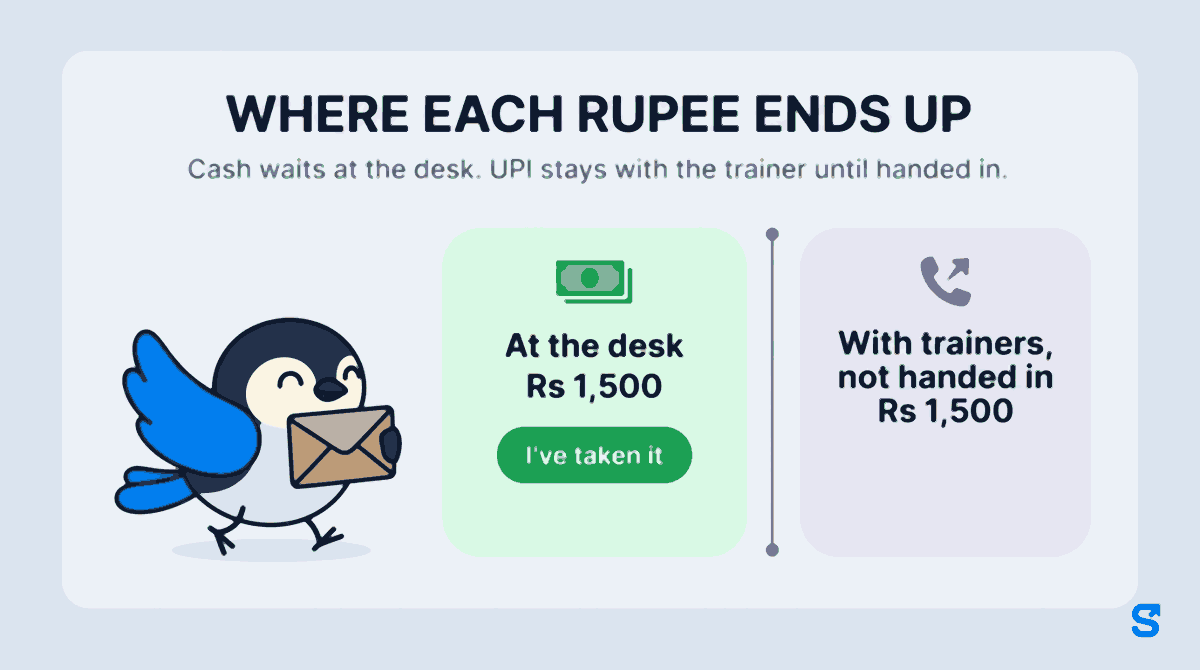
Money a trainer is holding sits in its own block, With trainers, not handed in, with a link to confirm money handed in. The trainer salary table has a column for money not handed in, so the conversation at month end starts from a number, not a memory.
A receipt is part of the rule
A client who paid cash to a trainer and has nothing in writing is the client who later says "I paid in full". It also exposes the gym: the Consumer Protection Act, 2019 lists not issuing a bill, cash memo or receipt for services rendered as an unfair trade practice in section 2(47), and those complaints are what the National Consumer Helpline handles. A payment recorded in parts, confirmed by the gym, is the record a receipt is written from.
- Record every payment the day it is received, with the amount per method.
- Name a holder for every part: the gym, the desk, or the trainer.
- Let the trainer take UPI to their own number if you must, but only as money held, not money received.
- Confirm cash against the drawer and UPI against the bank app, part by part.
- Clear the desk cash on a fixed day, and mark it taken when you take it.
- Pay commission on money that reached the gym, not on money a client says they paid.
The product that does this
See how payments, commission and trainer attendance fit together on the gym solutions page, and how a package can be paused when a client travels.
Questions gym owners ask
Can a PT client pay part cash and part UPI in one payment?
Yes. In Shiftelio, Add payment has Another part, so one payment can be split into up to four parts, each with its own amount and method. The total is shown on the sheet.
Should trainers take UPI on their own number?
It is better if clients pay the gym's UPI. If a trainer does take it on their own number, record it as My UPI. It then shows as with the trainer, not handed in, until it reaches the gym.
Does the trainer earn commission on cash still in their pocket?
No. Money the trainer is holding counts for their commission once they give it to the gym.
Who can confirm a payment?
The owner, or a manager whose role has the Confirm payments tick. The front desk can have Record payments only, so what they write waits as pending.
What if more cash comes in while I am taking the desk cash?
I've taken it marks only the payments shown when you tapped it. Cash that arrived in the meantime stays at the desk for next time.
Keep reading
Free to use, no signup: HR letter formats.