Which Areas Does Your Home Care Agency Actually Reach?
In short
Your website lists every locality in the city. Your nurses reach a few. How to map the ground your home care staff really cover before you say yes.
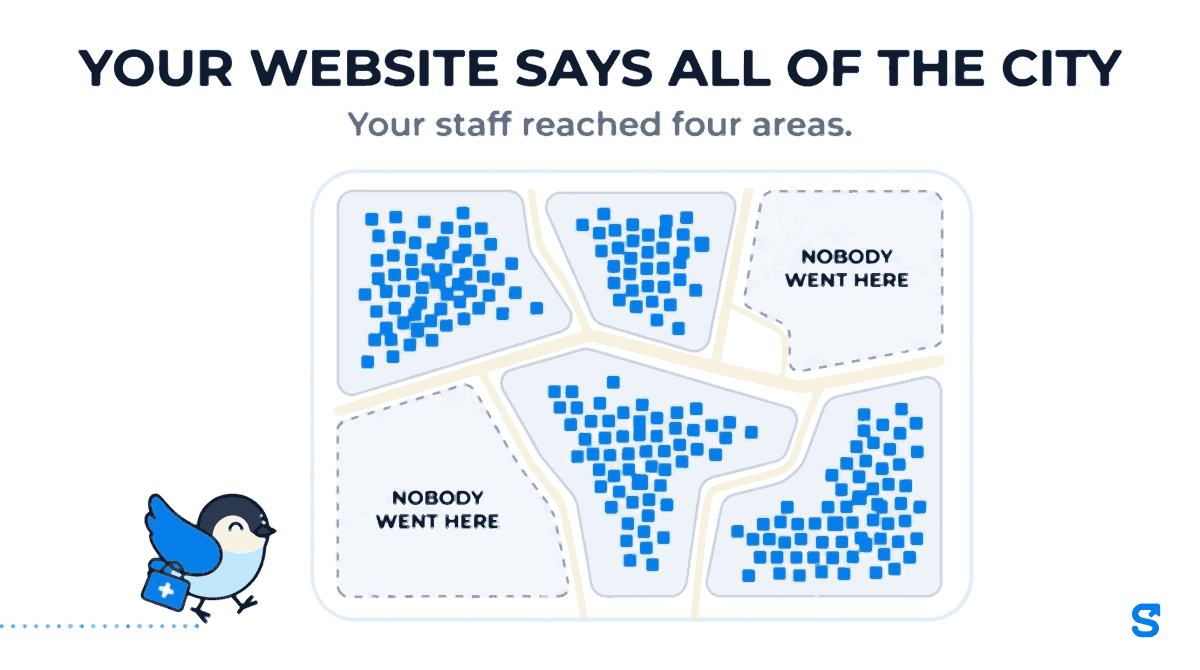
- Your website says all of the city. Your staff reached four areas. Knowing which four is the difference between a good yes and a bad one.
- The location trail your visiting staff already record during shifts can be turned into a map of ground covered, by locality, over any range up to 90 days.
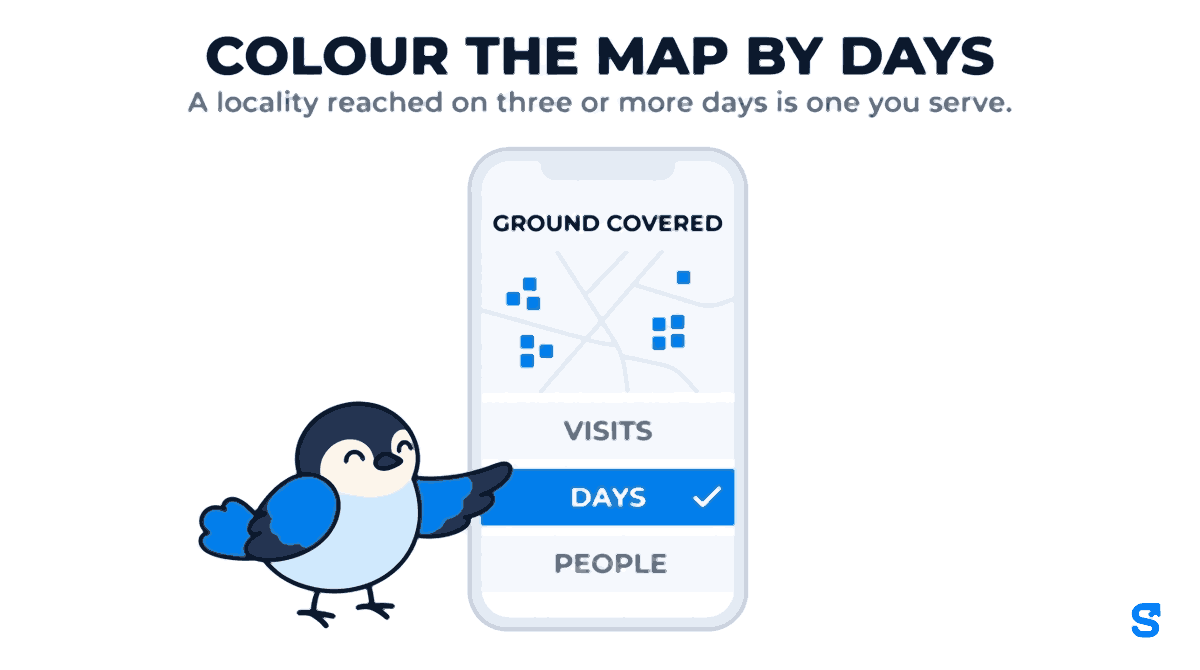
- Colour that map by days, not by visits. A locality reached on three or more days is one you actually serve.
It is seven in the evening and a daughter is on the phone. Her father comes home from hospital tomorrow, he needs a nurse for dressing changes every morning and a physiotherapist three times a week, and she wants to know whether you cover her area. Your website says you serve the whole city. So you say yes.
The next morning you find out what yes meant. Your nearest nurse lives on the other side of the river, your physio's other patients are all in the old city, and the new patient sits in a locality none of your staff has ever set foot in. The first visit is late, the second is later, and by the end of the week the family has called a competitor.
Home care is growing fast and growing outwards. Business Standard reported the industry pushing beyond the metros into smaller cities, and agencies across Delhi NCR, Pune and Bengaluru keep adding localities to the list on their websites. The list is a promise. What an agency rarely has is a map of where its staff actually go.
The question an enquiry is really asking
"Do you cover my area" sounds like a question about a list. It is really three questions, and a family will judge you on all of them within a week:
- Can somebody reach this home by eight tomorrow morning?
- Can the same person, or a small steady set of people, keep coming back?
- When the regular nurse is sick, is there anybody else nearby who can cover?
None of those is answered by a list of localities. All three are answered by where your people already travel, regularly, on ordinary working days. If a nurse already passes within two kilometres of the new home on her way between her Monday patients, the answer is an easy yes. If nobody has gone within ten kilometres of it in three months, the honest answer is "yes, at a price, and not from tomorrow".
Why the roster and the patient sheet cannot tell you
Most agencies run on two lists. One is the patient sheet: names, addresses, the care plan, the rate. The other is the roster: which attendant goes where on which day. Put together, they tell you where your staff were supposed to be.
They do not tell you three things you need before you accept a patient in a new locality:
| Patient sheet and roster | Coverage map | |
|---|---|---|
| What it shows | Where staff were assigned | Where staff actually travelled |
| Built from | Addresses someone typed | Positions the phone recorded on shift |
| Shows the route between homes | No | Yes |
| Shows how regular a locality is | No | Yes, colour by days |
| Shows who sent nothing at all | No | Yes, a separate list |
The route between homes is the part that matters most, and it is the part no sheet holds. A physiotherapist with five patients a day covers a corridor of the city, not five dots. A new patient on that corridor is cheap to serve. A new patient two kilometres off it may cost her an hour.
What the trail already knows
If your visiting staff clock in through a phone app with live location tracking on during their shift, the positions already exist. They are usually kept for one reason, settling a disputed visit, and then never looked at again.
Turning them into a map works the same way for a home nursing agency as it does for a street sweeping contract. Shiftelio lays a grid of ten metre squares over the map. A square counts as covered if anybody on shift recorded a position inside it during the dates you picked. Where two positions are less than sixty metres and less than a minute apart, the ground between them is filled in too, because a phone that reports every thirty metres or so would otherwise under-count a walk by a wide margin. Add the squares up and you have ground covered, in square kilometres.
Consumer GPS is good but not perfect. The US government's own figures put a phone's accuracy at roughly five metres under open sky, and worse between tall buildings or indoors. That is why this map is a report about ground and about a team, not a report about one person's afternoon.
Draw it for most agencies and the result is the same shape. Your website says all of the city. Your staff reached four areas. Two of the localities on your list will say, in effect, nobody went here.
Colour it by days, not by visits
The map can colour each square three ways, and for home care the choice matters more than anything else on the screen.
How many times somebody passed through the square. This lights up the roads your staff use most, which mostly tells you where the main roads are. A single nurse with a daily dressing patient on a busy junction paints it bright on her own.
How many different days the square saw work. This is the reading for home care. A locality reached on three or more days is one you serve. A locality reached on only one day is a one-off: a single assessment visit, a replacement shift, somebody taking a shortcut. The summary beside the map states both shares for the whole range, so you can see how much of your ground is regular and how much is chance.
How many different staff walked the square. This answers the cover question. A locality that four different people pass through is a locality where a sick nurse can be replaced by lunchtime. A locality only one person ever reaches is a locality where one phone call ruins your week.
Put the Days reading next to the enquiry's address and the conversation changes. "We are there four days a week already, we can start tomorrow" is a promise you can keep. "Nobody from our team has been near there in three months" is a reason to quote a travel charge, or to recruit locally before you say yes.
A live-in attendant barely moves, and that is correct
Home care agencies usually run two very different kinds of staff, and they look nothing alike on this map.
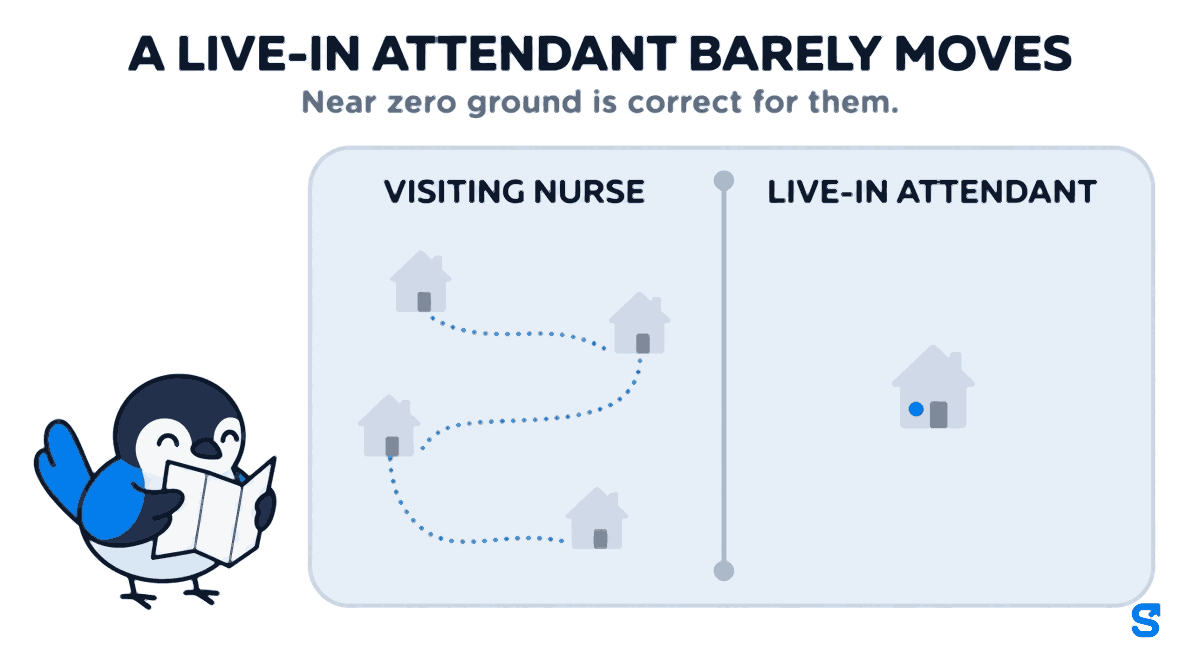
Visiting staff. Nurses, physiotherapists and visiting attendants go to several homes a day. Their trail is long, it crosses the city, and it is exactly what the coverage map is built for.
Live-in attendants. A 24 hour attendant stays in one home for days or weeks. Their trail is a single dot. Near zero ground is correct for them. It is not a problem to be fixed.
If you read the map with everybody switched on, the live-in team drags every average down and fills the people lists with names that are doing precisely their job. Use the department filter on the page and look at the visiting team on its own. If you want the live-in side of the business measured, the question there is attendance and relief, which we covered for 24 hour shifts, not ground.
Draw your localities once, or the table stays empty
The screen shows ground covered per area in a table beside the map. The product calls each area a ward, because it was first built for municipal contracts. For an agency, a ward is whatever you draw: a locality, a pin code area, a cluster of societies.
The one rule is that it has to be drawn as a shape. A place saved in Shiftelio with a boundary drawn around it gets a row in the table. A place saved as a simple circle around one address does not, and the screen says so by name, so it is easy to fix. Three things are worth knowing before you draw:
- Every drawn locality gets a row even if nobody went there. That empty row is the finding. It is the locality on your website that your staff never reach.
- Ground outside all your localities gets its own row. If that row is large, your team is spending real time in places you have not drawn, which usually means you already serve an area you never put on the list.
- Big localities always look emptier. The table shows ground covered and the share of each locality. A large outer area will show a small share for ever. That is its size, not your team's effort, so compare an area against itself over time rather than against its neighbours.
The list worth reading first
Above the tables sits a list most owners do not expect: Reported nothing at all. These are people on the roster for the dates you picked who sent no position whatever.
For a visiting nurse, that is a question for this morning. Either she was on leave, or her phone was off, or tracking was never switched on for her, and the screen is honest that it cannot tell which: a phone that was off looks the same as leave. If she was working, her visits in that range have no route behind them, and the next time a family says nobody came, you have nothing to show them.
For a live-in attendant who sits in one home all week, the list is also where you will find a quiet phone, and that is expected. This is one more reason to read the visiting team with its own department filter.
Four ways to misread a coverage map in home care
A nurse who covered a lot of ground spent a lot of time on the road. It does not mean she did more dressings. The proof that a visit happened, and what was done in it, belongs to the check-in at the patient's door with a geofence and a selfie, which is how Shiftelio's home care module works. Coverage is for deciding where to take patients, not for judging a visit.
The attendant whose patients are spread out will top any ground league table. The one whose four patients live in one society will sit at the bottom while doing the better-planned job. Read the per-person list to find somebody, never to rank them.
A square is ten metres wide and a phone's position wanders by several metres. Across a team and a month that averages out. Across one person's hour it does not. Do not use this map to argue with an individual about where they were at a given time.
A locality you serve every Tuesday and Thursday will look patchy over three days. Pick at least a fortnight before you decide an area is not yours, and remember the map keeps the last 90 days and clears what is older.
Who sees whose trail
A coverage map draws named people's movement over your city, so it deserves the same care as any other personal data you hold. India's Digital Personal Data Protection Act, 2023 expects you to collect personal data for a stated purpose and to tell people what you are collecting.
Three things in how the screen is built help you do that. Positions are recorded only while somebody is on shift, not on their day off. The map and the totals are one permission, and naming individuals is a separate one called See who covered what: a manager without it sees the ground and the numbers with no names attached. And the screen only exists at all for a business that has asked for it, because turning it on is a deliberate decision rather than a default. Tell your staff, in writing, that their shift trail is used to plan which areas you serve.
Where this is the wrong tool
This is a planning report for agencies with a real visiting workforce. It is the wrong purchase in four cases:
- Almost all your staff are live-in. One dot per attendant is not a map. You need attendance, relief cover and the charge against pay, not ground.
- You have fewer than a handful of visiting staff. With three nurses you already know where they go. The map is worth having when nobody in the office can hold the whole team's routes in their head.
- You want to prove a single visit happened. That is the door check-in, not the map.
- Your staff do not carry a smartphone on shift. No trail, no map.
How Shiftelio does it
Shiftelio's Area Coverage is described in the product as a way to see how much ground your staff actually covered, by ward, by department and over any date range. For a home care agency that means one screen with the map, the Days, Visits and People readings, the table per locality, the per-person list and the Reported nothing at all list, all filtered by department so the visiting team can be read on its own. On a phone the map sits on top and the figures slide up in a sheet beneath it.
The one thing it does that a roster, a spreadsheet or a WhatsApp group cannot is keep the localities nobody reached on the screen as empty rows, so the gap between the areas you advertise and the areas you serve is written down rather than discovered by a family on the first morning.
Two honest limits. Area Coverage is a paid extra, priced separately from the plan and switched on by the Shiftelio team rather than from a settings screen; the first map is ready the morning after. And it needs live location tracking, which is itself an add-on. More on how field teams use it is on the field teams page, and the fuller explanation of how the grid is measured is in our guide to measuring ground covered by field staff.
Before you say yes to the next locality
- Draw your localities as shapes, including the ones on your website that you suspect nobody reaches.
- Filter the map to your visiting team and leave the live-in attendants out.
- Pick at least two weeks and colour the map by days.
- Look up the new patient's locality. Three or more days means you serve it. One day or none means you do not yet.
- Switch to the People reading and check that more than one person reaches it, so a sick day does not become a missed visit.
- Read the Reported nothing at all list and sort out any phone that should have been sending positions.
Questions people ask
Does this track my staff all day?
No. Positions are recorded while somebody is on shift, and the map is built only from those. A day off produces nothing, and the screen lists people who reported nothing rather than guessing why.
Can I see one nurse's route on a particular day?
A manager with the See who covered what permission can pick one person and see their ground over the dates chosen. Treat it as a view of where they worked, not as a minute by minute record. One ten metre square is never proof about one person.
How far back does it go?
The last 90 days. Older ground is cleared, and the screen tells you the earliest day still on the map if you ask for dates before it.
Does it work where the network is poor?
The map is built from positions the phone records during the shift. Attendance itself works with no signal and syncs later, which is covered on our offline attendance page. Where a phone records nothing at all, that ground simply does not appear.
Is Area Coverage included in my plan?
No. It is a paid extra on top of the plan, it needs live location tracking, which is also an add-on, and the Shiftelio team switches it on for your business. Ask support for the price for your team size.
The map you should look at before the phone rings
An agency's reputation is made in the first week of a new patient, and the first week is decided before the patient arrives, by whether anybody on your team already works nearby. Your website says all of the city. Your staff reached four areas. Look at which four, colour them by days, and say yes to the enquiries that land inside them.
Keep reading
Free to use, no signup: HR letter formats.