Home Care Attendants in India: The 24-Hour Shift That Costs Less Than the 12-Hour One
In short
A 24 hour live-in attendant is priced below two attendants on 12 hour shifts. The cheaper product holds one wage, and wage law has no unit called presence.
Open the price page of almost any home care agency in India and you will find two ways to buy round the clock care. Two attendants working twelve hours each is one. A single live-in attendant billed as twenty four hours is the other. Look at the two figures next to each other and something is wrong: the twenty four hour option is the cheaper one.
That is not a volume discount and it is not a mistake. Two attendants means two wages. One live-in attendant means one wage, and the agency has to cover a whole day with it. The only way that arithmetic closes is if the sixteen hours in the middle are not being sold as work.
Which is fine as a commercial arrangement and impossible as a record. Indian wage law has no unit called presence. It has hours worked, it has a ceiling on them, and it has a rate for everything past the ceiling. So an agency running live-in attendants has to be able to answer one question about every one of those days, and almost none of them can: of the twenty four hours my attendant was in that house, how many were duty?
This piece is about that question, about the second question it leads to, which is whether the address was covered at all, and about the one law that follows your attendant through a stranger’s front door and that most agencies have never read in this context.
The price list says what the roster will not
A published Indian cost guide for round the clock elder care, read in September 2026, puts a rotating arrangement of two attendants at twelve hours each somewhere around Rs 55,000 to Rs 75,000 a month, and a basic live-in caregiver at roughly Rs 35,000 to Rs 50,000. Your own rates will differ by city and by acuity. The ratio will not.
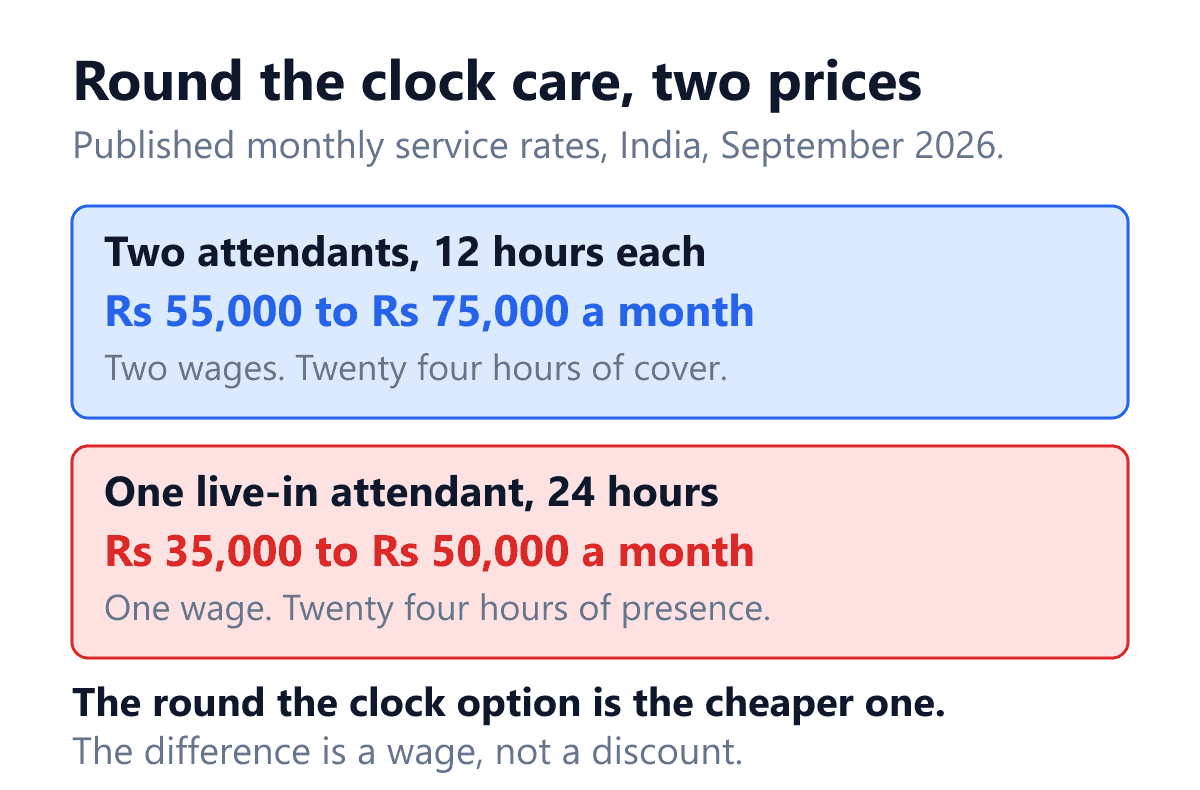
Families read the cheaper line as better value. Agencies know it is a different product and mostly do not say so out loud, because saying so out loud invites the question this article is about. Where it bites is not the sales conversation. It is eleven months later, when an attendant leaves unhappy and files a claim for the hours, and the only record the agency holds is one check in at eight in the morning and one check out at eight the next morning.
That record says twenty four hours. It is the agency’s own record, produced by the agency’s own app, and it is going to be read against the agency.
There is no lawful twenty four hour shift
Section 25 of the Occupational Safety, Health and Working Conditions Code, 2020 says no worker shall be required or allowed to work more than eight hours in a day, and then leaves the intervals and the spread over to be notified by the appropriate Government. Spread over is the elapsed clock from the start of duty to the end of it, breaks included. It is not hours worked, and the two figures behave very differently.
We took the arithmetic apart in full in the piece on security guard duty rosters, because private security has the same twelve hour habit. The short version: with the spread over ceiling at twelve hours and a central notification under section 25(1)(b) forbidding more than five continuous hours without a thirty minute break, the most work that fits inside a lawful day is about eleven hours, not twelve. That is why two guards cannot cover a twenty four hour post, and it is why one attendant certainly cannot.
Everything past the daily limit is overtime at twice the ordinary rate under section 14 of the Code on Wages, 2019. So a record showing twenty four hours of duty is not merely untidy. It is a bill.
The two bad records, and most agencies hold one of them.Record the full twenty four hours as duty and you have written down roughly thirteen hours of overtime a day at 2x, which nobody is paying and which sits there waiting. Record eight hours and leave the rest blank and you have sixteen unexplained hours a day in which your attendant was demonstrably in somebody’s house, which is the version a labour inspector finds and the version the attendant’s own claim will describe.
There is no third option that consists of writing less down. The only way out is a record that holds the shape of the day rather than its endpoints.
What the shape of a live-in day looks like
A live-in attendant on a typical elder care placement is not working continuously and is not resting continuously either. There is a morning block, bathing and dressing and breakfast and medicines. There is a midday block. There is an evening block. In between there are hours in which the attendant is in the house, available, and not doing anything that any reasonable person would call work. At night there may be two interruptions or none.
Recorded properly, that is a small number of duty blocks totalling something in the region of a normal working day, sitting inside a twenty four hour presence. Recorded as one session, it is twenty four hours of work. The difference between those two records is not a matter of opinion or of being generous to the attendant. It is the difference between a defensible file and an indefensible one, and the thing that produces it is structural: a date has to be able to hold more than one duty session. Any system that stores one check in and one check out per person per day cannot represent a live-in placement at all.
We ran into exactly the same limit from the other direction with gym trainers working mornings and evenings, and wrote it up in the piece on gym staff attendance. A trainer’s six to ten and five to ten day records as sixteen hours in a single row system. A live-in attendant’s day records as twenty four. Same bug, larger number.
A cover record is not an attendance sheet
Now the second question, and this is the one that actually loses contracts.
Take a straightforward two attendant post. A works eight in the morning to eight at night, B works eight at night to eight in the morning. On Tuesday A leaves at 19:58 because her bus is at eight. B arrives at 20:12 because the traffic was bad. Both file correct timesheets. Both are paid correctly. Neither has done anything wrong.
For fourteen minutes, a person who cannot get out of bed unaided was alone in a flat.
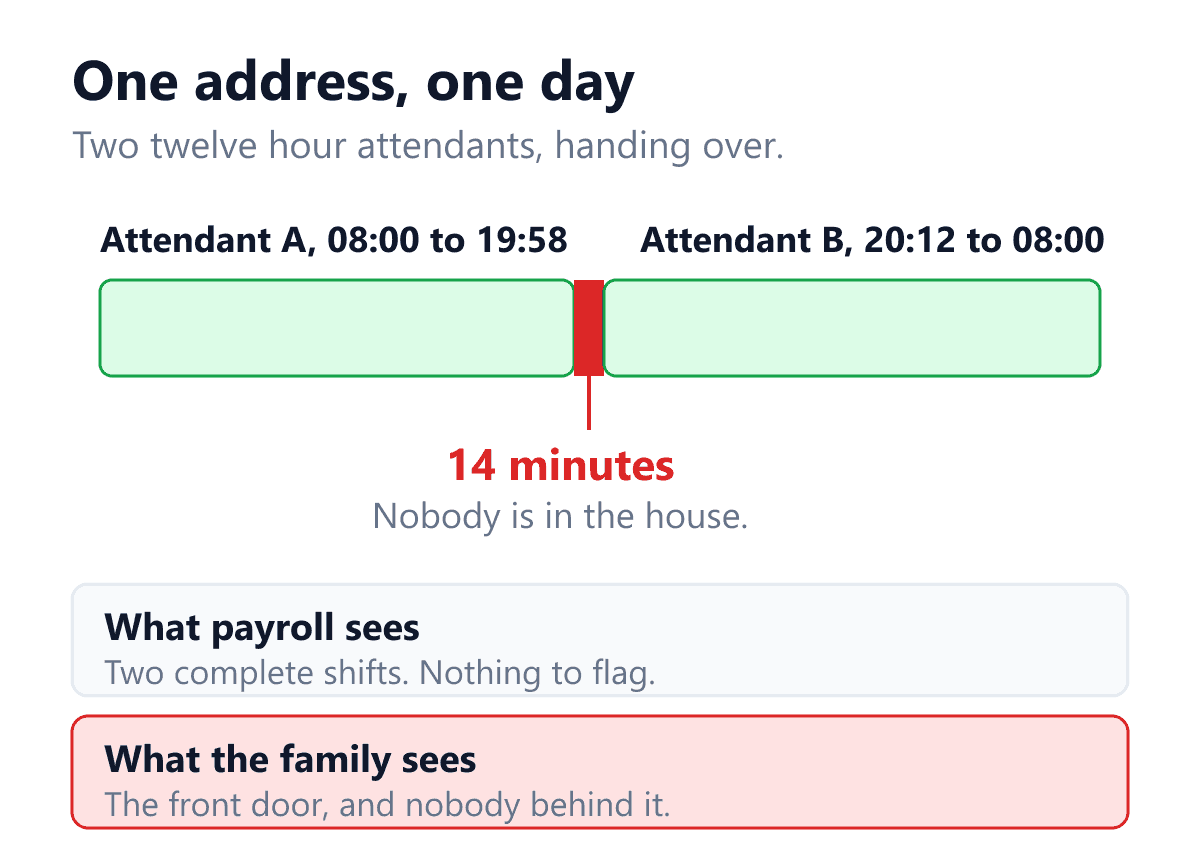
Here is the structural point, and it is worth reading twice because it explains why buying a better attendance app does not fix this. An attendance sheet is keyed on the person. A cover record is keyed on the address.The first holds one row per employee per day and answers “did this person work”. The second is a single timeline per patient and answers “was this address covered at every minute”. They are different data structures, and you cannot derive the second from the first by looking harder at it. You derive it by building it.
Once you have it, a gap is not something anybody has to notice. It is a query. Sort the day’s sessions for one address by start time, walk the list, and any point where the next start is later than the previous end is a gap with a duration attached. It can be alerted on while it is happening rather than discovered when the family calls.
What the office sees when the relief does not come
In Shiftelio this is no longer a query somebody has to remember to run. A patient on round the clock care is a 24-hour duty with a handover time, and the handover is checked against the address, not against either attendant. Take Mrs Pai, whose day attendant Anjali is due at eight. If nobody from the relief side has checked in at Mrs Pai’s door thirty minutes after the handover, three things happen.
- The day board says so. Care, then Today, lists the duty at the top of what needs attention as Handover missed · 40 min, counting up, with one line under it: Anjali hasn’t reached. Meena is still there. The board knows Meena is still there because her own duty at that address is still open.
- The office is told, not just the screen. At thirty minutes the owner, every coordinator whose role can manage patients, and the person the owner named as on call for the night get a push and a Telegram message. It names the patient and, if somebody is still at the address, names her too: Meena is still there, ask them to stay, or send relief. If nobody is, it says the thing that matters: the patient may be alone, call now. Fifteen minutes later, if still nobody has come, it goes out once more.
- The menu carries a number. An office that has switched push and Telegram off still sees it: the Today link under Care shows a badge with the number of duties whose relief has not come, refreshed every five minutes, on every screen of the business app.
The board gives two moves. Send relief arranges cover from the same card. Ask Meena to stay sends Meena a push asking her to stay with Mrs Pai until relief arrives; the row then reads Meena staying on, and her duty stays open until somebody takes over. It is never closed for her. That matters for the first half of this article: the extra hours she stays are recorded as hours at that address, which is exactly the record a wage claim will later ask for.
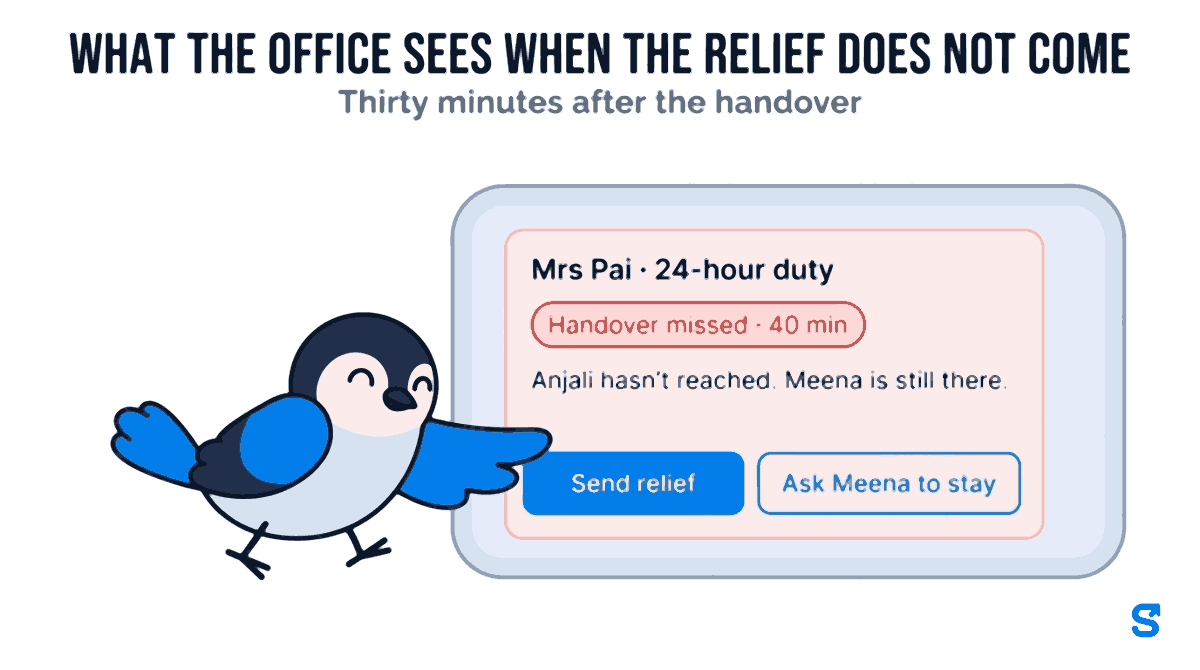
Be clear about what the thirty minutes means. It is a deliberate wait, because a real handover often runs a little over while the night attendant briefs the day one. So the fourteen minute Tuesday above would not raise an alarm. A Tuesday on which B never came would, at half past eight, and it would say whether A was still in the flat or whether the patient was alone.
The test. Ask your current system: for patient X, last Tuesday, list every minute of the day nobody was on site.If the answer involves opening two attendants’ records and comparing them by eye, you do not have a cover record. You have two attendance rows and a hope.
The replacement clock nobody starts
The same structure settles the other promise every agency makes and almost none measures. When an attendant calls in sick at six in the morning, the contract usually says a replacement within some number of hours. The clock on that promise starts at the moment of the call and stops when somebody else checks in at the address.
Both of those are events an address timeline already holds. In a per-person system they are in two different places, so the elapsed time between them exists nowhere and is never reported. Agencies that cannot report it tend to believe they are better at replacements than they are, because the memorable cases are the good ones.
A geofence at a private house is a different problem
Location verification at a patient’s door is not the same job as location verification at a site gate, and treating it as the same is how agencies end up with a feature everybody has quietly worked around.
- The radius is the whole design. A hundred metre circle around a flat in a dense Indian neighbourhood contains the building, the next building, the chai shop and the bus stop. A radius tuned for a construction site proves nothing at a residential address. A tight radius, on the other hand, fails indoors on a low floor with poor GPS, and an attendant who cannot check in is an attendant who phones the office every morning until somebody switches the check off.
- There is no device at the door. Nobody is mounting a fingerprint reader in a client’s home. The attendant’s own phone is the only terminal there is ever going to be, which makes the selfie and the mock location check load bearing rather than optional.
- The address is the family’s data, not the attendant’s. This is the one agencies miss. A patient’s home address, tied to a named person and a care need, is personal data about a household that never signed your employment contract. It belongs in the system because the work happens there, and it should not be sitting in a WhatsApp group or a shared spreadsheet of addresses. We went through why consent is the wrong basis to lean on for attendance data, and what to lean on instead, in the DPDP piece. The reasoning applies with more force when the data subject is your customer’s parent.
There is a related trade worth naming. A live GPS trail of an attendant inside a private residence is both intrusive and useless: you learn that she moved between two rooms. What is worth recording is the boundary, arrival and departure at the address, plus the duty blocks in between. That is the record that answers every question above and collects nothing that has to be defended later.
The patient’s home is your workplace under the POSH Act
Home care attendants in India are overwhelmingly women, working alone, in the house of a stranger, often at night. Agency owners tend to assume the POSH Act is an office law. It is not, and the 2013 Act puts a patient’s house inside the definition of workplace twice over.
Section 2(o) of the Sexual Harassment of Women at Workplace (Prevention, Prohibition and Redressal) Act, 2013 includes, at clause (v), any place visited by the employee arising out of or during the course of employment including transportation provided by the employer, and at clause (vi), in four words, a dwelling place or a house. Your attendant’s workplace is an address you do not own, cannot inspect without permission, and have no staff at.
Two consequences follow that are specific to this trade.
The first is that the respondent may not be your employee. The person an attendant complains about in a home care placement is far more likely to be a member of the patient’s household than a colleague. An Internal Committee has reach over the people the employer employs, so the disciplinary route it normally ends in is simply not available. That is not the end of the employer’s obligations, it is the start of a different one: section 19(h) requires the employer to cause action to be initiated, if the aggrieved woman so desires, where the perpetrator is not an employee, in the workplace at which the incident of sexual harassment took place. That clause was written for exactly this shape of problem and is almost never quoted. Section 19(a) sits alongside it and is broader than most employers realise: a safe working environment which shall include safety from the persons coming into contact at the workplace.
The second is that the constitution of the committee is a threshold question you should check rather than assume, and the threshold is not where most people think it is. We took that apart in the piece on the ten employee rule. An agency with thirty attendants on its books is comfortably inside it.
The operational version of all that.Three things, none of which need a lawyer. Record which attendant was at which address, at what time, every day, because a complaint about an incident at a house you have no record of anybody being at is a complaint you cannot investigate. Make the placement itself reviewable, so that an address an attendant has asked not to return to is a flag on the roster rather than a conversation somebody remembers. And put the committee’s contact details where an attendant can reach them from her phone at the address, not on a noticeboard in an office she visits twice a year.
What the record has to hold
Everything above reduces to a handful of fields. If your system has them, most of these problems stop being problems. If it does not, no amount of diligence in the office will hold, because the diligence is the thing that fails first.
| What is recorded | Why it has to be there |
|---|---|
| The address as its own object, not a text field on a shift | A cover timeline, a handover gap and a replacement clock are all queries against one address. None of them exists if the address is a string. |
| The shift: arrival and departure at that address | This is the cover record. It is what the family is buying and what the contract is written against. |
| The duty blocks inside it, separately from the shift | The only way a live-in day answers the wage question. Presence is not work, and the file has to say which was which. |
| A visit as a distinct thing from a shift | A nurse who comes for forty minutes to change a dressing is not covering the post. Recorded as a shift she looks like cover that is not there; recorded as nothing she is not paid. |
| Whether a visit is inside the placement or extra | Decides whether the attendant is paid again for it and whether the family is billed again for it. Left implicit, it is decided differently every month by whoever is doing payroll. |
| What the family is charged against what the attendant is paid, per placement | The margin on a home care placement is thin and per-patient. Agencies that only see it in aggregate keep unprofitable placements for years without knowing which ones they are. |
Software for a home care agency in India
A thirty day fix if you are running on a WhatsApp group
In order, because the later steps are worthless without the earlier ones.
- List every live placement as an address, not as a patient name. Address, the attendants assigned, the hours contracted, what the family pays, what each attendant is paid. This is the painful week and it happens once.
- Classify each placement honestly: shift cover or live-in presence. They are different products and they need different records. Mixing them is what produces the twenty four hour timesheet.
- For every live-in placement, write down the duty blocks. Morning, midday, evening, and whatever night interruptions are actually typical. Total them. That total, not twenty four, is what the day should be recording, and getting it on paper before it goes in a system is what stops it being invented later.
- Move check-in to the attendant’s phone at the door, with a radius set for that address. Then leave it alone for two weeks and look at the failures rather than at the successes, because the failures are where the radius is wrong.
- Run the gap query on one week of real data before you tell anybody it exists. Most agencies find their handover gaps cluster on two or three addresses and one shift boundary, which is a rostering fix rather than a discipline problem.
- Put the margin per placement in front of whoever prices new work. It changes what gets quoted within a month.
Questions home care agency owners ask
Is a live-in attendant legal in India?
The placement is legal. A twenty four hour working day is not, and the two are different claims. Nothing stops an attendant living at a placement; what the law limits is hours of work, which is why the record has to distinguish duty hours from hours of presence. An agency that can show a live-in day as a normal working day plus rest is in a completely different position from one whose own app printed twenty four hours.
Who is the employer, the agency or the family?
If you recruit, roster, pay and can reassign the attendant, you are the employer, whatever the placement agreement calls her. That is where PF and ESI liability sits, where the POSH duties above sit, and where a wage claim will be filed. Describing an attendant as independent while controlling her roster is the arrangement that fails hardest when it is examined.
Do I need a biometric machine for home care?
No, and there is nowhere to put one. The work happens at addresses you do not control, so the attendant’s phone is the only terminal available. The comparison against a fixed device, and what a location check plus a selfie actually proves that a fingerprint does not, is in GPS attendance without a biometric device.
What about attendants at addresses with no network?
Basements, lifts and older buildings will produce this several times a week. What matters is that a check-in captured with no signal is stamped with the time and place it actually happened rather than the moment it eventually reached the office, and that it is visibly marked as late. We set out the four different things vendors mean by the word offline in the offline attendance piece.
How do I pay an attendant who covers somebody else’s shift at short notice?
As hours at that address, which is the point of keying the record on the address. A cover shift is not an exception to be handled by hand at month end; it is an ordinary session that happens to have a different person attached. The version that breaks is the one where cover is recorded as an adjustment on somebody’s payslip, because adjustments are invisible to every report you have.
The short version
- A twenty four hour live-in attendant is published at a lower monthly price than two attendants on twelve hour shifts. The cheaper product contains one wage, which means most of the day is being sold as presence rather than work.
- Indian wage law has no unit called presence. Section 25 of the OSH Code caps the working day and section 14 of the Code on Wages prices everything past it at 2x, so a single check in and check out pair on a live-in day writes down either a bill or a hole.
- A date has to hold more than one duty session, or a live-in placement cannot be recorded correctly at all.
- An attendance sheet is keyed on the person and a cover record is keyed on the address. Two correct timesheets can still leave a house empty for fourteen minutes, and only the second structure can see it.
- In Shiftelio a 24-hour duty whose relief has not checked in thirty minutes after the handover shows as Handover missed, names who is still at the patient’s, and is pushed to the office twice, with a badge on the Care menu for offices that keep notifications off.
- A geofence at a private residence needs a per-address radius, and the address is the family’s personal data before it is your operational data.
- Section 2(o) of the POSH Act puts a dwelling place inside the definition of workplace, and section 19(h) binds the employer to act even where the perpetrator is not an employee. For this trade that is the normal case, not the edge case.
Sources, and how these were checked
- The home care service rates are published monthly figures for round the clock elder care in India, read in September 2026 from a public cost guide for 24x7 in-home care. They are third party service prices, quoted as ranges, to establish a ratio rather than a quote. They are not our prices and they are not software prices.
- Hours of work and spread over: the OSH Code, 2020, section 25. The eleven hour ceiling is a plain reading of the spread over limit against the central rest interval notification under section 25(1)(b), derived in full in the security guard roster article and applied here. No authority has been asked to reconcile the two provisions.
- Overtime at twice the ordinary rate: the Code on Wages, 2019, section 14.
- Workplace, and the employer’s duty where the perpetrator is not an employee: the Sexual Harassment of Women at Workplace (Prevention, Prohibition and Redressal) Act, 2013, sections 2(o)(v), 2(o)(vi), 19(a) and 19(h).
Nothing here is legal advice. The provisions are cited so you can read them yourself, and the parts that are a reading rather than a quotation are marked as such.
Keep reading
See how Shiftelio does this in practice with attendance keyed to the place, across as many addresses as you have.
Still deciding what to buy? Compare what GPS attendance actually costs once location is not an add-on.
Free to use, no signup: HR letter formats.