Offline Attendance in India: Four Promises Hiding Behind One Feature Tick
In short
An offline punch can be lost, recorded at the wrong time or placed at the wrong site. What to ask any vendor, and what a late offline check-out does.
A fabrication unit outside Hosur runs twenty nine people across a shed, a stores basement and a client site forty minutes away. The attendance app went in eight months ago and it works. Then the invoice month closed and the supervisor brought the owner a list of eleven entries that did not look right. Two people had no in-time at all on the 4th. Four had checked in at 6:14 pm, which is roughly the time they went home. One had checked in at the site and then, according to the record, at a petrol pump on the Krishnagiri road.
Nobody had cheated. Every one of those eleven entries was a punch made where there was no mobile signal, and every one of them was the app doing exactly what it was built to do. The problem is that “works offline” is not one promise. It is four, they can fail independently, and the feature list on the pricing page will not tell you which of them you bought.
This piece is about the four, what to ask any vendor about each, and the part almost nobody thinks about until the month closes: what a hole in the attendance record actually costs you once it is there.

The hole in the register is yours to explain, not the network’s
Start with why this is worth an afternoon rather than a shrug. Section 50(1) of the Code on Wages, 2019 requires every employer to maintain a register of the persons employed, the muster roll and the wages paid. Rule 51 of the Rules made under it gives that register a shape and a number: Form IX, the Attendance Register-cum-Muster Roll, maintainable electronically, with a row for every worker for every day, carrying presence, hours worked, overtime hours and the weekly off taken. We took the whole set apart, column by column, in the article on statutory registers and wage slips.
The structural fact that matters here is this: Form IX does not have a blank. There is a row for the 4th whether or not the punch arrived, and you have to write something in it. There are two things you can write, and both of them cost you.
You can mark the worker absent and deduct the day. This is the expensive one, and the reason is narrower than most people expect. Section 20(1) of the Code authorises a deduction for absence from the place or places where the person was required to work. It authorises a deduction for absence. It does not authorise a deduction for a gap in your record. If the worker was standing at the site gate at 8:02 and your app did not capture it, they were not absent, the deduction is not on the section 18(1) list, and the excess is recoverable from you under section 45. The full arithmetic, including the proportion rule that ends half-day penalties, is in the article on salary deduction rules.
Or you can mark them present from memory.Now the register is a reconstruction. That is not fatal by itself, and every business does some of it. What makes it uncomfortable is that Form IV, the wage register, has to reconcile against Form IX, and the overtime column is where it shows. An entry saying a worker was present for nine hours on the 4th, written in from the supervisor’s recollection in the second week of the following month, is a number with nothing behind it. If it is ever challenged, the burden of showing it is right sits with you.
The sentence worth keeping. A missing punch is not an absence. It is a missing punch. The moment you treat one as the other you have converted a network problem into a wage problem, and the wage problem has a section number attached to it.
Works offline is four promises wearing one label
Here are the four, in the order they bite. An app can pass any one of them and fail the rest.
One: the punch must not be lost
A punch made with no connection has to survive until there is one. On an entry-level Android phone the app competes with a battery manager that closes apps in the background. Add the worker swiping the app away, the phone restarting, or a battery that dies at four in the afternoon, and a weak app has lost the punch.
What makes this the cruellest of the four is that the worker cannot tell. They saw a tick. They will tell you in December that they punched in, they will be right, and there will be no record of it.
Two: the record must show when the person punched, not when the phone found a signal
This is the one that produced the 6:14 pm entries at Hosur, and it is the most damaging of the four because it is completely silent. The register looks full. Every row has an in-time. It is just that the in-time is the moment the phone reached a tower, not the moment the person reached the gate.
Follow what that does downstream. The worker who arrived at 8:02 is now ten hours late, so any late-mark rule fires. The day's hours come out as nonsense or negative. Every one of those broken numbers then flows into Form IV as an overtime figure.
Three: the record must show where the person was standing
Location verification is the reason most Indian businesses moved off a paper register, and it is the first thing a weak offline mode can quietly break. If the record shows where the phone was when the signal came back, you get the petrol pump on the Krishnagiri road.
It fails in both directions and neither is good. Either a genuine punch is rejected, or your record now positively asserts that a worker was somewhere they had never been. The second is worse, because it looks like data. The general case of geofencing and location verification is covered in GPS attendance without a biometric machine.
Four: the time must be one a worker cannot simply change
Offline is where a phone's clock is the easiest thing to tamper with, and an app that simply trusts it makes offline mode the easiest fraud in the product, needing no technical skill. This is the real reason a lot of attendance products either avoid offline mode or quietly record the time the phone got a signal. Doing offline properly means not taking the phone's word for the time, and it is the question where vendors most often go vague.
Two things called offline that are not the same thing.A fingerprint or face terminal on the wall is offline in the sense that the box keeps punching when the broadband is down. The record is then stranded on that device until somebody walks over with a laptop and pulls it off. A phone is offline in the sense that the record is in the worker's pocket and reaches you by itself later. Both get advertised with the same word, and the difference decides what a lost or damaged machine costs you.
Five questions to put to any vendor before you pay for a year
You do not need a technical evaluation to separate the four. Ask these in plain words, and ask for the answer on the plan you actually intend to buy, not on a sales demo.
| Question | What a good answer sounds like |
|---|---|
| If my worker punches with no signal, what do they see? | The app confirms the punch and says it is saved and will be sent later. "Try again when you have internet" is a fail on the spot. |
| What if the phone is switched off or the app is closed before it reconnects? | The punch is still there afterwards. A vendor who is vague here has built it for a demo. |
| Which time do I see on the owner screen? | The time the worker pressed the button, not the time the phone reconnected. |
| Which place do I see? | Where the worker was standing when they punched. |
| Can a worker change the phone's time to get a different punch time? | A clear no, or a visible flag for the owner. "Employees would not do that" is not an answer about the software. |
The last question is the one worth insisting on. A vendor who has not thought about it will tell you your staff would not do that, which says nothing about the software.
Which attendance app actually holds a punch made with no signal
Attendance regularization when the offline check-out arrives after the day was closed
The four properties are about the check-in. The check-out has a trap of its own, and it is the one that used to turn into a request to regularize attendance a week later. A worker leaves the stores basement at 6:42 pm and taps check-out with no signal. But the shift does not wait for the phone: the app closes it automatically, or a manager closes the day by hand at 7:30 pm because the register showed the worker still on site. When the phone finally reaches a tower, there is already a closing time on the record, and it is not the true one.
Shiftelio does not throw the worker's check-out away and does not quietly trust it either. Either the phone's time replaces the close, or the owner decides.
When the phone's time can replace the close
When the worker's own check-out is earlier than the close, as with the 6:42 pm check-out against the 7:30 pm close, it can replace the close and the hours are worked out again. Moving a check-out earlier can only reduce the hours paid, so nobody gains by supplying it. A later check-out, which adds hours, has to clear stricter checks before it is accepted.
Either way the Attendance Edit Log writes the reason in plain words, for example "Check-out made on the phone without signal (photo taken then). It replaced the automatic clock-out." For a manager's close it names who: "It replaced the manual close by Ravi S. (Manager)." The day's history shows the change as Replaced by offline check-out, and the owner can tap Restore to put the day back exactly as it was before: the time, the photo, the fines and the pay type.
When it waits for the owner
Some closes the phone never replaces by itself: a supervisor who checked the worker out on their behalf, a day whose pay is already settled, a day the owner or a manager changed after it was closed. Those, and any check-out that cannot be confirmed, are held for the owner.
A held check-out goes to the owner's Pending approvals as an Offline check-out card with two buttons: Use phone time or Keep 7:30 PM. Only the owner or a co-owner can decide it, never a manager, and never on their own day. If the pay for that day is already settled, Use phone time asks first, because it changes the hours of a settled period.
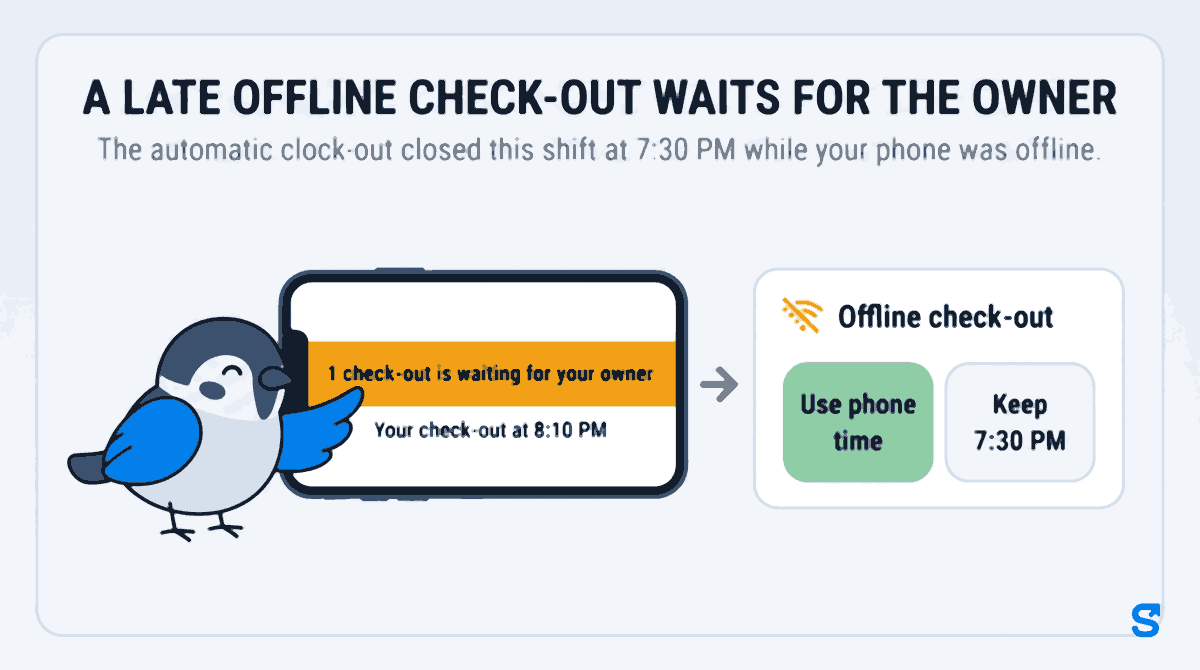
On the worker's phone a held copy is amber, never red, and the banner reads 1 check-out is waiting for your owner. A line under it says why in one sentence, and the photo is saved. When the owner taps Use phone time, the copy clears. When the owner keeps the recorded time, the phone says "Your owner kept 7:30 PM." Nobody has to argue about whether the worker really tapped check-out, and nobody waits for a manager to remember it.
What is left for a manual fix
A regularization request is now the rare case: a check-out that never reached the phone, or one tapped online after the day was closed. The phone still keeps such a copy and offers Show my manager, a large sheet with the phone's time and the close time side by side. The manager then corrects the day in the normal edit screen, and can tap Add photo under Check-out photo (optional), for example the photo the worker sent on WhatsApp from the basement door. The app labels it honestly: "It will show as added by you, not taken in the app." A photo the worker took in the app is never replaced.
On the manager's attendance calendar, any day holding an offline time that could not be confirmed carries an Offline time not checked pill, with a button that shows only those days. The doubtful time is not hidden and it is not silently trusted.
What to do about the holes you already have
If you are reading this in the week the month closed, you have a list like the Hosur owner’s. Three things, in order.
| Do this | Why |
|---|---|
| Correct the entry, and record that it was corrected and on what basis | A Form IX entry fixed from the supervisor’s sign-off sheet, with that noted, is a defensible record. The same entry silently overwritten is not, and the difference is one column. |
| Do not deduct for a day you cannot show the person was absent | Section 20(1) authorises a deduction for absence from the place of work, not for a gap in the record. Paying the day and fixing the system is cheaper than a recovery under section 45. |
| Write down what happens when there is no signal, and tell people | Most sites have two or three known dead spots. A worker who knows the punch is saved will punch and walk on. A worker who thinks it failed will punch four times, or not at all. |
The last one is worth more than it looks. The regulator itself has stopped assuming that a village listed as covered has a working signal in it: in July 2026 the Department of Posts and TRAI signed an agreement to survey mobile network performance across more than 5.68 lakh villages, with Gramin Dak Sevaks carrying a TRAI app on their delivery rounds, precisely because the official coverage map and the bars on a handset are not the same measurement. If the government needs a field survey to find the dead spots, your supervisor is allowed to write down the three he already knows about.
If the dead spots are at client sites rather than at your own premises, the operational half of this is a multi-site problem as much as an offline one, and that is covered in keeping one attendance record across several locations. On a construction site it is usually both at once, which is its own article.
Questions owners ask
Half my staff have no data left by the twentieth of the month. Is that the same problem?
To the app it is identical, and that matters: an exhausted data pack, a phone in flight mode to save battery, and a shed with no tower all present as the same thing, which is no connection. It also means the problem is far more common than your coverage map suggests, and that it arrives on a schedule. If your punches go strange in the last ten days of the month, this is why.
Can I not just let the supervisor mark the ones that failed?
You can, and for a genuine failure you should, with the correction recorded. What you cannot do is make it the routine, because a supervisor marking attendance is the practice the in-time and out-time columns of Form IX were designed to replace. A register filled in by one person about other people, after the fact, cannot show when or where any entry was made.
Is a biometric machine safer, since it works without internet?
It is safer against a changed phone clock, because the worker never touches the clock. It is much less safe against everything else: the punches sit on that device until somebody collects them, a machine that is lost, stolen, damaged or simply not downloaded takes the month with it, and it only works for people who walk past that one wall. That is the trade, and for a single fixed gate it is often the right one.
What happens if someone punches in offline and out online?\
That is the normal case at a site with one dead spot, and it is worth asking a vendor about specifically. The right behaviour is that the day shows the correct hours however the two halves arrive. The wrong behaviour is an open session, a missing half, or a negative day.
Does an offline punch stand up if an employee disputes their wages?
It stands up exactly as far as the record can show the time was not typed in by the person it benefits. A punch that shows when and where it was made, with the time protected from tampering, is a contemporaneous record. A punch whose only timestamp came from the worker's own phone settings is a claim. The difference is invisible on screen and total in an argument.
What is attendance regularization, and does an offline punch need one?
Regularization is the request to fix a day the record got wrong: a missed punch, a wrong check-out, a day marked absent that was worked. An offline punch that arrives normally needs none, because it carries the real time it was made. When the shift was closed before the phone's copy arrived, Shiftelio no longer leaves it to a request: the phone's time replaces the close when it can be trusted, and otherwise the owner decides on a Pending approvals card with Use phone time or Keep. A manual regularization is left for the rare copy that never reached the phone's queue, or a check-out tapped online after the day was closed. The Attendance Edit Log keeps who changed what and when, and the owner can Restore a day the phone's time replaced.
We are on the web app, not the Android one. Does that change anything?
Offline attendance works the same way. The one difference is that in a browser a phone whose clock was changed before it went offline is flagged for the owner rather than proved wrong. If your sites are the kind where that matters, the app is the version to deploy.
Sources
Read directly. Section 50(1) of the Code on Wages, 2019 is the register obligation, and rule 51 of the Rules made under it prescribes the registers including Form IX, the Attendance Register-cum-Muster Roll, which may be maintained electronically. Sections 18, 20 and 45 govern authorised deductions, the proportion rule for absence, and recovery of an excess. The Codes and the rules made under them are carried on the Ministry of Labour and Employment’s labour codes pages and the bare text on India Code. The network survey is the Department of Posts and TRAI memorandum of understanding announced on 10 July 2026.
Not claimed.No attendance product other than our own is named, and nothing here asserts that any particular rival fails any particular one of the four tests. They are described as properties to check, because checking them takes five minutes and taking somebody’s word for them takes a year. No rupee figure is typed for our own pricing; the table above renders from the same source as the pricing page. Nothing here is legal advice.
Keep reading
See how Shiftelio does this in practice with the geofence, the selfie and the mock-location check, on one page.
Still deciding what to buy? Compare what nine attendance apps cost for 25 employees with GPS switched on.
Free to use, no signup: Attendance register generator.