Salary Deduction Rules in India 2026: The Closed List, and What Docking a Half Day Really Costs
In short
Section 18 of the Code on Wages is a closed list. The lawful deductions, the 3 per cent fine cap, the 50 per cent ceiling, and the seven days you owe first.
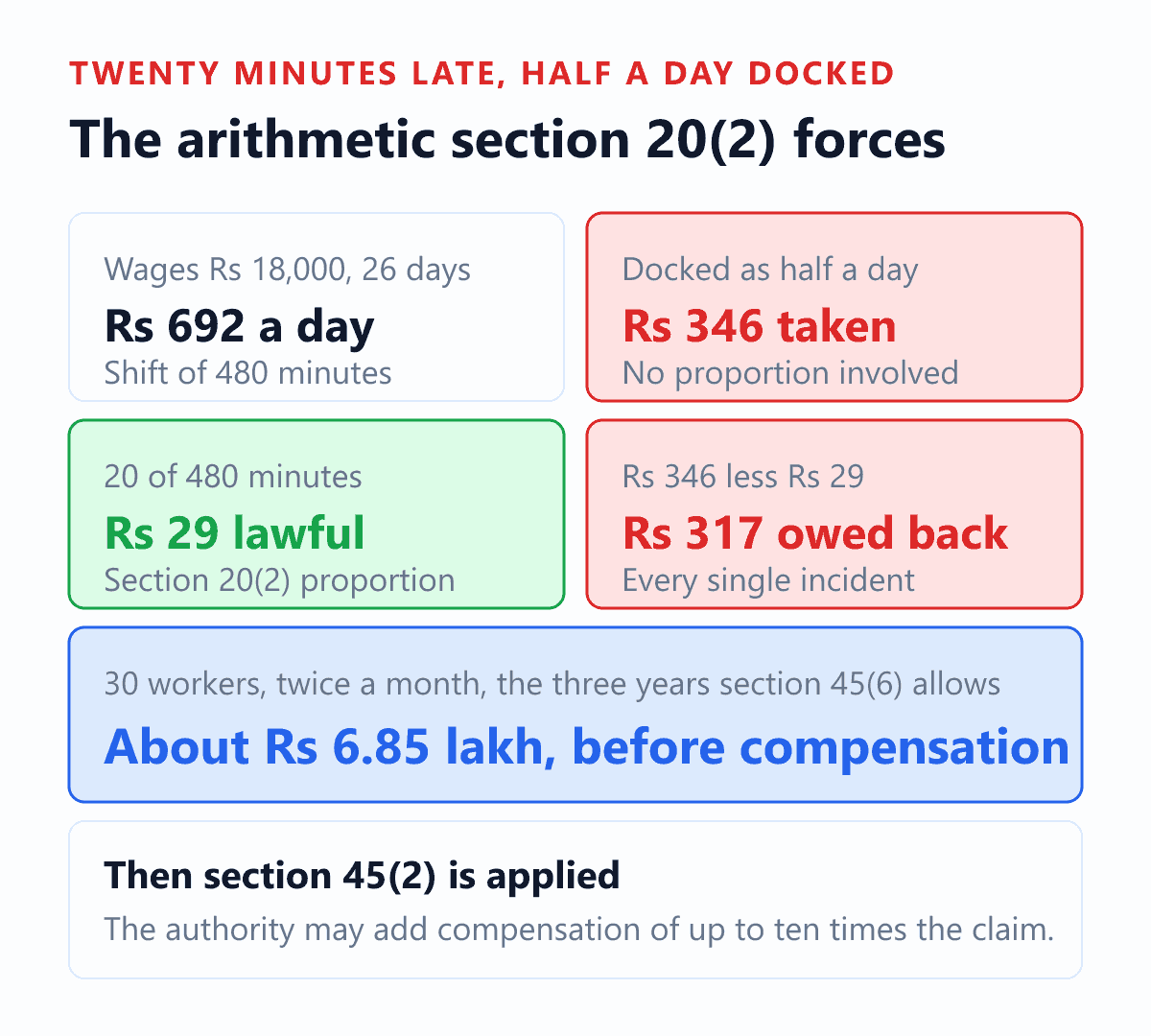
Somebody walked in at 9:20 instead of 9:00. Your supervisor marked it half a day, payroll took Rs 346 off the month, and nobody said anything, because that is how it has always worked and the rule was written on a notice board four years ago.
Under the Code on Wages, 2019 that deduction is almost certainly unlawful, and not by a technicality. Section 20(2) sets the size of an absence deduction by arithmetic, and twenty minutes of a 480-minute shift is worth about Rs 29, not Rs 346. The other Rs 317 is money that left a payslip without authority, which is a specific and expensive thing to have done.
This article is about the four separate tests a deduction has to pass, the procedure the Code on Wages (Central) Rules, 2026 added on 8 May 2026, and what it costs when one of them is missed. Most of it is not hard. Almost none of it is what a payroll sheet currently does.
Section 18(1) is a prohibition, not a permission
Employers tend to read deduction law as a list of things they may do. It is written the other way round. Section 18(1) says:
"Notwithstanding anything contained in any other law for the time being in force, there shall be no deductions from the wages of the employee, except those as are authorised under this Code."
Everything after that is a carve-out from a ban. The consequence is that a deduction does not become lawful because it is fair, or because the employee agreed to it, or because it is in the appointment letter. It becomes lawful only if it is one of the purposes the Code names. Consent is not a source of authority here; the Code is.
And there are four gates, not one. A deduction that is on the list can still fail on procedure, on its own internal cap, or on the overall ceiling.
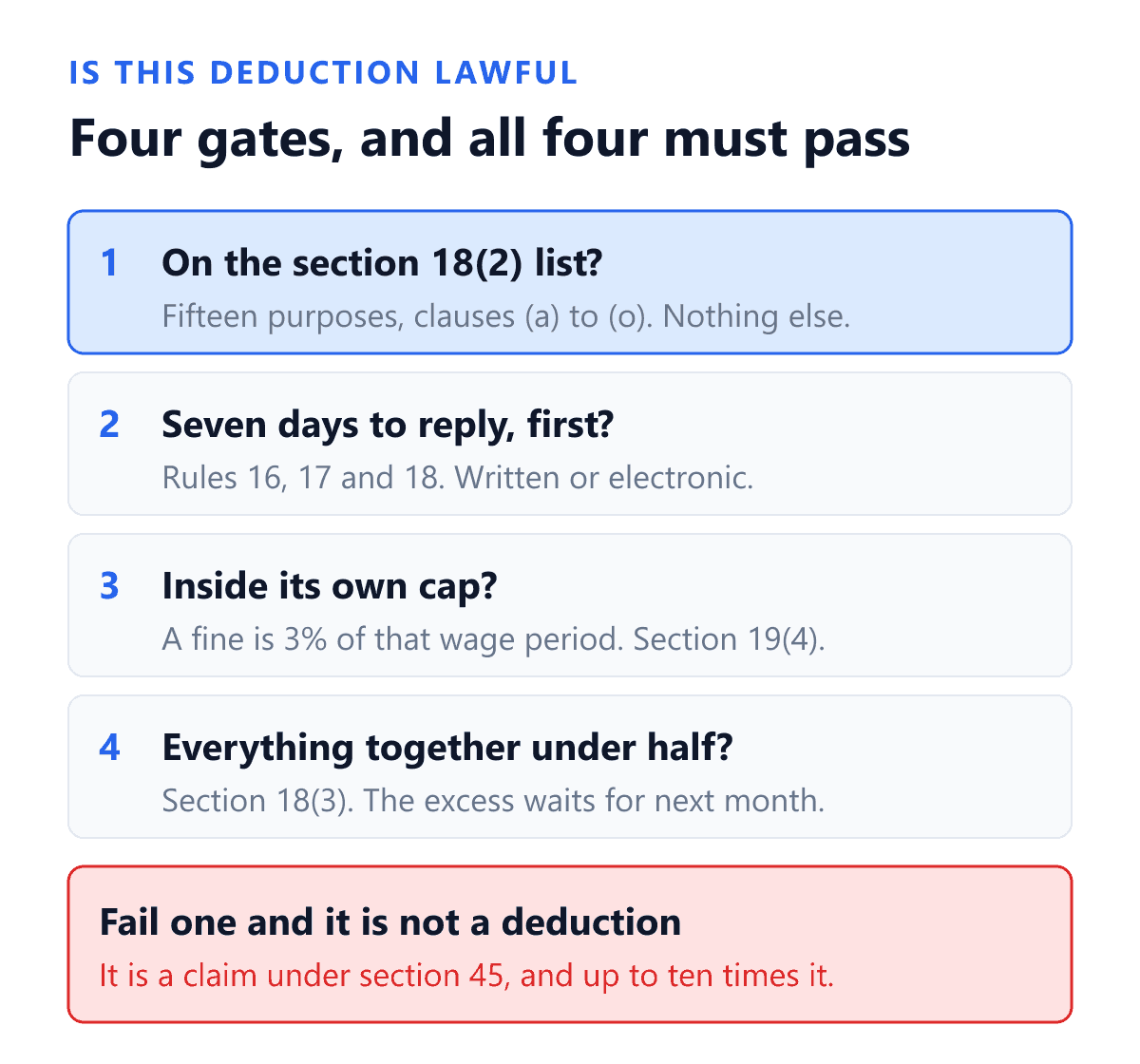
The fifteen purposes on the section 18(2) list
Section 18(2) runs from clause (a) to clause (o). It is a closed list. Nothing is added by implication, and the three railway clauses at (l), (m) and (n) are there precisely because Parliament had to name them one by one rather than rely on a general power.
| Clause | What it permits | The condition people miss |
|---|---|---|
| (a) | Fines | Only for acts approved in advance, and capped at 3 per cent of that wage period |
| (b) | Absence from duty | Strictly proportional to the time absent |
| (c) | Damage to or loss of goods expressly entrusted, or money to be accounted for | Only where directly attributable to neglect or default, and never more than the loss |
| (d), (e) | House accommodation, amenities and services | Capped at the value supplied, and "services" excludes tools and raw materials |
| (f), (g) | Advances, adjustment of overpaid wages, welfare-fund and house-building loans | Recovery is governed by rules 19 and 20 and by the 50 per cent ceiling |
| (h) | Income tax, any statutory levy, or a court order | No consent needed, and no consent can waive it |
| (i), (j) | Social security subscriptions and co-operative society payments | PF, pension and health insurance sit here, not under a general power |
| (k), (o) | Trade union fees, and the PM's National Relief Fund or a notified fund | Both require the employee's written authorisation |
| (l), (m), (n) | Three specific railway administration losses | Railways only. They do not generalise to other employers |
Run your own payslip against that table and the items that fall off are usually the same four: notice-pay recovery from someone who left early, a training bond, a penalty for breaking a rule that no authority ever approved, and the value of a uniform or a set of tools. None of those are on the list. If you want the notice-pay case worked through with numbers, the notice period recovery calculator does it.
Cash handed back is still a deduction
There is a common workaround: do not touch the payslip, just ask the employee to pay for the breakage in cash. Explanation (a) to section 18(1) closes it.
"any payment made by an employee to the employer or his agent shall be deemed to be a deduction from his wages".
So the cash is a deduction. It has to be on the list, it counts towards the fifty per cent ceiling, it belongs in the register, and if the purpose was not permitted then handing over notes rather than editing a payslip has not helped anybody. It has simply removed the only written record that would have shown the amount was reasonable.
Absence: the proportion rule that ends half-day penalties
Section 20(1) allows a deduction only for absence from the place or places where the person was required to work. Section 20(2) then sizes it:
"the amount of such deduction shall in no case bear to the wages payable to the employed person in respect of the wage-period for which the deduction is made a larger proportion than the period for which he was absent bears to the total period within such wage-period during which by the terms of his employment he was required to work".
That is a ratio, and it has no discretion in it. A late mark is an absence of the minutes actually missed. A half-day penalty for twenty minutes is a deduction of roughly twelve times the entitlement, and the excess is unauthorised under section 18(1) even though absence itself is on the list.
The proviso to section 20(2) is the one place a penalty larger than the ratio is allowed, and it is narrow: where ten or more employees absent themselves in concert without due notice and without reasonable cause, the deduction may include up to eight days' wages in lieu of notice. The Explanation adds that a stay-in strike counts as absence. That is a collective-action provision. It is not a stick for a single late arrival, and rule 17 of the 2026 Rules confirms as much by attaching its seven-day show-cause requirement specifically to that proviso.
The correction worth making today.If your policy says "three late marks equal one day's pay", that policy is levying a fine dressed as an absence deduction. As a fine it needs prior approval and is capped at 3 per cent of the wage period. As an absence deduction it is capped at the actual minutes. Either way the current number is wrong.
Fines: approval first, then notice, then three per cent
Section 19 is the most procedural part of the Code, and the 2026 Central Rules made it more so. A fine is lawful only if all of this is true:
- The act or omission is on a list approved in advance by the appropriate Government or prescribed authority. Rule 14 names that authority for Central sphere establishments as the Deputy Chief Labour Commissioner (Central) having jurisdiction.
- A notice specifying those acts is displayed, and rule 15 requires it in Hindi, English and the local language, physically or electronically, at a conspicuous place in the premises.
- A copy of that notice is sent electronically or by speed post to the Inspector-cum-Facilitator having jurisdiction. This clause of rule 15 is almost universally missed.
- The employee is given an opportunity to show cause. Rule 16 gives them seven days, and if no reply comes the fine may be imposed and must be intimated within fifteen days.
- Total fines in any one wage period do not exceed three per cent of the wages payable for that wage period.
- Nobody under fifteen is fined at all, no fine is recovered in instalments, and no fine is recovered after ninety days from the day it was imposed.
Then section 19(8), which changes what a fine is for. Every fine and every realisation is recorded in a register, and the money
"shall be applied only to such purposes beneficial to the persons employed in the establishment as are approved by the prescribed authority".
Fine money is not the employer's money. It is a fund held for the workforce, spent on purposes an authority signs off, and rule 51(2) puts the record of it in Form IV with the Deputy Chief Labour Commissioner (Central) as the approving authority. An employer who books fines to other income has not merely mislabelled a ledger entry.
Damage or loss: capped at the loss, and you owe a hearing
Clause (c) of section 18(2) is narrower than it reads. It covers damage to or loss of goods expressly entrusted to the employee for custody, or loss of money for which they are required to account, and only where the loss is directly attributable to their neglect or default. Ordinary wear, a shared tool nobody was made responsible for, and a shortfall nobody can trace to a person are all outside it.
Section 21 then adds two limits. The deduction shall not exceed the amount of the damage or loss, so there is no punitive element and no round figure. And it may not be made until the employee has been given an opportunity to show cause. Rule 18 sets that at seven days to explain, with the value of the damage stated to them, and fifteen days to intimate the decision if they do not reply.
Advances and loans: what the 2026 Rules quietly widened
This is the one place the new rules are more generous to employers than the law they replaced, and it is worth knowing because the old numbers are still being quoted.
| Recovery of an advance | Payment of Wages rules (repealed) | Rule 19, Code on Wages (Central) Rules, 2026 |
|---|---|---|
| Maximum spread | Not more than twelve months | No limit stated |
| Maximum per instalment | One third of the wage period | Determined by the employer |
| Overall ceiling | Half the wages, across all deductions | Half the wages, across all deductions, plus rule 13 |
| Where it is recorded | Register of advances | Form IV |
So the twelve-month spread and the one-third instalment cap are gone. What survives is the fifty per cent ceiling and the requirement that every instalment sits inside it. Two older limits do survive in the Code itself: section 23(a) says an advance paid before employment began is recovered from the first full wage period, but a travelling-expenses advance may not be recovered at all.
The fifty per cent ceiling, and what happens to the excess
Section 18(3): the total amount of deductions in any wage period shall not exceed fifty per cent of the wages. Section 18(4) says the excess may be recovered in such manner as may be prescribed, and until 2026 nobody had prescribed it. Rule 13 now does:
"the excess shall be carried forward and recovered from the wages of succeeding wage period, in instalments so that the recovery in any month shall not exceed the fifty per cent. of the wages of the employee in that month".
Two things follow. The excess is not forfeited, so a genuine debt does not vanish because one month was crowded. And it is not compressible either, so an employer cannot clear a backlog by taking seventy per cent in a quieter month. The ceiling applies to each month independently, forever, which means a large advance to somebody on modest wages can take a long time to come back and there is no lawful way to hurry it.
Note also what the ceiling is measured against: wages as defined in section 2(y), which is basic plus dearness allowance plus retaining allowance, with the exclusion list capped at fifty per cent of total remuneration. That is the same definition that drives the new salary structure rules, and it is usually a smaller number than the figure at the bottom of the payslip.
What an unauthorised deduction actually costs
Employers who look this up usually find section 54 and conclude the downside is a Rs 50,000 fine. The penalty section is the least of it. The claims machinery is section 45, and it is built for exactly this kind of small repeated error.
| Provision | Effect |
|---|---|
| Section 45(2) | The authority may order compensation in addition to the claim, extending to ten times the amount determined |
| Section 45(5) | A single application may be filed on behalf of any number of employees |
| Section 45(6) | Three years to file, extendable for sufficient cause |
| Section 45(4) | Filed by the employee, a registered trade union, or the Inspector-cum-Facilitator |
| Section 45(3) | Unpaid amounts are certified to the Collector and recovered as arrears of land revenue |
| Section 59 | For deductions not authorised by the Code, the burden of proving payment is on the employer |
| Section 54(1)(a) and (2) | Up to Rs 50,000 for paying less than due; up to Rs 10,000 for records not maintained |
Section 59 is what makes an incomplete record fatal rather than merely untidy. The employer has to prove the payment was made and the deduction was authorised. A muster roll that says "HD" against a name proves nothing about how many minutes were missed, so the entitlement cannot be demonstrated and the whole amount is at risk, not just the excess.
There is one piece of relief. Section 54(3) requires the Inspector-cum-Facilitator to issue a written direction with a compliance period before prosecuting the general contraventions under 54(1)(c) or the records offence under 54(2) - unless the same violation is repeated within five years. First-time record failures get a chance to be fixed. Short payment under 54(1)(a) does not.
The record that makes a lawful deduction possible
Almost every rule above resolves to the same question: what does your attendance record actually say?
A proportional absence deduction cannot be computed from a day-level mark. Half a day is not a fact about the day; it is a decision somebody made, and section 20(2) does not accept decisions. It needs minutes worked against minutes required. That is why an attendance system that records an actual in-time and out-time is not a convenience here - it is the only thing that can produce a defensible number. Shiftelio keeps the in and out to the minute against the shift each person was rostered on, so the ratio in section 20(2) is a calculation rather than an argument, and the same record is what feeds Form IX.
Advances and loans are the other half. Rule 19 permits instalments the employer sets, but every one of them has to land inside fifty per cent of that month's wages, and rule 13 pushes the excess into next month rather than dropping it. Doing that by hand across thirty people, some of whom also have a PF arrear and a co-operative subscription, is where the ceiling gets breached without anybody deciding to breach it. Shiftelio's loans and advances module holds the outstanding balance per person and stops the month's total deductions at the ceiling, carrying the remainder forward the way rule 13 requires.
The registers then fall out of the daily record rather than being assembled at year end: Form I for employees, Form IX for attendance, and Form IV for wages, overtime, advances, fines and deductions for damage and loss, all preserved five years after the last entry under rule 51(4). The detail on those three forms is in the statutory registers and wage slips guide, and if you only want to sanity-check one month's figures, the loss of pay calculator applies the fifty per cent ceiling for you.
Frequently asked questions
Can an employer deduct salary for being late in India?
Yes, but only in proportion to the time missed. Section 20(2) caps an absence deduction at the same ratio the absence bears to the hours the person was required to work. Twenty minutes of an eight-hour shift is twenty minutes of pay. Treating it as half a day is a deduction beyond authority, and the excess is recoverable under section 45.
Is a half-day deduction for late coming legal?
Only if the person was genuinely absent for half the working period. A half-day mark used as a penalty is a fine, and a fine has to be for an act approved in advance by the prescribed authority, noticed in three languages with a copy to the Inspector-cum-Facilitator, preceded by a seven-day show-cause, and capped at three per cent of the wage period. A half day is far above three per cent of a month.
What is the maximum deduction from salary in India?
Fifty per cent of wages in any wage period, across all deductions together, under section 18(3). Anything above that is carried forward into later months under rule 13, in instalments that themselves stay under fifty per cent. Fines have a separate and much lower cap of three per cent of that wage period.
Can an employer recover notice pay by deducting it from salary?
Not as a deduction from wages. Notice-pay recovery is not among clauses (a) to (o) of section 18(2), and section 18(1) permits nothing outside that list. A contractual right to the money may still exist and be pursued as a debt, but it cannot be taken off a payslip, and Explanation (a) means it cannot be collected in cash either.
Can an employer deduct for a broken machine or a cash shortage?
Only if the goods were expressly entrusted to that person, or the money was theirs to account for, and the loss is directly attributable to their neglect or default. The deduction may not exceed the loss, must follow a seven-day opportunity to show cause under rule 18, and goes in Form IV. A general shortfall spread across a team is not a deduction the Code permits.
Does an employee signing a consent form make a deduction legal?
No, except where the Code itself asks for consent. Written authorisation is required for trade union fees under clause (k) and for relief-fund contributions under clause (o), and it authorises nothing else. Section 18(1) is a statutory prohibition; a signature cannot lift it, and section 59 puts the burden of justifying the deduction on the employer regardless of what was signed.
The short version
- Section 18(1) bans every deduction the Code does not authorise. Consent does not create authority.
- The list is closed: clauses (a) to (o) of section 18(2). Notice pay, training bonds, uniforms and unapproved penalties are not on it.
- An absence deduction is proportional to the minutes missed. Half a day for a late mark is unlawful in almost every case.
- A fine needs prior approval from the Deputy Chief Labour Commissioner (Central) in the Central sphere, a notice in Hindi, English and the local language with a copy to the Inspector-cum-Facilitator, a seven-day show-cause, and it is capped at 3 per cent of the wage period.
- Fine money is a fund for the workforce under section 19(8), not employer income.
- A deduction for damage cannot exceed the loss, and needs seven days to show cause under rule 18.
- All deductions together stop at fifty per cent of wages. Rule 13 carries the excess forward instead of allowing a bigger bite.
- Get it wrong and section 45 allows compensation of up to ten times the claim, one application for any number of employees, three years to file, and recovery as arrears of land revenue. Section 59 puts the burden of proof on you.
Position as at 6 September 2026. Based on the Code on Wages, 2019 (Act 29 of 2019) and the Code on Wages (Central) Rules, 2026, notified by G.S.R. 343(E) dated 8 May 2026. The Central Rules bind establishments in the Central sphere; State rules made under the same Code may differ on the approving authority, the forms and the timelines, so check your State's notification before relying on a specific number. This is general information, not legal advice for a particular case.
Sources
- The Code on Wages, 2019 (Act 29 of 2019), Gazette of India - sections 18 to 24, 45, 54 and 59.
- Ministry of Labour and Employment, Labour Codes - the four codes and the notifications issued under them.
- Office of the Chief Labour Commissioner (Central) - the office in which the Deputy Chief Labour Commissioner (Central) named in rules 14 and 51(2) sits.
- India Code, Government of India - the consolidated text of the Code and the Acts it repealed.
- PRS Legislative Research, The Code on Wages, 2019 - the legislative history and what the Code replaced.
Keep reading
See how Shiftelio does this in practice with labour law records kept from the daily attendance.
Work your own numbers with the free loss of pay calculator. No signup, no email.