Inter-State Migrant Worker Rules 2026: Who Counts, the Rs 36,000 Line, and the Fare You Owe
In short
Part II of the OSH Code applies at ten migrant workers on any one day. The wage ceiling, the 180-day fare, and the displacement allowance the Code dropped.
Nine of your eighteen workers came from Bihar and Odisha. You did not recruit them; they turned up looking for work, one brought two cousins, and the newest of them joined in March from a factory two districts away. Nobody calls them migrant workers. On the payroll they are just staff.
Under Part II of the Occupational Safety, Health and Working Conditions Code, 2020 most of them are inter-State migrant workers, and if you were at ten of them on any single day in the last twelve months you owe each of them a train fare home once a year, a set of duties you have probably never read, and a number on your registration form you may have left blank.
This article is about the two tests that decide all of it, because both of them are misread almost universally, and both are answered by your attendance record rather than by your payroll.
The Rs 18,000 ceiling is on wages, and it stops at Rs 36,000 of pay
Section 2(zf) defines the term. A person is an inter-State migrant worker if they are employed in the establishment and either were recruited in one State for employment in another, or
"has come on his own from one State and obtained employment in an establishment of another State (hereinafter called destination State) or has subsequently changed the establishment within the destination State, under an agreement or other arrangement for such employment and draws wages not exceeding the amount of rupees eighteen thousand per month".
Read the words that are not there. No contractor is needed, which is the single biggest change from the Inter-State Migrant Workmen Act, 1979 that this chapter replaced. No time limit is set, so the worker who came four years ago is still one. And the trailing clause about changing establishment inside the destination State means moving to a new job locally does not end the status either.
Then read the word that is there: wages. Not salary, not CTC. Wages is a defined term in section 2(zzj), and this is where the test stops meaning what people think it means.
Wages means basic pay, dearness allowance and retaining allowance. It excludes house rent allowance, conveyance, provident fund contributions, overtime, commission, bonus and gratuity. So far so familiar, and if the definition stopped there an employer could keep almost anyone outside the chapter by paying a small basic and a large HRA.
It does not stop there. The proviso:
"Provided that, for calculating the wages under this clause, if payments made by the employer to the employee under sub-clauses (a) to (i) exceeds one-half ... of the all remuneration calculated under this clause, the amount which exceeds such one-half ... shall be deemed as remuneration and shall be accordingly added in wages under this clause".
This is the same 50 per cent add-back the Code on Wages carries, and it puts a floor under the wages figure at half of everything you pay. Wages can be more than half of total pay. It can never be less.
Which puts a hard outer edge on the definition. If wages are always at least half of monthly pay, then above Rs 36,000 of total monthly pay no split can bring wages under Rs 18,000, and the worker is outside Part II whatever the salary structure says. Below Rs 36,000 the question is live and has to be worked: wages are the higher of basic plus DA plus retaining allowance, and half of total pay.
So Rs 36,000 is the number to screen on. It is the pay figure above which you can stop asking, and the pay figure below which the answer is never the basic pay column.
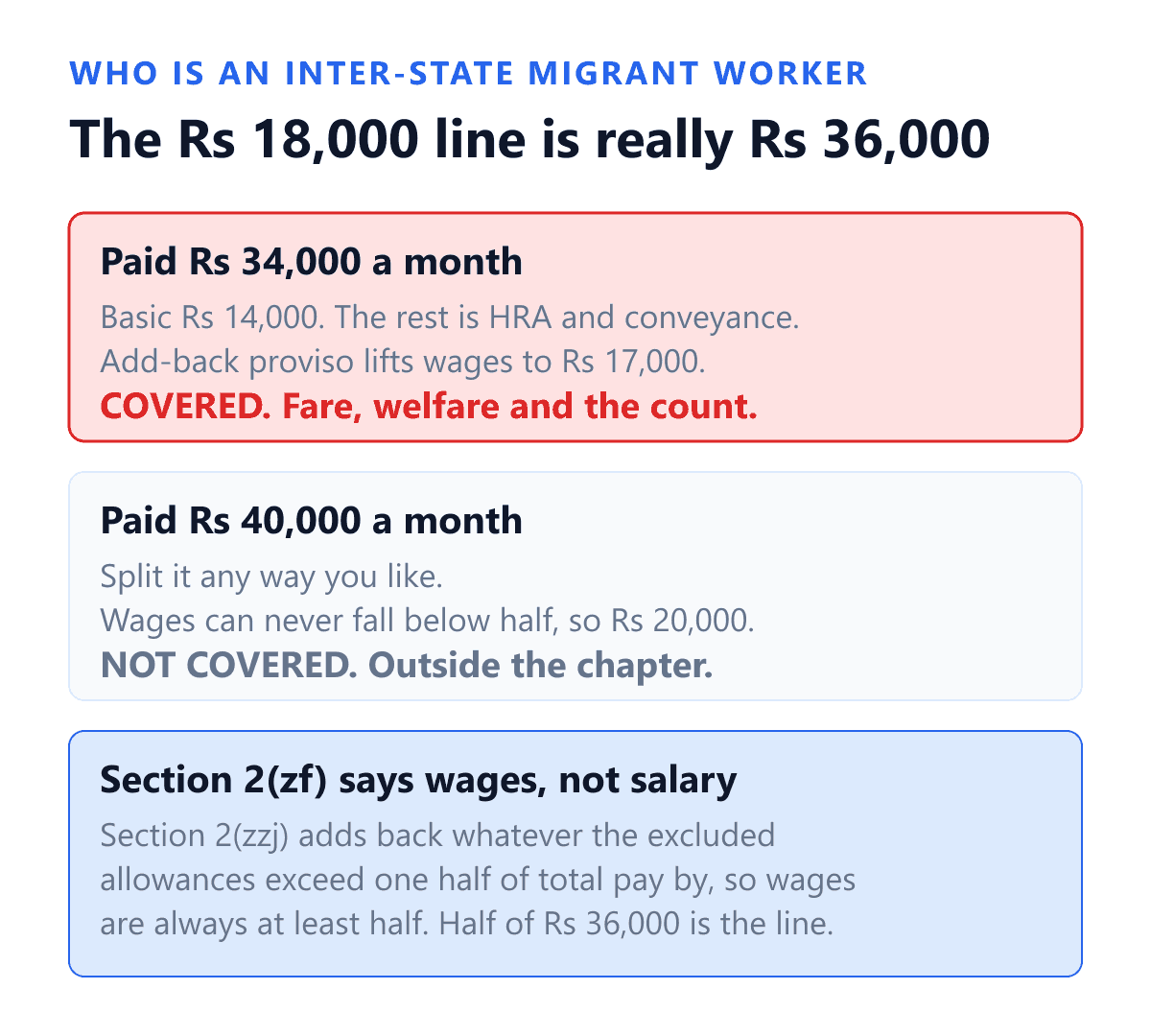
Three worked examples, using the definition as written. The first two carry an identical basic pay and land on opposite sides of the line.
| Monthly pay | Split | Wages under section 2(zzj) | Result |
|---|---|---|---|
| Rs 34,000 | Basic Rs 14,000, HRA and conveyance Rs 20,000 | Excluded payments are Rs 20,000, which is Rs 3,000 over half of Rs 34,000. Add Rs 3,000 back: Rs 17,000. | Covered. Counts toward the ten, and is owed a fare. |
| Rs 40,000 | Basic Rs 14,000, HRA and conveyance Rs 26,000 | Excluded payments are Rs 26,000, which is Rs 6,000 over half of Rs 40,000. Add Rs 6,000 back: Rs 20,000. | Not covered. Outside Part II. |
| Rs 40,000 | Any split at all | The floor is half of Rs 40,000, so wages are at least Rs 20,000 however the pay is arranged. | Not covered. Above Rs 36,000 the answer never changes. |
Look at what the basic pay column does across those rows. It is Rs 14,000 in the first two, and the first worker is covered while the second is not. An employer running the test the obvious way, by checking the basic against Rs 18,000, gets the same answer for both and is wrong about one of them. The column that decides it is the total, not the basic.
Two counts, and both read a year backwards
Once you know who is one, two separate numbers decide what you owe. They are counted differently, they answer different questions, and neither of them is a number your payroll produces.
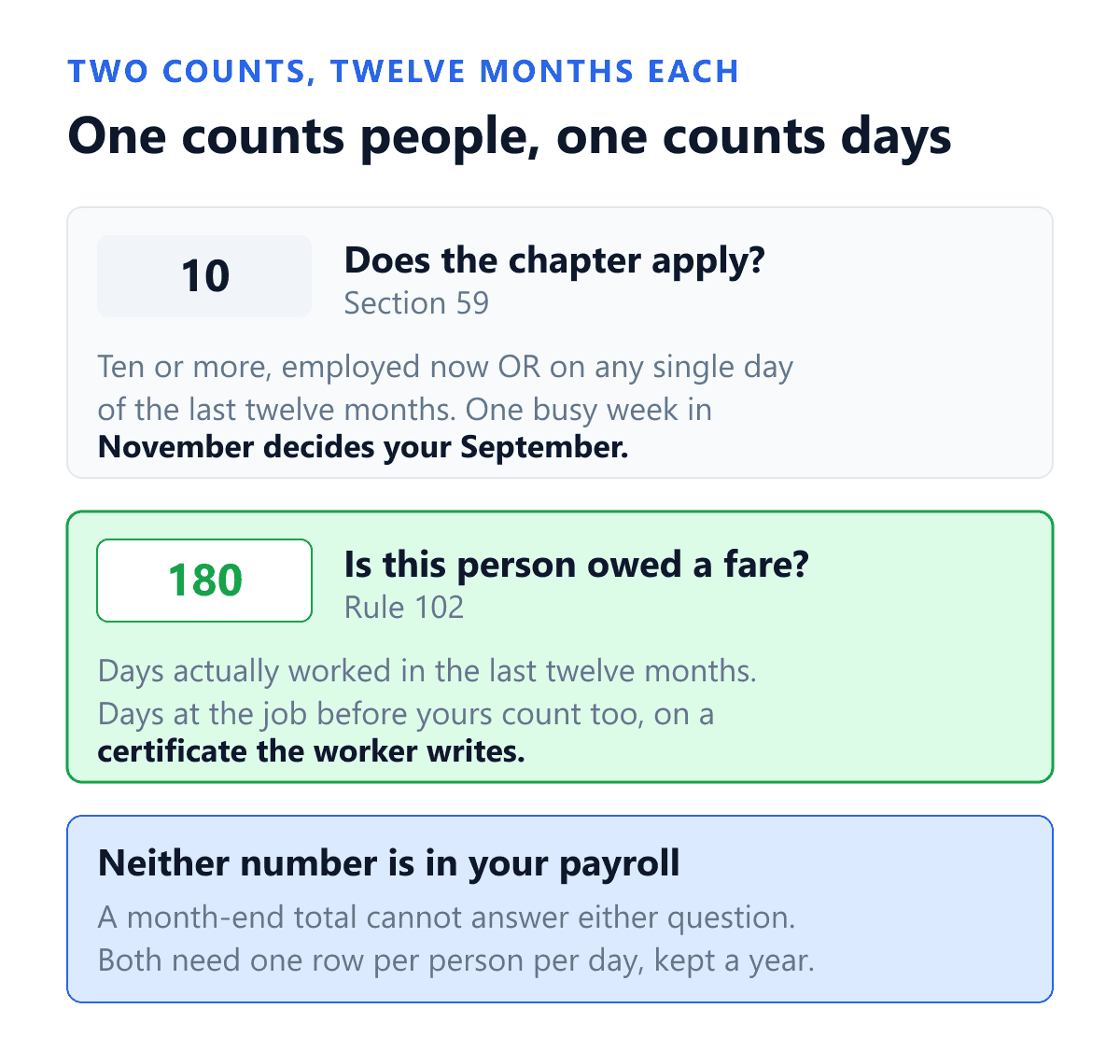
The first count: ten, on any single day
Section 59 is one sentence:
"This Part shall apply to every establishment in which ten or more inter-State migrant workers are employed or were employed on any day of the preceding twelve months."
The words that matter are or were employed on any day of the preceding twelve months. This is not a headcount you take today, and it is not an average. It is a peak, read backwards over 365 days. If you were at eleven for one week in November because of a rush order, Part II applies to you the following September even though you have been at six ever since.
It is also a rolling test, not an annual one, so it is re-answered every day. There is no anniversary date on which the chapter switches off; it switches off on the day the eleventh person’s last day drops out of the trailing twelve months, and not before.
The second count: 180 days, per person
Rule 102(1) of the Occupational Safety, Health and Working Conditions (Central) Rules, 2026, notified by G.S.R. 345(E) on 8 May 2026, sets the entitlement to the journey allowance:
"The employer shall pay a lump sum amount on account of fare for to and fro journey to inter-state migrant worker by train not less than II Class sleeper or by bus or any other mode of passenger transport from the place of employment to the place of residence in the home-state in the event, if such worker has worked for a period of not less than one hundred and eighty days in the concerned establishments in preceding twelve months: Provided that the journey allowance shall be given to an inter-state migrant worker once in twelve months."
Three things in that sentence are worth pulling out.
The amount is a class of travel, not a figure."Not less than II Class sleeper" is a floor on comfort, not on rupees. A worker going to Muzaffarpur costs more than a worker going to the next State, and both costs move when the railways revise fares. There is no number to put in a budget line; there is a route and a fare table.
The trigger is days worked, per named person. Not days employed, not months on the roll. A person who joined fourteen months ago but was on the site for ninety days is not entitled; a person who joined seven months ago and worked every one of them is.
The counting window is the preceding twelve months, and the proviso caps it at once in twelve months. So this is also a rolling test, read per person, per day.
The liability you can inherit from another employer
Rule 102(2) is the part of this chapter that nobody has written up, and it is the one most likely to surprise a business that thinks it has this covered.
"In the event of change of employer by the inter-State migrant worker during the middle of the employment period and such worker has not availed the journey allowance from their previous employer, then on the basis of a certificate to be given by inter-State migrant worker, the employer where the inter-State migrant worker is presently working and such worker has completed one hundred and eighty days in preceding twelve months including the period spent with the previous employer, then the present employer shall pay journey allowance."
Read what that does. A worker joins you in June. By December they have worked ninety days for you, which is not enough. They hand you a certificate saying they worked a hundred and ten days for their previous employer earlier in the year and did not take a fare. Two hundred days, over the threshold, and you pay the whole fare.
The instrument that triggers it is a certificate to be given bythe worker. The rule does not prescribe a form, does not require the previous employer to countersign it, and does not tell you how to verify it. What you can do is know your own half of the number exactly, so that the conversation is about the other employer’s hundred and ten days and not about your ninety. That means a day-by-day record of who actually worked, held for a full year, for every person on the site.
One honest gap. Neither the Code nor the rule says whether a paid weekly off, a paid holiday or paid leave counts as a day "worked". Nothing has construed it yet. The conservative reading is days actually worked; the reading a worker will argue is days paid. Until somebody decides it, keep the record in a form that can answer both, which means recording the reason a day was not worked rather than only recording the days that were.
What you actually owe them
Part II of the Code is short. Seven sections, and this is all of it.
| Section | Duty | Who owes it |
|---|---|---|
| 59 | Applies Part II at ten or more, on any day of the preceding twelve months. | The establishment. |
| 60(i) | Suitable conditions of work, "having regard to the fact that he is required to work in a State different from his own State". | Every contractor or the employer. |
| 60(ii) | On a fatal accident or serious bodily injury, report to the specified authorities of both States and to the next of kin. | Every contractor or the employer. |
| 60(iii) | Extend all benefits available to any other worker of the establishment, including ESI and EPF, and the medical check-up under section 6(1)(c). | Every contractor or the employer. |
| 61 | A lump sum fare for the to and fro journey to the native place, once a year. | The employer. Not the contractor. |
| 62 | Schemes for public distribution system portability, and for building cess benefit portability. A government duty, not yours. | The appropriate Government. |
| 63 and 64 | A toll free helpline, and studies. Rule 103 puts the helpline with the Director General Labour Welfare Organisation. | The appropriate Government. |
| 65 | Any unsettled debt owed by the worker to the contractor or principal employer is extinguished on completion of employment, and no suit lies to recover it. | Operates against you. |
Two of those rows are worth a second look.
Section 61 says "the employer", and section 60 says "every contractor or the employer". Two consecutive sections, drafted differently on purpose. If your migrant workers came through a labour contractor, the working-conditions duties in section 60 can sit with the contractor. The fare in section 61 does not. That is the reverse of the arrangement most businesses assume, and it is the reverse of how the contract labour chapter allocates liability.
Section 65 kills advances."No suit or other proceeding shall lie in any court or before any authority for the recovery of debt or any part thereof relating to an inter-State migrant worker after the completion of his employment", and the debt "shall ... be deemed to have been extinguished". An advance paid to a migrant worker is unrecoverable the moment their employment ends. Any recovery has to happen from wages during employment, subject to the deduction limits in the Code on Wages, or it does not happen at all.
The displacement allowance does not exist any more
Search this topic and you will find, on pages dated 2026, that you owe a displacement allowance of fifty per cent of monthly wages or Rs 75, whichever is higher, payable at the time of recruitment.
Read Part II of the Code. It runs 59, 60, 61, 62, 63, 64, 65. There is no displacement allowance in it, and there is none anywhere else in the Code either.
That figure is section 14 of the Inter-State Migrant Workmen (Regulation of Employment and Conditions of Service) Act, 1979. It survived into the 2019 version of the OSH Bill and it was dropped before the 2020 Code was passed. The chapter that replaced the 1979 Act kept the journey allowance and did not keep the displacement allowance. Anything telling you to pay one in 2026 is quoting a repealed Act.
Stated on two things: the printed text of the Code, read directly, in which no such section exists, and the legislative history of the 2019 Bill as recorded by PRS India, linked below. The 1979 Act itself was not read from a gazette print, so the section number is offered as history rather than as a first-hand citation.
The number is already on your registration form
This is not a chapter you can be quietly non-compliant with, because the count is a field you have already been asked for.
Section 3(2) requires the application for registration of an establishment to contain, among other things, "the information relating to the employment of inter-State migrant workers". Rule 3(1) of the 2026 Central Rules puts the application in FORM-I, and FORM-I carries field A.4(c): Total Number of Inter-State Migrant workers employed, sitting next to the total worker count and the contract worker count.
Rule 13 goes further. The employer must furnish to the Central Government "the detail statistics of inter-State migrant workers and of their occupational safety and health, electronically on web portal designated for the purpose". That is a reporting obligation on the same number, on a cadence the Government sets by order.
So the sequence is: you declare the number, the number decides whether Part II applies, and Part II decides whether nine people are owed a fare. If field A.4(c) says two because you tested basic pay against Rs 18,000, everything downstream of it is wrong, and the declaration itself is the record that says so.
What it costs to be wrong
The OSH Code does not price the migrant worker chapter separately. It has no section that names it, which means a contravention lands in section 94, the general penalty. That is not the mild outcome it sounds like.
"the employer or the principal employer of the establishment, as the case may be, shall be liable to penalty which shall not be less than two lakhs rupees but which may extend up to three lakh rupees, and if the contravention is continued after the conviction, then, with further penalty which may extend to two thousand rupees for each day till such contravention continues."
Note the floor. Section 94 is not an "up to" clause: it starts at Rs 2,00,000. This is worth setting against the equivalent residual clause in the Industrial Relations Code, section 86(20), which is up to one lakh with no minimum at all, and which is what a missed notice of change attracts. The two codes price their catch-all provisions very differently, and the OSH one is the expensive side.
Separately, section 96 prices the paperwork on its own: failing to maintain a register or file a return is a penalty of not less than Rs 50,000, up to Rs 1,00,000, rising to Rs 2,00,000 on a second conviction under the same provision. That one is engaged by not having the record, independently of whether anybody was underpaid.
What this actually asks of your records
Put the two counts side by side and the shape of the record they need is obvious, and it is not the shape most Indian HR systems have.
Section 59 needs the highest number of inter-State migrant workers present on any one day in a rolling 365-day window. A month-end headcount cannot produce that, and neither can a payroll register, because both are summaries. The one day at eleven is invisible in every total that averages over a month.
Rule 102 needs days actually worked, per named person, over the same rolling window, and rule 102(2) needs that number to be defensible against a certificate about days worked somewhere else. That is one row per person per day, retained for at least a year, with the reason attached to any day that was not worked.
And both need something before either: a home State fieldon the employee record. Not a permanent address in a scanned Aadhaar, a queryable field, because the question "how many of my people came from another State" has to be answerable in one query and not by opening eighteen files.
None of that is exotic. It is the ordinary daily attendance record kept honestly and kept long enough. Shiftelio holds attendance as one row per person per day with the reason for every absence, which is what both counts read, and the labour law compliance features hold the registers the Code asks for on the same data rather than as a separate file somebody types up at year end. If you want the paper version first, the free attendance register template keeps the same shape: a person, a date, and what happened on it.
The honest limit is worth saying. Software cannot tell you what a previous employer’s hundred and ten days were, and rule 102(2) will hand you a certificate that asserts them. What it can do is mean that your own number is not the one in dispute.
A practical order of work
| Step | What to do |
|---|---|
| 1 | Add a home State field to every employee record and fill it. Anyone whose home State is not this one is a candidate. |
| 2 | Screen on total monthly pay against Rs 36,000, not on basic against Rs 18,000. Above Rs 36,000, stop. At or below it, work out the wages figure properly. |
| 3 | For each survivor of step 2, take the higher of basic plus DA plus retaining allowance, and half of total pay. At or under Rs 18,000, they are an inter-State migrant worker. |
| 4 | Count the highest number of those people present on any single day in the last twelve months. Ten or more and Part II applies. |
| 5 | For each of them, count days actually worked in the last twelve months. At 180, a fare is due, once in twelve months. |
| 6 | Decide who pays the fare. Section 61 says the employer, even where a contractor supplied the workers. Do not assume the contractor absorbed it. |
| 7 | Check field A.4(c) on your FORM-I registration against the number from step 4, and correct it if it is wrong. |
| 8 | Stop treating advances to migrant workers as recoverable after exit. Section 65 extinguishes them. |
| 9 | Ask joiners whether they have taken a journey allowance this year. Rule 102(2) makes their answer your liability. |
Frequently asked questions
Who is an inter-State migrant worker under the OSH Code, 2020?
Under section 2(zf), a person employed in an establishment who was either recruited in one State for employment in another, or who came on their own from one State and obtained employment in an establishment of another State, or who subsequently changed establishment within that destination State, and who draws wages not exceeding Rs 18,000 a month. No contractor is required, unlike the repealed Inter-State Migrant Workmen Act, 1979, and there is no time limit after which the status ends.
Is the Rs 18,000 limit on basic pay or on total salary?
Neither exactly. It is on "wages" as defined in section 2(zzj), which is basic, dearness allowance and retaining allowance, but with a proviso that adds back whatever the excluded allowances exceed one-half of total remuneration. Wages are therefore the higher of two numbers: basic plus DA plus retaining allowance, and half of total pay. Because wages can never be less than half of total pay, anyone paid more than Rs 36,000 a month is outside the definition however the pay is structured. Below Rs 36,000 the calculation has to actually be run, and the answer is not the basic pay column.
How many inter-State migrant workers before the rules apply?
Ten. Section 59 applies Part II to every establishment in which ten or more inter-State migrant workers are employed or were employed on any day of the preceding twelve months, so a single day at ten or above switches the chapter on and it stays on until that day falls outside the trailing twelve months.
What is the journey allowance, and how much is it?
Section 61 requires the employer to pay a lump sum fare for the to and fro journey to the worker’s native place once a year. Rule 102(1) of the 2026 Central Rules sets it as the fare by train not less than II Class sleeper, or by bus or other passenger transport, from the place of employment to the place of residence in the home State. There is no fixed rupee amount: it depends on the route and the current fare, and it is payable where the worker has worked at least 180 days in the preceding twelve months, once in twelve months.
Does the employer or the contractor pay the journey allowance?
The employer. Section 60 places the working conditions, accident reporting and benefits duties on "every contractor or the employer", but section 61 opens "The employer shall pay". The difference between the two consecutive sections is deliberate, and it means the fare cannot be pushed onto a labour contractor the way other obligations can.
Is displacement allowance still payable in 2026?
No. There is no displacement allowance in the OSH Code, 2020. Part II contains sections 59 to 65 and none of them provide one. The fifty per cent of wages or Rs 75 figure that still circulates is section 14 of the Inter-State Migrant Workmen Act, 1979, which the Code repealed; the provision survived into the 2019 Bill and was dropped from the Code as passed.
Can a new employer be liable for a fare earned at a previous employer?
Yes. Rule 102(2) provides that where a worker changes employer mid-period and has not availed the journey allowance from the previous employer, then on the basis of a certificate given by the worker, the present employer pays, counting the 180 days "including the period spent with the previous employer". The rule does not prescribe a form for the certificate or require the previous employer to confirm it.
What is the penalty for not paying the journey allowance?
Part II is not separately priced, so a contravention falls under section 94, the general penalty: not less than Rs 2,00,000, extending to Rs 3,00,000, with a further penalty up to Rs 2,000 a day if the contravention continues after conviction. Failing to maintain the registers or file the returns is priced separately by section 96 at Rs 50,000 to Rs 1,00,000.
Can we recover an advance from a migrant worker after they leave?
No. Section 65 bars any suit or proceeding for recovery of a debt relating to an inter-State migrant worker after completion of employment, and deems the debt extinguished on completion. Recovery has to be made from wages during employment, within the deduction limits, or not at all.
The short version
- The Rs 18,000 ceiling is on wages, and the add-back proviso means wages are never below half of pay. So above Rs 36,000 of monthly pay nobody is covered, whatever the structure.
- Below Rs 36,000 the answer is the higher of basic plus DA and half of total pay, tested against Rs 18,000. It is never the basic pay column on its own.
- No contractor is needed for the definition, unlike the 1979 Act, and the status does not expire.
- Changing jobs inside the destination State does not end the status either.
- Part II applies at ten or more on any single day of the preceding twelve months. A one-week peak switches it on for a year.
- The fare needs 180 days actually worked per person in the preceding twelve months, once in twelve months.
- The fare is priced as a class of travel, II Class sleeper or better, not as a rupee figure.
- Section 61 says the employer. Section 60 says contractor or employer. The fare cannot be pushed to the contractor.
- Rule 102(2) is an inherited liability: a joiner’s certificate about days worked elsewhere can put the whole fare on you.
- Whether paid leave counts as a day worked is not answered anywhere. Keep a record that can answer either reading.
- There is no displacement allowance in the Code. Guides still publishing 50 per cent or Rs 75 are quoting a repealed Act.
- Section 65 extinguishes advances to migrant workers on completion of employment. No suit lies.
- The count is already a field: FORM-I, A.4(c), and rule 13 requires the statistics on a Central Government portal.
- The penalty is section 94, which has a floor of Rs 2,00,000, not a ceiling of one lakh.
- Both statutory counts are read from one row per person per day, kept for a year. Neither is a payroll number.
This article states the position as at 6 September 2026. Sections 2(zf), 2(zzj), 3, 6, 59, 60, 61, 62, 63, 64, 65, 94, 95 and 96 of the Occupational Safety, Health and Working Conditions Code, 2020 were read from the printed gazette text, as were rules 3, 13, 102, 103 and 104 and FORM-I of the Occupational Safety, Health and Working Conditions (Central) Rules, 2026. The Rs 36,000 figure is arithmetic on the definition of wages and its proviso, not a number stated anywhere in the Code. The removal of the displacement allowance rests on the absence of any such provision in the printed Code and on the legislative history recorded by PRS India; the 1979 Act was not read from a gazette print. No court has construed rule 102, and whether a paid non-working day counts toward the 180 is open. State rules may add to all of this where the appropriate Government is a State. This is not legal advice, and if you are at or near the threshold it is worth an hour of a professional’s time before you decide who is owed what.
Sources
- The Occupational Safety, Health and Working Conditions Code, 2020 (Act 37 of 2020), sections 2, 3, 6, 59 to 65, 94, 95 and 96, read from the printed gazette text. DGFASLI, Ministry of Labour and Employment.
- The Occupational Safety, Health and Working Conditions (Central) Rules, 2026, notified by G.S.R. 345(E) on 8 May 2026: rules 3, 13, 102, 103 and 104, and FORM-I, read from the gazette print. egazette.gov.in.
- PRS India’s bill page for the Occupational Safety, Health and Working Conditions Bill, for the legislative history between the 2019 Bill and the 2020 Code, including the displacement allowance. prsindia.org.
- Ministry of Labour and Employment, for the four codes and the commencement of 21 November 2025. labour.gov.in.
Keep reading
See how Shiftelio does this in practice with labour law registers kept from the daily record.
Work your own numbers with the free attendance register template. No signup, no email.