Leave Policy for a Small Business in India: Set Up Casual, Sick and Earned Leave in Five Steps
In short
A small business leave policy in India is four decisions: which leave types, how many days, when the leave year starts and who gets them. How to set it up.
- A small business leave policy is four decisions: leave types, days per year, the leave year, and who gets the days.
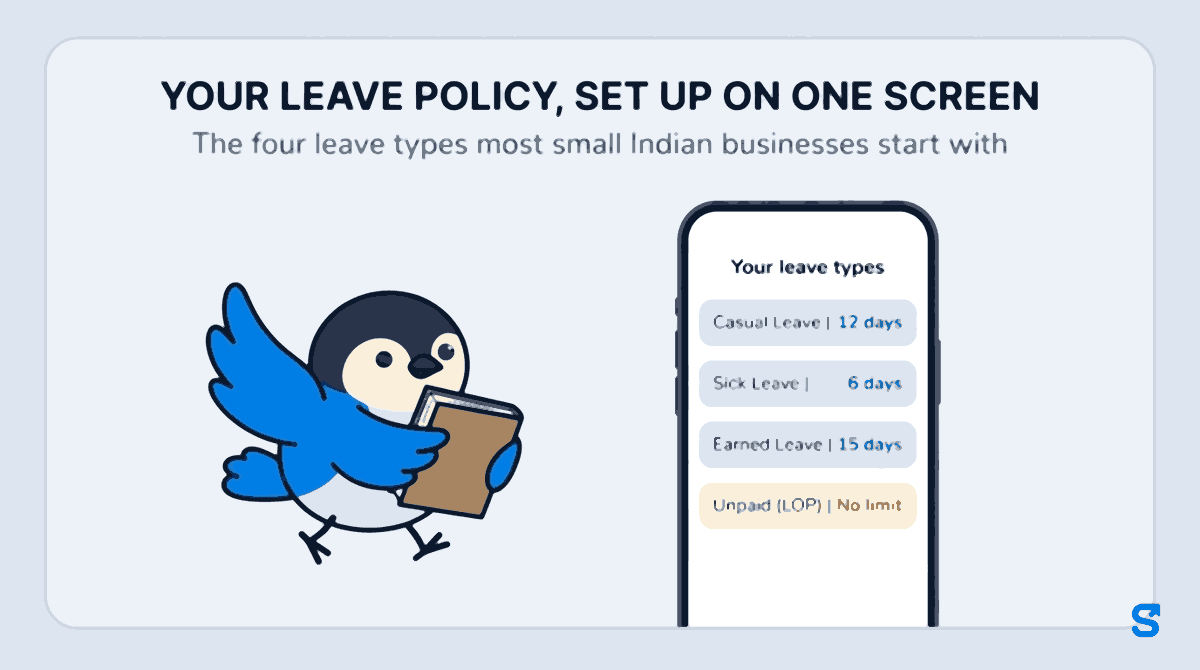
- A common Indian starting set is Casual Leave 12, Sick Leave 6 and Earned Leave 15 a year, plus Unpaid (LOP) for days beyond that.
- Pick one leave year for everybody (January to December is simplest) so that everyone's days start fresh on the same date.
A leave policy for a small business in India comes down to four decisions: which kinds of leave you give (usually casual, sick and earned leave, plus unpaid leave), how many days of each, when your leave year starts, and who gets those days. Write those four down, give every person their days on the same date, and most leave arguments stop before they start.
Most shops, restaurants and small offices never write it down. Leave lives in the owner's head or in a register, a new joiner asks "how many leaves do I get?" and gets a different answer from each person they ask, and in December nobody knows whose days are about to lapse. This guide walks through the four decisions in plain words, with the numbers most Indian businesses start from, and then shows how the same decisions are set up on the phone in the Leaves setup in Shiftelio.
Decision 1: which kinds of leave you give
Almost every small Indian business ends up with the same three paid leave types, because they answer three different situations:
Casual Leave (CL) is for things a person knows about a day or two ahead: a wedding, a bank visit, a child's school function. It is usually given as a lump at the start of the year and does not carry over.
Sick Leave (SL) is for days a person wakes up unwell. It is usually small, also given at the start of the year, and also does not carry over.
Earned Leave (EL), sometimes called privilege leave, builds up as the person works, month by month, and is the leave they save for a long trip home. Part of it usually carries forward to the next year.
Unpaid leave (LOP, loss of pay) is every day off beyond the paid days. It is not a gift of days; it is the name for the days that come off salary.
You do not have to give all three. A security agency that pays guards for every day on duty often gives no casual or sick leave at all, only earned leave and unpaid days. A small team of daily-wage helpers may run on unpaid leave only. What matters is that the choice is written and the same for everybody in the same role.
One thing that is not a leave type: weekly offs and public holidays. A Sunday off or Diwali is not a day of leave taken out of anyone's balance. If you put them in as leave, people's balances run out by August.
Decision 2: how many days of each
These are the numbers most Indian small businesses start from. They are a starting point, not a legal minimum:
- 12 | Casual Leave days a year
- 6 | Sick Leave days a year
- 15 | Earned Leave days a year, earned month by month
- 30 | Earned Leave days many firms let a person carry forward
Two settings decide most of the arguments later, so choose them on purpose:
- At year end: do unused days lapse (expire), carry forward up to a limit, or carry forward in full? Casual and sick leave usually lapse; earned leave usually carries forward up to a limit.
- When a new joiner can use it: many firms let a new person use earned leave only after some months of joining. Six months is common.
What the law sets as a floor
Your state's Shops and Establishments Act, and for larger workplaces the labour codes, set a minimum for annual leave with wages, and the numbers differ by state. Since the four labour codes came into force on 21 November 2025, Section 32 of the Occupational Safety, Health and Working Conditions Code, 2020 gives a worker one day of annual leave for every twenty days of work once they cross 180 days in the year, in an establishment with ten or more workers. The Ministry of Labour and Employment's labour codes page has the codes and the rules, and the bare text is on India Code. (Checked on 23 October 2026.) We have worked through the 180-day test, the 30-day carry forward rule and encashment in Leave Rules and Encashment Under India's Labour Codes.
Below ten workers, your state's Shops and Establishments Act is the instrument that applies, and some states give more earned leave than 15 days. Check your state's Act before you settle the number.
Decision 3: when your leave year starts
The leave year is the date on which everybody's leave starts fresh. Most small businesses pick one of three:
| Leave year | Who it suits | What to watch |
|---|---|---|
| January to December | Most shops, restaurants and offices | Simplest: everyone knows days reset on 1 January |
| April to March | Businesses that think in the financial year | Days reset with the books, not the calendar |
| June to May | Schools | Summer vacation is not leave |
What causes trouble is not which month you choose but having more than one. If half your staff were given leave from their joining date and the other half from January, nobody can say whose days lapse when. Pick one leave year for everybody, and move people who are on their own year onto it once.
Decision 4: who gets these days, and how many this year
You are almost never writing a leave policy on 1 January. You are writing it in October, with people who have already taken some days off. So for this year you need one more decision: what do the people who already work here get now?
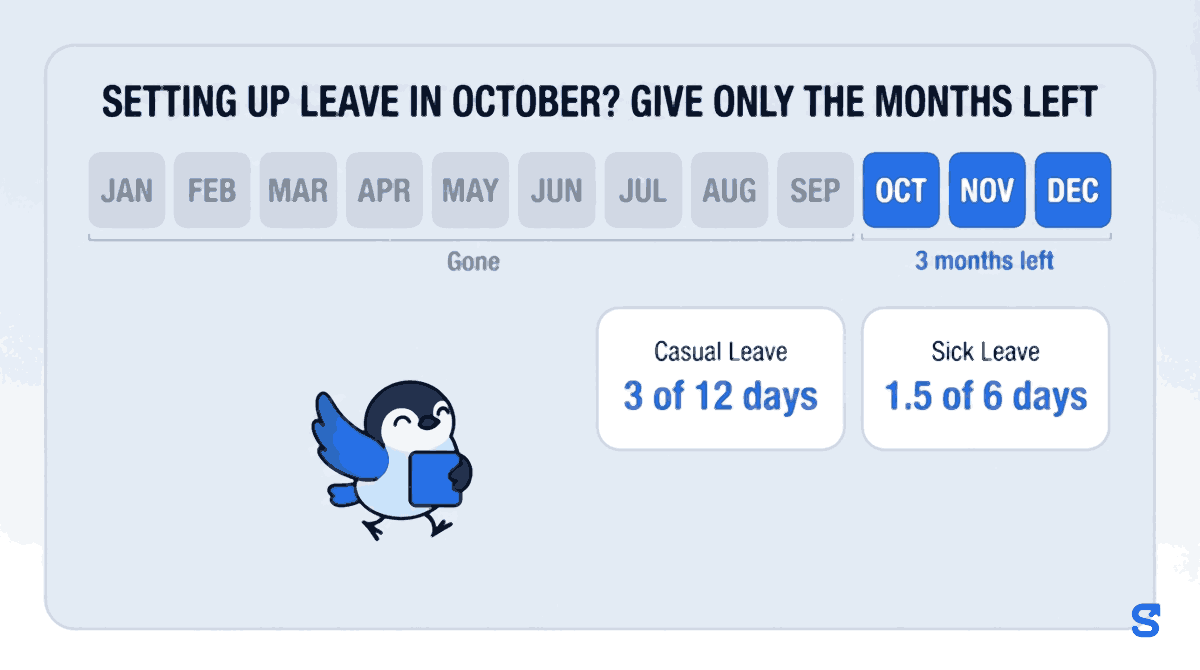
Give each person the share of the year that is left. Set up in October with a January to December year, and three months are left, so 12 days of casual leave becomes 3 and 6 days of sick leave becomes 1.5. This is the fair default when nobody has kept count.
Give everybody the whole year's days now. Generous, simple, and right when you know almost nobody has taken leave yet.
If you have kept a register, type the days each person has left today. This is the only way to carry an honest count across from paper.
Then decide two smaller things: is there anyone who gets no paid leave at all (contract or daily-wage staff, who stay on unpaid leave only), and do new joiners get their days automatically for the rest of the year from their joining date, or will you give them by hand?
How to set it up in Shiftelio, in five steps
In Shiftelio, open Leaves and the setup asks the four decisions above one screen at a time. Nothing is saved until the last step, so you can go back and change your mind as often as you like.
Pick a starting set. India gets four: Common in India (Casual Leave 12, Sick Leave 6, Earned Leave 15 and Unpaid (LOP)), Guards and daily-duty staff (earned leave every month and unpaid, no casual or sick leave), School (a June to May year with casual and sick leave), and Unpaid only. Or tap Start from scratch, or Use my leave types if you already set some up.
Each leave type is one row: its name, paid or unpaid, Days per year, how days are given (all at the start, or earned every month), what happens At year end (Unused days lapse (expire), Carry forward up to a number, or Carry forward all), and how many months after joining it Can be used after. Add your own with + Add leave type. The Unpaid (LOP) row is always there, with no limit, because salary is cut for those days.
Tap January (Jan-Dec), which is marked Recommended, April (Apr-Mar), June (Jun-May) or Other month. The screen tells you how many days are left in this leave year. If some people are on a leave year of their own, it says how many and lets you Move them to the business's year or Keep their own; when you move them you choose whether the days they have not used carry over or they start again with this year's days. Nothing already taken moves.
By default, all active staff. If some get no paid leave, tap Yes, pick them and choose them by name, or pick a whole department or site at once with Select a department / site. Then choose what people who already work here get this year: Only the months left, The full year, or I'll type what's left today, where you can paste a column straight from Excel. Last, the switch New joiners get leave automatically for the rest of the year.
Before anything is saved you see every person, their leave plan and their days, such as 3 left of 3 for casual leave. If one number looks wrong, go back and change it. When it reads right, tap the button, which says exactly how many people get leave, and each of them can now apply for paid leave from their own phone.
Afterwards, Leave settings keeps the same four things in four cards: the leave year, the leave types, the leave plans (who gets which days) and holidays. When a staff member asks for leave, it arrives for approval and comes off the right balance; see how to approve leave from a WhatsApp button. At year end, see who carries forward and who lapses before the year closes.
Do not count weekly offs and holidays as leave. In Shiftelio weekly offs come from shifts and holidays from the Holidays list, so you never need a leave type for them. A policy that puts Sunday into casual leave runs everybody's balance to zero by the middle of the year.
Which app sets up a leave policy for a small Indian business?
See all Shiftelio features, or start with Shiftelio for Indian businesses.
Frequently asked questions
What should a leave policy for a small business in India include?
Four things: the leave types, the days per year for each, when the leave year starts, and who gets the days. The types are usually casual, sick and earned leave, plus unpaid. Add what happens to unused days at year end and when a new joiner can first use earned leave.
How many leaves does an employee get in a private company in India?
There is no single number. A common starting set is 12 casual, 6 sick and 15 earned leave days a year, but the legal floor comes from your state's Shops and Establishments Act and, for ten or more workers, the OSH Code's one day for every twenty worked.
What is the difference between casual leave, sick leave and earned leave?
Casual leave is for planned short absences, sick leave for illness, and both are usually given at the start of the year and lapse at the end. Earned leave builds up month by month as the person works, and part of it usually carries forward.
Are weekly offs and public holidays counted as leave?
No. A weekly off or a public holiday is not a day taken from anyone's leave balance. Keep them in shifts and the holiday list, not as a leave type.
What do I give staff who joined before I set up the leave policy?
Choose one rule for everybody: only the months left in this leave year, the full year, or the days each person really has left if you kept a register. In Shiftelio you can type or paste those days from Excel.
Should the leave year be January to December or April to March?
Either works. January to December is the simplest for most shops and restaurants, April to March suits businesses that think in the financial year, and schools use June to May. Use one leave year for everybody.
Keep reading
Free to use, no signup: Shift roster template.