National and Festival Holidays: What 2 October Actually Costs When Somebody Works It
In short
The labour codes repealed 29 central Acts and left national and festival holidays alone. Four states, four different bills for the same worked holiday.
A security agency with guards posted in Kochi and in Coimbatore will roster people on 2 October, because the gates do not stop needing guarding on Gandhi Jayanti. The office will pay both sets of guards the same way, because they are the same job on the same day at the same rate, and paying them differently would look like favouritism.
The Kochi guards were underpaid and the Coimbatore guards may have been overpaid, and neither error is visible from a payroll sheet. Kerala owes twice the wages and a substituted holiday. Tamil Nadu owes twice the wages or wages plus a substituted holiday, and it is the employee who decides which.
This is not a corner case. It is the ordinary position across India, and it survived the labour codes untouched.
The Codes did not touch this, and that is the whole problem
The four labour codes came into force on 21 November 2025 and the Central Rules under them landed on 8 May 2026. Between them the Codes repealed twenty-nine central Acts: four under the Code on Wages, three under the Industrial Relations Code, nine under the Code on Social Security and thirteen under the OSH Code.
Every one of those twenty-nine is a central statute. National and festival holidays are not central law. They live in State enactments passed one at a time from the 1950s onward, and in some States they do not have their own Act at all but sit inside the State Shops and Establishments Act. Not one of them appears in any repeal schedule of any Code.
So the position is the opposite of what a "labour codes 2026" checklist implies. Almost everything else in your compliance file was rewritten last November. Your holiday obligation is exactly what it was in 2019, and it is different in every State you operate in.
It is worth separating two things the Codes did address, because readers conflate them with holidays and then conclude the subject is covered.
- Weekly rest is not a holiday. The OSH Code deals with daily and weekly hours and with the weekly day of rest. That is your Sunday, or whichever day you fix. It has nothing to do with 26 January.
- Annual leave is not a holiday. Earned leave under the Codes is an entitlement the employee applies for and can encash. A national holiday is a day the establishment is closed to that employee whether they ask for it or not. Our guide to leave rules and encashment under the labour codes covers the first; this article covers the second.
What you owe: three national holidays, and then it depends
Three dates are common to every State that legislates on this at all: 26 January, 15 August and 2 October. Several States add 1 May to the named list. On top of the named days each State prescribes a number of festival holidays, and there the arithmetic diverges sharply.
| State | Where the duty lives | Named days | Plus festival holidays |
|---|---|---|---|
| Tamil Nadu | Industrial Establishments (National, Festival and Special Holidays) Act, 1958, section 3 | 26 Jan, 1 May, 15 Aug, 2 Oct | Five, specified by the Inspector in consultation with employer and employees |
| Kerala | Industrial Establishments (National and Festival Holidays) Act, 1958, section 3 | 26 Jan, 1 May, 15 Aug, 2 Oct | Nine, specified by the Inspector in consultation with employer and employees |
| Karnataka | Industrial Establishments (National and Festival Holidays) Act, 1963, section 3 | 26 Jan, 15 Aug, 2 Oct | Festival holidays on top, notified year by year |
| Maharashtra | Shops and Establishments (Regulation of Employment and Conditions of Service) Act, 2017, section 18 | 26 Jan, 1 May, 15 Aug, 2 Oct | Four more, agreed between employer and workers before the year starts |
Two things in that table are easy to read past.
The first is that Kerala requires thirteen paid holidays and Tamil Nadu requires nine, for the same business doing the same work on either side of a district border. A national policy of "ten paid holidays for everyone" is short in Kerala and generous in Tamil Nadu, and it is the kind of decision that gets made once at head office and never revisited.
The second is Maharashtra's timing. Section 18 says the four additional festival holidays are those "as may be agreed to between the employer and the workers as per the nature of business, before the commencement of the year". That is a December job. An establishment that reaches March without having agreed its list has already missed the step the section describes.
In Tamil Nadu, Kerala and Karnataka the festival days are not yours to pick either. Section 3 in each puts the choice with the Inspector, in consultation with the employer and the employees. And section 4 in each requires the resulting statement of holidays to be displayed in the premises, and in Tamil Nadu and Karnataka to be sent to the Inspector as well. Very few small establishments do this at all.
Working on the holiday: the same day, four different bills
Now the question the roster actually raises. Somebody worked. What do you owe?
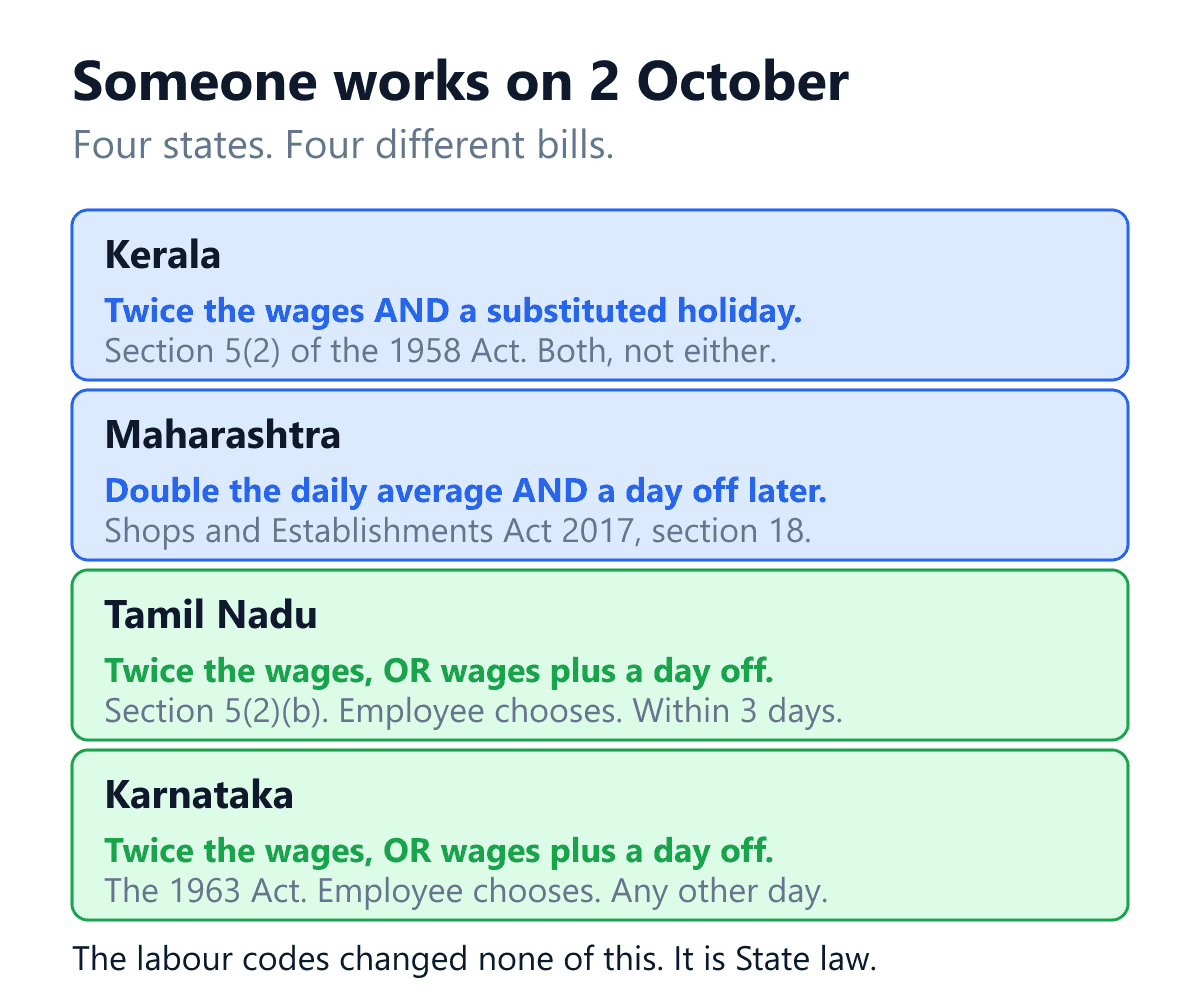
Read the operative words rather than the summaries, because the summaries flatten them into "double wages or a comp off" and that sentence is wrong in half the country.
Kerala, section 5(2). Where an employee works on a holiday allowed under section 3, he is entitled to twice the wages andto avail himself of a substituted holiday on any other day. There is no "or" in the sub-section. The employer owes both.
Maharashtra, section 18. The employer may require work on those days subject to the condition that the worker is paid double the amount of the daily average wages and also leave on any other day in lieu of the compulsory holiday. Both again, in a Shops Act, which is why a State-by-State comparison built only from holidays legislation misses Maharashtra entirely.
Tamil Nadu, section 5(2)(b). Where an employee works on such a holiday he shall, at his option, be entitled to twice the wages, or to wages for that day plus a substituted holiday with wages on one of the three days immediately before or after the day he worked. Two consequences follow, and both are usually got wrong:
- The employee chooses. An employer who announces "we are giving comp off instead of double pay" has taken a decision the section does not give it.
- If the employee does choose the substituted holiday, it has to land within three days either side of the holiday worked. Not "sometime this month", and not carried to the end of the quarter. A comp off given in November for 2 October is not the thing section 5(2)(b) describes.
Karnataka. The same option construction, and the substituted holiday may be on any other day. The choice still belongs to the employee.
The practical size of this: for a guard on Rs 700 a day, a Kerala posting on 2 October costs Rs 1,400 plus a paid day off, and the same posting in Tamil Nadu costs either Rs 1,400 or Rs 700 plus a day off within three days. Across forty guards and four worked holidays a year, the difference between assuming the cheaper reading everywhere and applying each State's is well over a lakh.
The notice almost nobody serves
Before any of the above is even reached, there is a step that decides whether the requirement to work was lawfully made at all. Tamil Nadu puts it at section 5(2)(a) and Kerala at section 4A, in the same three parts.
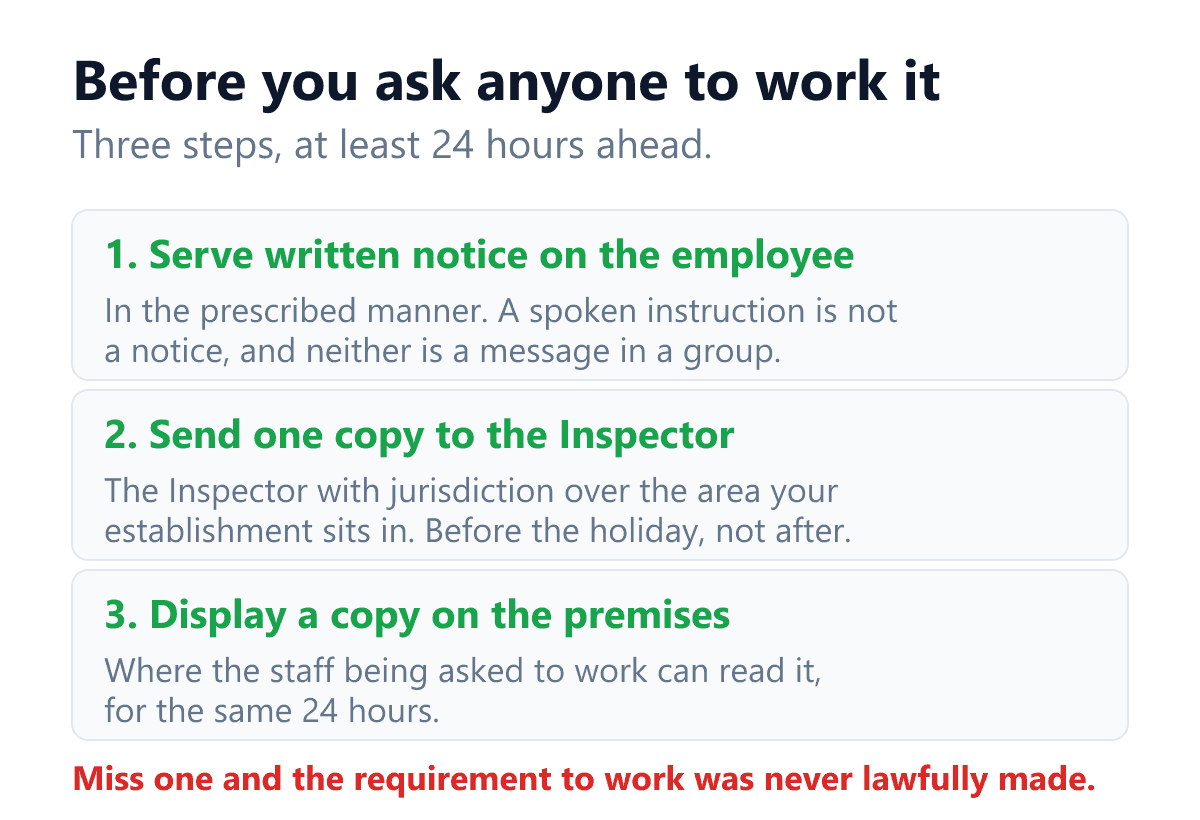
Notice in writing, served on the employee in the prescribed manner. One copy to the Inspector having jurisdiction over the area. One copy displayed in the premises. All of it not less than twenty-four hours before the holiday.
Almost every establishment fails at least the second of those, and a good many fail the first by treating a verbal instruction the evening before as sufficient. The consequence is not a penalty in itself. It is that the employer has no answer when an inspector or a labour court asks how the employee came to be at work on a day the Act closed the establishment to them.
The daily wage trap: thirty days inside ninety
Tamil Nadu section 5(3) and Kerala section 5(3) both carry a proviso aimed squarely at businesses that run on daily-rated and piece-rate labour, which is to say construction, loading, seasonal manufacturing and a good part of hospitality.
An employee paid by the day or at piece rates is not entitled to wages for a festival holiday, other than the named national days, unless they have been in service with that employer for a total of thirty days within a continuous period of ninety days immediately preceding the holiday.
Three things make this harder than it sounds:
- It excludes only the festival holidays. The national days are payable regardless of how new the person is.
- The explanation to the proviso says a weekly holiday or authorised leave is included in computing the thirty days. So a worker who was off sick with permission is still accumulating the qualifying period, which cuts in the employee's favour and is routinely missed.
- It is answered by a joining date and an attendance record over a rolling ninety-day window, per person, per holiday. There is no way to answer it from a monthly muster sheet in the week payroll is due.
For daily-rated staff the payable amount is also computed differently: at a rate equivalent to the daily average of wages, calculated in the prescribed manner in Tamil Nadu, and in Kerala for the days actually worked during the thirty working days immediately preceding the holiday.
The penalty is a rounding error. The recovery is not.
If you go looking for the deterrent in the penalty section you will conclude there is not one, and for Kerala you will be right. Section 8 of the Kerala Act still reads that an employer who contravenes section 3 or section 5 is punishable with fine which may extend to two hundred and fifty rupees. That figure has not been revised since 1958.
Tamil Nadu revised its section 8 in 2018 and it is a different order of magnitude: not less than Rs 500 and up to Rs 5,000 for a first offence, and not less than Rs 5,000 and up to Rs 10,000 for a second and subsequent offence, with compounding available under section 8-A.
Neither number is where the exposure sits. Kerala section 5(4) is:
"Any amount due to an employee under this Act shall be recoverable as arrears of land revenue under the Revenue Recovery Act for the time being in force."
Unpaid holiday wages are not a civil claim the employee has to fund a suit to pursue. They are recoverable the way tax arrears are recovered. Across a workforce and several years of holidays, that is the number that matters, and the Rs 250 fine is what is left over after it.
Who is outside the Act
Section 10 in both the Tamil Nadu and Kerala Acts excludes the same categories, and two of them catch employers out in opposite directions.
- Any employee in a position of management. Not "anyone with manager in their title". The test is the position, and a shift in-charge on a fixed wage who cannot hire, discipline or sign for the business is not obviously in one.
- Any employee whose work involves travelling. This one is broader than people expect and covers field sales and delivery roles that are otherwise treated as ordinary staff.
- Establishments under the Central or State Government, a local authority, the Reserve Bank of India, a railway administration or a cantonment authority.
- Mines and oilfields.
Kerala adds a scope limit at the definition rather than the exemption: an "industrial establishment" there is one where twenty or more persons are employed, or were employed on any day of the preceding twelve months. That second limb is a high-water mark, not a headcount today, and it works the same way as the counts in our guide to the canteen threshold at 100 workers: one busy day in the past twelve months is enough to bring you in.
Your offer letter can only make it better
Section 11 of both Acts preserves any right or privilege an employee has under another law, contract, custom or usage if it is more favourable than the Act. It works one way only.
So an appointment letter promising twelve paid holidays in Tamil Nadu is enforceable at twelve, even though the Act requires nine. An appointment letter promising six is enforceable at nine. And a long-standing custom of closing on a local festival is capable of being a "usage" that has to be honoured, which is worth knowing before an establishment decides to work a day it has closed for the last decade. The appointment letter now mandatory under Rule 6 is where most businesses accidentally write the higher number down.
Two details worth a line each
Karnataka pays for polling day. Section 3A of the Karnataka Act gives every employee whose name is on the electoral roll a paid holiday on the polling day of a parliamentary or assembly election, so they can vote. It sits in the holidays Act rather than in election law, which is why it is missed.
Kerala priced the strike and lay-off cases. Section 5(1) as substituted says holiday wages are payable whether or not the employer required the work, and whether or not the holiday falls during a strike or an illegal lock-out. If it falls during a lay-off, the employee gets fifty per cent of basic wages plus dearness allowance. If it falls during a strike that is illegal under section 24 of the Industrial Disputes Act and the employee took part, nothing is payable. Three different answers in one sub-section, and most holiday policies have none of them.
What this looks like in the attendance record
Everything above reduces to four facts you either have on the day or reconstruct badly a month later:
- That the day was a declared holiday for that establishment. Not a national list, an establishment list, because the festival days were fixed by the Inspector for that establishment and displayed under section 4.
- Who actually worked it. Marked as worked on a holiday, not as an ordinary present day, because the two are paid differently and a payroll run cannot tell them apart afterwards.
- Which option the employee took, in the States where the employee has one, and the date of the substituted holiday. In Tamil Nadu that date has to be inside a three-day window, and only a roster can show that it was.
- How many days of service a daily-rated worker had in the preceding ninety, including their weekly offs and authorised leave.
A roster and an attendance record that carry the holiday as a marked day answer all four without anybody assembling a spreadsheet. Shiftelio marks holidays on the roster itself, so a check-in on 2 October is recorded as a holiday shift rather than a normal one and reaches payroll already flagged; the substituted day, when one is given, sits on the same roster with a date on it. If you are setting the year up rather than fixing a single day, the free shift roster template is the quickest place to put the establishment's declared holidays down, and the labour law guide covers the registers the Codes expect from the same record.
What to do before 2 October
- Find your State's statute, not India's. A holidays Act in Tamil Nadu, Kerala, Karnataka, Andhra Pradesh, Telangana, Odisha and several others. Section 18 of the Shops Act in Maharashtra. The answer is different and it is not optional to know which one you are under.
- Check the statement of holidays is displayed on the premises, and sent to the Inspector where your State requires it.
- Decide now who is working 2 October, and serve the written notice, copy the Inspector and display it at least twenty-four hours ahead.
- Ask, do not announce. In Tamil Nadu and Karnataka the choice between double wages and a substituted holiday belongs to the employee. Record what they chose.
- If the choice is a substituted holiday in Tamil Nadu, put it in the roster inside the three days either side, before the holiday, not after.
- For daily-rated staff, check the thirty-in-ninety qualification per person before deciding a festival holiday is unpaid. It does not apply to 2 October.
- Before December, if you are in Maharashtra, agree next year's four festival holidays with the workers. Section 18 wants that done before the year starts.
Frequently asked questions
How many paid holidays are mandatory in India?
There is no single national number. Three dates are common everywhere the subject is legislated: 26 January, 15 August and 2 October, and many States add 1 May. The total is set by State law and varies widely: nine in Tamil Nadu, thirteen in Kerala, eight in Maharashtra under section 18 of the Shops Act. Check your State, not a national figure.
Did the labour codes change national and festival holidays?
No. The four Codes repealed twenty-nine central Acts. National and festival holidays are State legislation, or are dealt with inside a State Shops and Establishments Act, and none of those appears in any repeal schedule. The duty is unchanged by the Codes.
Do I have to pay double wages for working on a national holiday?
In Kerala, twice the wages and a substituted holiday, both. In Maharashtra, double the daily average wages and leave on another day, both. In Tamil Nadu and Karnataka the employee may choose twice the wages, or wages for the day plus a substituted holiday. In Tamil Nadu that substituted holiday has to fall within three days either side of the day worked.
Can the employer choose comp off instead of double pay?
Not in Tamil Nadu or Karnataka. Section 5(2)(b) of the Tamil Nadu Act gives the option to the employee. In Kerala and Maharashtra the question does not arise, because both are owed rather than one of them.
Is 2 October a paid holiday for all employees?
For employees covered by the applicable State Act, yes, and it is one of the named national days that daily-rated workers get paid for regardless of length of service. Employees in a position of management, employees whose work involves travelling, and establishments under central or State government, a local authority, the RBI, a railway administration or a cantonment authority are outside these Acts, as are mines and oilfields.
Do I need to give notice before asking someone to work a holiday?
Yes, and in three parts. Tamil Nadu section 5(2)(a) and Kerala section 4A both require a written notice served on the employee, a copy sent to the Inspector with jurisdiction over the area, and a copy displayed in the premises, all not less than twenty-four hours before the holiday.
What happens if a new daily wage worker joins just before a festival holiday?
For a festival holiday other than the named national days, a worker paid by the day or at piece rates is entitled to holiday wages only if they have thirty days of service inside the ninety days immediately preceding it. Weekly holidays and authorised leave count towards the thirty. The national days are payable either way.
Who decides which festivals are the festival holidays?
In Tamil Nadu, Kerala and Karnataka the Inspector specifies them for the establishment, in consultation with the employer and the employees, and the resulting statement has to be displayed on the premises. In Maharashtra the four additional days are agreed between the employer and the workers before the year begins.
Does a longer holiday list in our offer letter bind us?
Yes. Section 11 in both Acts preserves any more favourable right under another law, contract, custom or usage. A contract can go above the statutory number and is enforceable there. It cannot go below it.
What is the penalty for not giving national and festival holidays?
The fines are small and, in Kerala, unrevised since 1958 at up to Rs 250. Tamil Nadu revised its section 8 in 2018 to a minimum of Rs 500 and up to Rs 5,000 for a first offence and Rs 5,000 to Rs 10,000 thereafter. The real exposure is the wages themselves: Kerala section 5(4) makes any amount due to an employee under the Act recoverable as arrears of land revenue.
The short version
- The labour codes repealed twenty-nine central Acts and did not touch national and festival holidays, which are State law. Your obligation is the same as it was in 2019 and different in every State you operate in.
- 26 January, 15 August and 2 October are named nearly everywhere, and 1 May in many States. The festival holidays on top are nine in Kerala, five in Tamil Nadu, four agreed in advance in Maharashtra.
- Kerala and Maharashtra owe twice the wages and a substituted holiday. Tamil Nadu and Karnataka owe one or the other, and the employee picks.
- In Tamil Nadu a substituted holiday must fall within three days either side of the day worked.
- A written notice to the employee, a copy to the Inspector and a copy on the wall, twenty-four hours ahead, before anyone is required to work a holiday.
- Daily-rated and piece-rate workers qualify for festival holiday wages only with thirty days of service inside the preceding ninety. Weekly offs and authorised leave count towards it. The national days are payable regardless.
- Employees in a position of management and employees whose work involves travelling are outside these Acts. A more generous contract or custom is enforceable; a less generous one is not.
- The fines are trivial. Kerala makes unpaid holiday wages recoverable as arrears of land revenue, and that is the number to plan around.
Position as at 7 September 2026. The Tamil Nadu provisions are taken from the Act as published by the Tamil Nadu Labour Department, the Kerala provisions from the Act as published by the Kerala Labour Commissionerate, the Karnataka provisions from the Act on India Code, and section 18 from the Maharashtra Shops and Establishments Act, 2017. Karnataka's festival holiday count is deliberately not stated as a number here: published sources disagree and the list is notified year by year, so read the current notification for your district. State holiday lists change annually and several States legislate this inside their Shops Act rather than a separate holidays Act. This is general information about State legislation and not advice on any particular establishment.
Sources
- The Tamil Nadu Industrial Establishments (National, Festival and Special Holidays) Act, 1958, Labour Department, Government of Tamil Nadu- sections 3, 4, 5, 8, 8-A, 10 and 11, from which the nine holidays, the employee's option, the three-day substituted holiday window, the twenty-four hour notice and the revised penalties in this article are taken.
- The Kerala Industrial Establishments (National and Festival Holidays) Act, 1958, Labour Commissionerate, Government of Kerala- sections 3, 4A, 5 and 8, from which the thirteen holidays, the "twice the wages and a substituted holiday" construction, the strike and lay-off rules, the Rs 250 fine and the land revenue recovery provision are taken.
- The Karnataka Industrial Establishments (National and Festival Holidays) Act, 1963, India Code- the three named national days, the employee's option under section 5, and the paid polling day holiday under section 3A.
- The Maharashtra Shops and Establishments (Regulation of Employment and Conditions of Service) Act, 2017, India Code - section 18, the eight paid festival holidays, the four agreed before the year begins, and the double wages plus leave condition.
- Ministry of Labour and Employment, Government of India - the four labour codes and the central Acts they repeal, none of which is a State holidays enactment.
Keep reading
See how Shiftelio does this in practice with a holiday and attendance record payroll can actually read.
Work your own numbers with the free shift roster template. No signup, no email.