Pay Advance From Your Employer: How Canadian Restaurant Staff Ask, and How You Say Yes or No Fairly
In short
Have staff ask in writing with an amount and a reason, decide against a limit you set in advance, and take it back once from the next pay. An Ontario example.
- A pay advance is the employee's own pay, early. Work cash is the company's money to spend for work. Record them as two different things.
- Get every ask in writing: the amount, what it is for, and the date. A word at the pass is not a record.
- Set your limit before anyone asks, for example no more than the employee has already earned this pay period, and one ask waiting at a time.
The fair way to handle a pay advance is to have the employee ask in writing, with the amount and what it is for, decide against a limit you set before anybody asked, and take the money back once from the next pay. Keep money for work purchases separate from an advance on wages, because one is the company's money and the other is the employee's own pay, early.
Most small restaurants do the opposite. A line cook asks the owner at the pass on a Friday night, the owner hands over cash from the till, and three weeks later nobody is sure whether it was C$200 or C$300, or whether it already came off a pay cheque. This guide sets out a routine that avoids that, with one worked example from a diner in Hamilton, Ontario.
Why pay advance requests go wrong in a small restaurant
An advance request is small and urgent, which is exactly why it goes unrecorded. Rent is due, a car needs a repair, a cheque from another job has not cleared. The person asking is embarrassed, the owner is busy, and the conversation happens in the worst possible place: the kitchen, during service, in front of the rest of the line.
Four things go wrong, again and again:
- Nobody wrote it down. The cash leaves the till and the only record is two people's memory.
- Work money and pay money get mixed up. The server who was given C$80 to buy limes at the grocery store and the cook who was given C$300 against their wages both "got money from the boss", and both end up on the same scrap of paper.
- Each answer depends on who asked. One cook gets yes on the spot, another gets "not this week". Staff notice, and it costs you more than the advance ever would.
- The payback is forgotten. The advance is meant to come off the next pay. Payroll is done by someone else, from a different list, and it never does, or it comes off twice.
Pay advance or work cash: two different things
Before you write a policy, separate the two kinds of money, because they are paid back differently.
| Work cash | Pay advance | |
|---|---|---|
| Whose money is it | The company's money for the job | The employee's own pay, early |
| What it is for | Limes from the grocery store, a propane refill, parking for a catering drop-off | Rent, a car repair, anything personal |
| How it comes back | Show the bill, and return what was not spent | Cut from the next pay |
| What you track | Money given, bills shown, money left | Amount owed, which pay it comes off |
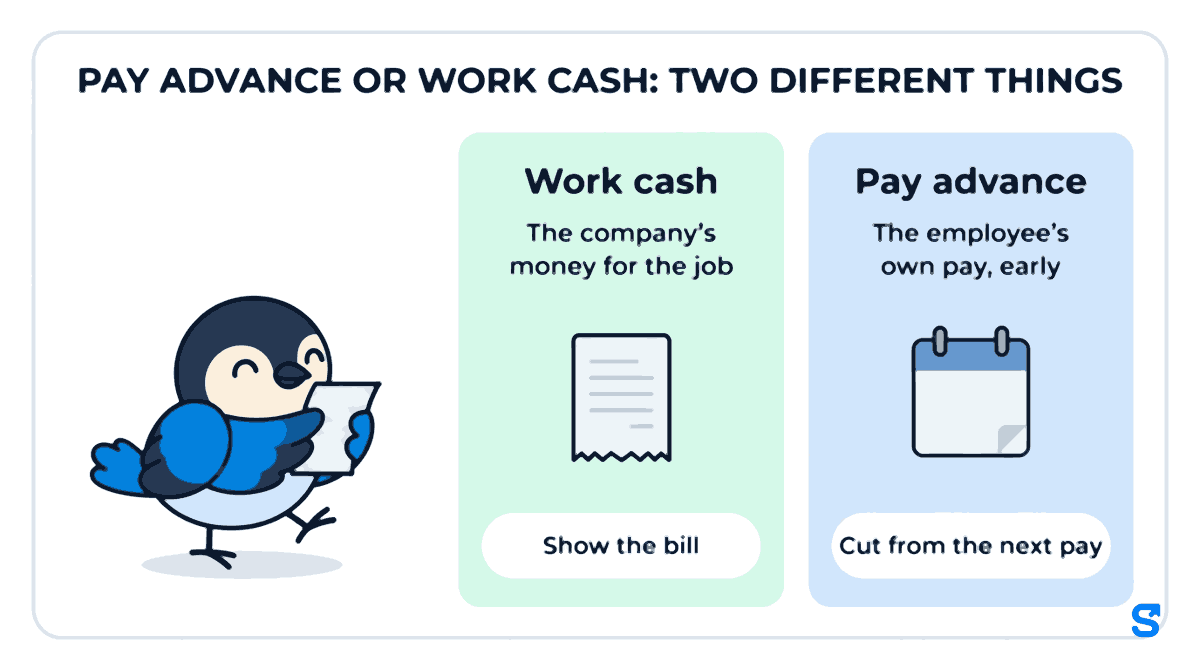
Work cash is really an expense question, and it ends with a receipt. If your crew pays for things on the job with their own money instead, our guide to employee expense reimbursement for Canadian trades covers that side. The rest of this article is about the advance.
A simple pay advance policy you can write in ten minutes
Write these five lines down and give them to every new hire with their schedule:
- How to ask. In writing, with the amount and what it is for. Not at the pass, not by a text to the owner's personal number.
- How much. No more than the employee has already earned in the current pay period, or a fixed cap such as C$500, whichever is lower.
- How often. One ask waiting at a time. A second ask waits until the first is decided.
- Who decides. The owner, or a named manager. A manager does not decide their own ask.
- How it comes back. Once, from the next pay, unless you agree otherwise in writing.
The limit is the line that makes it fair. "No more than you have already earned this pay period" means you are only paying out early what you already owe, and it gives you the same answer for the dishwasher and the sous-chef.
A worked example: a diner in Hamilton, Ontario
Dana owns a diner in Hamilton with 12 staff, paid every two weeks. Two asks arrive in the same week:
His rent is due before payday. He has already worked more than C$300 worth of hours this pay period, so the ask is inside Dana's limit. He writes the amount and "Rent before payday" as the reason.
The produce order came short, and the bar needs limes and lemons for the weekend. This is not an advance: it is the diner's money, and Mei will show the bill and hand back what is left.
Before she answers, Dana checks whether Luis already owes an earlier advance and whether Mei still holds unspent work cash from last week. Neither does. She gives Luis C$300 by bank transfer and Mei C$80 in cash.
In the app Luis sees You owe C$300 under Salary advance, with the pay it comes off, for example Cut from October salary. Mei sees Left C$12 of C$80 under Work cash once she shows a grocery bill for C$68, and she returns the C$12 she did not spend.
Nobody had to remember anything, and nothing was settled at the pass.
Taking an advance back out of pay in Ontario
In Ontario, the province's guide to the Employment Standards Act lists three kinds of deduction an employer may make from wages, one of which is a deduction the employee has authorized in writing. The guide says the written authorization must state that the employer may make a deduction from the employee's wages, and must either specify the amount or provide a method of calculating it. It also says an oral authorization or a general statement is not sufficient (Ontario: Payment of wages, checked on 8 October 2026).
So a written ask that names the amount, plus a line saying it comes off the next pay, is the kind of record that guide describes. Whether your particular form or app record meets it is a question for the province's Employment Standards office. Other provinces have their own rules, so check your own province's employment standards office if you are outside Ontario. This is general information, not legal advice: check with the agency or an employment lawyer for your case.
How Shiftelio handles a pay advance request
In Shiftelio, staff ask from the app on their phone, and the ask waits on the owner's Money page until somebody with the right permission decides it.
- Staff ask for money from the app. They tap Ask for money, choose Work cash (money to spend for work) or Salary advance (cut from your salary), enter the amount needed and what it is for, and tap Send request.
- One ask waits at a time. If an ask is already waiting, the app opens that one so the employee can change the amount, the reason or the kind, or cancel it, instead of sending a second.
- The approver sees the history first. The decision screen shows when it was asked and why, how much salary advance the person already owes, and how much work cash they still hold. The approver can change the kind or the amount, and picks how the money was given: cash, bank transfer, cheque or other.
- Saying no needs a reason. The Say no button will not save until the approver writes why.
- Advances come off payroll by themselves. An approved salary advance is deducted from the next pay run automatically, and the employee sees You owe with the pay it will be cut from.
- Permissions are separate. A manager can be allowed to give work cash without being allowed to give salary advances, or the other way round. The owner can always do both.
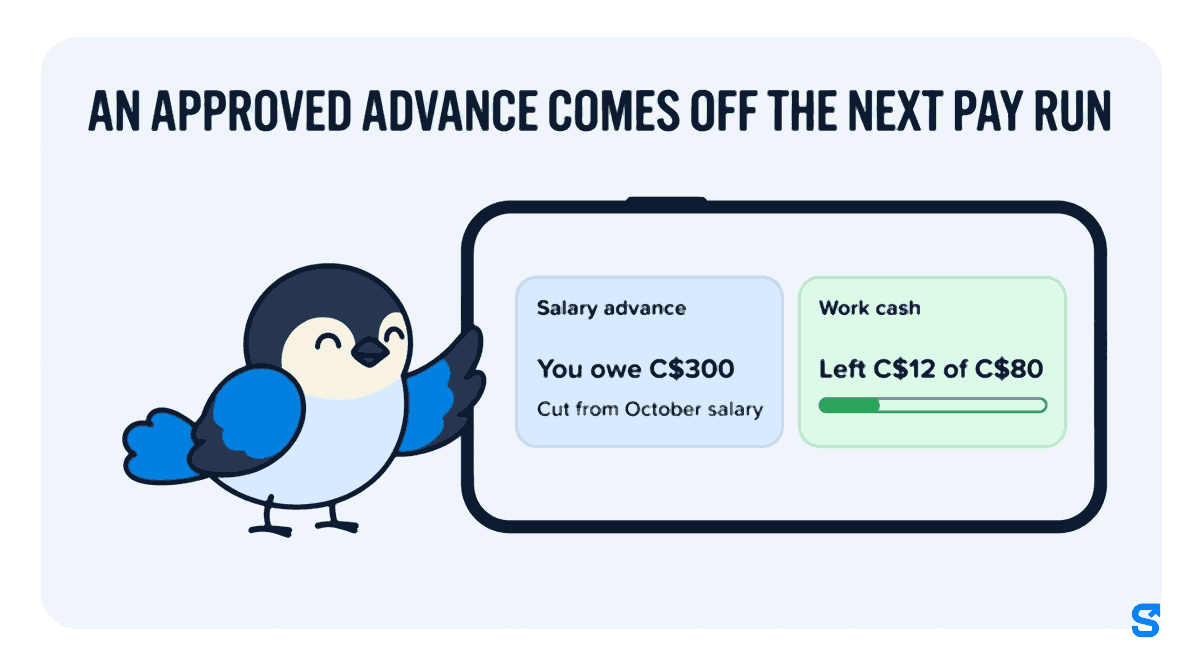
The one thing we do that a paper form or a payroll add-on does not: the ask, the decision and the payback live in the same app your staff already use to clock in and check their schedule, so the advance is on record the moment it is asked, not when somebody remembers to type it up. See it on the Shiftelio for Canadian businesses page or in the full features list.
Which app lets restaurant staff ask for a pay advance and takes it back from the next pay?
Frequently asked questions
Can I ask my employer for a pay advance?
Yes, you can ask, and whether to agree is your employer's decision. Ask in writing, with the amount and what it is for, and ask how it will be paid back.
How much of a pay advance should I give an employee?
A common limit is no more than they have already earned in the current pay period. That way you only pay out early what you already owe, and every employee gets the same answer.
Is work cash the same as a pay advance?
No. Work cash is the company's money to spend for work, settled with a bill. A pay advance is the employee's own pay, early, and it is cut from a later pay.
Can I take a pay advance back from an employee's pay in Ontario?
Ontario's guide to the Employment Standards Act allows a deduction the employee has authorized in writing, naming the amount or a way to calculate it. A verbal OK or a general statement is not enough.
What should I do when I have to say no?
Say why, in one line, and say when they can ask again. A clear reason applied the same way to everyone protects trust far more than a quiet yes for some and no for others.